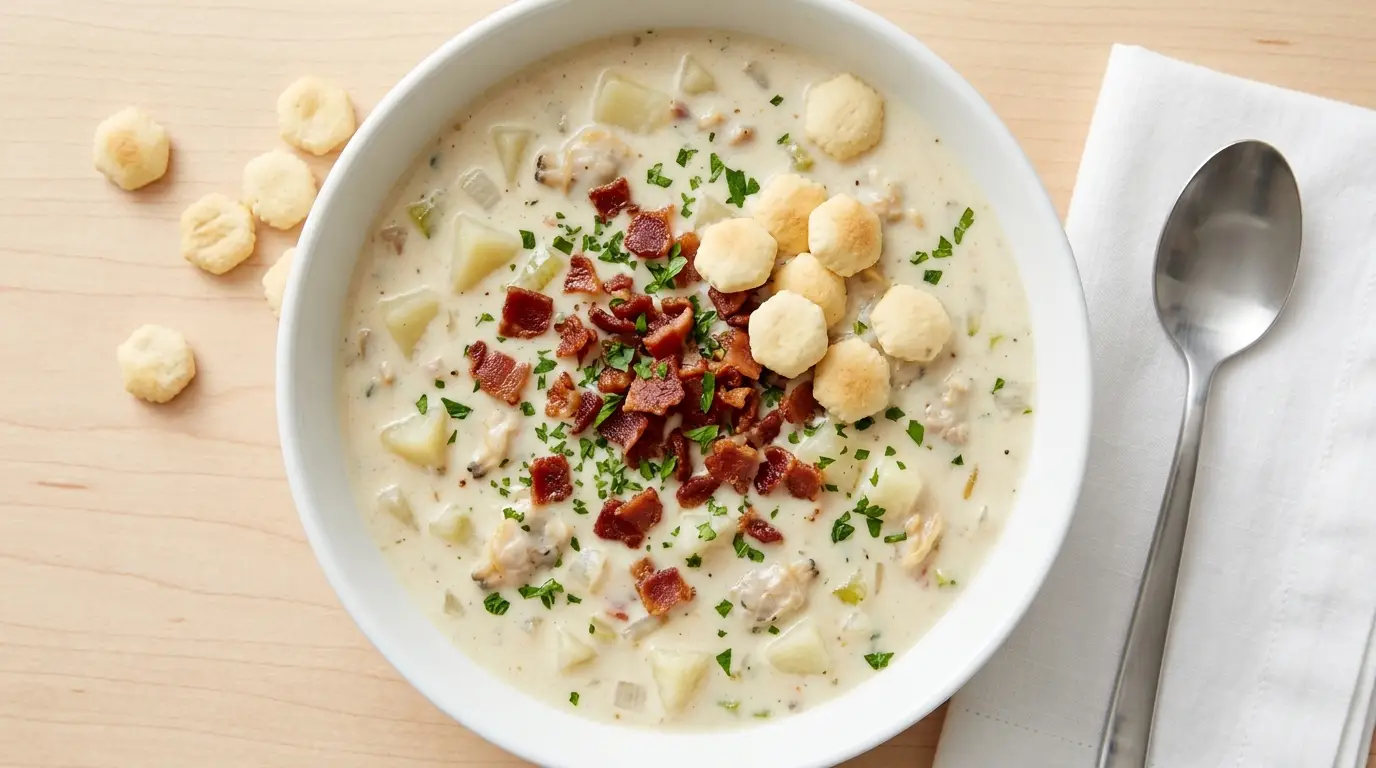
A good New England Clam Chowder recipe should coat the back of a spoon without sliding off, yet still taste like the sea rather than flour paste.
That balance comes from Yukon Gold potatoes, which hold their shape while releasing just enough starch, and a single cup of heavy cream stirred in off the heat.
Most versions fail in one of two ways. They come out watery, or they break into grainy curds.
The fix is simple: mash a few cooked potatoes right in the pot, then drop the temperature before the cream ever meets a boil.
The whole pot comes together in about an hour. Canned chopped clams and bottled clam juice do the heavy lifting, so there is no shucking involved.
Expect smoky bacon, sweet softened onion, and a broth thick enough to hold a handful of oyster crackers on top.
| Quick Recipe Summary | |
|---|---|
| Prep Time | 20 minutes |
| Cook Time | 40 minutes |
| Total Time | 60 minutes |
| Servings | 6 bowls |
| Difficulty Level | Easy |
Read Also: Manhattan Clam Chowder

Why You’ll Love This New England Clam Chowder Recipe
This is the thick, creamy, Boston-style bowl people picture when they think of clam chowder. It skips the fresh-clam shucking without giving up the briny depth that makes the dish worth making.
Here is what sets it apart:
- It uses pantry clams. Three cans of chopped clams plus two bottles of clam juice deliver real clam flavor with no coastal grocery run required.
- The texture is controlled, not accidental. Yukon Gold potatoes and a couple of mashed spoonfuls thicken the broth naturally, so you are not stuck with a thin, watery pot.
- It will not curdle. Adding the cream off the boil keeps the dairy smooth instead of grainy.
- It is a one-pot meal. Everything happens in a single Dutch oven, from rendering the bacon to the final simmer.
- It reheats well. A gentle warm-up on the stove brings it right back the next day, which makes it good for batch cooking.
- It scales easily. The ratios double cleanly for a crowd or a potluck.
For another creamy seafood bowl in this style, take a look at Seafood Chowder.
Ingredients
Everything here is easy to find, and most of it keeps in the pantry or freezer. Measurements are given in both imperial and metric.
- 4 slices thick-cut bacon, chopped (about 4 oz / 115 g)
- 2 tbsp (28 g) unsalted butter
- 1 large yellow onion, diced (about 1½ cups / 200 g)
- 2 celery ribs, diced (about ¾ cup / 100 g)
- 2 garlic cloves, minced
- ⅓ cup (40 g) all-purpose flour
- 3 cans (6.5 oz / 184 g each) chopped clams, drained, with juices reserved
- 2 bottles (8 oz / 240 ml each) clam juice
- 1 cup (240 ml) water
- 1½ lb (680 g) Yukon Gold potatoes, peeled and cut into ½-inch (1.25 cm) cubes
- 1 bay leaf
- 1 tsp fresh thyme leaves (or ¼ tsp / 1 g dried thyme)
- 1 cup (240 ml) heavy cream
- ½ tsp (1 g) ground black pepper, plus more to taste
- Salt, to taste
- 2 tbsp (8 g) chopped fresh parsley, for garnish
- Oyster crackers, for serving
You might also enjoy: Fish Chowder
Kitchen Equipment Needed
A chowder this simple does not ask for much, but a heavy pot makes a real difference in how evenly it cooks.
- A heavy enameled Dutch oven or thick-bottomed soup pot (5 to 6 quart)
- A sharp chef’s knife for dicing
- A cutting board
- A wooden spoon for the roux
- A whisk
- A fine mesh strainer for the reserved clam juice
- A potato masher or a fork
- A ladle
- Measuring cups and spoons
A similar base works beautifully in Corn Chowder.
Recommended Products for This Recipe
These are the tools and ingredients I reach for every time I make this, chosen because each one solves a problem that comes up when you are cooking chowder at home.
1. Le Creuset Enameled Cast Iron Dutch Oven
Thin pots scorch the flour and catch the dairy on the bottom, which is where a burnt, grainy flavor sneaks in. The heavy enameled base holds a low, even heat so the roux and the cream behave, and the wide mouth gives you room to stir without sloshing.
2. Bar Harbor Chopped Clams
Cheaper canned clams can taste tinny and turn rubbery fast. These come packed with a cleaner, sweeter clam flavor and hold their texture when you fold them in at the end, which is the whole point of adding them late.
3. Immersion Blender
I keep an immersion blender on the counter specifically for this, giving the pot two quick pulses to thicken the broth without a single extra spoon of flour. It saves you from fishing out potatoes to mash separately and keeps every bit of starch in the pot.
4. Bar Harbor Clam Juice
The bottled juice is the backbone of the broth, so a good one matters more than people expect. This brand tastes like actual shellfish stock rather than salty water, and it lets you dial the consistency thinner or thicker without thinning the flavor.
For a lighter catch, try: Shrimp Chowder

Step-by-Step Instructions: How to Make New England Clam Chowder
Follow these steps in order and you will have a thick, creamy pot of chowder ready in about an hour.
Step 1: Render the Bacon
- Set your Dutch oven over medium heat and add the chopped bacon.
- Cook, stirring now and then, for 6 to 8 minutes until the bacon is crisp and the fat has rendered out.
- Use a slotted spoon to lift out the crisp bacon and set it on a paper-towel-lined plate. Leave the rendered fat in the pot.
- Hold the bacon aside for garnish rather than stirring it back in now.
Step 2: Soften the Vegetables
- Add the butter to the bacon fat and let it melt over medium heat.
- Stir in the diced onion and celery.
- Cook for 5 to 7 minutes, stirring often, until the onion turns soft and translucent but not browned.
- Add the minced garlic and cook for 1 more minute, just until fragrant.
Step 3: Build the Roux
- Sprinkle the flour evenly over the vegetables.
- Stir constantly with a wooden spoon for 2 to 3 minutes.
- The mixture will look like wet sand and smell toasty. This cooks out the raw flour taste so the broth does not turn pasty.
Step 4: Add the Liquid
- Slowly pour in the two bottles of clam juice while whisking.
- Whisk in the reserved juice from the canned clams and the 1 cup of water.
- Keep whisking until the roux fully dissolves and no lumps remain. Scrape the bottom corners of the pot as you go.
Step 5: Simmer the Potatoes
- Add the cubed Yukon Gold potatoes, the bay leaf, and the thyme.
- Bring the pot to a gentle boil, then reduce to a steady simmer.
- Cook uncovered for 15 to 18 minutes, until the potatoes are fork-tender.
Step 6: Thicken the Broth
- Press a few of the cooked potato cubes against the side of the pot with your masher or fork, then stir them back in.
- This releases their starch and thickens the chowder naturally without any extra flour.
- For a smoother, thicker result, give the pot two short pulses with an immersion blender instead, leaving plenty of chunks.
Step 7: Add the Cream and Clams
- Lower the heat to the gentlest simmer.
- Pour in the heavy cream and add the drained chopped clams.
- Warm through for 3 to 5 minutes, stirring gently. Do not let it boil, or the cream can break and the clams can toughen.
Step 8: Season and Serve
- Remove and discard the bay leaf.
- Stir in the black pepper, then taste and add salt as needed. The bacon and clam juice are already salty, so season last.
- Ladle into bowls, scatter the reserved crisp bacon and chopped parsley on top, and serve with oyster crackers.
Read Also: Salmon Chowder

Tips for The Best New England Clam Chowder
A few small habits are the difference between a chowder that tastes homemade and one that tastes like a diner on a bad day.
- Never let it boil after the cream goes in. I ruined an early batch by walking away while it bubbled, and the dairy curdled into something closer to cottage cheese. A bare simmer fixed it for good.
- Reach for Yukon Gold or red potatoes. I’ve found they hold together far better than russets here, which fall apart and cloud the broth with too much loose starch.
- Season at the very end. Clam juice, canned clams, and bacon all carry salt, so taste before you reach for the salt shaker.
- Add the clams last. They are already cooked in the can, so they only need to warm through. Long simmering turns them chewy.
- Hold the bacon for the table. Reserved bacon stays crisp when you scatter it on at serving rather than stirring it in, where it softens within minutes.
- Thin it with clam juice, not water. If the pot gets too thick, loosen it with a splash of extra clam juice so you do not dilute the flavor.
- Let it rest 10 minutes. The chowder thickens and the flavors settle if you give it a short rest off the heat before serving.
Those same techniques carry over to Chicken Corn Chowder.
What to Serve with New England Clam Chowder
Chowder is rich and filling, so the best partners are either crusty things for dipping or something bright to cut through the cream. Here are the pairings I come back to most.
- Warm, flaky Homemade Biscuits for soaking up the broth
- Soft, buttery Dinner Rolls
- A crackly loaf of Same Day Sourdough Bread, ideal hollowed into a bread bowl
- A wedge of Healthy Cornbread for a slightly sweet contrast
- Crisp, tangy Coleslaw to balance the richness
- A simple green salad with a sharp vinaigrette
- Oyster crackers or saltines, the traditional topping
- A cold lager or a crisp white wine for the adults at the table
- Steamed or roasted asparagus for a light vegetable side
Another bowl to bookmark: Loaded Baked Potato Soup
Variations of New England Clam Chowder
Once you have the base down, the recipe takes well to small swaps. Here are the directions worth trying.
- Fresh clam version: Steam 3 to 4 dozen littleneck or cherrystone clams, chop the meat, and strain the liquor to replace the canned clams and some of the bottled juice.
- Bacon-free: Skip the bacon and start with ½ cup (113 g) of butter instead for a cleaner, pure-clam flavor.
- Lighter chowder: Swap half-and-half for the heavy cream for a thinner, less rich pot.
- Thinner, old-style broth: Reduce the flour by half and lean on mashed potatoes alone to thicken, which gives you the traditional New England consistency.
- Extra vegetables: Add diced carrot with the onion, or stir in a cup of corn kernels during the last few minutes.
- A splash of sherry: Stir in 2 tablespoons of dry sherry with the cream for a restaurant-style finish.
- Spicy edge: A few dashes of hot sauce or a pinch of cayenne brightens the whole bowl.
- Herb finish: Swap the parsley for fresh chives or dill for a different aroma.
If you lean toward shellfish, another option worth trying is Oyster Stew.
Storage and Reheating
Chowder keeps well with a little care, though the dairy means it needs a gentle hand when you warm it back up.
- Refrigerate: Cool the chowder, then store it in an airtight container in the fridge for up to 3 days.
- Reheat on the stove: Warm it over low heat, stirring often, and never let it boil. A splash of milk or clam juice loosens it if it has thickened overnight.
- Avoid the microwave for large portions: It heats unevenly and can split the cream, though a single bowl on low power works in a pinch.
- Freezing: Cream-based chowders can separate and turn grainy once thawed, so freezing is not ideal.
- Freeze-ahead workaround: If you want to freeze it, make the base through the potato step and freeze it without the cream. Thaw, reheat, then stir in fresh cream and the clams.
- Make-ahead tip: The flavor actually deepens overnight, so cooking a day early is a genuine advantage.
For a heartier pot, try: Seafood Stew
Nutritional Facts
The values below are estimates per serving, based on six servings. Actual numbers will shift with the exact brands and quantities you use.
| Nutrient | Amount per Serving |
|---|---|
| Calories | 385 kcal |
| Total Fat | 24 g |
| Saturated Fat | 13 g |
| Cholesterol | 95 mg |
| Sodium | 790 mg |
| Total Carbohydrates | 24 g |
| Dietary Fiber | 2 g |
| Sugars | 4 g |
| Protein | 18 g |
Read Also: Chicken Chowder
Health Benefits of Key Ingredients
Beyond being comfort food, this chowder leans on a few ingredients that bring real nutritional value to the bowl. Here is what the main players contribute.
- Clams: An excellent source of lean protein and remarkably high in vitamin B12 and iron, which support energy and healthy red blood cells.
- Potatoes: Provide potassium, vitamin C, and fiber, especially when you leave some of the skin on.
- Onion and garlic: Contain antioxidant and anti-inflammatory compounds, and they add flavor without added fat.
- Celery: Low in calories while adding fiber, vitamin K, and a savory base note.
- Thyme and parsley: Fresh herbs add vitamins A, C, and K along with antioxidants for almost no calories.
- Heavy cream: Delivers fat-soluble vitamins A and D, and the fat helps you absorb the nutrients from the vegetables and clams.
- Bacon: Adds protein and savory depth, best enjoyed in the modest amount this recipe uses.
For a creamy, clam-free comfort bowl, see Potato Soup.
FAQs About New England Clam Chowder
1. Why is my clam chowder watery instead of thick?
Thin chowder usually means the potatoes never released enough starch or the roux was skipped or underused. Mashing a few cooked potatoes into the broth is the easiest fix.
If it is still thin, whisk a tablespoon of flour or cornstarch into a little cold clam juice and stir that slurry into the simmering pot. Let it cook a couple of minutes to thicken.
2. Why did my chowder curdle or turn grainy?
Curdling almost always comes from boiling the chowder after the cream was added. High heat causes the dairy to separate into grainy curds.
Keep the pot at a bare simmer once the cream goes in, and add the cream at room temperature if you can. Tempering it with a ladle of warm broth first also helps.
3. Can I use canned clams instead of fresh?
Yes, and canned chopped clams are what this recipe is built around. They are convenient, consistent, and still carry plenty of briny flavor.
Save the juice from the cans and add it to the broth so none of that flavor goes to waste. Fold the clams in at the end so they stay tender.
4. What kind of potatoes work best?
Yukon Gold and red potatoes are the top choices because they hold their shape while still releasing some thickening starch. They keep the broth from turning cloudy.
Russets work if that is what you have, but they break down more and can make the chowder gluey. Cut whichever you use into even half-inch cubes so they cook at the same rate.
5. Can I make New England clam chowder ahead of time?
You can, and many cooks think it tastes even better the next day once the flavors settle. Store it in the fridge for up to three days.
Reheat it slowly over low heat without boiling, adding a splash of clam juice or milk to loosen it. For longer storage, freeze the base before the cream is added.
6. What is the difference between New England and Manhattan clam chowder?
New England clam chowder is creamy and white, thickened with dairy and potatoes. Manhattan clam chowder is tomato-based and has no cream at all.
The two taste completely different, and most people have a firm favorite. This recipe is the classic creamy New England style.
You might also enjoy: Lobster Rolls
New England Clam Chowder
Ingredients
- 4 slices thick-cut bacon - about 4 oz / 115 g, chopped
- 2 tbsp unsalted butter - 28 g
- 1 large yellow onion - about 1½ cups / 200 g, diced
- 2 ribs celery - about ¾ cup / 100 g, diced
- 2 cloves garlic - minced
- ⅓ cup all-purpose flour - 40 g
- 3 cans chopped clams - 6.5 oz / 184 g each, drained with juices reserved
- 2 bottles clam juice - 8 oz / 240 ml each
- 1 cup water - 240 ml
- 1½ lb Yukon Gold potatoes - 680 g, peeled and cut into ½-inch / 1.25 cm cubes
- 1 bay leaf
- 1 tsp fresh thyme - leaves, or ¼ tsp / 1 g dried thyme
- 1 cup heavy cream - 240 ml
- ½ tsp ground black pepper - 1 g, plus more to taste
- salt - to taste
- 2 tbsp fresh parsley - 8 g, chopped, for garnish
- oyster crackers - for serving
Equipment
- Enameled Dutch oven - or thick-bottomed soup pot, 5 to 6 quart
- Chef’s knife - sharp, for dicing
- Wooden spoon - for the roux
- Fine-mesh strainer - for the reserved clam juice
- Potato masher - or a fork
Method
- Set a Dutch oven over medium heat and add the chopped bacon. Cook, stirring occasionally, for 6 to 8 minutes until crisp and the fat has rendered. Remove the bacon with a slotted spoon and set aside on a paper-towel-lined plate, leaving the fat in the pot.
- Add the butter to the bacon fat and melt over medium heat. Stir in the diced onion and celery and cook for 5 to 7 minutes until soft and translucent but not browned. Add the garlic and cook for 1 more minute until fragrant.
- Sprinkle the flour evenly over the vegetables and stir constantly with a wooden spoon for 2 to 3 minutes. The mixture will look like wet sand and smell toasty, which cooks out the raw flour taste.
- Slowly pour in the bottled clam juice while whisking, then whisk in the reserved juice from the canned clams and the water. Keep whisking until the roux fully dissolves and no lumps remain, scraping the bottom corners of the pot.
- Add the cubed potatoes, bay leaf, and thyme. Bring to a gentle boil, then reduce to a steady simmer. Cook uncovered for 15 to 18 minutes until the potatoes are fork-tender.
- Press a few cooked potato cubes against the side of the pot with a masher or fork, then stir them back in to release their starch and thicken the broth naturally. For a smoother result, give the pot two short pulses with an immersion blender, leaving plenty of chunks.
- Lower the heat to the gentlest simmer. Pour in the heavy cream and add the drained chopped clams. Warm through for 3 to 5 minutes, stirring gently, without letting it boil so the cream does not break and the clams do not toughen.
- Remove and discard the bay leaf. Stir in the black pepper, then taste and add salt as needed. Ladle into bowls, scatter the reserved crisp bacon and chopped parsley on top, and serve with oyster crackers.
Nutrition
Notes
- Never let the chowder boil after the cream goes in, or the dairy can curdle into grainy curds. Keep it at a bare simmer.
- Yukon Gold or red potatoes work best because they hold their shape while releasing enough starch to thicken the broth. Russets break down more and can make it gluey.
- Season at the very end, since the clam juice, canned clams, and bacon all carry salt.
- Add the clams last. They are already cooked in the can and only need to warm through, or they turn chewy.
- Hold the bacon for the table and scatter it on at serving so it stays crisp instead of softening in the pot.
- If the chowder gets too thick, thin it with a splash of extra clam juice rather than water to avoid diluting the flavor.
- Let it rest 10 minutes off the heat before serving so it thickens and the flavors settle.
- Store leftovers in an airtight container in the fridge for up to 3 days. Reheat gently on the stove over low heat without boiling, adding a splash of milk or clam juice if needed.
- Freezing is not ideal for cream-based chowder because it can separate and turn grainy. To freeze ahead, make the base through the potato step without the cream, freeze, then thaw, reheat, and stir in fresh cream and clams.
- The flavor deepens overnight, so making it a day ahead is a genuine advantage.
Private Notes
Tried this recipe?
Let us know how it was!Final Thoughts
This is the kind of pot that makes a quiet weeknight feel like something special, and it asks for very little in return. Pantry clams, a few potatoes, and one careful cream step are all it takes.
Once you learn to keep the heat low and let the potatoes do the thickening, you will make it without even glancing at the recipe. It is forgiving, generous, and always better the next day.
Give this New England Clam Chowder a try the next time you want something warm and hearty on the table. If you make it, leave a comment to tell me how it turned out, and share it with anyone who loves a good bowl of chowder.
Recommended:
- Creamy Tomato Basil Soup
- Classic Tomato Soup
- Potato Leek Soup
- Old Fashioned Salmon Patties
- Salmon Croquettes
- Sourdough Focaccia
- Broccoli Salad
- Classic Potato Salad
- Scalloped Potatoes
- Chicken Soup