I first tried making a Panera Mac and Cheese recipe at home out of pure desperation.
It was a Sunday afternoon, I had a serious craving, and there was no way I was driving across town just for a bowl of pasta. So I pulled up what I remembered about Panera’s iconic white cheddar sauce and started experimenting in my kitchen.
Three failed batches later, I finally landed on a version that made my husband look up from his bowl and say, “Wait, did you actually go to Panera?”
That’s the reaction I was going for. The secret turned out to be two things: using both sharp white cheddar AND white American cheese, and making a proper roux first instead of just melting cheese into milk.
Once I figured that out, the rest fell into place. This recipe is now in my regular dinner rotation, and I genuinely think it tastes better than the restaurant version.
| Quick Recipe Summary | |
|---|---|
| Prep Time | 10 minutes |
| Cook Time | 20 minutes |
| Total Time | 30 minutes |
| Servings | 6 servings |
| Difficulty Level | Easy |
If you love rich, stovetop pasta dishes, you’ll also want to check out this Creamy Mac and Cheese Recipe for another ultra-satisfying version.
Why You’ll Love This Panera Mac and Cheese Recipe
You don’t need any fancy equipment or hard-to-find ingredients.
Everything comes together in one pot in about 30 minutes, which makes it perfect for weeknights when you just don’t have the energy for anything complicated.
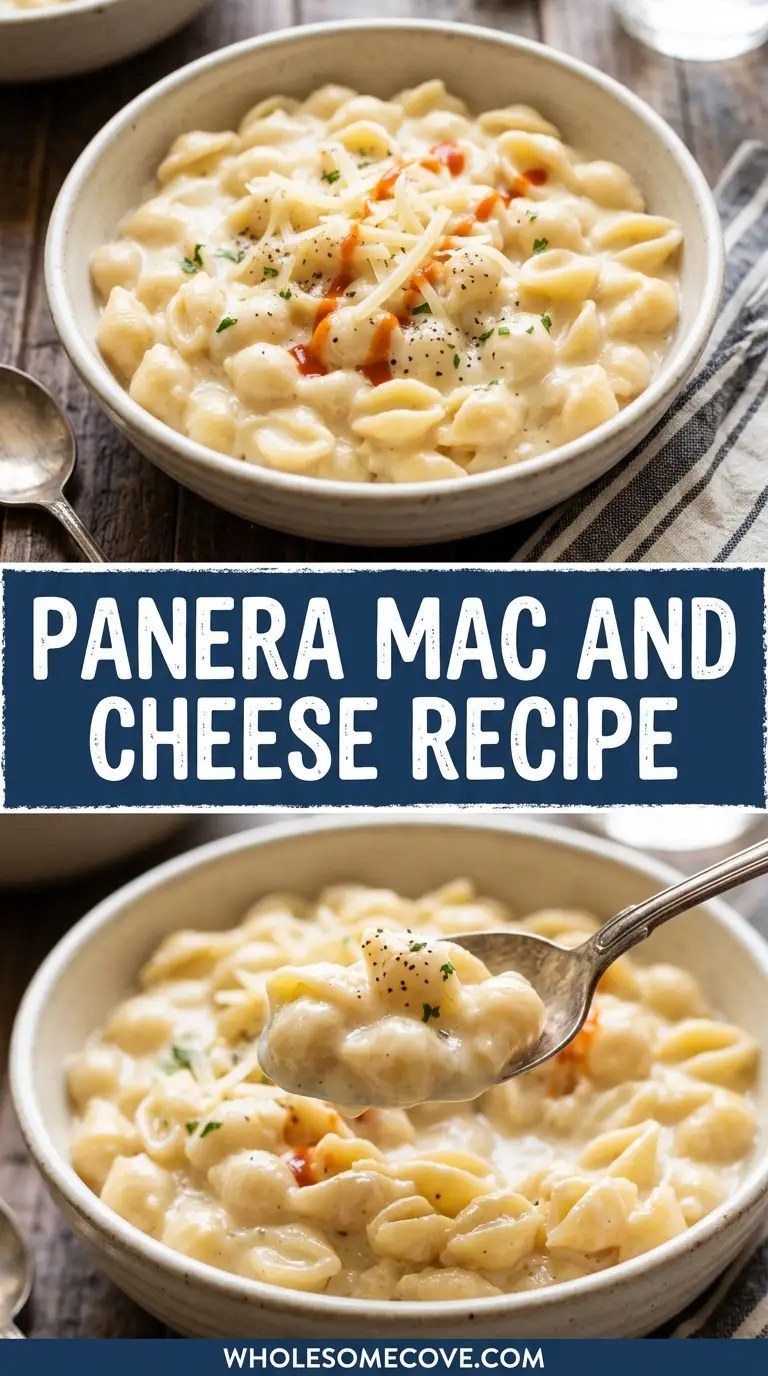
The white cheddar sauce is what sets this apart from basic boxed mac and cheese.
It’s thick, velvety, and coats every piece of pasta beautifully, with a slight tang from the Dijon mustard that makes the whole thing taste more sophisticated than it has any right to be.
Kids go absolutely crazy for this recipe.
Every time I make it, my kids finish their bowls and immediately ask if there’s more.
It works as both a side dish and a full main course.
On nights when I serve it as a main, I just toss a quick green salad alongside it and dinner is done.
- Spot-on copycat flavor: The combination of sharp white cheddar and white American cheese nails that signature Panera creaminess.
- Ready in 30 minutes: Faster than driving to the restaurant and waiting in line.
- One-pot sauce: Less cleanup means more time to actually enjoy your meal.
- Kid-friendly and crowd-pleasing: Picky eaters and food lovers alike devour this one.
- Customizable: Easy to add proteins, vegetables, or extra toppings.
- Budget-friendly: A fraction of the cost of the restaurant version, and you get a bigger portion.
Read Also: Baked Mac and Cheese Recipe
Ingredients
You only need a handful of ingredients for this recipe, but quality really matters here. Use the best white cheddar you can find, buy your white American cheese from the deli counter, and please, shred the cheese yourself. Pre-shredded cheese is coated in anti-caking agents that prevent it from melting smoothly, and you’ll end up with a grainy, broken sauce instead of a silky one.
- 1 lb (450g) medium shell pasta (or cavatappi, pipette, or elbow macaroni)
- 3 tablespoons (42g) unsalted butter
- 3 tablespoons (24g) all-purpose flour
- 2 cups (480ml) whole milk, warmed
- 1/2 cup (120ml) heavy cream
- 2 cups (225g) sharp white cheddar cheese, freshly shredded (about 8 oz block)
- 4 oz (113g) white American cheese from the deli counter, torn or sliced thin
- 1 teaspoon Dijon mustard
- 1/2 teaspoon fine sea salt, plus more to taste
- 1/4 teaspoon black pepper
- 1/2 teaspoon hot sauce (such as Tabasco or Frank’s), plus more to taste
You might also enjoy: One Pot Mac and Cheese Recipe
Kitchen Equipment Needed
Getting the equipment right makes this recipe so much easier. A heavy-bottomed saucepan is important because thinner pans cause the sauce to scorch on the bottom before it fully thickens. A good box grater or food processor with a shredding disc will save you a lot of elbow grease when shredding the white cheddar block.
- Large pot for boiling pasta
- Heavy-bottomed saucepan or Dutch oven (3-4 quart)
- Whisk
- Box grater or food processor for shredding cheese
- Colander for draining pasta
- Wooden spoon or silicone spatula
- Measuring cups and spoons
- Ladle for serving
Read Also: Southern Mac and Cheese Recipe
Recommended Products for This Recipe
These are products I personally use and recommend based on years of making this recipe. Each one genuinely improves the outcome and makes the process easier.
1. Cracker Barrel Vermont Sharp White Cheddar Cheese Block
This is the closest cheese you’ll find to what Panera uses in their actual mac and cheese. The sharpness and tang level is exactly right, and it melts beautifully into the sauce. Skip the pre-shredded bags and go straight for the block.
2. All-Clad Tri-Ply Stainless Steel Saucepan
A good heavy-bottomed saucepan is the single biggest factor in getting a smooth, lump-free cheese sauce. This one distributes heat so evenly that the sauce never hot-spots or scorches. It’s what I reach for every single time I make this recipe.
3. OXO Good Grips Box Grater
I shred my cheese fresh every time because it makes such a massive difference in texture. This grater has a non-slip base, sharp blades, and a comfortable handle that makes shredding a whole 8-ounce block quick and easy.
4. Cavatappi Pasta (Barilla)
While shells are the easiest to find, cavatappi (also called cellentani) is the pasta shape that holds the most sauce in every bite. Barilla’s version is widely available and cooks to a perfect al dente texture. Highly recommend trying it if you haven’t.
Another reader favorite to check out: Tini’s Mac and Cheese Recipe
Step-by-Step Instructions: How to Make Panera Mac and Cheese
Step 1: Cook the Pasta
- Bring a large pot of water to a rolling boil over high heat.
- Add a generous pinch of salt to the water (about 1 tablespoon). The pasta water should taste like the sea, which seasons the pasta from the inside out.
- Add 1 lb (450g) of medium shell pasta to the boiling water.
- Cook according to package directions until al dente, which means the pasta should still have just a tiny bit of firmness in the center. Al dente pasta holds up better in the sauce and won’t turn mushy.
- Before draining, scoop out about 1/2 cup (120ml) of pasta water and set it aside. This starchy water can help thin the sauce later if needed.
- Drain the pasta through a colander. Do NOT rinse the pasta. The starch on the outside of the noodles helps the sauce cling to them.
- Set the drained pasta aside.
Step 2: Shred the Cheese
- While the pasta is cooking, shred your white cheddar cheese using a box grater or a food processor with a shredding disc.
- You need about 2 cups (225g) of shredded sharp white cheddar, which is roughly an 8-ounce block.
- Tear or thinly slice the 4 oz (113g) of white American cheese from the deli counter into smaller pieces. Smaller pieces melt faster and more evenly.
- Set both cheeses aside at room temperature. Room-temperature cheese melts much more smoothly than cold cheese straight from the fridge. Cold cheese can cause your sauce to seize up or turn grainy.
Step 3: Warm the Milk and Cream
- Pour 2 cups (480ml) of whole milk and 1/2 cup (120ml) of heavy cream into a small saucepan or microwave-safe measuring jug.
- Heat gently on the stovetop over low heat, or microwave for about 60-90 seconds, until the mixture is warm to the touch but not steaming or boiling.
- Warming the dairy before adding it to the roux prevents the sauce from seizing or becoming lumpy. Cold milk poured into a hot roux is one of the most common reasons for a broken cheese sauce.
- Set the warmed milk and cream mixture aside.
Step 4: Make the Roux
- In your heavy-bottomed saucepan, melt 3 tablespoons (42g) of unsalted butter over medium-low heat. Watch it carefully so the butter doesn’t brown.
- Once the butter is fully melted and starting to bubble gently, add 3 tablespoons (24g) of all-purpose flour all at once.
- Immediately start whisking the butter and flour together. Keep whisking constantly for about 60-90 seconds. This step cooks out the raw flour taste, and you’ll know it’s ready when the mixture smells slightly nutty and looks like a pale golden paste.
- The roux should be smooth and thick, with no dry flour lumps. If you see lumps, keep whisking until they’re gone.
Step 5: Build the Cheese Sauce
- While whisking constantly, slowly pour the warmed milk and cream mixture into the roux in a thin, steady stream. Adding the liquid too fast can cause lumps, so go slowly for the first few tablespoons.
- Once all the liquid is incorporated, increase the heat slightly to medium. Continue whisking frequently.
- Cook the sauce for about 4-6 minutes, whisking often, until it has thickened noticeably and coats the back of a spoon. When you run your finger across the back of the spoon, the line should hold cleanly.
- The sauce should be smooth, glossy, and starting to bubble gently at the edges.
Step 6: Add the Cheese and Seasonings
- Remove the saucepan from the heat. This is important. Adding cheese to a very hot sauce can cause the proteins to seize and turn grainy.
- Add the torn white American cheese pieces first, and stir until fully melted.
- Add the shredded white cheddar in two batches, stirring thoroughly between each addition. Take your time with this step.
- Once all the cheese is melted and the sauce is smooth, stir in 1 teaspoon of Dijon mustard, 1/2 teaspoon of fine sea salt, 1/4 teaspoon of black pepper, and 1/2 teaspoon of hot sauce.
- Taste the sauce. Adjust salt, pepper, and hot sauce to your liking.
Step 7: Combine Pasta and Sauce
- Return the saucepan to very low heat (or turn the heat off entirely if your burner runs hot).
- Add the drained cooked pasta to the cheese sauce.
- Gently fold the pasta into the sauce using a wooden spoon or silicone spatula until every piece of pasta is evenly coated.
- If the sauce looks too thick, stir in a splash of the reserved pasta water, 1-2 tablespoons at a time, until you reach your desired consistency.
- Cook for about 1 minute on low heat, stirring gently, until everything is heated through and the sauce clings nicely to the pasta.
Step 8: Serve Immediately
- Ladle the mac and cheese into bowls or a serving dish.
- Serve right away for the creamiest texture. Mac and cheese thickens as it sits, so the sooner you serve it, the more saucy and loose it will be.
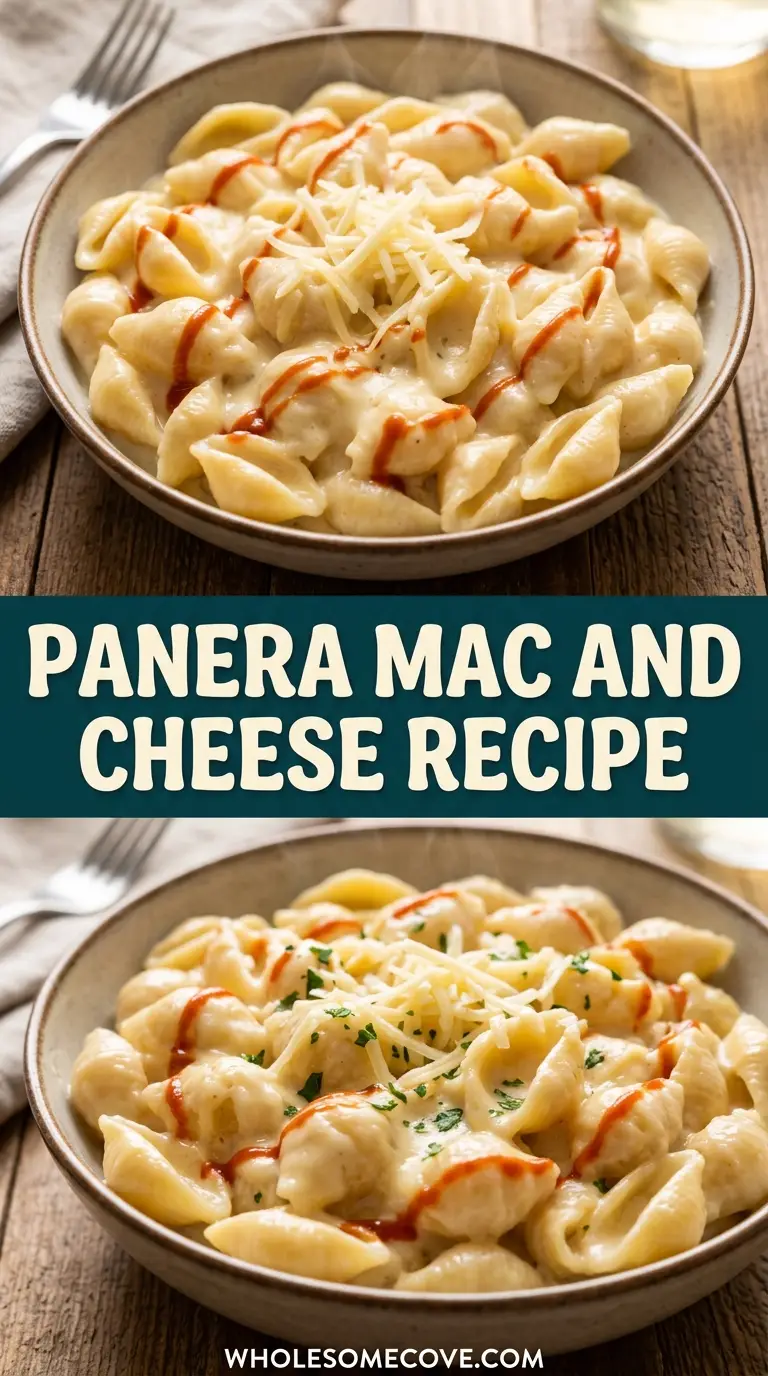
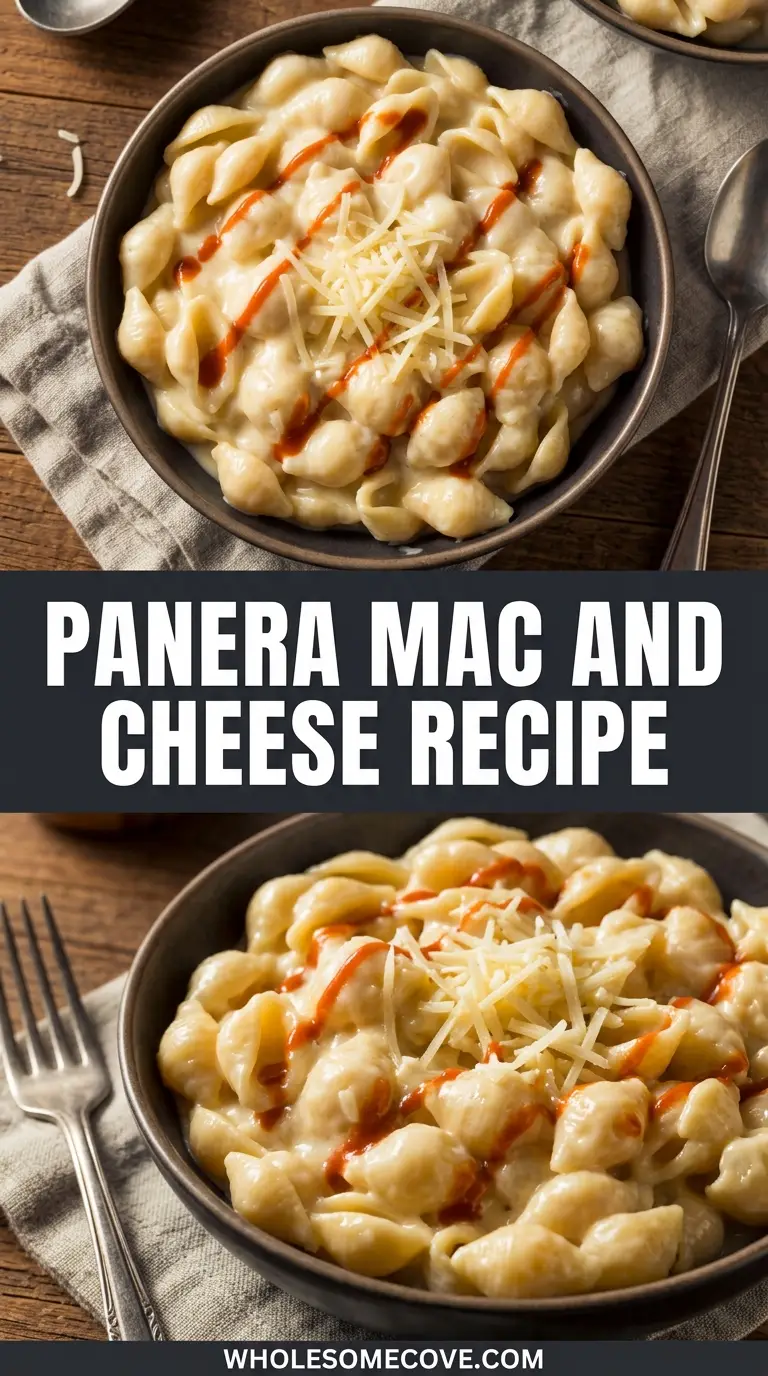
- Optional toppings include extra shredded white cheddar, a drizzle of hot sauce, chopped fresh parsley, or even crispy breadcrumbs if you like a little texture on top.
Also worth trying alongside this dish: Panera Broccoli Cheddar Soup Recipe
Tips for The Best Panera Mac and Cheese
Getting this recipe right comes down to a few key technique points. The biggest lesson I learned from my early failed attempts was that heat is the enemy of a smooth cheese sauce. Once I started pulling the pan off the heat before adding the cheese, everything changed.
- Always shred your own cheese: Pre-shredded cheese is coated in cellulose or potato starch to prevent clumping in the bag. These coatings prevent the cheese from melting smoothly and can cause a grainy, separated sauce. Buy a block and grate it yourself.
- Warm the milk before adding it: Cold milk poured into a hot roux is a recipe for lumps. Taking 90 seconds to warm it up makes the sauce come together much more easily.
- Pull the pan off the heat before adding cheese: High heat causes the proteins in cheese to tighten and separate, resulting in a greasy, grainy sauce. Remove the pan from the burner, then stir in the cheese.
- Use a combination of two cheeses: Sharp white cheddar gives you the flavor and tang. White American cheese gives you the melting smoothness and creaminess. Using only cheddar can make the sauce a bit stringy or oily.
- Don’t overcook the pasta: Aim for al dente. The pasta will continue absorbing liquid as it sits in the sauce, so if you cook it all the way through, it will become mushy by the time it hits the table.
- Don’t rinse the pasta: Rinsing washes away the starch that helps the sauce stick. Drain it well, but skip the rinse.
- Save your pasta water: A splash of reserved pasta water, which is starchy and slightly salty, can rescue a sauce that has become too thick.
- Taste as you go: The Dijon, hot sauce, and salt levels are all adjustable. Start with the amounts listed, then tweak to your preference.
Read Also: Instant Pot Mac and Cheese Recipe
What to Serve with Panera Mac and Cheese
This mac and cheese is hearty enough to hold its own as a main dish, but it also plays beautifully as a side. Some of my favorite pairings have become household staples.
A simple tomato soup is the ultimate pairing for mac and cheese, and this Tomato Soup is a natural companion that rounds out the meal perfectly.
- Broccoli Salad: The bright, slightly tangy crunch of broccoli salad cuts right through the richness of the cheese sauce.
- Roast Chicken: A simple roast chicken makes this side dish feel like a full, satisfying dinner.
- Dinner Rolls: Soft, pillowy dinner rolls are perfect for scooping up any leftover sauce from the bowl.
- Green Bean Casserole: A classic combination for holidays and family dinners alike.
- Coleslaw: The cool, crisp texture of coleslaw balances the warm, creamy pasta perfectly.
- Roasted Tomato Soup: Dipping a spoonful of mac and cheese into tomato soup is one of life’s great pleasures.
- Mississippi Pot Roast: The savory, fall-apart tender pot roast pairs beautifully with creamy mac and cheese as a side.
- Roasted Brussels Sprouts with Bacon: A slightly bitter, smoky vegetable side that complements the richness of the cheese sauce.
Read Also: Panera Bread Chicken Salad Recipe
Variations of Panera Mac and Cheese
The base recipe is already amazing, but it’s also a fantastic jumping-off point for creative additions. I’ve tried most of these myself over the years, and they all work beautifully.
The beauty of making mac and cheese at home is that you can customize it to fit exactly what you’re craving or what you have in the fridge.
- Bacon Mac and Cheese: Cook 6 slices of thick-cut bacon until crispy, crumble it, and stir half into the pasta. Sprinkle the rest on top before serving. Check out this Best Bacon Mac and Cheese Recipe for a fully developed version.
- Lobster Mac and Cheese: Fold in chunks of cooked lobster meat right before serving for a luxurious upgrade. The Best Lobster Mac and Cheese Recipe has all the details you need.
- Broccoli Mac and Cheese: Steam or roast 2 cups of broccoli florets and stir them into the finished pasta. This is a great way to sneak vegetables into a kid-friendly dinner.
- Vegan Mac and Cheese: Swap the dairy for plant-based alternatives and use a cashew-based cheese sauce. The Vegan Mac and Cheese Recipe on this site walks you through the whole process.
- Spicy Mac and Cheese: Double the hot sauce, add a pinch of cayenne pepper, and stir in some diced pickled jalapeños for a kick that warms you up from the inside.
- Crock Pot Mac and Cheese: Make the cheese sauce on the stovetop, then transfer everything to the slow cooker on warm. The Crock Pot Mac and Cheese Recipe is perfect for keeping it warm at parties or potlucks.
- Baked Mac and Cheese: Transfer the finished mac and cheese to a baking dish, top with buttered breadcrumbs and extra shredded white cheddar, and bake at 375°F (190°C) for 15-20 minutes until golden and bubbly on top.
- Truffle Mac and Cheese: Drizzle a small amount of white truffle oil over the finished pasta and stir in a tablespoon right before serving for an earthy, elegant twist.
Read Also: Chick-fil-A Mac and Cheese Recipe
Storage and Reheating
This mac and cheese is honestly best eaten straight from the pot, but leftovers are totally worth saving. The sauce thickens considerably in the fridge, but with the right reheating technique, you can bring it back to its original creamy glory.
- Refrigerator storage: Transfer cooled leftovers to an airtight container and refrigerate for up to 3-4 days. The pasta will absorb quite a bit of sauce as it sits.
- Freezer storage: Technically you can freeze this, but the dairy in the sauce tends to separate when thawed, leading to a grainy texture. I don’t recommend freezing it if you can help it.
- Stovetop reheating (recommended): Place the leftover mac and cheese in a saucepan over medium-low heat. Add 2-3 tablespoons of whole milk or a splash of heavy cream, and stir continuously until warmed through and creamy again. Add more milk a tablespoon at a time until you reach your desired consistency.
- Microwave reheating: Transfer a portion to a microwave-safe bowl, add a splash of milk, and cover loosely with a damp paper towel. Microwave in 30-second intervals, stirring between each, until heated through.
- Reheat gently: High heat when reheating can break the sauce just like it can during initial cooking. Low and slow is the key to getting a creamy result from leftovers.
- Make-ahead tip: If you want to prepare this ahead of time, make the cheese sauce and cook the pasta separately, then combine just before serving. This prevents the pasta from soaking up all the sauce during storage.
Another great make-ahead pasta dish to explore: Velveeta Mac and Cheese Recipe
Nutritional Facts
The following nutritional information is an estimate based on one serving (approximately 1 heaping cup), calculated for 6 servings.
| Nutritional Facts (Per Serving) | |
|---|---|
| Calories | 560 kcal |
| Total Fat | 28g |
| Saturated Fat | 17g |
| Cholesterol | 88mg |
| Sodium | 620mg |
| Total Carbohydrates | 52g |
| Dietary Fiber | 2g |
| Total Sugars | 6g |
| Protein | 22g |
| Calcium | 420mg (32% DV) |
| Iron | 1.5mg (8% DV) |
| Potassium | 260mg (6% DV) |
| Vitamin A | 850 IU (17% DV) |
Nutritional values are estimates and will vary depending on the specific brands and products used.
Read Also: Air Fryer Mac and Cheese Recipe
Health Benefits of Key Ingredients
While mac and cheese is absolutely a comfort food first and a health food second, the ingredients in this recipe do bring some genuine nutritional value to the table. It’s worth knowing what you’re actually eating.
Sharp white cheddar is one of the more nutrient-dense cheeses available, and when you pair it with whole milk and quality pasta, you’re getting a meal that offers real sustenance.
- White Cheddar Cheese: An excellent source of calcium, which supports bone density and muscle function. It also provides a solid hit of high-quality protein and fat-soluble vitamins A, D, E, and K.
- Whole Milk: Rich in calcium, phosphorus, and vitamins B12 and D. Whole milk provides more fat-soluble vitamins than reduced-fat alternatives, and the fat helps your body absorb those vitamins properly.
- Heavy Cream: Though high in saturated fat, cream contributes vitamins A and D. In moderation, the fat it provides helps you feel fuller for longer and promotes satiety.
- Pasta (Enriched): A reliable source of complex carbohydrates for sustained energy. Enriched pasta is fortified with B vitamins including folic acid and iron, making it more nutritious than plain refined flour products.
- Butter: Contains butyrate, a short-chain fatty acid that supports gut health. Also provides fat-soluble vitamins A, E, and K2, which many people are deficient in.
- Dijon Mustard: Contains a small amount of selenium and magnesium. Mustard seeds are also rich in antioxidants, and Dijon adds depth of flavor without adding significant calories.
- Hot Sauce: Most hot sauces are very low in calories and contain capsaicin, the compound in chili peppers that has been studied for its potential metabolism-boosting and anti-inflammatory properties.
- American Cheese: Contributes to the overall calcium and protein content of the dish. When bought from the deli counter, it contains fewer preservatives and additives than individually wrapped processed slices.
For another comforting dish with wholesome ingredients, try this Broccoli Cheese Potato Soup Recipe.
FAQs About Panera Mac and Cheese
1. What kind of pasta does Panera use in their mac and cheese?
Panera Bread traditionally uses pipette or lumaconi pasta shapes in their mac and cheese. These shapes are hollow and slightly curved, which means the cheese sauce gets trapped inside every piece for maximum flavor in every bite. At home, medium shells, cavatappi, or elbow macaroni all work beautifully as substitutes, and most grocery stores carry them year-round.
2. Why is my cheese sauce grainy or lumpy?
A grainy sauce almost always comes down to one of two things. First, the cheese was added while the heat was too high, which causes the proteins to seize and separate. Second, pre-shredded cheese was used, which contains anti-caking agents that interfere with smooth melting. To fix it, remove the pan from the heat, add a splash of warm milk, and whisk vigorously to try to bring it back together.
3. Can I make this recipe ahead of time?
You can, but with a caveat. Prepare the cheese sauce and cook the pasta separately, then store them in separate airtight containers in the refrigerator for up to two days. Combine them when you’re ready to serve, warming gently on the stovetop with a splash of milk. Combining them ahead of time and storing together will result in the pasta soaking up all the sauce and a much drier finished dish.
4. What can I use instead of white American cheese?
White American cheese from the deli is what gives this mac and cheese its silky, smooth creaminess. If you can’t find it, you can substitute Velveeta white, which has a similar melt quality. Another option is to use a small amount of cream cheese (about 2 oz) blended into the sauce, which adds creaminess and a mild tang. Provolone is also a decent substitute with a slightly more pronounced flavor.
5. Can I double this recipe for a crowd?
Absolutely. Simply double all the ingredients and use a large heavy-bottomed pot or Dutch oven. Keep the heat moderate throughout, since a larger volume of liquid and cheese takes longer to heat through evenly. If you’re making it for a party, transfer the finished mac and cheese to a slow cooker on the “warm” setting to keep it creamy and loose for serving.
Read Also: Crock Pot Mac and Cheese Recipe
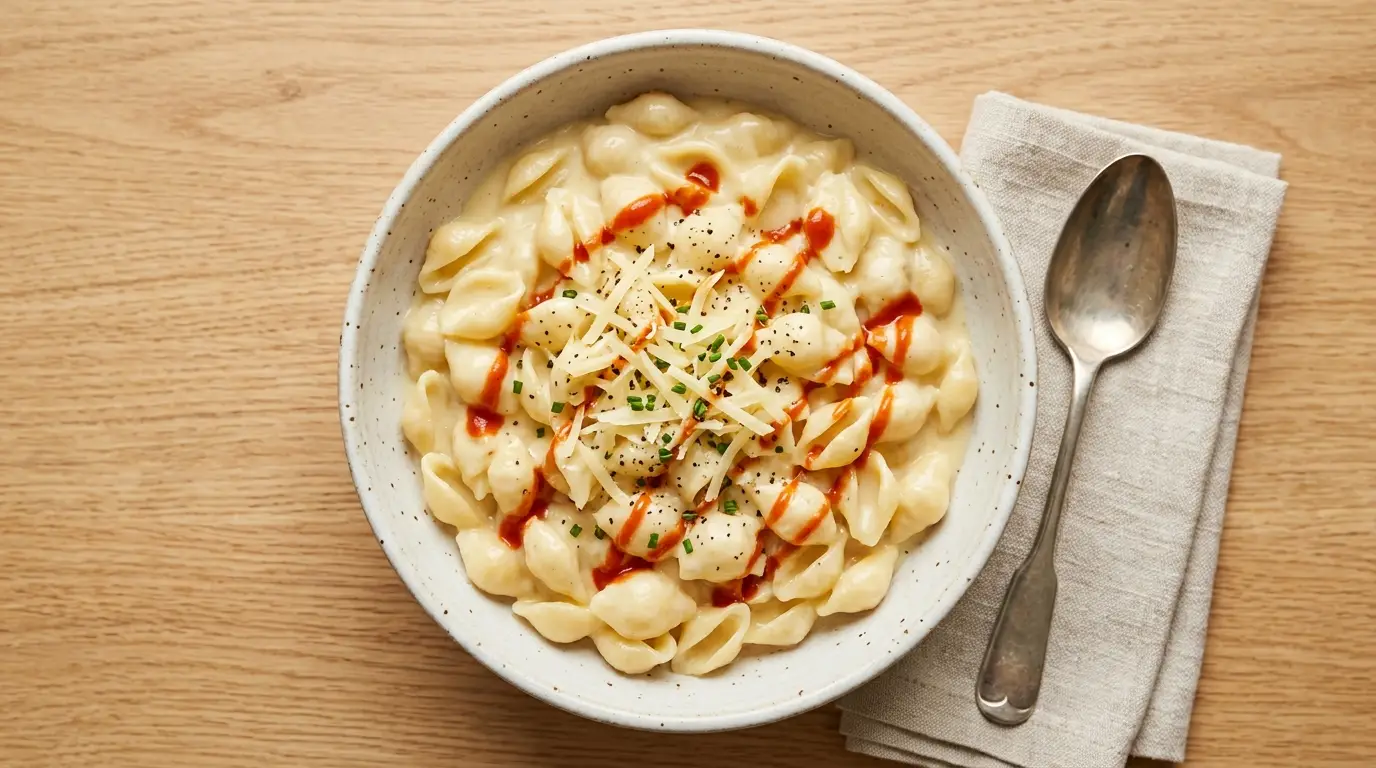
Panera Mac and Cheese
Ingredients
- 1 lb medium shell pasta - 450g; or cavatappi, pipette, or elbow macaroni
- 3 tablespoons unsalted butter - 42g
- 3 tablespoons all-purpose flour - 24g
- 2 cups whole milk - 480ml, warmed
- 1/2 cup heavy cream - 120ml
- 2 cups sharp white cheddar cheese - 225g, freshly shredded from an 8 oz block; do not use pre-shredded
- 4 oz white American cheese - 113g, from the deli counter, torn or sliced thin
- 1 teaspoon Dijon mustard
- 1/2 teaspoon fine sea salt - Plus more to taste
- 1/4 teaspoon black pepper - Freshly ground
- 1/2 teaspoon hot sauce - Such as Tabasco or Frank’s; plus more to taste
- extra shredded white cheddar cheese - For topping
- hot sauce - Drizzle on top
- fresh parsley - Chopped, for garnish
- crispy breadcrumbs - Optional, for texture on top
Equipment
- Large pot - For boiling pasta
- Heavy-bottomed saucepan or Dutch oven - 3-4 quart capacity for making the cheese sauce
- Whisk - For making the roux and incorporating dairy smoothly
- Box grater or food processor - For shredding the white cheddar block
- Colander - For draining the cooked pasta
- Wooden spoon or silicone spatula - For folding pasta into cheese sauce
- Ladle - For serving
Method
- Bring a large pot of salted water to a rolling boil, add the shell pasta, and cook until al dente according to package directions. Before draining, scoop out 1/2 cup (120ml) of starchy pasta water and set aside, then drain the pasta without rinsing.
- Shred 2 cups (225g) of sharp white cheddar from the block using a box grater, and tear or thinly slice the white American cheese into smaller pieces. Set both cheeses aside at room temperature so they melt smoothly into the sauce.
- Combine the whole milk and heavy cream in a small saucepan or microwave-safe jug and heat gently until warm to the touch but not boiling, about 60-90 seconds in the microwave. Warmed dairy prevents lumps when added to the hot roux.
- Melt the butter in a heavy-bottomed saucepan over medium-low heat, then add the flour all at once and whisk constantly for 60-90 seconds until the mixture smells slightly nutty and looks like a smooth pale golden paste.
- Slowly pour the warmed milk and cream into the roux in a thin, steady stream while whisking constantly, then increase heat to medium and cook for 4-6 minutes, whisking often, until the sauce is thick enough to coat the back of a spoon.
- Remove the saucepan from the heat, then stir in the American cheese until melted, followed by the white cheddar in two batches, stirring between each addition. Once smooth, stir in the Dijon mustard, salt, pepper, and hot sauce, then taste and adjust seasoning.
- Return the saucepan to very low heat and fold the drained pasta into the cheese sauce using a spatula until every piece is evenly coated, adding reserved pasta water a tablespoon at a time if the sauce is too thick. Cook for 1 minute until heated through.
- Ladle the mac and cheese into bowls and serve right away for the creamiest texture, topped with extra shredded white cheddar, a drizzle of hot sauce, fresh parsley, or crispy breadcrumbs if desired.
Nutrition
Notes
- Always shred your own cheese from a block. Pre-shredded cheese is coated in anti-caking agents that prevent smooth melting and can make your sauce grainy.
- Warm the milk and cream before adding to the roux. Cold dairy poured into a hot roux is one of the most common causes of a lumpy sauce.
- Remove the pan from the heat before stirring in the cheese. High heat causes the proteins in cheese to seize and separate, resulting in a greasy or grainy texture.
- Do not rinse the pasta after draining. The surface starch helps the cheese sauce cling to every piece of pasta.
- Save about 1/2 cup of pasta water before draining. This starchy liquid is perfect for loosening a sauce that becomes too thick.
- The white American cheese is key to achieving the silky, smooth creaminess of Panera’s sauce. Velveeta White or a small amount of cream cheese can substitute in a pinch.
- To reheat leftovers, warm gently in a saucepan over medium-low heat with 2-3 tablespoons of milk, stirring constantly until creamy again. Avoid high heat when reheating.
- Store leftovers in an airtight container in the refrigerator for up to 3-4 days. Freezing is not recommended as the dairy sauce separates upon thawing.
- For a make-ahead option, prepare the cheese sauce and pasta separately, store in the refrigerator for up to 2 days, and combine when ready to serve.
- Customize with add-ins: fold in crispy bacon, steamed broccoli florets, cooked lobster meat, or a drizzle of truffle oil before serving.
Private Notes
Tried this recipe?
Let us know how it was!Final Thoughts
This Panera Mac and Cheese recipe genuinely earns a spot in your regular dinner rotation.
It’s quick, it’s comforting, and it tastes like something from a restaurant, only better because you made it yourself.
Once you nail the technique of a smooth roux and off-heat cheese melting, you’ll never go back to boxed mac again.
I really hope you give this one a try and that it becomes as much of a staple in your home as it is in mine.
If you make it, drop a comment below and let me know how it turned out. I’d love to hear if you added your own twist!
Recommended:
- Velveeta Mac and Cheese Recipe
- Best Bacon Mac and Cheese Recipe
- Best Lobster Mac and Cheese Recipe
- Vegan Mac and Cheese Recipe
- Loaded Baked Potato Soup Recipe
- Cheese Sauce Recipe
- Cheesy Potatoes Recipe
- Shrimp Macaroni Salad Recipe
- Roasted Potatoes Recipe
- Healthy Cornbread Recipe