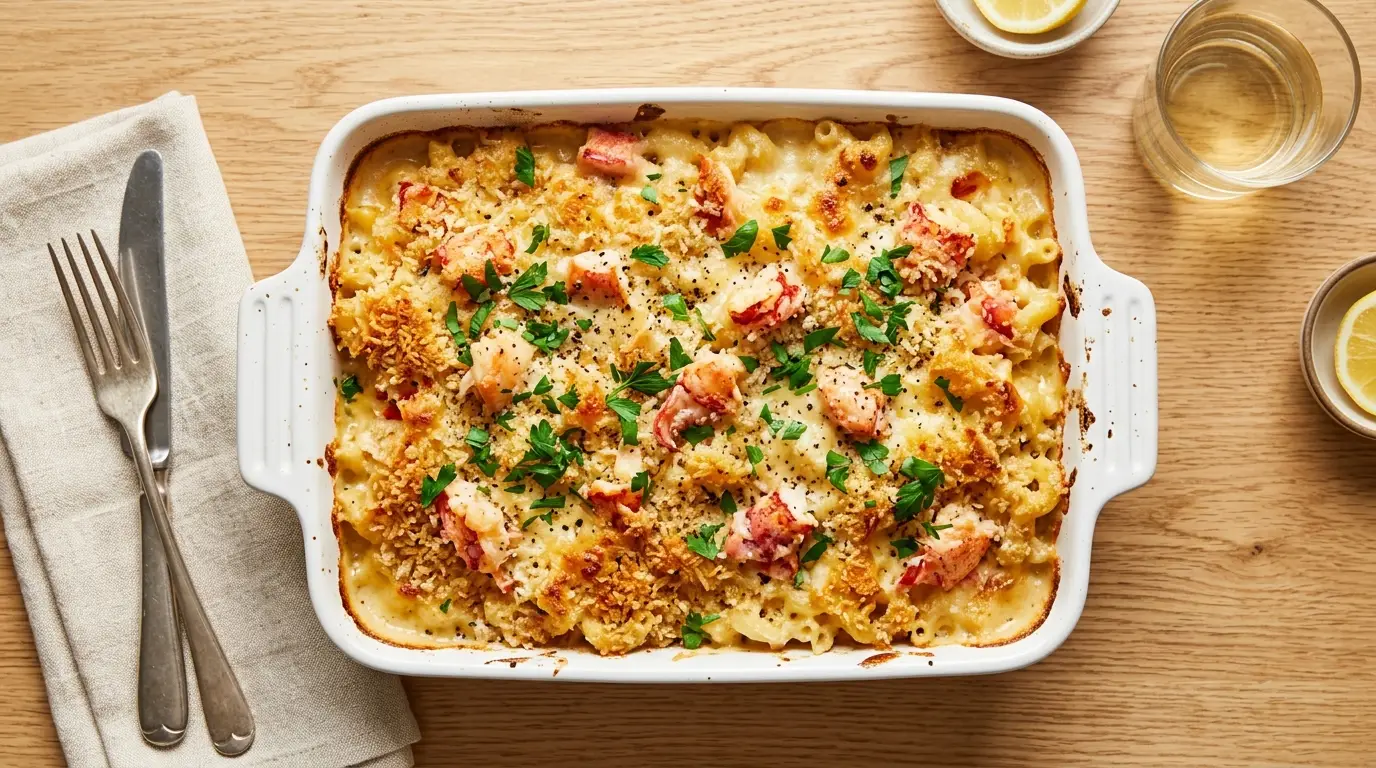
I made this Lobster Mac and Cheese Recipe for the first time on a cold February evening, fully expecting it to be a kitchen disaster. I had two lobster tails in the freezer, no real plan, and about an hour before my husband got home from work. What came out of that oven was the most ridiculous, over-the-top, lick-the-spoon delicious thing I had made in years.
It was silky, cheesy, loaded with sweet tender lobster, and had a golden breadcrumb crust that shattered with every bite.
I burned my first batch of the roux (a crispy, bitter mess), undercooked my second attempt at the lobster, and nearly gave up before I figured out the exact method that works every single time.
Now? This is my most-requested dinner for birthdays, holidays, and any night that calls for serious comfort food.
| Quick Recipe Summary | |
|---|---|
| Prep Time | 25 minutes |
| Cook Time | 35 minutes |
| Total Time | 1 hour |
| Servings | 6 servings |
| Difficulty Level | Medium |
If you love mac and cheese in all its forms, you might also enjoy my Best Bacon Mac and Cheese Recipe post for even more tips and inspiration.

Why You’ll Love This Lobster Mac and Cheese Recipe
This dish feels like a restaurant splurge but costs a fraction of what you’d pay to eat it out.
The combination of buttery lobster and a three-cheese sauce is just plain irresistible.
Every component pulls its weight here: the béchamel base is velvety, the cheese blend is bold and complex, and the panko topping adds a crunch that contrasts beautifully with the creamy sauce underneath.
You can prep this entirely ahead of time and bake it fresh when guests arrive.
It reheats well, which means leftovers are just as satisfying as the first serving.
- It is genuinely impressive. This is the dish that gets people asking you for the recipe before they even finish their plate.
- The texture is perfect. Creamy cheese sauce, tender pasta, sweet lobster, and a golden crunchy topping in every single bite.
- The flavors are layered. Sharp cheddar, nutty Gruyère, and creamy mozzarella work together to build depth without being one-note.
- It is easier than it looks. A roux-based cheese sauce sounds fancy, but it comes together in about 10 minutes if you follow the steps.
- It is flexible. You can use lobster tails, fresh whole lobster, or even frozen cooked lobster meat.
- Kids and adults love it equally. This bridges the gap between “fancy dinner” and pure comfort food.
- It is make-ahead friendly. Assemble it the day before, refrigerate, and bake it fresh, which makes hosting so much easier.
Read Also: Baked Mac and Cheese Recipe
Ingredients
You want every ingredient here to be as good as you can get it. The lobster is the star, so using real, fresh or frozen cooked lobster meat makes all the difference. Pre-shredded cheese is a shortcut I would skip entirely, since the anti-caking agents prevent it from melting into a smooth, silky sauce.
- Lobster tails (about 3-4 tails, totaling approximately 1.5 lbs / 680g of meat after cooking): You can use fresh or thawed frozen tails. Look for cold-water Maine lobster tails for the sweetest, most tender meat. Alternatively, use 1.5 lbs (680g) of pre-cooked, shelled lobster meat.
- 1 lb (450g) cavatappi or elbow macaroni pasta: Cavatappi (corkscrew pasta) is ideal because the ridges and hollow shape trap the cheese sauce beautifully. Elbow macaroni works just as well.
- 6 tablespoons (85g) unsalted butter, divided: You will use 4 tablespoons for the cheese sauce and 2 tablespoons for the breadcrumb topping.
- 1/3 cup (40g) all-purpose flour: This forms the base of your roux, which thickens the cheese sauce.
- 2 cups (480ml) whole milk, warmed: Warm milk prevents lumps when added to the roux. Do not use skim or low-fat milk here.
- 1 cup (240ml) heavy cream: This gives the sauce its signature richness and velvety texture.
- 1.5 cups (170g) sharp cheddar cheese, shredded from a block: Sharp cheddar gives the sauce its familiar mac-and-cheese flavor and a slight tang.
- 1 cup (115g) Gruyère cheese, shredded from a block: Gruyère melts beautifully and adds a nutty, slightly sweet depth that elevates the whole dish.
- 1/2 cup (57g) low-moisture mozzarella, shredded from a block: Mozzarella adds creaminess and helps the sauce stay smooth and stretchy.
- 1 teaspoon Dijon mustard: This does not taste mustardy. It sharpens the cheese flavor and rounds out the sauce.
- 1/2 teaspoon garlic powder: Adds gentle savory depth to the cheese sauce.
- 1/2 teaspoon onion powder: A subtle background note that makes the sauce taste more complex.
- 1/4 teaspoon cayenne pepper: Just enough to add warmth without making the dish spicy. Adjust to taste.
- 1/4 teaspoon freshly grated nutmeg: A classic béchamel addition that adds a warm, slightly floral note.
- 1 teaspoon Old Bay seasoning, divided: Use 1/2 teaspoon in the cheese sauce and 1/2 teaspoon to season the lobster. Old Bay is practically made for seafood dishes like this.
- Salt and black pepper to taste
- 1 cup (60g) panko breadcrumbs: Panko creates a lighter, crispier topping than regular breadcrumbs. Do not substitute with fine crumbs.
- 2 tablespoons fresh parsley, chopped: For garnish. Adds a pop of color and a fresh herby finish.
- 1 tablespoon olive oil: For sautéing the garlic when cooking the lobster.
- 2 cloves garlic, minced: Cooked briefly with butter when finishing the lobster meat for extra flavor.
You might also enjoy my Creamy Mac and Cheese Recipe if you want a classic base without the lobster.
Kitchen Equipment Needed
Having the right equipment really does make the process smoother. The most important item is a large, heavy-bottomed pot or Dutch oven for the cheese sauce, since it distributes heat evenly and prevents scorching. A good 9×13 inch baking dish is also non-negotiable for getting that beautiful golden crust.
- Large pot or Dutch oven: For cooking the pasta and making the cheese sauce.
- 9×13 inch baking dish: Ceramic or glass works best for even baking. This is what goes into the oven.
- Large colander: For draining the pasta after it is cooked.
- Whisk: Essential for making a smooth, lump-free roux and béchamel sauce.
- Large mixing bowl: For tossing the shredded cheeses together before adding to the sauce.
- Box grater or food processor with grater attachment: For shredding your cheese from the block.
- Rimmed baking sheet: For roasting the lobster tails in the oven before removing the meat.
- Sharp kitchen shears or chef’s knife: For cutting through the lobster shell and removing the meat cleanly.
- Rubber spatula: For folding the pasta and lobster into the cheese sauce without breaking the pasta.
- Small saucepan or skillet: For toasting the panko breadcrumbs in butter before adding to the top.
- Measuring cups and spoons: For accurate measurements throughout.
- Aluminum foil: For lining the baking sheet when cooking the lobster tails.
Read Also: Southern Mac and Cheese Recipe
Recommended Products for This Recipe
These are the products I personally come back to every time I make this dish. After trial and error across multiple batches, these are the items that genuinely make a difference.
1. Maine Lobster Now Frozen Lobster Tails
Sourcing quality lobster makes or breaks this recipe. These cold-water Maine tails are consistently sweet, tender, and perfectly sized for this dish, and they come already cleaned and ready to cook with no mystery involved.
2. Le Creuset Enameled Cast Iron Baking Dish
I switched to this baking dish two years ago and have not looked back. The enameled cast iron heats evenly from edge to edge, which means you get that perfect golden crust across the entire top, not just in the center.
3. Microplane Fine Grater for Nutmeg
Freshly grated nutmeg is worlds away from the pre-ground stuff, and a fine Microplane grater handles whole nutmeg in seconds. It is one of those small investments that pays off in almost every cream-based sauce you will ever make.
4. Cuisipro Box Grater
Shredding your own cheese is one of the most important steps in this recipe. A high-quality box grater with a sharp etched blade makes this task fast and easy, and it works equally well for Gruyère, cheddar, and mozzarella.
5. Ian’s Panko Breadcrumbs
Not all panko is created equal. This brand consistently delivers large, airy flakes that toast up beautifully and stay crispy even after baking, which is exactly what you want for that signature crunchy topping.
Another great mac and cheese variation worth trying: Velveeta Mac and Cheese Recipe

Step-by-Step Instructions: How to Make Lobster Mac and Cheese
Step 1: Prepare and Cook the Lobster
- Preheat your oven to 425°F (220°C). Line a rimmed baking sheet with aluminum foil.
- If using lobster tails, use sharp kitchen shears to cut along the top of the shell lengthwise, from the base of the tail all the way to where the shell meets the tail fin. Do not cut through the fan at the end.
- Gently pull the shell apart and lift the lobster meat out of the shell, keeping it attached at the base. Lay the meat on top of the shell so it sits slightly above it. This is called “butterflying” the lobster.
- Brush each lobster tail with 1 tablespoon of melted butter and sprinkle with 1/2 teaspoon Old Bay seasoning, a small pinch of salt, and a small pinch of black pepper.
- Place the prepared lobster tails on the lined baking sheet and roast in the preheated oven for 10 to 12 minutes, depending on the size of the tails. The meat should be opaque, white to light pink, and just firm when pressed. Avoid overcooking, as the lobster will continue cooking slightly in the oven during the final bake.
- Remove from the oven and allow the lobster to cool for 5 minutes. Once cool enough to handle, remove the meat from the shell and chop it into generous, bite-sized chunks, roughly 1 to 1.5 inches (2.5 to 4cm) in size. Set aside.
- Reduce the oven temperature to 375°F (190°C) now so it is ready for the final bake.
Step 2: Cook the Pasta
- Fill your large pot with generously salted water. The water should taste pleasantly salty, like light broth.
- Bring the water to a full rolling boil over high heat.
- Add 1 lb (450g) of cavatappi or elbow macaroni to the boiling water and cook according to the package instructions, but pull it out about 1 to 2 minutes early so it is slightly underdone, or al dente. The pasta will finish cooking in the oven, and if you cook it fully now it will become mushy.
- Reserve about 1/2 cup (120ml) of pasta cooking water before draining, in case you need to loosen the cheese sauce later.
- Drain the pasta in a colander and rinse briefly with cold water to stop the cooking. Set aside.
Step 3: Make the Roux
- In your large pot or Dutch oven, melt 4 tablespoons (57g) of unsalted butter over medium heat.
- Once the butter is fully melted and beginning to foam, add 1/3 cup (40g) of all-purpose flour all at once.
- Whisk the butter and flour together constantly for 2 full minutes. This cooks out the raw flour taste and creates a smooth paste called a roux. The roux should turn a light golden color and smell slightly nutty. Do not walk away during this step.
Step 4: Build the Béchamel Cheese Sauce
- With the pot still over medium heat, slowly pour in 2 cups (480ml) of warm whole milk in a thin, steady stream while whisking constantly. Adding it slowly prevents lumps from forming.
- Once all the milk is incorporated and the mixture is smooth, pour in 1 cup (240ml) of heavy cream, again whisking continuously.
- Increase the heat to medium-high and bring the sauce to a gentle simmer, stirring frequently. Cook for 4 to 5 minutes until the sauce thickens enough to coat the back of a spoon. When you run your finger across the spoon, the line should hold its shape.
- Reduce the heat to low. Add 1 teaspoon of Dijon mustard, 1/2 teaspoon garlic powder, 1/2 teaspoon onion powder, 1/4 teaspoon cayenne pepper, 1/4 teaspoon freshly grated nutmeg, and 1/2 teaspoon Old Bay seasoning. Whisk to combine.
- Remove the pot from the heat completely. This is important. Adding the cheese while the sauce is too hot can cause it to break and become grainy.
- Add the shredded cheeses in three batches, stirring between each addition until fully melted and smooth. Add the sharp cheddar first, then the Gruyère, then the mozzarella. Stir gently and patiently.
- Taste the sauce and adjust salt and black pepper to your preference. The sauce should taste boldly cheesy, slightly tangy, and rich.
Step 5: Combine the Pasta and Sauce
- Add the drained pasta to the pot with the cheese sauce and stir with a rubber spatula until every piece of pasta is well coated.
- If the sauce feels very thick at this stage, add a splash of the reserved pasta cooking water (about 2 to 3 tablespoons) and stir to loosen it. The sauce will thicken further in the oven, so it is fine to have it slightly looser than you want the final dish to be.
- Gently fold in about half (roughly 3/4 lb / 340g) of the chopped lobster meat, being careful not to break the chunks. Reserve the remaining lobster for the top.
- Transfer the pasta mixture to your greased 9×13 inch baking dish. Spread it into an even layer using your spatula.
Step 6: Add the Lobster and Breadcrumb Topping
- Distribute the reserved lobster chunks evenly over the top of the pasta. Press them in slightly so they sit at the surface and will be visible and lightly browned after baking.
- In a small saucepan or skillet, melt the remaining 2 tablespoons (28g) of butter over medium heat.
- Add 1 cup (60g) of panko breadcrumbs to the melted butter and stir constantly for 2 to 3 minutes until the panko is lightly golden and well coated in butter. Remove from heat.
- Sprinkle the buttered panko evenly over the top of the dish. Try to scatter it around the lobster pieces rather than covering them completely, so the lobster stays visible.
Step 7: Bake and Rest
- Place the baking dish in the preheated oven (375°F / 190°C) and bake uncovered for 25 to 30 minutes, until the sauce is bubbling at the edges, the top is a deep golden brown, and the breadcrumbs are crispy.
- If you want an even more deeply browned top, switch the oven to broil for the last 2 to 3 minutes. Watch it closely, as it can go from golden to burnt very quickly.
- Remove the dish from the oven and allow it to rest for 10 minutes before serving. This resting time lets the sauce set up slightly and makes it easier to serve in scoops.
- Sprinkle with 2 tablespoons of freshly chopped parsley and serve immediately.
You might also enjoy this showstopper side dish: Lobster Rolls Recipe

Tips for The Best Lobster Mac and Cheese
Getting this recipe right comes down to a few key habits. The biggest one? Always shred your cheese fresh from the block. I made the mistake of using a bag of pre-shredded cheddar once and ended up with a gritty, oily sauce that I had to throw out entirely. The starches and anti-caking agents in pre-shredded cheese truly ruin the texture.
- Shred your own cheese every single time. Pre-shredded cheese contains cellulose and anti-caking agents that prevent proper melting and result in a grainy sauce.
- Warm your milk before adding it to the roux. Cold milk shocks the roux and creates lumps. Warm it in the microwave for 60 to 90 seconds before adding.
- Take the pot off the heat before adding the cheese. Excess heat causes cheese proteins to seize up and the sauce to become grainy or oily. Always remove from heat first.
- Do not overcook the lobster. It should be just opaque when you take it out of the oven for the first time. It will cook more in the final bake.
- Salt your pasta water generously. This is your main opportunity to season the pasta itself. Underseasoned pasta leads to a flat-tasting final dish.
- Cook the pasta al dente. Pull it out a minute or two early. It finishes cooking in the oven, and if it starts out fully cooked it will become mushy.
- Let the dish rest before serving. Ten minutes of resting allows the sauce to thicken and the flavors to settle. Serving it straight from the oven will result in a runnier dish.
- Use a heavy-bottomed baking dish. It distributes heat more evenly and gives you a consistent, golden crust across the whole top.
- Do not skip the Dijon mustard. It sounds like a strange addition, but it sharpens the cheese flavor without tasting like mustard at all.
- Season in layers. Taste the cheese sauce before adding the pasta, and taste again after combining. Adjust salt, pepper, or cayenne at each stage.
For another mac and cheese variation with great flavor: Tini’s Mac and Cheese Recipe
What to Serve with Lobster Mac and Cheese
This is a rich, hearty main dish, so the best sides are ones that balance and contrast rather than add more heaviness. A lightly dressed salad, something with brightness and acidity, or a simple roasted vegetable all work beautifully here.
Light, fresh sides that cut through the richness of the dish make the best companions. Think about contrasting the creamy, cheesy sauce with something that has crunch, acid, or brightness.
- Simple arugula salad with lemon vinaigrette: The peppery bitterness of arugula and a sharp lemon dressing cuts right through the richness of the mac and cheese. Dress it just before serving.
- Roasted asparagus: Crispy roasted asparagus with a little olive oil, salt, and lemon juice is an elegant side that pairs naturally with the seafood element of the dish.
- Deviled Eggs: A classic appetizer that guests always love, and the creamy, tangy filling makes a lovely contrast before the main course.
- Coleslaw: A tangy vinegar-dressed coleslaw adds crunch and acidity that balance the richness perfectly.
- Crusty sourdough bread or dinner rolls: Ideal for scooping up that extra cheese sauce from the dish. Nobody needs to pretend they are not doing this.
- Roasted Brussels sprouts with bacon: The slight bitterness of the Brussels sprouts and the smoky bacon complement the buttery sweetness of the lobster beautifully.
- Corn on the cob: Sweet corn and lobster are a classic pairing. Serve it simply buttered for the best effect.
- A crisp white wine: A glass of Chardonnay or Sauvignon Blanc alongside this dish is absolutely worth mentioning. The wine’s acidity balances the fat in the cheese sauce.
Variations of Lobster Mac and Cheese
This recipe is a fantastic base to build on once you have mastered the original. Swapping out the protein, changing up the cheeses, or adding different toppings all create new versions that feel distinct but use the same reliable technique.
The core method stays the same: roux, béchamel, cheese, pasta, protein, topping, bake. Once that is in your muscle memory, the variations are endless.
- Crab Mac and Cheese: Substitute the lobster with 1.5 lbs (680g) of lump crab meat. Use the same seasoning approach. Crab is slightly sweeter and more delicate than lobster, so go easy on the cayenne.
- Shrimp Mac and Cheese: Use 1.5 lbs (680g) of large shrimp, peeled and deveined. Season and sauté them in butter and garlic for 2 to 3 minutes per side before folding into the pasta.
- Truffle Lobster Mac and Cheese: Add 1 to 2 teaspoons of white or black truffle oil to the finished cheese sauce just before combining with the pasta. This is the special-occasion upgrade.
- Spicy Cajun Version: Double the cayenne, add 1 teaspoon of smoked paprika to the cheese sauce, and season the lobster with full Cajun seasoning instead of Old Bay. Serve with hot sauce on the table.
- Stovetop Version: Skip the oven entirely. After combining the pasta and cheese sauce, fold in all the lobster and serve directly. Toast the breadcrumbs separately in butter and sprinkle on top just before serving for crunch.
- Four-Cheese Version: Replace the mozzarella with fontina and add 1/4 cup (28g) of grated Parmesan to the breadcrumb topping. This makes the dish slightly more savory and complex.
- Mini Individual Portions: Divide the assembled dish among individual ramekins or small gratin dishes before baking. This is great for dinner parties and makes serving effortless.
Another great mac and cheese recipe to try: Air Fryer Mac and Cheese Recipe
Storage and Reheating
Lobster Mac and Cheese stores well in the fridge for a few days, and while it is always best fresh from the oven, the leftovers are genuinely delicious if you reheat them the right way. The key is adding a splash of liquid to revive the cheese sauce and prevent it from drying out.
- Refrigerator storage: Allow the dish to cool completely before transferring to an airtight container. Store in the refrigerator for up to 3 days.
- Freezer storage: Lobster Mac and Cheese can be frozen for up to 2 months. Cover the baking dish tightly with plastic wrap and then two layers of aluminum foil before freezing. Thaw overnight in the refrigerator before reheating.
- Oven reheating (best method): Cover the dish with foil and bake at 350°F (175°C) for 20 to 25 minutes, or until heated through. Remove the foil for the last 5 minutes to re-crisp the breadcrumb topping.
- Stovetop reheating: Scoop individual portions into a small saucepan. Add 1 to 2 tablespoons of whole milk or cream and heat over low heat, stirring gently until warmed through. Do not rush this or the sauce may separate.
- Microwave reheating: Place a portion in a microwave-safe bowl. Add 1 tablespoon of milk, cover loosely, and microwave in 60-second increments, stirring between each, until hot. The breadcrumb topping will soften, so this is best for quick individual portions.
- Make-ahead tip: Assemble the entire dish (pasta, sauce, lobster, breadcrumb topping) and refrigerate unbaked for up to 24 hours. When ready to bake, let it sit at room temperature for 20 minutes, then bake covered for 25 minutes, uncover, and bake for another 15 to 20 minutes.
Another comfort food classic to explore: One Pot Mac and Cheese Recipe
Nutritional Facts
The following values are approximate and based on one serving out of six total servings.
| Nutritional Facts (Per Serving) | |
|---|---|
| Calories | 610 kcal |
| Total Fat | 32g |
| Saturated Fat | 19g |
| Cholesterol | 185mg |
| Sodium | 780mg |
| Total Carbohydrates | 48g |
| Dietary Fiber | 2g |
| Total Sugars | 5g |
| Protein | 34g |
| Calcium | 480mg (37% DV) |
| Iron | 2mg (11% DV) |
| Vitamin A | 1,200 IU (24% DV) |
| Potassium | 340mg (7% DV) |
Nutritional values are estimates and may vary depending on specific brands and exact portion sizes used.
For another indulgent mac and cheese spin: Crock Pot Mac and Cheese Recipe
Health Benefits of Key Ingredients
This recipe is an indulgent comfort food, no question about it. But a few of its key ingredients do bring some real nutritional value to the table, and it is worth knowing about the good stuff packed into each serving.
Lobster, in particular, is often overlooked as a healthy protein, but it is genuinely impressive from a nutritional standpoint.
- Lobster is a lean, high-quality protein. A 3.5 oz (100g) portion of lobster provides around 20 to 22 grams of protein with relatively low saturated fat. It is also rich in selenium, zinc, and vitamin B12.
- Lobster supports thyroid function. It is one of the better dietary sources of iodine, a mineral essential for healthy thyroid hormone production.
- Lobster contains omega-3 fatty acids. These healthy fats support heart health, reduce inflammation, and support brain function.
- Gruyère cheese provides calcium. One ounce of Gruyère delivers around 285mg of calcium, supporting bone density and muscle function.
- Cheddar cheese is a source of vitamin K2. This often-overlooked nutrient plays a role in bone health and cardiovascular function.
- Whole milk and cream provide fat-soluble vitamins. Vitamins A, D, E, and K are all present in full-fat dairy and are absorbed more efficiently when consumed with fat.
- Garlic has antimicrobial properties. Fresh garlic contains allicin, a compound associated with immune support and reduced inflammation.
- Parsley is rich in vitamin K and vitamin C. As a garnish, it adds more than just color. It contributes a small but meaningful dose of antioxidants.
- Pasta provides steady energy. As a complex carbohydrate, pasta digests more slowly than simple sugars, supporting longer-lasting energy levels.
Another seafood-forward recipe you will love: Seafood Chowder Recipe
FAQs About Lobster Mac and Cheese
1. Can I use pre-cooked lobster meat instead of fresh lobster tails?
Yes, absolutely. Pre-cooked lobster meat, whether fresh from a fishmonger or frozen and thawed, works perfectly in this recipe.
Just make sure to pat the meat dry with paper towels to remove any excess moisture before folding it into the pasta. Cut it into bite-sized chunks and fold half into the pasta mixture and place the rest on top, exactly as described in the recipe.
2. What is the best cheese combination for Lobster Mac and Cheese?
The combination of sharp cheddar, Gruyère, and mozzarella is a tried-and-true blend for this dish.
Sharp cheddar provides flavor and color, Gruyère adds nutty depth and melts beautifully, and mozzarella contributes creaminess and stretch. If you want to swap anything out, fontina is a great replacement for mozzarella, and smoked gouda can replace Gruyère for a smokier profile.
3. Can I make Lobster Mac and Cheese ahead of time?
Yes, and it works very well.
Assemble the complete dish, including the breadcrumb topping, and cover it tightly with plastic wrap. Refrigerate for up to 24 hours. When you are ready to bake, remove it from the fridge 20 minutes before baking, cover with foil, and bake at 375°F (190°C) for 25 minutes. Remove the foil and bake for an additional 15 to 20 minutes until bubbly and golden.
4. Why did my cheese sauce turn out grainy?
A grainy cheese sauce is almost always caused by one of two things: adding the cheese to a sauce that is too hot, or using pre-shredded cheese.
Always remove the pot from the heat before adding the cheese, and always shred your cheese fresh from the block. If your sauce is already grainy, try adding a tablespoon of cream and stirring vigorously over very low heat to bring it back together.
5. Can I freeze Lobster Mac and Cheese?
You can freeze it, though the texture may change slightly upon thawing.
The pasta can become a little softer and the sauce can be slightly less silky after freezing and reheating. For best results, freeze it before baking, thaw overnight in the refrigerator, and bake fresh. If you have already baked it, it will still taste good after freezing, just not quite as pristine as the original.
For another great comfort food: Instant Pot Mac and Cheese Recipe
Lobster Mac and Cheese
Ingredients
- 1.5 lbs lobster tails - 680g total meat after cooking; approximately 3-4 tails; cold-water Maine lobster tails recommended; can substitute with pre-cooked shelled lobster meat
- 1 tbsp unsalted butter - melted; for brushing the lobster tails before roasting
- 0.5 tsp Old Bay seasoning - for seasoning the lobster tails before roasting
- 1 tbsp olive oil - for sautéing when finishing the lobster
- 2 garlic cloves - minced; cooked briefly with butter when finishing lobster meat
- 1 lb cavatappi or elbow macaroni pasta - 450g; cavatappi preferred for its ridged, hollow shape that holds sauce; cook al dente
- 4 tbsp unsalted butter - 57g; for making the roux
- 1/3 cup all-purpose flour - 40g; forms the base of the roux to thicken the sauce
- 2 cups whole milk - 480ml; warmed before adding to roux to prevent lumps; do not substitute skim or low-fat milk
- 1 cup heavy cream - 240ml; gives the sauce its velvety richness
- 1.5 cups sharp cheddar cheese - 170g; shredded fresh from the block; do not use pre-shredded
- 1 cup Gruyère cheese - 115g; shredded fresh from the block; adds nutty depth and melts beautifully
- 0.5 cup low-moisture mozzarella - 57g; shredded fresh from the block; adds creaminess and stretch
- 1 tsp Dijon mustard - sharpens cheese flavor without tasting like mustard
- 0.5 tsp garlic powder
- 0.5 tsp onion powder
- 0.25 tsp cayenne pepper - adjust to taste
- 0.25 tsp freshly grated nutmeg - classic béchamel addition; use a microplane for best results
- 0.5 tsp Old Bay seasoning - for the cheese sauce
- salt and black pepper - to taste; season in layers throughout cooking
- 2 tbsp unsalted butter - 28g; for toasting the panko
- 1 cup panko breadcrumbs - 60g; creates a lighter, crispier topping than regular breadcrumbs
- 2 tbsp fresh parsley - chopped; adds color and a fresh herby finish
Equipment
- Large pot or Dutch oven - For cooking pasta and making the cheese sauce
- 9×13 inch baking dish - Ceramic or glass recommended for even baking
- Large colander - For draining cooked pasta
- Whisk - Essential for a smooth, lump-free roux and béchamel
- Large mixing bowl - For tossing shredded cheeses together
- Box grater or food processor with grater attachment - For shredding cheese fresh from the block
- Rimmed baking sheet - For roasting lobster tails before removing the meat
- Sharp kitchen shears or chef’s knife - For cutting lobster shell and removing meat
- Rubber spatula - For folding pasta and lobster into cheese sauce without breaking
- Small saucepan or skillet - For toasting panko breadcrumbs in butter
- Measuring cups and spoons - For accurate measurements throughout the recipe
- Aluminum foil - For lining the baking sheet when cooking lobster tails
Method
- Preheat oven to 425°F (220°C) and line a rimmed baking sheet with foil. Use kitchen shears to cut along the top of each lobster tail shell lengthwise, gently lift the meat out of the shell, and lay it on top (butterflied).
- Brush each butterflied tail with melted butter and sprinkle with Old Bay seasoning, salt, and pepper. Roast for 10 to 12 minutes until the meat is opaque and just firm, then cool for 5 minutes and chop into 1 to 1.5 inch (2.5 to 4cm) chunks.
- Reduce oven temperature to 375°F (190°C). Cook pasta in a large pot of generously salted boiling water until 1 to 2 minutes shy of al dente, then reserve 1/2 cup (120ml) of pasta water, drain, and rinse briefly with cold water.
- Melt 4 tablespoons (57g) of butter in a large pot or Dutch oven over medium heat. Add the flour all at once and whisk constantly for 2 full minutes until the roux is golden and smells slightly nutty.
- Slowly pour in the warmed milk in a thin stream while whisking constantly, then add the heavy cream. Bring to a gentle simmer over medium-high heat, stirring frequently, and cook for 4 to 5 minutes until the sauce thickens enough to coat the back of a spoon.
- Reduce heat to low and stir in Dijon mustard, garlic powder, onion powder, cayenne, nutmeg, and Old Bay. Remove the pot from the heat completely, then add the shredded cheeses in three batches, stirring between each addition until fully melted and smooth.
- Add the drained pasta to the cheese sauce and stir until every piece is well coated, adding a splash of reserved pasta water if the sauce seems too thick. Gently fold in half of the chopped lobster meat, then transfer the mixture to a greased 9×13 inch baking dish.
- Distribute the remaining lobster chunks evenly over the top of the pasta, pressing them in slightly. In a small skillet, melt 2 tablespoons butter over medium heat, add panko breadcrumbs, and stir for 2 to 3 minutes until golden, then sprinkle evenly over the top.
- Bake uncovered at 375°F (190°C) for 25 to 30 minutes until the sauce is bubbling at the edges and the breadcrumb topping is deep golden brown. Rest for 10 minutes, then garnish with chopped fresh parsley and serve.
Nutrition
Notes
- Always shred cheese fresh from the block. Pre-shredded cheese contains anti-caking agents that prevent proper melting and result in a grainy, oily sauce.
- Warm your milk before adding it to the roux. Cold milk can cause lumps to form. Microwave it for 60 to 90 seconds before adding.
- Remove the pot from the heat completely before adding the cheese. Excess heat causes the cheese proteins to seize and the sauce to turn grainy.
- Do not overcook the lobster in the first roasting step. It should be just opaque when removed, since it will continue cooking in the final bake.
- Cook the pasta al dente (1 to 2 minutes short of done). It finishes cooking in the oven, and fully cooked pasta will become mushy.
- Make-ahead tip: Assemble the entire dish, cover tightly, and refrigerate for up to 24 hours. Let it sit at room temperature for 20 minutes before baking.
- To freeze: Cover the assembled unbaked dish with plastic wrap and two layers of foil. Freeze for up to 2 months. Thaw overnight in the fridge before baking.
- For extra browning on top, switch the oven to broil for the final 2 to 3 minutes of baking. Watch it closely to prevent burning.
- Lobster substitution: Lump crab meat, large shrimp, or a combination of seafood all work beautifully using the same method and seasoning.
- For a truffle upgrade, stir 1 to 2 teaspoons of white truffle oil into the finished cheese sauce just before combining with the pasta.
Private Notes
Tried this recipe?
Let us know how it was!Final Thoughts
This Lobster Mac and Cheese Recipe is one of those dishes that earns its place as a household legend.
It is rich, comforting, deeply satisfying, and genuinely special enough to serve at any occasion from a casual weeknight dinner to a full holiday spread.
Once you make it at home, you will wonder why you ever paid restaurant prices for a smaller, less indulgent version.
Give it a try, make it your own with your favorite cheese combination or a little extra heat, and let me know in the comments how it turned out.
If this becomes a regular in your rotation (and I have a strong feeling it will), share a photo and tag me. I love seeing your versions!
Recommended:
- New England Clam Chowder Recipe
- Shrimp Macaroni Salad Recipe
- Cheese Sauce Recipe
- Garlic Parmesan Sauce Recipe
- Baked Ziti Recipe
- Roasted Brussels Sprouts with Bacon Recipe
- Scalloped Potatoes Recipe
- Grilled Salmon with Dill Sauce Recipe
- Coleslaw Recipe