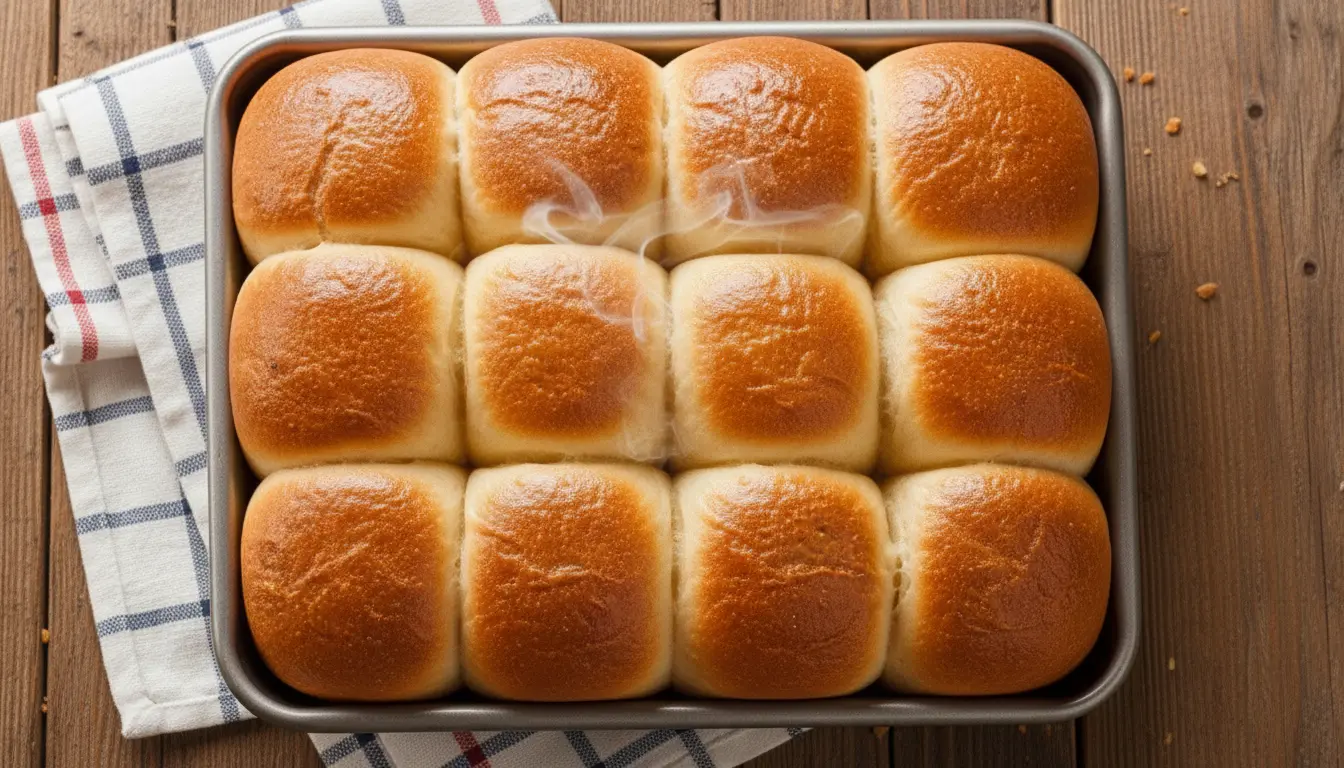
A good dinner rolls recipe should give you rolls that tear apart in soft, feathery layers and stay tender well after they leave the oven.
This version leans on seven simple ingredients and instant yeast. The tops get brushed with butter twice for a glossy, golden finish.
The most common reason homemade rolls turn out dense is milk that runs too hot, which quietly kills the yeast. Warming it to just 110°F (43°C) keeps the yeast alive and lets the dough rise properly.
These bake in one 9×13-inch pan, so the rolls stay soft where they touch and turn deep golden on top. Including both rises, the full batch takes about two and a half hours and makes 15 rolls.
| Quick Recipe Summary | |
|---|---|
| Prep Time | 25 minutes |
| Rise Time | 1 hour 45 minutes |
| Cook Time | 20 minutes |
| Total Time | 2 hours 30 minutes |
| Servings | 15 rolls |
| Difficulty Level | Easy |
For another enriched dough with a similar buttery softness, see Hot Cross Buns.

Why You’ll Love This Dinner Rolls Recipe
These rolls come together with pantry staples and a single pan, and they reward a little patience with a bakery-soft crumb. Here is what makes the recipe worth keeping.
- Seven everyday ingredients. Flour, yeast, milk, sugar, butter, egg, and salt are all you need, with no specialty items to track down.
- Reliably soft texture. Whole milk, butter, and one egg create an enriched dough that bakes into a tender, pillowy crumb.
- One-pan simplicity. Baking all 15 rolls snug in a 9×13-inch pan keeps the sides soft and the centers cloud-like.
- Beginner friendly. Instant yeast mixes straight into the flour, so there is no separate proofing step to get wrong.
- Buttery golden tops. A double brush of melted butter gives the crowns a glossy shine and rich flavor.
- Make-ahead flexibility. The shaped rolls can rise slowly in the fridge overnight and bake fresh the next day.
- Crowd-sized batch. Fifteen rolls is enough for a family dinner with a few left for sandwiches or breakfast.
- Freezer friendly. Baked rolls freeze well, so you can bake once and enjoy them over several weeks.
Read Also: Homemade Biscuits
Ingredients
Measure the flour carefully, since too much is the fastest route to dense rolls. Spoon it into the cup and level it off, or weigh it for the most consistent result. Here is everything you need for 15 rolls.
- All-purpose flour – 3¾ cups (450g), plus extra for dusting the work surface
- Instant yeast – 2¼ teaspoons (7g), which is one standard ¼-ounce packet. Instant yeast
- Whole milk – 1 cup (240ml), warmed to 110°F (43°C)
- Granulated sugar – ¼ cup (50g)
- Unsalted butter – ¼ cup (57g), melted and slightly cooled, plus 2 tablespoons (28g) for brushing. A richer European-style butter gives the tops extra flavor.
- Large egg – 1, at room temperature
- Fine salt – 1 teaspoon (6g)
Whole milk gives the softest, most flavorful crumb, though 2% milk works if that is what you have. Bring the egg to room temperature so it blends smoothly into the warm dough rather than seizing the butter.
You might also enjoy: Fresh Milled Flour Bread
Kitchen Equipment Needed
You can make these rolls entirely by hand, but a few tools take the guesswork out of temperature and shaping. Here is what helps most.
- Stand mixer with dough hook – handles the kneading in about 6 minutes, though a bowl and clean hands work too. Stand mixer
- Large mixing bowl – for combining the dough and letting it rise. Large glass mixing bowl
- 9×13-inch baking pan – metal pans brown the bottoms best. 9×13 baking pan
- Instant-read thermometer – checks both the milk temperature and the finished rolls. Instant-read thermometer
- Silicone pastry brush – for the melted butter before and after baking. Silicone pastry brush
- Bench scraper – makes dividing the dough into even portions quick and clean. Bench scraper
- Wire cooling rack – keeps the bottoms from steaming and turning soggy. Wire cooling rack
- Measuring cups and spoons – for accurate portions of flour, sugar, and salt. Measuring cups and spoons set
If you enjoy working with yeast doughs, a similar method appears in Same Day Sourdough Bread.
Recommended Products for This Recipe
These are the products I reach for when I want the rolls to turn out the same every time. Each one solves a specific problem that used to trip me up.
1. SAF Instant Yeast
Small yeast packets lose potency fast once opened, which leads to sluggish rises and flat rolls. A vacuum-sealed brick of instant yeast stays active far longer, and you can mix it straight into the flour without proofing, which makes the whole recipe more forgiving.
2. King Arthur Bread Flour
If you like a slightly chewier pull to your rolls, a higher-protein bread flour builds more gluten than all-purpose. It also holds its shape well during the second rise, so the rolls dome up instead of spreading sideways.
3. USA Pan Bakeware Baking Pan
Thin, dark pans scorch the bottoms of rolls before the centers finish. A heavier aluminized-steel pan spreads heat evenly, so the undersides brown gently while the tops reach that deep golden color.
4. Escali Digital Kitchen Scale
Cup measurements for flour can vary by a lot depending on how you scoop, and extra flour is the number one cause of tough rolls. Weighing the flour to 450 grams removes that variable entirely and gives you the same soft dough every time.
5. KitchenAid Stand Mixer
Enriched dough is sticky, and kneading it by hand can mean adding too much flour just to manage it. A stand mixer with a dough hook develops the gluten in about 6 minutes without any extra flour, which keeps the crumb tender.
Read Also: Sourdough Focaccia

Step-by-Step Instructions: How to Make Dinner Rolls
Follow these steps in order and you’ll have soft, golden dinner rolls ready to pull apart at the table.
Step 1: Warm the Milk and Combine the Wet Ingredients
- Warm the 1 cup (240ml) whole milk until it reaches 110°F (43°C), which should feel just barely warm to the touch, not hot.
- Stir the ¼ cup (50g) granulated sugar into the warm milk until it dissolves.
- Melt the ¼ cup (57g) unsalted butter and let it cool for a few minutes so it is warm rather than hot.
- Whisk the cooled melted butter and the room-temperature egg into the milk mixture until smooth.
I ruined my first batch by pouring in the butter while it was still hot, which cooked the egg into little threads and left the dough greasy. Now I always let the butter cool until it is just warm before it meets the egg.
Step 2: Mix the Dough
- In the bowl of a stand mixer, whisk together the 3¾ cups (450g) all-purpose flour, the 2¼ teaspoons (7g) instant yeast, and the 1 teaspoon (6g) fine salt.
- Add the wet milk mixture to the dry ingredients.
- Fit the mixer with the dough hook and mix on low speed until a shaggy dough forms, about 1 to 2 minutes.
- If the dough seems very wet and sticky, add flour 1 tablespoon at a time, but stop as soon as it comes together to avoid drying it out.
Step 3: Knead the Dough
- Knead on low to medium-low speed for about 6 minutes, until the dough is smooth, elastic, and slightly tacky.
- To knead by hand, turn the dough onto a lightly floured surface and work it for 8 to 10 minutes using a push, fold, and turn motion.
- Test the dough by pressing it with a finger; it should spring back slowly and hold together without tearing.
- The dough should pull away from the sides of the bowl but still stick lightly to the bottom.
Step 4: First Rise
- Shape the dough into a ball and place it in a lightly greased bowl, turning once to coat.
- Cover the bowl with a damp kitchen towel or plastic wrap.
- Let it rise in a warm, draft-free spot for 1 hour to 1 hour 15 minutes, until doubled in size.
- To speed the rise, set the covered bowl in an oven with only the interior light on.
Step 5: Shape the Rolls
- Grease the 9×13-inch baking pan lightly with butter.
- Punch down the risen dough gently to release the air, then turn it onto a lightly floured surface.
- Divide the dough into 15 equal pieces, about 55g each if you are weighing them.
- Shape each piece into a smooth ball by tucking the edges underneath and rolling it against the counter under a cupped hand.
- Arrange the rolls in the pan in rows, spacing them so they will touch as they rise.
I keep a bench scraper on the counter for this step, because dividing the dough by eye always left me with a few giant rolls and a few tiny ones until I started cutting it into even portions.
Step 6: Second Rise
- Cover the pan loosely with the damp towel or greased plastic wrap.
- Let the rolls rise again for 30 to 45 minutes, until puffy and touching one another.
- Meanwhile, preheat the oven to 375°F (190°C) so it is fully heated when the rolls are ready.
- The rolls are ready to bake when a gentle press leaves a slow-filling dent.
Step 7: Bake
- Brush the tops of the risen rolls lightly with a little of the 2 tablespoons (28g) melted butter.
- Bake at 375°F (190°C) for 18 to 22 minutes, until the tops are deep golden brown.
- For certainty, check that the center rolls read about 190°F (88°C) on an instant-read thermometer.
- If the tops brown too quickly, tent the pan loosely with foil for the last few minutes.
Step 8: Butter and Serve
- Remove the pan from the oven and immediately brush the hot rolls with the remaining melted butter.
- Let the rolls cool in the pan for about 5 minutes.
- Transfer them to a wire rack, or serve them warm straight from the pan.
- Pull the rolls apart at the seams to keep the soft sides intact.
For a heartier homemade loaf, try: Einkorn Bread

Tips for The Best Dinner Rolls
Small details make the difference between good rolls and great ones. Keep these pointers in mind as you bake.
- Check the milk temperature. Anything hotter than about 120°F (49°C) risks killing the yeast, so use a thermometer until you can judge it by feel.
- Do not over-flour. Add just enough flour to bring the dough together; a slightly tacky dough bakes into softer rolls than a dry, stiff one.
- Weigh the flour when you can. Scooping straight from the bag can pack in an extra ¼ cup, which is enough to toughen the crumb.
- Let the rolls touch. Spacing them so they connect during the rise keeps the sides tender and helps them climb upward.
- Watch color, not just the clock. Ovens vary, so pull the rolls when the tops are deep golden and the centers hit 190°F (88°C).
- Butter twice. A light brush before baking helps the tops color, and a second brush right out of the oven adds shine and flavor.
- Warm your kitchen for faster rising. A turned-off oven with the light on makes a reliable proofing box on cold days.
I have found that instant yeast rises more reliably in this dough than active dry, mostly because it can go straight into the flour without a separate proofing step where things tend to go wrong.
For a quick bread that skips the rise entirely, see Healthy Cornbread.
What to Serve with Dinner Rolls
Soft dinner rolls slot into almost any meal, whether they are catching gravy, wiping a bowl clean, or holding a small sandwich. Here are the pairings I come back to most.
- Hearty stews and braises like a rich Beef Stew, where the rolls are perfect for soaking up the sauce.
- Roasts such as a special-occasion Prime Rib or a simple weeknight Roast Chicken.
- Holiday centerpieces like a Thanksgiving Turkey, where warm rolls round out the plate.
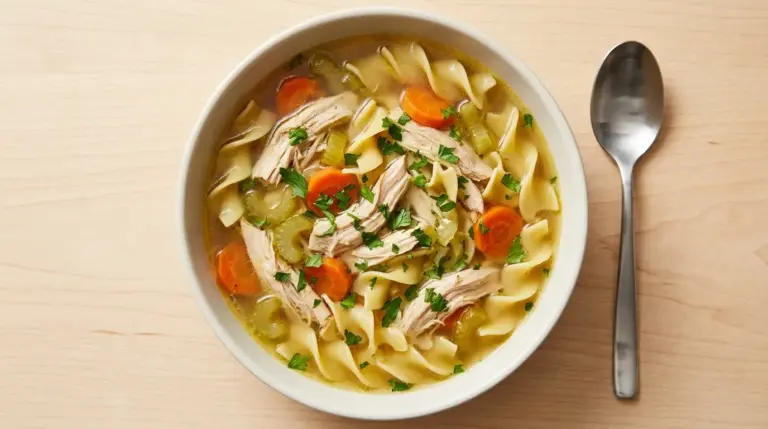
- Cozy soups including a classic Chicken Soup or a bright Tomato Soup for dipping.
- Comfort sides such as Mashed Potatoes and Green Bean Casserole at a big family meal.
- Baked pasta like a bubbling Lasagna, balanced by a soft roll on the side.
- A simple spread of Honey Butter, which turns a plain roll into the highlight of the table.
- Breakfast the next morning, split and toasted with jam or used for a small egg sandwich.
Read Also: Jiffy Spoon Bread
Variations of Dinner Rolls
Once you have the base dough down, it is easy to change the flavor or shape. Try any of these spins on the classic.
- Garlic herb rolls. Stir 2 teaspoons of dried rosemary and 2 teaspoons of garlic powder into the flour, then brush with garlic butter after baking.
- Sweet Hawaiian style. Swap part of the milk for pineapple juice and increase the sugar to ⅓ cup (67g) for a softer, sweeter roll.
- Cheddar rolls. Fold ¾ cup (85g) of shredded sharp cheddar into the dough after the first rise.
- Whole wheat blend. Replace up to 1¼ cups (150g) of the all-purpose flour with whole wheat flour for a nuttier flavor and a bit more structure.
- Everything bagel tops. Brush with egg wash and sprinkle with everything seasoning before baking for a savory crust.
- Cloverleaf rolls. Divide each portion into three small balls and bake them in a greased muffin tin for a pull-apart shape.
- Cinnamon sugar rolls. Brush the baked rolls with butter and roll them in cinnamon sugar for a quick sweet treat.
Bread flour gives these rolls a chewier pull, while all-purpose keeps them softer and more tender, so I reach for all-purpose whenever I want that cloud-like crumb and bread flour when I want more bite.
Another homemade bread worth baking is: Cracklin Bread
Storage and Reheating
These rolls keep well for several days and freeze beautifully, so a single batch can stretch across more than one meal. Follow these guidelines to keep them soft.
- Room temperature. Store cooled rolls in an airtight container or zip-top bag for up to 3 days.
- Refrigerator. Refrigeration is not ideal, since it dries bread out faster, so freeze instead if you need to keep them longer than 3 days.
- Freezer. Freeze fully cooled rolls in a freezer bag for up to 3 months, pressing out as much air as possible.
- Thawing. Let frozen rolls come to room temperature on the counter for about an hour before reheating.
- Reheating in the oven. Wrap rolls in foil and warm at 350°F (175°C) for 8 to 10 minutes to bring back the fresh-baked softness.
- Reheating in the microwave. Wrap a roll in a damp paper towel and heat for 15 to 20 seconds for a quick single serving.
- Make-ahead overnight. After shaping, cover the pan and refrigerate overnight, then let the rolls sit at room temperature for about 45 minutes before baking as directed.
For a sweeter bake that stores just as well, see Chocolate Chip Bread.
Nutritional Facts
Values below are estimates for one roll, based on a batch of 15 rolls. Actual numbers will vary with brands and any variations you add.
| Nutrient | Amount per Roll |
|---|---|
| Calories | 180 kcal |
| Total Fat | 6 g |
| Saturated Fat | 3.5 g |
| Cholesterol | 25 mg |
| Sodium | 165 mg |
| Total Carbohydrates | 27 g |
| Sugars | 4 g |
| Protein | 4 g |
Read Also: Vasilopita Bread
Health Benefits of Key Ingredients
Dinner rolls are a treat, but the everyday ingredients that go into them still bring some real nutritional value. Here is what the main components contribute.
- All-purpose flour provides carbohydrates for energy, and enriched flour is fortified with iron and B vitamins like folate and niacin.
- Whole milk adds calcium and vitamin D for bone health, along with a dose of protein that supports the tender crumb.
- Egg contributes complete protein and choline, a nutrient that plays a role in brain and cell function.
- Butter supplies fat-soluble vitamin A and, in moderation, adds the richness that makes the rolls satisfying.
- Yeast is a natural source of B vitamins, including several that support energy metabolism.
- A small amount of sugar feeds the yeast during rising, so much of it is consumed in fermentation rather than left in the final roll.
For a filling make-ahead breakfast, try: Baked Oatmeal
FAQs About Dinner Rolls
1. Why did my dinner rolls turn out dense and hard?
The usual culprits are too much flour or yeast that was not fully active. Measure the flour by spooning and leveling, and make sure your milk sits around 110°F (43°C) so it does not kill the yeast.
Under-proofing also leads to heavy rolls. Give the dough enough time to double on both rises, since rushing the process leaves the crumb tight and tough.
2. Can I make dinner rolls ahead of time?
Yes, and the fridge does most of the work for you. Shape the rolls, cover the pan, and refrigerate overnight, then let them sit at room temperature for about 45 minutes before baking.
You can also bake them a day ahead and reheat. Wrap the rolls in foil and warm them at 350°F (175°C) for about 10 minutes to refresh the softness.
3. Can I freeze dinner rolls?
Baked rolls freeze very well for up to 3 months. Cool them completely, then seal them in a freezer bag with as much air pressed out as possible.
To serve, thaw them at room temperature and warm them in a low oven. They will taste close to freshly baked.
4. What type of yeast is best for these rolls?
Instant yeast is the easiest, since it mixes straight into the flour with no separate proofing step. Active dry yeast also works well, though it usually needs to be dissolved in the warm liquid first and may take a little longer to rise.
If you are unsure whether your yeast is still good, dissolve a pinch in warm water with a little sugar. It should foam within about 10 minutes.
5. Can I make these rolls without a stand mixer?
Absolutely, this dough is very friendly to hand kneading. Mix everything in a large bowl, then knead on a lightly floured surface for 8 to 10 minutes until smooth and elastic.
The dough will feel sticky at first, so resist adding too much flour. A little tackiness now means softer rolls later.
6. Why didn’t my dough rise?
The most common reason is inactive or expired yeast, often from liquid that was too hot. Always check the milk temperature and the yeast date before you start.
A cold kitchen can also stall the rise. Move the covered dough somewhere warm, such as a turned-off oven with the light on, and give it extra time.
7. Can I make dinner rolls dairy-free?
You can swap the whole milk for an unsweetened plant milk and use a plant-based butter in equal amounts. The rolls will be slightly less rich but still soft.
Look for a plant butter with a higher fat content for the best texture. Brushing the tops after baking still gives them a lovely finish.
Another soft-dough favorite for gatherings is Pigs in a Blanket.
Soft and Fluffy Homemade Dinner Rolls
Ingredients
- 3¾ cups all-purpose flour - 450g, plus extra for dusting the work surface
- 2¼ teaspoons instant yeast - 7g, one standard ¼-ounce packet
- 1 cup whole milk - 240ml, warmed to 110°F (43°C)
- ¼ cup granulated sugar - 50g
- ¼ cup unsalted butter - 57g, melted and slightly cooled
- 2 tablespoons unsalted butter - 28g, for brushing
- 1 large egg - at room temperature
- 1 teaspoon fine salt - 6g
Equipment
- Stand mixer with dough hook - handles the kneading in about 6 minutes; a bowl and clean hands work too (optional)
- Large mixing bowl - for combining the dough and letting it rise
- 9×13 inch baking pan - metal pans brown the bottoms best
- Instant-read thermometer - checks both the milk temperature and the finished rolls
- Silicone pastry brush - for the melted butter before and after baking
- Bench scraper - makes dividing the dough into even portions quick and clean
- Wire cooling rack - keeps the bottoms from steaming and turning soggy
- Measuring cups and spoons - for accurate portions of flour, sugar, and salt
Method
- Warm the whole milk to 110°F (43°C), stir in the sugar until dissolved, then whisk in the cooled melted butter and room-temperature egg until smooth.
- In a stand mixer bowl, whisk together the flour, instant yeast, and salt, then add the wet milk mixture and mix on low until a shaggy dough forms, about 1 to 2 minutes.
- Knead on low to medium-low speed for about 6 minutes until smooth, elastic, and slightly tacky, or knead by hand for 8 to 10 minutes.
- Shape the dough into a ball, place it in a lightly greased bowl, cover, and let it rise in a warm spot for 1 hour to 1 hour 15 minutes until doubled in size.
- Grease the 9×13-inch pan, punch down the dough, divide it into 15 equal pieces (about 55g each), shape each into a smooth ball, and arrange them in the pan so they will touch as they rise.
- Cover the pan loosely and let the rolls rise for 30 to 45 minutes until puffy and touching, then preheat the oven to 375°F (190°C).
- Brush the tops lightly with melted butter and bake at 375°F (190°C) for 18 to 22 minutes until deep golden brown and the centers reach about 190°F (88°C).
- Immediately brush the hot rolls with the remaining melted butter, cool in the pan for about 5 minutes, then transfer to a wire rack or serve warm.
Nutrition
Notes
- Check the milk temperature with an instant-read thermometer; anything hotter than about 120°F (49°C) risks killing the yeast.
- Do not over-flour the dough; a slightly tacky dough bakes into softer rolls than a dry, stiff one.
- Weigh the flour when possible, since scooping straight from the bag can pack in an extra ¼ cup and toughen the crumb.
- Let the rolls touch during the rise to keep the sides tender and help them climb upward.
- Watch color, not just the clock; pull the rolls when the tops are deep golden and the centers hit 190°F (88°C).
- Butter twice: a light brush before baking helps the tops color, and a second brush right out of the oven adds shine and flavor.
- Make-ahead: after shaping, cover the pan and refrigerate overnight, then let the rolls sit at room temperature for about 45 minutes before baking as directed.
- Store cooled rolls in an airtight container at room temperature for up to 3 days, or freeze for up to 3 months.
- Reheat wrapped in foil at 350°F (175°C) for 8 to 10 minutes, or microwave a single roll wrapped in a damp paper towel for 15 to 20 seconds.
- For variations, try garlic herb, sweet Hawaiian style, cheddar, whole wheat blend, everything bagel tops, cloverleaf, or cinnamon sugar.
Private Notes
Tried this recipe?
Let us know how it was!Final Thoughts
Homemade dinner rolls turn an ordinary meal into something that feels special, and the soft, buttery crumb is well worth the little bit of rising time.
Once you bake a batch, you will see how easily they fit into everything from a quiet weeknight to a holiday table. The recipe is forgiving enough to make your own with different flavors and shapes.
Give these rolls a try and let them fill your kitchen with that fresh-bread smell. If you make them, leave a comment below to share how they turned out, and pass the recipe along to someone who loves warm bread as much as you do.
Recommended:
- Cranberry Sauce
- Sweet Potato Casserole
- Thanksgiving Stuffing
- Meatloaf
- Sausage Balls
- Slow Cooker Pot Roast
- French Onion Soup
- Chicken Stew
- Creamed Spinach
- Scalloped Potatoes