I fell in love with crepes on a rainy Saturday morning when I had nothing in the fridge but eggs, a little whole wheat flour, and some almond milk. A healthy crepe recipe was never really on my radar before that — I’d always assumed crepes were a fancy French thing that required special skills and a mountain of butter. Turns out, I was completely wrong.
What I ended up with that morning was a stack of thin, golden crepes that felt indulgent but were actually packed with real, nourishing ingredients. My kids ate them with fresh berries and a drizzle of honey and declared them better than pancakes.
Since then, this has become our Saturday morning ritual. I’ve made this recipe at least fifty times and tweaked it until every crepe comes out perfectly thin, pliable, and delicious.
| Quick Recipe Summary | |
|---|---|
| Prep Time | 10 minutes (plus 30 minutes resting time) |
| Cook Time | 20 minutes |
| Total Time | 60 minutes |
| Servings | 8 crepes |
| Difficulty Level | Easy |
If you love a light, wholesome breakfast, you might also enjoy my Healthy Waffle Recipe — another weekend favorite in our house.

Why You’ll Love This Healthy Crepe Recipe
These crepes are genuinely easy to make, even on a busy weekday morning. Once you have the batter ready, each crepe takes less than two minutes to cook.
They are incredibly versatile. You can go sweet with fresh fruit, nut butter, and honey, or savory with eggs, spinach, and feta.
The whole wheat flour adds a subtle nuttiness that regular crepes just don’t have. It also gives you a little fiber boost without making the crepes dense or heavy.
The batter comes together in the blender in about two minutes. No whisking, no lumps, no fuss.
These crepes are also naturally lower in calories than typical restaurant versions. You get all the satisfaction without the heavy cream and loads of butter.
They store beautifully in the fridge. Making a double batch on Sunday means you have quick breakfasts or snacks ready all week long.
They are naturally egg-based and protein-rich. That means they actually keep you full, unlike a lot of other breakfast options.
You might also love this Protein Waffle Recipe if you’re looking for another high-protein breakfast to rotate into your routine.
Ingredients
This recipe uses simple, wholesome ingredients that you probably already have in your kitchen. The combination of whole wheat flour and a small amount of all-purpose flour gives the crepes great structure while keeping them light.
- 1 cup (120g) whole wheat flour
- ¼ cup (30g) all-purpose flour
- 2 large eggs
- 1 ½ cups (360ml) unsweetened almond milk (or regular milk)
- 2 tablespoons (30ml) melted coconut oil (plus extra for the pan), or use light olive oil
- 1 tablespoon (15ml) pure maple syrup (for sweet crepes; omit for savory)
- ½ teaspoon vanilla extract (for sweet crepes; omit for savory)
- ¼ teaspoon fine sea salt
- Pinch of ground cinnamon (optional, for sweet crepes)
For sweet fillings (choose your favorites):
- Fresh strawberries, sliced
- Fresh blueberries or raspberries
- Banana slices
- Greek yogurt
- Honey or pure maple syrup (for drizzling)
- Strawberry sauce (for serving)
For savory fillings (choose your favorites):
- Sautéed spinach and mushrooms
- Scrambled eggs
- Crumbled feta cheese
- Diced avocado
- Sliced smoked salmon
Read Also: Easy Pancake Recipe
Kitchen Equipment Needed
You don’t need any specialty equipment to make these crepes. A good non-stick pan is really the most important tool here. I tried making crepes in a stainless steel pan once and it was a disaster — things stuck and tore instantly. Learn from my mistakes.
- Non-stick crepe pan (8–10 inches / 20–25cm; a standard non-stick skillet works too)
- Blender (for a smooth, lump-free batter)
- Mixing bowl (if mixing by hand instead)
- Whisk (if mixing by hand)
- Silicone spatula (for flipping crepes gently without tearing)
- Crepe spreader / T-spreader (optional but very helpful for even spreading)
- Ladle or ¼ cup measuring cup (for portioning batter)
- Liquid measuring cup with pour spout (makes pouring batter easier)
- Pastry brush or paper towel (for greasing the pan between crepes)
- Large plate or cooling rack (for stacking finished crepes)
Read Also: Air Fryer Pancake Recipe
Recommended Products for This Recipe
These are the tools and ingredients I personally use and genuinely recommend. They make the whole process easier and give you consistently better results.
1. Non-Stick Crepe Pan (10-inch)
A dedicated crepe pan has low, sloped sides that make tilting the batter and flipping the crepes dramatically easier than a standard skillet. I switched to one about a year ago and it changed my whole crepe-making experience. The difference in how evenly the batter spreads is immediately noticeable.
2. High-Speed Blender
Using a blender to make the batter is the single biggest tip I can give you. It creates a perfectly smooth, airy batter in under a minute with zero lumps. I’ve tried whisking by hand and it just never comes out as silky. A high-speed blender is worth every penny for weekly batter-making.
3. Organic Whole Wheat Flour
The quality of your whole wheat flour really does matter in a recipe this simple. I use an organic whole wheat flour that’s finely milled, which gives the crepes a lighter texture than coarser varieties. It also has a mild, slightly sweet flavor that pairs beautifully with fruit toppings.
4. Pure Maple Syrup
For sweetening the batter and drizzling over the finished crepes, I always reach for pure maple syrup instead of refined sugar. It adds a warm, caramel-like depth of flavor that honey or sugar just can’t replicate. A small bottle goes a long way.
5. Silicone Pastry Brush
Lightly brushing the pan with coconut oil between each crepe ensures a perfect non-stick surface without overgreasing. A silicone brush is heat-safe and easy to clean. I use mine for every single crepe.
You might also enjoy my Healthy Fried Rice Recipe for a savory meal that’s just as easy and wholesome.

Step-by-Step Instructions: How to Make Healthy Crepes
Step 1: Blend the Batter
- Add the whole wheat flour and all-purpose flour to your blender first.
- Crack both eggs directly into the blender on top of the flour.
- Pour in the 1 ½ cups (360ml) of unsweetened almond milk.
- Add the 2 tablespoons (30ml) of melted coconut oil, making sure it’s not too hot or it may cook the eggs.
- If making sweet crepes, add the 1 tablespoon (15ml) of maple syrup, ½ teaspoon vanilla extract, and a pinch of cinnamon.
- Add the ¼ teaspoon of fine sea salt.
- Blend on high for 30–45 seconds until the batter is completely smooth and slightly frothy on top.
- Scrape down the sides of the blender with a spatula and blend for another 10 seconds to make sure everything is incorporated.
Step 2: Rest the Batter
- Pour the blended batter into a bowl or leave it in the blender jar.
- Cover with plastic wrap or a lid and refrigerate for at least 30 minutes. This step is non-negotiable for great crepes.
- Resting allows the flour to fully hydrate and the gluten to relax, which gives you more pliable, easier-to-flip crepes with no rubbery texture.
- If you’re in a rush, you can rest it at room temperature for 15 minutes, but 30 minutes in the fridge gives the best results.
- You can also make the batter the night before and refrigerate it overnight. Just give it a quick stir or re-blend for 5 seconds before cooking.
Step 3: Heat Your Pan
- Place your non-stick crepe pan or skillet over medium heat.
- Let it heat up for about 2 minutes. A pan that isn’t hot enough will cause the batter to spread unevenly and stick.
- Dip a folded paper towel in a little coconut oil (or use a silicone pastry brush) and lightly coat the surface of the pan.
- The pan is ready when a few drops of water flicked onto the surface immediately sizzle and evaporate. This is your signal to start cooking.
- Keep the heat at medium throughout. Too high and the crepes will cook too fast and get crispy edges before the center sets.
Step 4: Pour and Swirl the Batter
- Remove the batter from the fridge and give it a quick stir or swirl to recombine any settled ingredients.
- Lift the pan off the heat and hold it with one hand at about a 30-degree angle.
- Pour approximately ¼ cup (60ml) of batter into the center of the pan.
- Immediately tilt and rotate the pan in a circular motion to swirl the batter outward into a thin, even circle.
- This step needs to happen quickly — within 3–4 seconds of adding the batter — before it starts to set.
- The crepe should be about 8–9 inches (20–23cm) in diameter and very thin. If it looks too thick, use slightly less batter next time.
- Return the pan to the heat and set it flat.
Step 5: Cook the First Side
- Cook the crepe over medium heat for 1 minute to 1 minute 30 seconds.
- Watch the edges carefully. You’ll see them start to lift and look dry and slightly golden — that’s your cue that the first side is done.
- The surface of the crepe should look mostly set (not wet or shiny) before you flip.
- Avoid the urge to press the crepe down or move it. Just let it cook undisturbed.
- If you have a crepe spreader, you can use it right after pouring to help spread the batter, but the swirl method works just as well once you get the hang of it.
Step 6: Flip and Cook the Second Side
- Slide a thin silicone spatula under the edge of the crepe gently.
- Flip it in one confident, smooth motion. Hesitating mid-flip often causes tearing.
- Cook the second side for only 30–45 seconds. It will have some golden-brown spots and won’t look as uniformly colored as the first side — that’s completely normal and expected.
- Don’t overcook the second side or the crepe will become stiff and less pliable.
- Slide the finished crepe onto a large plate.
Step 7: Stack and Repeat
- Stack each finished crepe directly on top of the previous one. They won’t stick together, and the gentle warmth from below actually keeps the stack soft and pliable.
- Lightly re-grease the pan with coconut oil before each new crepe using your pastry brush or paper towel.
- The first crepe is almost always a “test crepe” — the pan needs to calibrate to the right temperature, so don’t be discouraged if the first one isn’t perfect. Eat it as a chef’s snack.
- Continue until all the batter is used. You should get about 8 crepes from this recipe.
Step 8: Fill and Serve
- For sweet crepes: lay a crepe flat, add your filling to one half (sliced strawberries, a dollop of Greek yogurt, a drizzle of honey or maple syrup), then fold it in half and again into quarters. Serve with extra berries and a little strawberry sauce on the side.
- For savory crepes: lay the crepe flat, add sautéed greens, scrambled eggs, or crumbled feta, then roll it up or fold into quarters.
- Serve immediately while warm, or keep the stack covered with a clean kitchen towel to stay warm while you finish cooking.
Read Also: French Toast Recipe

Tips for The Best Healthy Crepe
Getting crepes right does take a little practice, but a few small adjustments make a huge difference. The first time I made these, my crepes kept tearing when I tried to flip them — I quickly realized I was flipping too soon and the pan wasn’t evenly heated. These tips will save you from the same mistakes.
- Always rest the batter. This is the single most important tip. Skipping the rest period produces tough, rubbery crepes. Thirty minutes minimum, overnight if you can.
- Use a blender, not a whisk. A blender creates a much smoother batter with no flour lumps. Lumps cause uneven cooking and tearing.
- Heat the pan properly before starting. A cold or unevenly heated pan is the number one cause of sticking. Two minutes of preheating at medium heat does the trick.
- Use just enough oil. Too much oil causes the batter to slide around instead of spreading. A very thin, barely-there coating is all you need between each crepe.
- Don’t flip too early. Wait until the edges are visibly dry and lightly pulling away from the pan before you flip. Rushing this step is how crepes tear.
- Keep the heat consistent at medium. High heat burns the outside before the inside sets. Low heat makes the batter spread before the pan has traction. Medium is the sweet spot.
- Use a ¼ cup measure for consistent portioning. This helps you get uniform crepes every time without guessing.
- Don’t panic if the first crepe fails. It almost always does. Consider it seasoning the pan. The second one will be much better.
- For thinner crepes, add a splash more milk. If your batter feels too thick after resting, whisk in a tablespoon or two of almond milk to thin it slightly.
- Tilt quickly. The swirling motion needs to happen within 3–4 seconds of adding batter to the pan. Once the batter starts to set, you can’t spread it further.
- Make extra and refrigerate. Cooked crepes keep for 3 days in the fridge, stacked with parchment between them and wrapped tightly. They reheat beautifully in 20 seconds.
Another great breakfast to prep ahead is my Protein Overnight Oats Recipe — perfect for mornings when you want zero cooking involved.
What to Serve with Healthy Crepes
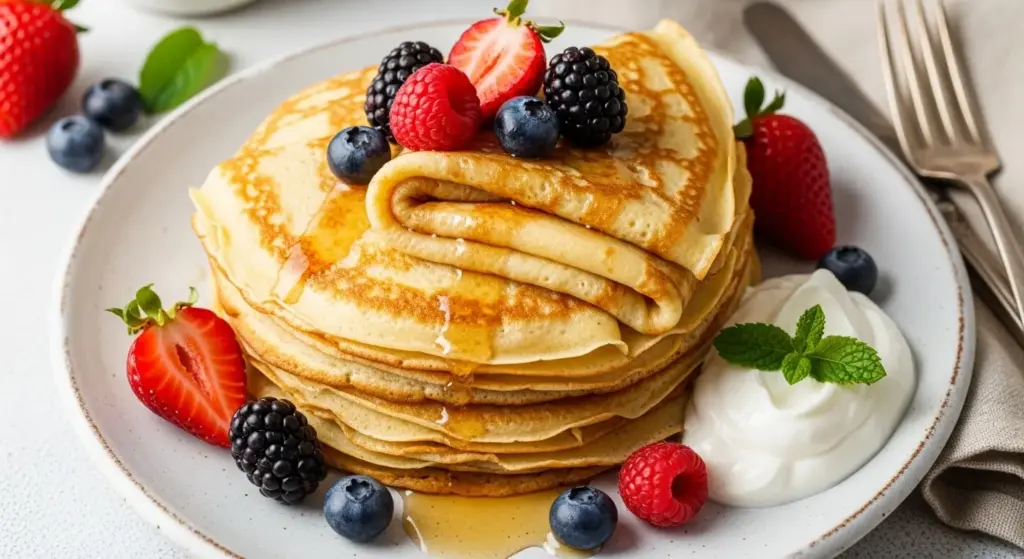
Crepes are wonderfully flexible and can take on almost any flavor profile. Here are my favorite pairings, both sweet and savory.
These crepes pair beautifully with my Healthy Egg Salad for a light and satisfying brunch spread.
Sweet Pairings:
- Fresh mixed berries — strawberries, blueberries, and raspberries with a drizzle of honey are the classic combination
- Strawberry Sauce — a warm berry sauce spooned over folded crepes is absolutely gorgeous and takes 5 minutes to make
- Greek yogurt and honey — a spoonful of thick, creamy Greek yogurt inside with a honey drizzle adds protein and a gorgeous tang
- Sliced banana and nut butter — peanut butter or almond butter with banana inside makes a filling, protein-rich breakfast crepe
- Caramel Sauce — for a more indulgent weekend version, a light drizzle of caramel is worth it
- Lemon juice and powdered sugar — the classic French café way: simple, bright, and always crowd-pleasing
- Fresh peach slices and Greek yogurt — especially wonderful in summer when peaches are at their peak
Savory Pairings:
- Shakshuka — serve savory crepes alongside a skillet of shakshuka for a complete brunch
- Sautéed spinach, mushrooms, and feta — one of the best savory crepe fillings; herby, salty, and satisfying
- Smoked salmon, cream cheese, and capers — elegant enough for a brunch party and incredibly easy
- Scrambled eggs and avocado — a simple, protein-rich filling that works any time of day
- Healthy Hummus — spread inside a savory crepe with roasted vegetables for a Mediterranean-inspired wrap
Variations of Healthy Crepe
The base recipe is incredibly adaptable. Once you’ve made it a few times, you’ll naturally start experimenting with different flavors and fillings.
Here are some of my favorite variations that I’ve tested and loved over the years.
- Oat flour crepes: Replace the whole wheat flour entirely with oat flour for a gluten-lighter option with a mild, slightly sweet flavor. The texture is slightly more delicate, so handle them gently.
- Buckwheat crepes (Galettes): Use 100% buckwheat flour for the traditional French savory crepe, called a galette. These have a deeper, earthier flavor and are traditionally filled with ham, cheese, and egg. They are also naturally gluten-free.
- Banana crepes: Add half a very ripe mashed banana to the batter for a naturally sweetened, banana-flavored crepe. The flavor is subtle but lovely, especially with peanut butter filling.
- Chocolate crepes: Add 1 tablespoon of unsweetened cocoa powder to the batter. These are incredible with sliced banana and a drizzle of nut butter inside. Reduce the vanilla to ¼ teaspoon.
- Spinach crepes: Blend a large handful of fresh baby spinach into the batter with the milk. The crepes turn a beautiful bright green and have an extra nutrient boost with zero detectable spinach flavor.
- Lemon zest crepes: Add the zest of one lemon to the batter for a bright, citrusy crepe that pairs perfectly with fresh blueberries and ricotta.
- Protein-boosted crepes: Replace ¼ cup of flour with an unflavored or vanilla protein powder. These are especially filling and great as a post-workout breakfast.
- Vegan crepes: Replace the eggs with 2 flax eggs (2 tablespoons ground flaxseed mixed with 6 tablespoons water, rested for 5 minutes). Use plant-based milk. The texture is slightly different but the crepes still hold up beautifully.
- Savory herb crepes: Omit the maple syrup and vanilla, and stir in 1 tablespoon of finely chopped fresh herbs (chives, parsley, or dill) to the batter for an aromatic savory crepe.
Read Also: Vegan Waffle Recipe
Storage and Reheating
One of the things I love most about this recipe is how well it stores. Making a double batch on Sunday and stacking them in the fridge means weekday breakfasts are ready in seconds.
Storing in the refrigerator:
- Allow the crepes to cool completely before stacking.
- Stack the crepes with a small piece of parchment paper between each one to prevent sticking.
- Wrap the stack tightly in plastic wrap or place in an airtight container.
- Refrigerate for up to 3 days.
- Always label with the date so you know how fresh they are.
Storing in the freezer:
- Place a sheet of parchment between each crepe and stack them in groups of 4–6.
- Wrap each stack tightly in plastic wrap and place inside a zip-lock freezer bag.
- Freeze for up to 2 months.
- Label the bag with the date and contents.
- Thaw overnight in the refrigerator or at room temperature for 30 minutes before reheating.
Reheating:
- Microwave: Place one crepe on a microwave-safe plate and cover with a damp paper towel. Microwave for 20–30 seconds. This is the fastest method and works well for just one or two crepes.
- Stovetop: Place the crepe in a dry, non-stick pan over low-medium heat for 30–40 seconds per side. This restores a slight warmth and softness that the microwave can’t quite replicate.
- Oven: Wrap a stack of crepes in foil and warm in a 300°F (150°C) oven for 10–12 minutes. Great for reheating a large batch for a group.
- Do not reheat crepes more than once after storing.
- Avoid adding wet fillings before storing — add them fresh when serving to prevent soggy crepes.
For another easy make-ahead breakfast, check out my Easy Healthy Homemade Granola Recipe.

Nutritional Facts
The values below are approximate per plain crepe (without fillings), based on 8 crepes per batch.
| Nutrient | Per Crepe (Approx.) |
|---|---|
| Calories | 105 kcal |
| Total Fat | 4.5g |
| Saturated Fat | 3g |
| Unsaturated Fat | 1.5g |
| Cholesterol | 47mg |
| Sodium | 85mg |
| Total Carbohydrates | 13g |
| Dietary Fiber | 1.5g |
| Sugars | 1.5g |
| Protein | 3.8g |
| Calcium | 50mg |
| Iron | 0.8mg |
Nutritional values are estimates and will vary based on specific ingredients and brands used.
You might want to pair your crepe breakfast with this Overnight Oats Recipe on days when you want a heartier start.
Health Benefits of Key Ingredients
Every ingredient in this recipe was chosen intentionally. This isn’t just a “healthier swap” — the ingredients genuinely support your nutrition goals while tasting great.
Here’s a look at what makes this crepe recipe particularly nourishing.
- Whole wheat flour: Unlike refined white flour, whole wheat retains the bran and germ, which means more fiber, B vitamins, and minerals like iron and magnesium. The fiber slows digestion and helps keep blood sugar stable after eating, which is why these crepes don’t leave you hungry an hour later.
- Eggs: Eggs are one of the most nutrient-dense foods available. They provide complete protein with all nine essential amino acids, plus choline (essential for brain health), lutein and zeaxanthin (important for eye health), and vitamins B12 and D. The protein in two eggs contributes meaningfully to the satiety of this recipe.
- Unsweetened almond milk: Using almond milk instead of whole milk reduces the calorie and saturated fat content significantly while keeping the batter perfectly pourable. Almond milk is also naturally lactose-free and fortified with calcium and vitamin D in most commercial varieties.
- Coconut oil: Coconut oil contains medium-chain triglycerides (MCTs), which are metabolized differently than other fats and may provide a quick source of energy. It also has a high smoke point, making it ideal for pan cooking without breaking down into harmful compounds.
- Pure maple syrup: Unlike white sugar, pure maple syrup contains trace minerals including manganese and zinc, as well as antioxidants. Its glycemic impact is slightly lower than white sugar, and the small amount used here keeps the overall sugar content of the recipe quite modest.
- Fresh berries (for serving): Strawberries, blueberries, and raspberries are among the highest antioxidant fruits available. They’re rich in vitamin C, fiber, and flavonoids linked to reduced inflammation. They also add natural sweetness so you need less added sugar on top.
- Greek yogurt (for filling): When used as a crepe filling, Greek yogurt adds a significant protein boost along with probiotics that support gut health. It makes the crepe feel much more substantial and balanced as a meal.
Read Also: Healthy Banana Bread Recipe
FAQs About Healthy Crepe
1. Can I make the batter without a blender?
Yes, you absolutely can. Whisk the eggs first in a large bowl, then gradually add the milk while whisking.
Add the flour a little at a time, whisking constantly to prevent lumps. A blender is faster and produces a smoother result, but the hand-whisk method works fine if you’re careful.
2. Why do my crepes keep tearing when I flip them?
The most common cause is flipping too early. The crepe needs to be fully set on the first side before you attempt to flip it.
Wait until the edges look dry and are beginning to lift away from the pan on their own. A thin, flexible silicone spatula also helps enormously compared to a thicker metal one.
3. Can I make these crepes gluten-free?
Yes, with some adjustments. A 1:1 gluten-free all-purpose flour blend works reasonably well as a direct substitute for the flour in this recipe.
Alternatively, buckwheat flour (which is naturally gluten-free despite its name) makes traditional French galettes and is wonderful with savory fillings. The texture will be slightly more delicate, so handle gently.
4. Do I really need to rest the batter?
Resting the batter makes a noticeable difference in the final texture. Skipping it tends to produce crepes that are chewier and less pliable.
During resting, the flour fully absorbs the liquid and the gluten strands relax, which gives you a more tender, flexible crepe. If you’re truly short on time, 15 minutes at room temperature is better than no rest at all.
5. Can I use regular milk instead of almond milk?
Absolutely. Regular whole milk, 2% milk, oat milk, or soy milk all work well in this recipe. The consistency of the batter will be slightly different depending on the milk’s fat content and thickness.
If using full-fat coconut milk from a can, dilute it with an equal amount of water first, as it’s too thick on its own. Any plant-based milk works just fine as a 1:1 substitute.
For another nourishing recipe to add to your breakfast rotation, try my Healthy Chocolate Chip Cookies Recipe — a better-for-you treat the whole family will love.

Healthy Crepe Recipe
Ingredients
- 1 cup whole wheat flour - 120g
- ¼ cup all-purpose flour - 30g
- 2 large eggs
- 1½ cups unsweetened almond milk - 360ml; regular milk, oat milk, or soy milk also work
- 2 tablespoons coconut oil - 30ml, melted; plus extra for greasing the pan; light olive oil also works
- 1 tablespoon pure maple syrup - 15ml; omit for savory crepes
- ½ teaspoon vanilla extract - Omit for savory crepes
- ¼ teaspoon fine sea salt
- 1 pinch ground cinnamon - Optional; recommended for sweet crepes
- fresh strawberries - Sliced
- fresh blueberries or raspberries
- banana - Sliced
- Greek yogurt - For filling; adds protein and creaminess
- honey or pure maple syrup - For drizzling over finished crepes
- strawberry sauce - For serving
- baby spinach - Sautéed
- mushrooms - Sautéed
- feta cheese - Crumbled
- avocado - Diced
- smoked salmon - Sliced; optional savory filling
Equipment
- Non-stick crepe pan (8–10 inch) - A standard non-stick skillet also works
- Blender - For smooth, lump-free batter; a mixing bowl and whisk also work
- Mixing bowl - Optional — only needed if mixing by hand
- Whisk - Optional — only needed if mixing by hand
- Silicone spatula - For gently flipping crepes without tearing
- Crepe spreader / T-spreader - (optional) Helps spread batter evenly
- Ladle or ¼ cup measuring cup - For portioning batter consistently
- Liquid measuring cup with pour spout - Makes pouring batter into the pan easier
- Pastry brush or paper towel - For greasing the pan with coconut oil between crepes
- Large plate or cooling rack - For stacking finished crepes
Method
- Add both flours, eggs, almond milk, melted coconut oil, maple syrup (if using), vanilla extract (if using), sea salt, and cinnamon (if using) to a blender. Blend on high for 30–45 seconds until completely smooth and slightly frothy, scraping down the sides as needed.
- Pour the batter into a bowl or leave it in the blender, cover, and refrigerate for at least 30 minutes (or overnight). This allows the flour to hydrate and the gluten to relax, resulting in more pliable crepes.
- Place a non-stick crepe pan or skillet over medium heat for about 2 minutes, then lightly coat the surface with coconut oil using a pastry brush or paper towel. The pan is ready when a few drops of water flicked onto the surface sizzle and evaporate immediately.
- Remove the batter from the fridge and give it a quick stir to recombine. Lift the pan off the heat, pour approximately ¼ cup (60ml) of batter into the center, and immediately tilt and rotate the pan in a circular motion to spread the batter into a thin, even 8–9 inch (20–23cm) circle.
- Return the pan to medium heat and cook for 1 to 1½ minutes, until the edges look dry and begin to lift away from the pan and the surface appears mostly set. Do not press down or move the crepe while it cooks.
- Slide a thin silicone spatula under the edge of the crepe and flip it in one confident motion. Cook the second side for 30–45 seconds until it has some golden-brown spots, then slide the finished crepe onto a plate.
- Stack finished crepes directly on top of one another (they won’t stick), lightly re-grease the pan between each crepe, and continue until all batter is used — you should get about 8 crepes total. Note that the first crepe often serves as a test crepe while the pan calibrates.
- For sweet crepes, lay flat, add your choice of fresh berries, Greek yogurt, and a drizzle of honey or maple syrup to one half, then fold into quarters and serve with strawberry sauce. For savory crepes, fill with sautéed spinach and mushrooms, crumbled feta, or scrambled eggs, then roll up and serve immediately.
Nutrition
Notes
- Always rest the batter: This is the most important step. A minimum of 30 minutes in the fridge (or overnight) gives you tender, pliable crepes. Skipping it produces tougher, chewier results.
- Use a blender: A blender creates a silky-smooth, lump-free batter far more efficiently than hand-whisking. Lumps cause uneven cooking and tearing.
- The first crepe is a test: Almost every batch has an imperfect first crepe as the pan reaches the right temperature — eat it as a cook’s snack and don’t be discouraged.
- Don’t flip too early: Wait until the edges look visibly dry and are beginning to pull away from the pan before flipping. Rushing this step is the most common cause of torn crepes.
- Thinning the batter: If the batter feels too thick after resting, whisk in 1–2 tablespoons of almond milk to thin it to the right consistency.
- Milk substitutions: Any milk works — regular whole milk, 2%, oat milk, or soy milk. If using full-fat canned coconut milk, dilute it 1:1 with water first as it’s too thick on its own.
- Gluten-free option: Substitute the flours with a 1:1 gluten-free all-purpose flour blend, or use 100% buckwheat flour for traditional French galettes (naturally gluten-free).
- Make-ahead: The batter can be prepared the night before and refrigerated. Cooked crepes keep well in the fridge for up to 3 days, stacked with parchment between each one and wrapped tightly.
- Freezing: Stack cooled crepes with parchment between each one, wrap tightly in plastic wrap, and freeze in a zip-lock bag for up to 2 months. Thaw overnight in the refrigerator before reheating.
- Reheating: Microwave a single crepe covered with a damp paper towel for 20–30 seconds, or warm in a dry non-stick pan over low-medium heat for 30–40 seconds per side. A whole stack can be wrapped in foil and warmed in a 300°F (150°C) oven for 10–12 minutes.
Private Notes
Tried this recipe?
Let us know how it was!Final Thoughts
If you’ve been intimidated by crepes, I hope this recipe proves that they’re much more approachable than they seem. The ingredients are simple, the technique just takes a little practice, and the results are genuinely impressive every single time.
This healthy crepe recipe has earned a permanent spot in our weekly breakfast lineup, and I’m confident it will do the same in yours. Give it a try this weekend and see for yourself how satisfying a light, nourishing crepe can be.
I’d love to hear how it goes — drop a comment below and let me know your favorite filling combinations! And if you snap a photo, sharing it on social media and tagging me always makes my day.
Recommended:
- Healthy Orange Chicken Recipe
- Baked Oatmeal Recipe
- Healthy Tiramisu Recipe
- Healthy Apple Pie Recipe
- Easy Healthy Dinner Recipes for Family
- Healthy Cabbage Skillet with Quinoa and Chickpeas
- Pumpkin French Toast Recipe
- Healthy Pumpkin Pie Recipe
- Creme Brulee French Toast Recipe
- Sourdough Waffle Recipe