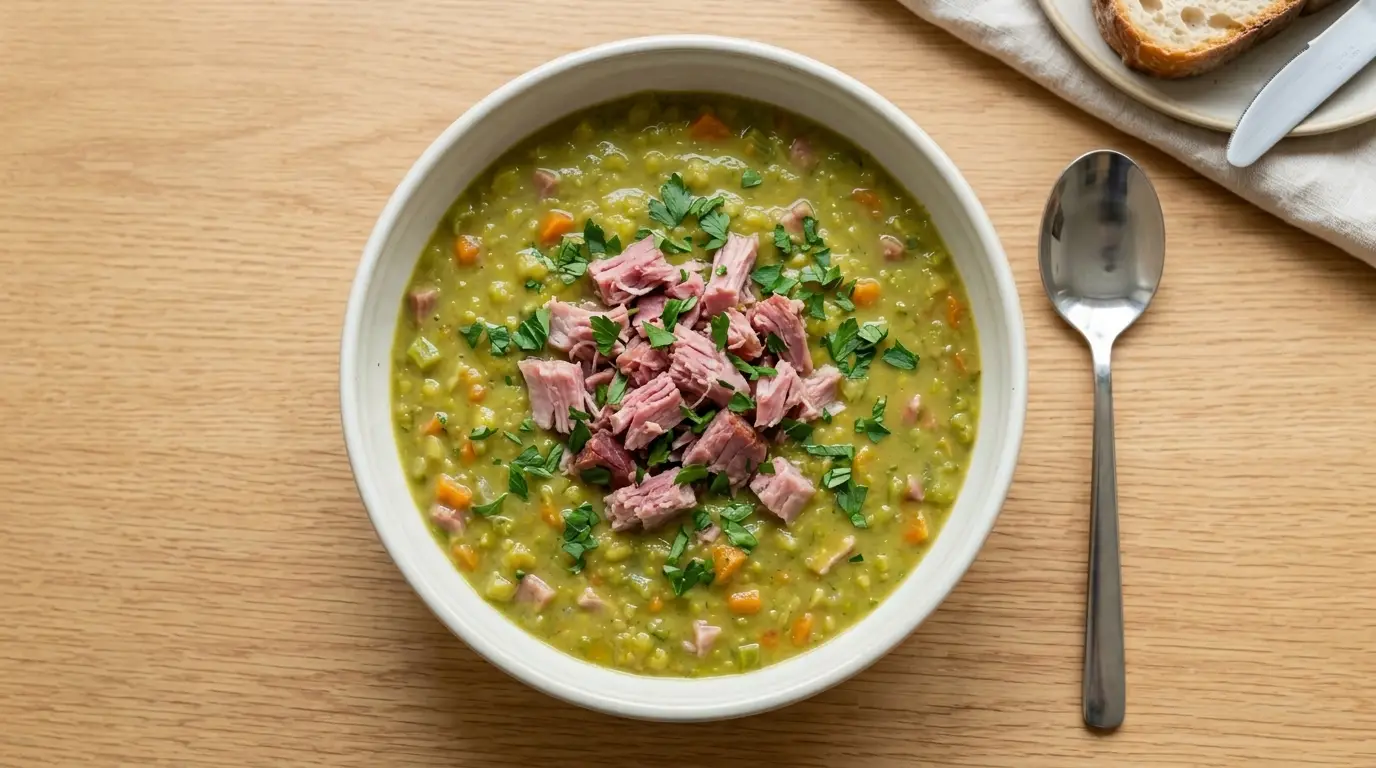
A pot of split pea and ham soup turns a leftover ham bone into one of the most economical dinners you can make, with green split peas that break down into a thick, velvety base after about 90 minutes of simmering. This split pea and ham soup recipe leans on a meaty ham bone, dried green peas, and a simple mix of onion, carrot, and celery for deep, smoky flavor.
One thing worth knowing upfront: split peas do not need soaking. They are hulled and split along a natural seam, so they soften and turn creamy on their own during a long simmer.
The most common frustration people run into is peas that never fully break down, which usually points to a stale bag rather than a technique problem. Fresh split peas soften reliably in an hour to an hour and a half.
This version uses about eight cups of liquid and yields a soup thick enough to coat the back of a spoon. It thickens even more as it cools, so a splash of water when reheating brings it right back.
| Quick Recipe Summary | |
|---|---|
| Prep Time | 15 minutes |
| Cook Time | 1 hour 30 minutes |
| Total Time | 1 hour 45 minutes |
| Servings | 6 to 8 bowls |
| Difficulty Level | Easy |
For another way to stretch a leftover bone, try this Ham Bone Soup.

Why You’ll Love This Split Pea and Ham Soup Recipe
This is a one-pot recipe that mostly cooks itself, which makes it ideal for a slow Sunday or a cold weeknight. You do the chopping, then the pot does the rest while you go about your day.
Here is what makes it worth putting on your rotation:
- It uses up a ham bone. A leftover bone from a holiday ham or a smoked ham hock adds smoky depth that no shortcut can match.
- No soaking required. You rinse and sort the peas, then they go straight into the pot.
- It costs very little. A pound of dried split peas is inexpensive, and the ham bone is often already paid for.
- It freezes beautifully. Portions keep for up to three months, so a single batch covers several lunches.
- The texture is naturally creamy. The peas break down into a thick puree with no blending needed, though a quick blend smooths it further.
- It is genuinely filling. A pound of split peas delivers a lot of fiber and protein per bowl.
If you like this style of hearty, bean-based soup, you might also enjoy: Ham and Bean Soup
Ingredients
The ingredient list is short, and most of it is pantry and produce staples. The one item that carries the flavor is the ham, so use a meaty bone or a smoked hock if you can.
- 1 lb (450 g) dried green split peas, rinsed and picked over for stones
- 1 meaty ham bone or 2 smoked ham hocks, plus about 1.5 cups (200 g) diced cooked ham
- 1 tablespoon (15 ml) olive oil (or butter)
- 1 large yellow onion, diced (about 1 cup / 150 g)
- 2 medium carrots, diced (about 1 cup / 130 g)
- 2 celery stalks, diced (about 1 cup / 100 g)
- 3 garlic cloves, minced
- 8 cups (1.9 L) chicken broth (or half broth, half water)
- 2 bay leaves
- 1 teaspoon dried thyme
- 1/2 teaspoon black pepper
- Salt, to taste (add at the end, since ham is salty)
- 2 tablespoons fresh parsley, chopped, for garnish (optional)
A quick note on the peas: I keep a separate small bowl by the strainer just for sorting, because in nearly every bag I find one or two tiny stones that are easy to miss when you rinse straight from the package.
Read Also: Baked Ham Recipe
Kitchen Equipment Needed
You do not need anything specialized here. A large heavy pot and a good knife cover almost the entire recipe.
- A large Dutch oven or heavy soup pot (at least 5 to 6 quarts)
- A sharp chef’s knife for dicing the vegetables and ham
- A cutting board
- A fine-mesh strainer for rinsing the split peas
- A soup ladle
- Tongs for lifting out the hot ham bone
- An immersion blender (optional, for a smoother texture)
- Storage containers for leftovers
You might also enjoy: Best Ham Recipes
Recommended Products for This Recipe
These are the items I reach for when making this soup. Each one earns its place by solving a specific problem, from scorched bottoms to weak flavor.
1. Le Creuset Enameled Dutch Oven
Split pea soup simmers for over an hour, and thin pots let the peas settle and scorch on the bottom. A heavy enameled Dutch oven holds steady, even heat so the peas cook down without sticking, and the wide base makes it easy to stir and lift out the bone.
2. Cuisinart Immersion Blender
If you like your soup fully smooth rather than rustic, an immersion blender does the job right in the pot with no ladling batches into a countertop blender. I usually blend about half the pot, which gives a creamy body while leaving some texture from the ham and carrots.
3. Smoked Ham Hocks
When there is no leftover holiday bone in the freezer, smoked ham hocks are the fix. They deliver the same smoky, savory backbone, and one or two hocks flavor an entire pot.
4. Bob’s Red Mill Green Split Peas
Stale split peas are the number one reason a batch refuses to break down. A trusted brand with good turnover cooks reliably tender in about 90 minutes, which takes the guesswork out of timing.
5. Better Than Bouillon Ham Base
For extra depth, or for the days you are working with lean diced ham and no bone, a spoonful of ham base builds back the savory flavor. Add it gradually and taste, since it is salty on its own.
A related recipe is Lentil Soup.

Step-by-Step Instructions: How to Make Split Pea and Ham Soup
Follow these simple steps and you’ll have a comforting pot of split pea and ham soup ready with very little hands-on effort.
Step 1: Rinse and Sort the Split Peas
- Pour the split peas onto a plate or into a shallow bowl and pick through them, removing any small stones, grit, or shriveled peas.
- Transfer the peas to a fine-mesh strainer and rinse under cold running water until the water runs clear.
- Set the drained peas aside. There is no need to soak them.
Step 2: Saute the Aromatics
- Heat the olive oil in a large Dutch oven or heavy pot over medium heat.
- Add the diced onion, carrots, and celery. Cook, stirring occasionally, for 6 to 8 minutes until the onion is soft and translucent.
- Add the minced garlic and cook for about 1 minute more, until fragrant, being careful not to let it brown.
Step 3: Build the Pot
- Add the rinsed split peas, bay leaves, dried thyme, and black pepper to the pot. Stir to coat everything in the aromatics.
- Nestle the ham bone (or ham hocks) into the center of the pot.
- Pour in the 8 cups of chicken broth and stir to combine.
Step 4: Simmer Until Tender
- Increase the heat and bring the soup to a boil.
- Once boiling, reduce the heat to low, cover partially with a lid, and let it simmer gently.
- Cook for 1 hour to 1 hour 30 minutes, stirring every 20 minutes or so and scraping the bottom to keep the peas from sticking, until the peas have broken down and the soup is thick.
Step 5: Shred the Ham
- Using tongs, lift the ham bone or hocks out onto a cutting board and let them cool for a few minutes.
- Pull the meat from the bone, discard the bone, fat, and any skin, then chop or shred the meat into bite-sized pieces.
- Return the shredded meat to the pot along with the 1.5 cups of diced cooked ham.
Step 6: Adjust and Finish
- Fish out and discard the bay leaves.
- For a smoother soup, blend about half the pot with an immersion blender, or mash some of the peas against the side with a spoon. Leave it fully rustic if you prefer texture.
- Taste and season with salt as needed. If the soup is thicker than you like, stir in a little more broth or water.
- Simmer for another 5 minutes to heat the added ham through, then ladle into bowls and top with fresh parsley.
Read Also: Honey Baked Ham

Tips for The Best Split Pea and Ham Soup
A few small choices make the difference between a flat, gluey pot and a rich, well-balanced one. These are the habits that keep mine consistent.
- Use fresh peas. If your peas are more than a year old, they may never soften. When a batch stays firm after 90 minutes, the peas are almost always the culprit.
- Salt at the end. Ham bones, hocks, and broth all carry salt, so wait until the soup is nearly done before adding any. I once salted early with a salty hock and ended up with a pot I had to dilute heavily to save.
- Stir and scrape the bottom. Split peas love to settle and scorch. A stir every 20 minutes with a spoon that reaches the corners prevents a burnt layer that would taint the whole pot.
- Add acid carefully. Acidic ingredients like tomatoes can slow the peas from softening, so leave any acid until the peas are already tender.
- Blend for body, not necessity. The peas thicken on their own, but blending part of the pot gives a silkier, restaurant-style finish.
- Save some diced ham for the end. Meat simmered the whole time flavors the broth, while ham stirred in at the finish keeps distinct, meaty bites in each bowl.
- Thin it as it sits. This soup sets up thick in the fridge. A splash of water or broth when reheating loosens it back to the right consistency.
For a lighter option, try: Ham and Potato Soup
What to Serve with Split Pea and Ham Soup
Split pea and ham soup is thick and filling, so it pairs best with something you can dip, plus a fresh side to cut the richness. Bread is the classic partner, and a crisp salad rounds out the meal.
Here are the sides and pairings that work best:
- Crusty bread or a warm baguette for dunking into the thick soup.
- Dinner Rolls, soft and pillowy, great for soaking up the last spoonfuls.
- Homemade Biscuits, buttery and flaky alongside a hot bowl.
- Cornbread, slightly sweet and a Southern-style match for smoky ham.
- A grilled cheese sandwich, the ultimate comfort-food pairing for a cold day.
- A simple green salad with a sharp vinaigrette to balance the soup’s heaviness.
- Coleslaw, crunchy and tangy for contrast.
- A glass of dry white wine or a crisp lager for an easy grown-up dinner.
A similar comforting pairing works well with Best Lentil Soup Recipes.
Variations of Split Pea and Ham Soup
The base recipe takes well to swaps, whether you want it meat-free, spicier, or thicker. Start with the classic, then adjust to taste.
- Vegetarian split pea soup: Skip the ham bone and diced ham, use vegetable broth, and add a big pinch of smoked paprika or a few drops of liquid smoke for smoky depth.
- Yellow split pea soup: Swap green peas for yellow. The flavor is slightly milder and the color turns golden.
- Slow cooker version: Add everything except the diced ham to the crock, cook on low for 7 to 8 hours, then shred the bone meat and stir in the reserved ham.
- Extra-smoky: Use two smoked ham hocks instead of a bone, or add a smoked turkey leg for a leaner smoky note.
- Heartier soup: Stir in a diced potato with the peas for extra body, or add more carrots.
- Spiced version: Add a pinch of cumin, a bay leaf’s worth of extra herbs, or a dash of cayenne for warmth.
- Sausage swap: Replace some of the ham with sliced smoked sausage or kielbasa for a different savory edge.
Read Also: Slow Cooker Ham
Storage and Reheating
This soup is a meal-prep favorite because it keeps and reheats so well. If anything, the flavor deepens by the next day.
- Refrigerate: Cool the soup, then store it in an airtight container in the fridge for up to 4 days.
- Freeze: Portion into freezer-safe containers, leaving a little room for expansion, and freeze for up to 3 months.
- Thaw: Move frozen soup to the fridge overnight before reheating, or reheat gently from frozen over low heat.
- Reheat on the stove: Warm over medium-low, stirring often, and add a splash of water or broth to loosen it since it thickens as it sits.
- Reheat in the microwave: Heat in short bursts, stirring between each, until hot throughout.
- Make-ahead note: The soup sets up very thick once chilled, which is normal. Thinning with liquid on reheating brings it right back to a smooth, spoonable texture.
You might also enjoy: Spiral Ham
Nutritional Facts
Values are approximate and based on one of eight servings made with a meaty ham bone and chicken broth. Actual numbers vary with the ham and broth used.
| Nutrient | Amount per Serving |
|---|---|
| Calories | 255 kcal |
| Protein | 18 g |
| Carbohydrates | 40 g |
| Dietary Fiber | 16 g |
| Sugars | 7 g |
| Fat | 3 g |
| Saturated Fat | 1 g |
| Sodium | 650 mg |
| Potassium | 810 mg |
| Iron | 3 mg |
Another dish worth trying is Smoked Ham.
Health Benefits of Key Ingredients
Beyond being comforting and cheap, this soup is genuinely nutritious. The peas do most of the heavy lifting, backed by the vegetables and lean ham.
- Green split peas: High in plant protein and fiber, which support fullness and steady blood sugar. They also provide iron, folate, and potassium.
- Ham: Adds protein and savory flavor. Choosing lean ham and using the bone mainly for flavor keeps the fat in check.
- Carrots: A strong source of beta-carotene, which the body converts to vitamin A for eye and immune health.
- Onion and garlic: Contain sulfur compounds and antioxidants linked to heart and immune support, plus they build flavor with no added fat.
- Celery: Low in calories and a source of vitamin K and potassium, adding volume and a savory base note.
- Thyme and bay leaves: Herbs that contribute antioxidants and aroma while letting you use less salt.
For a comforting side dish option, try: Scalloped Potatoes and Ham
FAQs About Split Pea and Ham Soup
1. Do I need to soak split peas before making the soup?
No, soaking is not required. Split peas are hulled and split, so they soften and break down on their own during the simmer.
Soaking can shave some time off the cooking, but it changes nothing about the final result. Rinsing and sorting for stones is the only prep the peas need.
2. Why won’t my split peas soften?
The most common reason is that the peas are old. Split peas that have sat in the pantry for a year or more can stay firm no matter how long you cook them.
Very hard water or adding acidic ingredients too early can also slow softening. Using a fresh bag and holding off on acid until the peas are tender usually solves it.
3. Can I make split pea soup without a ham bone?
Yes. Smoked ham hocks are the easiest substitute and give the same smoky depth.
If you have none of those, use diced ham plus a spoonful of ham base or a little smoked paprika. For a meat-free version, use vegetable broth and add smoked paprika or liquid smoke.
4. Why is my split pea soup so thick?
Split peas absorb liquid and thicken as they cook, and they thicken even more once chilled. This is normal for the soup.
Simply stir in a little water or broth to reach the consistency you want. Do this both when finishing the pot and again when reheating leftovers.
5. Can I freeze split pea and ham soup?
Yes, it freezes very well for up to three months. Cool it completely, then portion it into freezer-safe containers with a little headspace.
Thaw it in the fridge overnight before reheating. Add a splash of liquid as you warm it, since it will have thickened.
6. What’s the difference between green and yellow split peas?
Both work in this recipe and cook the same way. Green split peas have a slightly earthier, more pronounced flavor.
Yellow split peas are a touch milder and give the soup a golden color. Choose whichever you prefer or have on hand.
For more cozy soup ideas, see Potato Leek Soup.
Split Pea and Ham Soup
Ingredients
- 1 lb dried green split peas - 450g, rinsed and picked over for stones
- 1 meaty ham bone or 2 smoked ham hocks - plus about 1.5 cups (200g) diced cooked ham
- 1 tablespoon olive oil - 15ml, or butter
- 1 large yellow onion - about 1 cup or 150g, diced
- 2 medium carrots - about 1 cup or 130g, diced
- 2 celery stalks - about 1 cup or 100g, diced
- 3 garlic cloves - minced
- 8 cups chicken broth - 1.9L, or half broth, half water
- 2 bay leaves
- 1 teaspoon dried thyme
- 1/2 teaspoon black pepper
- salt - to taste, add at the end since ham is salty
- 2 tablespoons fresh parsley - chopped, for garnish (optional)
Equipment
- Large Dutch oven or heavy soup pot - At least 5 to 6 quarts
- Sharp chef’s knife - For dicing vegetables and ham
- Fine-mesh strainer - For rinsing the split peas
- Soup Ladle
- Tongs - For lifting out the hot ham bone
- Immersion blender - Optional, for a smoother texture
- Storage containers - For leftovers
Method
- Pour the split peas onto a plate or into a shallow bowl and pick through them, removing any small stones, grit, or shriveled peas. Transfer to a fine-mesh strainer and rinse under cold running water until the water runs clear, then set aside.
- Heat the olive oil in a large Dutch oven or heavy pot over medium heat. Add the diced onion, carrots, and celery and cook, stirring occasionally, for 6 to 8 minutes until the onion is soft and translucent. Add the minced garlic and cook for about 1 minute more until fragrant, being careful not to let it brown.
- Add the rinsed split peas, bay leaves, dried thyme, and black pepper to the pot and stir to coat everything in the aromatics. Nestle the ham bone or ham hocks into the center, then pour in the chicken broth and stir to combine.
- Increase the heat and bring the soup to a boil, then reduce the heat to low, cover partially with a lid, and simmer gently for 1 hour to 1 hour 30 minutes, stirring every 20 minutes or so and scraping the bottom, until the peas have broken down and the soup is thick.
- Using tongs, lift the ham bone or hocks out onto a cutting board and let them cool for a few minutes. Pull the meat from the bone, discard the bone, fat, and any skin, then chop or shred the meat into bite-sized pieces and return it to the pot along with the diced cooked ham.
- Fish out and discard the bay leaves. For a smoother soup, blend about half the pot with an immersion blender or mash some of the peas against the side with a spoon. Taste and season with salt as needed, thin with more broth or water if desired, then simmer another 5 minutes to heat the added ham through. Ladle into bowls and top with fresh parsley.
Nutrition
Notes
- Use fresh split peas: peas more than a year old may never soften, even after 90 minutes of simmering.
- Salt at the end, since ham bones, hocks, and broth all carry salt; salting early can make the pot too salty.
- Stir and scrape the bottom every 20 minutes, as split peas love to settle and scorch.
- Add acidic ingredients like tomatoes only after the peas are tender, since acid can slow softening.
- Blend about half the pot for a silkier, restaurant-style finish while leaving some texture.
- Save some diced ham to stir in at the end so each bowl has distinct, meaty bites.
- The soup thickens as it cools and in the fridge; a splash of water or broth when reheating brings it back to the right consistency.
- Refrigerate in an airtight container for up to 4 days, or freeze for up to 3 months; thaw overnight in the fridge before reheating.
- For a vegetarian version, skip the ham, use vegetable broth, and add smoked paprika or liquid smoke for smoky depth.
- A slow cooker version works too: add everything except the diced ham, cook on low for 7 to 8 hours, then shred the bone meat and stir in the reserved ham.
Private Notes
Tried this recipe?
Let us know how it was!Final Thoughts
There is a reason split pea and ham soup has stayed on tables for generations. It takes humble, inexpensive ingredients and a leftover bone and turns them into something warm, thick, and deeply satisfying.
Once you have made it a time or two, it becomes the kind of soup you throw together without a second thought. The pot does most of the work while your kitchen fills with that smoky, savory smell.
Give this one a try the next time you have a ham bone to use up. I think it will earn a permanent spot in your cold-weather rotation.
If you make it, I would love to hear how it turned out. Leave a comment with your favorite variation, and share the recipe with anyone who loves a good bowl of soup.
Recommended:
- Honey Glazed Ham
- Ham Glaze
- Ham Salad
- Deviled Ham
- Pulled Ham
- Ham and Cheese Sliders
- Loaded Baked Potato Soup
- Red Lentil Soup
- Chicken Soup