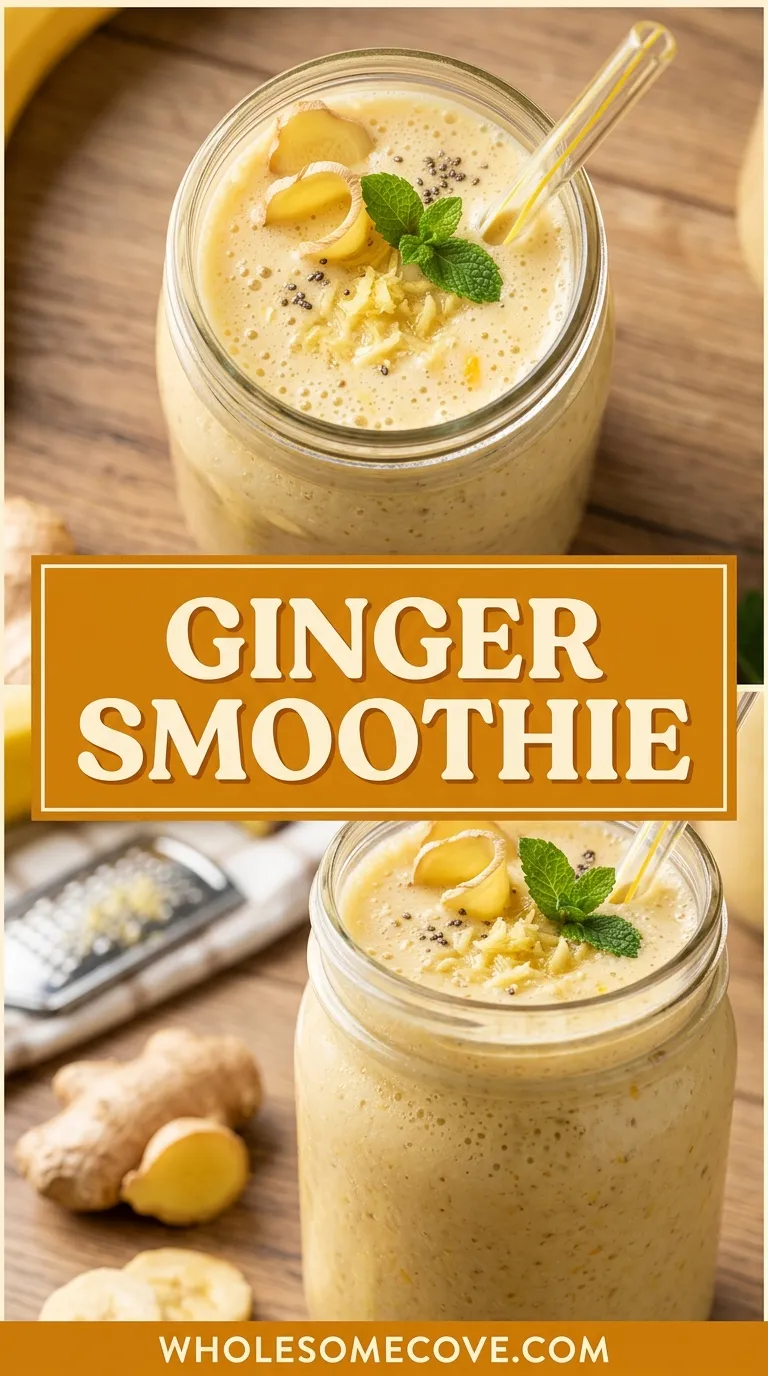
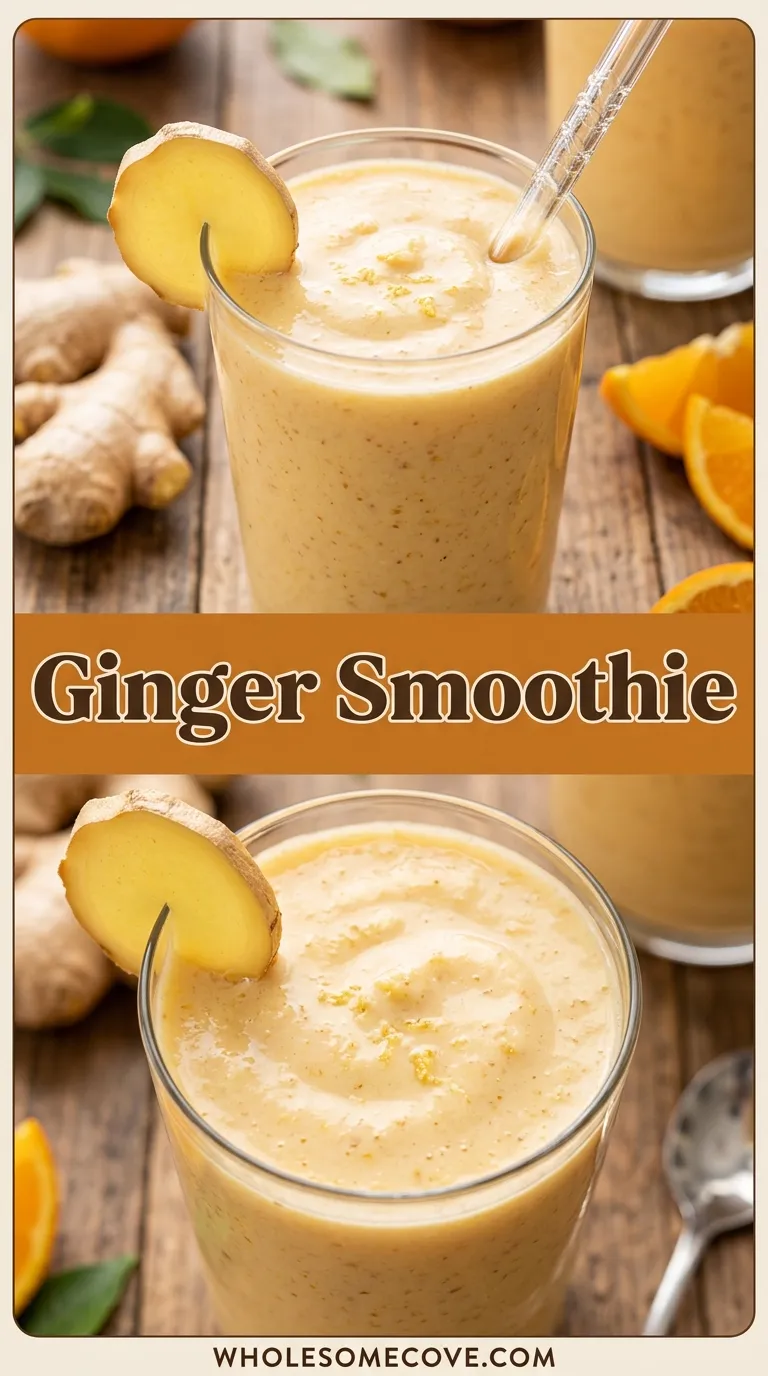
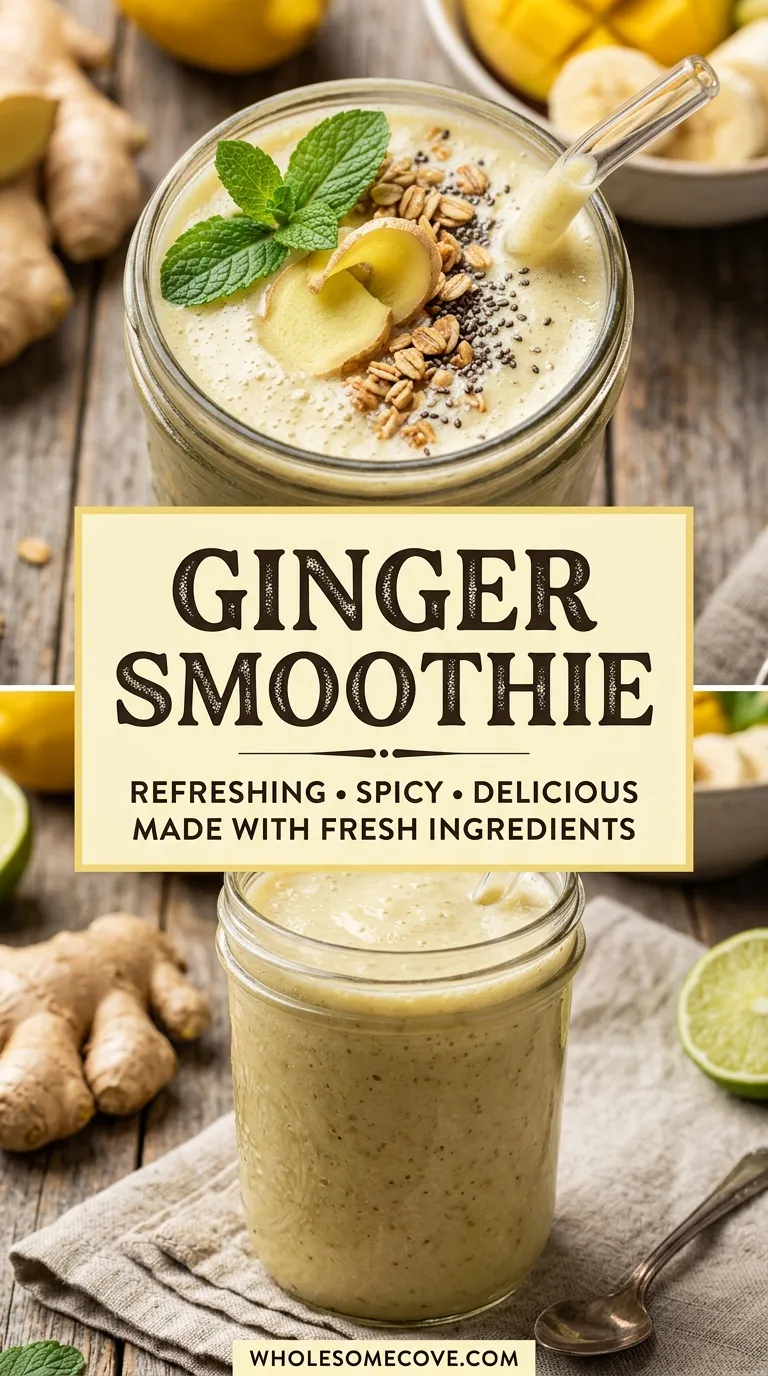
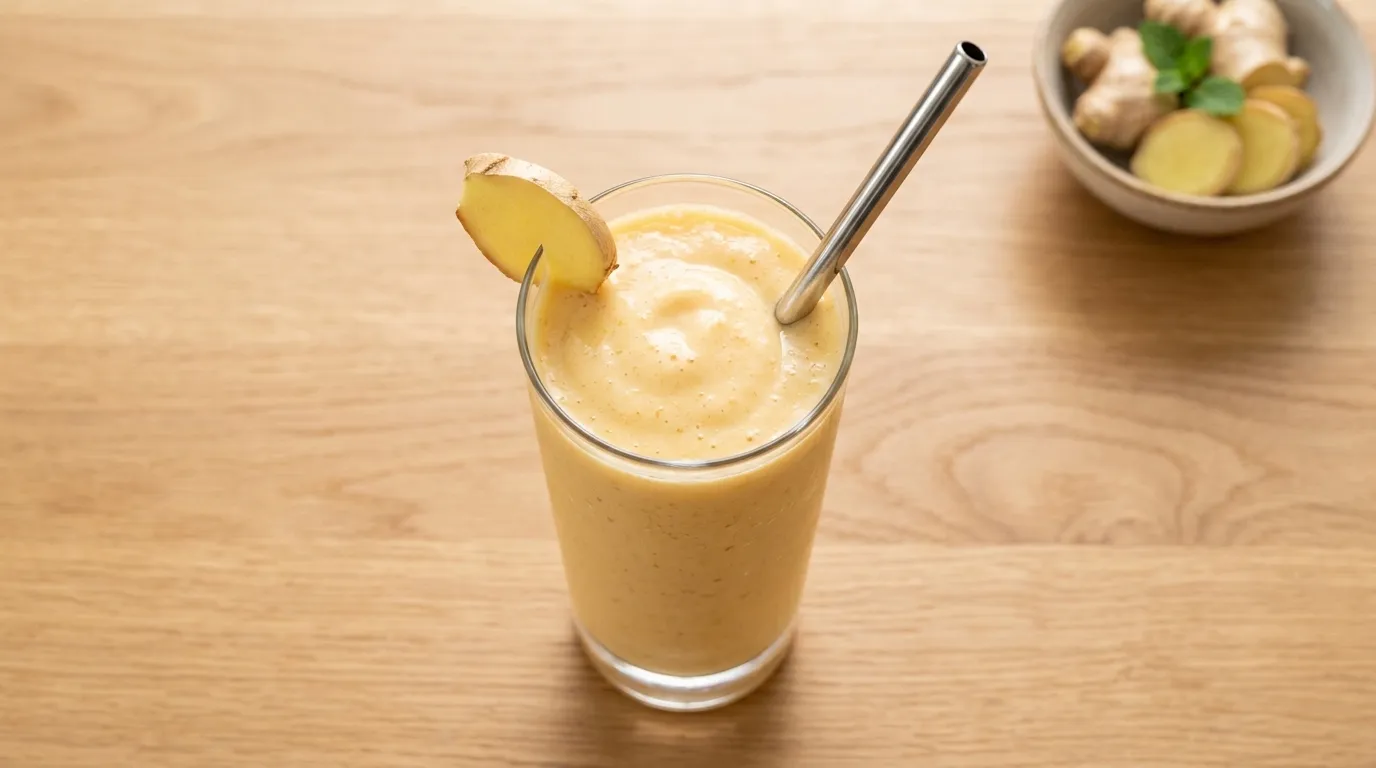
This ginger smoothie recipe uses eight ingredients, one blender, and five minutes from counter to glass. Frozen banana replaces the ice most versions rely on, so the ginger flavor stays sharp instead of getting diluted as the drink melts.
A single tablespoon of freshly grated ginger is enough to give the whole cup a warm, peppery bite without overwhelming the mango and banana underneath.
Fresh ginger has a fibrous grain that can leave stringy bits in a smoothie if it goes in whole or roughly chopped. Grating it finely on a microplane before it hits the blender solves that texture problem completely, and it’s the single biggest difference between a smooth ginger smoothie and a chewy one.
| Quick Recipe Summary | |
|---|---|
| Prep Time | 5 minutes |
| Cook Time | 0 minutes |
| Total Time | 5 minutes |
| Servings | 2 smoothies (16 oz / 480 ml each) |
| Difficulty Level | Easy |
I borrowed this exact ratio of banana to ginger from testing a dozen batches over a few weeks, and it’s the version I keep coming back to on busy mornings.
If you’re craving something in the same spice family, my Turmeric Smoothie uses a similar warming approach with a different root entirely.
Why You’ll Love This Ginger Smoothie Recipe
This ginger smoothie recipe earns its spot in regular rotation because it does a lot with very little effort. It comes together in one blender jar with no cooking, no chopping board full of dishes, and no ingredient you can’t find in a regular grocery store.
Here’s what makes it worth making again:
- Real ginger flavor, not a hint of it. A full tablespoon of freshly grated ginger means you actually taste it, rather than getting a smoothie that’s technically ginger flavored but tastes mostly like banana.
- Naturally sweetened. Ripe frozen banana and mango do the sweetening work, with just a small amount of honey to round things out, so there’s no reliance on flavored yogurt or added sugar syrups.
- Thick without added thickeners. Frozen fruit does the job that ice usually does in cheaper versions, which means the texture stays creamy instead of watery.
- Ready in five minutes. Every ingredient goes into the blender in one go. There’s no separate step for cooking, steeping, or straining anything.
- Hidden greens that don’t taste like greens. A cup of baby spinach blends in completely and adds color and nutrients without changing the flavor in any noticeable way.
- Easy to scale. Every ingredient here doubles or triples cleanly if you’re making smoothies for the whole household at once.
If you like building a rotation of smoothies with functional ingredients, my Anti-Inflammatory Smoothie Recipe is another one worth keeping on hand.
Ingredients
You’ll need eight ingredients for this recipe, and most of them are pantry or freezer staples if you make smoothies regularly. Exact measurements matter here more than in most smoothie recipes, since too much ginger will make the drink taste sharp instead of warm.
- 2 large ripe bananas (about 240g), sliced into coins and frozen at least 2 hours ahead
- 1 cup (150g) frozen mango chunks
- 1-inch (2.5cm) piece fresh ginger root (about 1 tablespoon once grated), peeled
- 1 cup (240ml) unsweetened almond milk, or milk of choice
- 1 cup (30g) organic baby spinach
- 1 tablespoon (15ml) raw honey, or more to taste
- 1 tablespoon (15ml) fresh lemon juice
- 1/2 cup (75g) ice cubes, optional, for a thicker consistency
A note on the ginger: a 1-inch knob sounds small, but fresh ginger is potent. Start with this amount and only add more once you’ve tasted the finished blend, since it’s much easier to add a bit more than to fix an overly spicy batch.
Before you start, browse my full Detox Smoothie Recipe if you want another green-forward option in your lineup.
Kitchen Equipment Needed
You don’t need much specialty equipment for this recipe, but a few tools make a real difference in how smooth the final drink turns out.
- High-speed blender, ideally one with at least 1000 watts of power, to fully break down the fibrous ginger
- Microplane fine grater, for turning the ginger into a fine pulp instead of stringy chunks
- Vegetable peeler or spoon, for removing the ginger skin
- Measuring cups and spoons set, for keeping the ratios consistent between batches
- Cutting board and paring knife, for slicing the bananas before freezing
- Airtight freezer containers, for storing pre-sliced frozen banana
- Reusable smoothie cups with lids, for serving
I ruined my first few batches by trying to blend whole, unpeeled ginger straight from the fridge, which left visible fibrous threads throughout the drink. Grating it first on a microplane fixed the problem completely.
For more inspiration on building out a smoothie routine, my Protein Smoothie Recipe is a good companion piece if you want a version with more staying power for breakfast.
Recommended Products for This Recipe
These are products I genuinely reach for when I make this recipe, based on what’s actually solved a problem in my own kitchen rather than a general wish list. None of these are required, but each one addresses something specific that trips people up with ginger smoothies.
1. Vitamix Explorian Blender
Cheaper blenders often leave small threads of ginger fiber behind no matter how finely you grate it first, which shows up as an unpleasant texture on the first sip. A high-torque blender like this one breaks the fiber down completely, so the ginger disappears into the drink instead of floating through it.
2. Stainless Steel Ginger Grater
A standard box grater tends to clog with ginger’s stringy fibers, which slows everything down and wastes a good portion of the root. A dedicated ginger grater has finer, sharper teeth that pull the juice and pulp free while leaving the tough fibers behind on the surface.
3. Glass Smoothie Bottles with Lids
Plastic cups pick up the smell of ginger and turmeric-family ingredients over time, even after washing. Glass bottles with silicone lids don’t hold onto odors the same way, and they make it easy to prep smoothies the night before for a grab-and-go breakfast.
4. Raw Unfiltered Honey
Standard processed honey works fine, but raw unfiltered honey has a rounder flavor that pairs better with the sharpness of fresh ginger. It also blends smoothly into a cold liquid without the slight graininess that some crystallized honey brands have.
You might also enjoy: Frozen Fruit Smoothie Recipe
Step-by-Step Instructions: How to Make Ginger Smoothie
Follow these simple steps and you’ll have a ginger smoothie ready in about five minutes.
1. Peel and grate the ginger
- Use a spoon or vegetable peeler to scrape the thin skin off the fresh ginger, working around the knobby edges rather than trying to peel it in one motion.
- Once peeled, use a microplane or fine grater to grate the ginger directly over a small bowl, which lets you measure exactly how much you’re using.
- Set aside 1 tablespoon of the grated ginger and discard any tough fibers left behind on the grater.
2. Add the liquid and soft ingredients first
- Pour the unsweetened almond milk into the blender jar first, since starting with liquid helps the blades catch everything else more easily.
- Add the fresh baby spinach on top of the liquid so it gets pulled down into the blades right away instead of sticking to the sides.
- Add the fresh lemon juice and the grated ginger.
3. Add the frozen fruit
- Add the frozen banana coins directly from the freezer, without thawing them first.
- Add the frozen mango chunks on top.
- If you’re using the optional ice cubes for a thicker texture, add them now as well.
4. Blend until completely smooth
- Secure the lid and start blending on low speed for about 10 seconds to break up the largest frozen pieces.
- Gradually increase to high speed and blend for 45 to 60 seconds, or until the mixture looks completely uniform with no visible ginger flecks or fruit chunks.
- Stop the blender once or twice if needed to scrape down the sides with a spatula, then resume blending.
5. Taste and adjust
- Taste the smoothie directly from the blender jar before pouring, since this is the easiest point to make adjustments.
- If it tastes too sharp, blend in an extra splash of almond milk or a touch more honey.
- If you want a stronger ginger kick, add another half teaspoon of grated ginger and blend for another 15 seconds.
6. Pour and serve
- Pour the finished smoothie evenly between two glasses.
- Serve immediately for the best texture, since the frozen fruit will start to soften and separate slightly after 15 to 20 minutes at room temperature.
I’ve found that blending the spinach with the liquid before adding the frozen fruit gives a noticeably smoother result than dumping everything in at once, especially in blenders under 1000 watts.
Once you’ve got the base method down, my Mango Smoothie Recipe uses a similar approach if mango is your favorite part of this drink.
Tips for The Best Ginger Smoothie
A few small adjustments make a noticeable difference in how this smoothie turns out, especially if you’re making it for the first time.
- Freeze your banana ahead of time. Slice ripe bananas into coins and freeze them in a single layer on a tray before transferring to a bag, which keeps them from clumping together.
- Buy ginger with smooth, taut skin. Wrinkled or shriveled ginger is older and tends to be more fibrous, which makes it harder to grate finely.
- Start with less ginger than you think you need. You can always blend in more, but there’s no way to remove ginger once it’s fully incorporated.
- Use a ripe banana, not an underripe one. Underripe bananas have a starchy flavor that clashes with ginger’s sharpness, while ripe, spotted bananas add natural sweetness that balances it.
- Add liquid gradually if your blender struggles. Adding all the almond milk at once can sometimes create an air pocket around the blades in weaker blenders, so add half first and the rest once it starts moving.
- Keep grated ginger in the freezer for later. Grate a larger batch of ginger, freeze it flat in a bag, and break off a tablespoon whenever you need it without buying fresh ginger every time.
- Rinse your citrus juicer immediately after use. Lemon juice residue can make plastic tools sticky if left to dry, which is a small annoyance that’s easy to avoid.
For a version built around similar functional ingredients, take a look at my Immune Boosting Smoothie Recipe.
What to Serve with Ginger Smoothie
This smoothie works well as a light breakfast on its own, but it also pairs naturally with foods that have some texture and substance, since the drink itself is fairly light. Here are pairings that work particularly well.
- Overnight Oats: The creamy, chilled texture of overnight oats matches the cold smoothie well, and together they make a more filling breakfast than either alone.
- Easy Banana Bread: A slice of banana bread on the side echoes the banana flavor already in the smoothie without competing with the ginger.
- Belgian Waffles: The crisp edges and light interior of a good waffle contrast nicely with the smooth, cold drink.
- Avocado Toast: A savory option that balances out the sweetness of the smoothie if you want something less dessert-like alongside it.
- Homemade Granola: Sprinkle a spoonful directly into the glass for crunch, or serve it on the side with yogurt.
- Breakfast Burrito: For a heartier, savory pairing that turns this into a full meal rather than a light start to the day.
- French Toast: Another sweet pairing that works well for a weekend breakfast spread built around a few different dishes.
If you’re planning a bigger weekend breakfast spread, my Banana Mango Smoothie Recipe is worth adding to the lineup since it shares two of the same core ingredients.
Variations of Ginger Smoothie
Once you’ve made the base recipe a few times, these variations are easy adjustments using ingredients you likely already have on hand.
- Tropical Ginger Smoothie: Swap the mango for an equal amount of frozen pineapple, and add a splash of coconut milk in place of half the almond milk for a more tropical flavor.
- Green Ginger Smoothie: Double the spinach to 2 cups, or swap in an equal amount of chopped kale for a more vegetable-forward version.
- Golden Ginger Smoothie: Add 1/2 teaspoon of ground turmeric and a small pinch of black pepper, which helps the body absorb the turmeric more effectively.
- Spicy Ginger Smoothie: Increase the fresh ginger to 1.5 tablespoons and add a small pinch of cayenne pepper for a warming kick.
- Protein-Boosted Ginger Smoothie: Add one scoop of unflavored or vanilla protein powder and an extra 1/4 cup of almond milk to keep the consistency from getting too thick.
- Keto Ginger Smoothie: Replace the banana and mango with 1/2 an avocado and a handful of ice, and swap the honey for a keto-friendly sweetener like monk fruit.
The base method stays the same across every variation. Only the fruit, sweetener, or add-in ratios change.
Before you experiment too far from the original, my Pineapple Smoothie Recipe is a good reference point if the tropical variation above catches your eye.
Storage and Reheating
Smoothies are always best served fresh, but this one holds up reasonably well in the refrigerator if you need to prep ahead for a busy morning.
- Refrigerator: Store in an airtight jar or bottle for up to 24 hours. Expect some natural separation, which is normal for a smoothie without added stabilizers.
- Shake or stir before drinking: Give the container a good shake or stir with a spoon to recombine the liquid and solids before serving.
- Freezer: Pour the finished smoothie into an ice cube tray and freeze for up to 2 months, then blend the frozen cubes with a splash of almond milk whenever you want a single serving.
- Do not reheat: This is a cold drink meant to be served chilled, so there’s no reheating step involved at any point.
- Avoid leaving it at room temperature: Because the base includes dairy alternative milk and fresh produce, don’t leave a finished smoothie out for more than an hour before refrigerating.
I keep a stash of pre-portioned frozen smoothie cubes in the freezer specifically for mornings when I don’t have time to prep fresh ginger, and it cuts the total time down to about two minutes.
For another make-ahead option, check out my Coconut Milk Smoothie Recipe, which stores in a similar way.
Nutritional Facts
| Nutrition Per Serving (1 of 2) | |
|---|---|
| Calories | 168 kcal |
| Carbohydrates | 39g |
| Protein | 2.5g |
| Fat | 2g |
| Saturated Fat | 0.2g |
| Fiber | 5g |
| Sugar | 24g |
| Sodium | 75mg |
| Potassium | 520mg |
| Vitamin C | 28mg |
| Iron | 1.2mg |
These values are estimates based on the specific ingredients and brands used in testing, and they’ll shift slightly depending on the exact almond milk or honey you choose.
If you’re tracking nutrition closely across your smoothie rotation, my Spinach Smoothie Recipe is another lower-sugar option worth comparing against this one.
Health Benefits of Key Ingredients
Beyond flavor, most of what’s in this smoothie is doing real nutritional work. Here’s a breakdown of what each key ingredient brings to the glass.
- Fresh ginger: Contains gingerol, a compound studied for its role in easing nausea and supporting digestion, which is part of why ginger has been used traditionally after meals.
- Banana: A good source of potassium, which supports healthy blood pressure and muscle function, along with natural sugars that provide quick, usable energy.
- Mango: High in vitamin C and vitamin A, both of which support immune function and skin health.
- Spinach: Provides iron, folate, and vitamin K without adding any noticeable flavor to the finished smoothie.
- Almond milk: A lower-calorie alternative to dairy milk that still provides a creamy base, plus a modest amount of vitamin E in most fortified versions.
- Lemon juice: Adds vitamin C and a touch of acidity that helps balance the sweetness of the fruit.
- Raw honey: Contains small amounts of antioxidants, though it should still be treated as an added sugar and used in moderation.
None of this makes the smoothie a replacement for a balanced meal, but it does mean every ingredient is contributing something beyond flavor.
For more ingredients with a similar functional angle, my Carrot Smoothie Recipe leans on a different root vegetable with its own nutritional profile.
FAQs About Ginger Smoothie
1. Can I use ground ginger instead of fresh ginger?
Ground ginger will work in a pinch, but the flavor is noticeably milder and slightly more one-dimensional than fresh.
If you substitute, start with 1/4 teaspoon of ground ginger for every tablespoon of fresh ginger called for, then adjust to taste.
2. Why is my smoothie too spicy?
This usually means either too much ginger was added, or the ginger itself was unusually potent, since fresh ginger’s strength can vary quite a bit by season and source.
Blend in a bit more frozen banana or a splash of almond milk to dilute the intensity without changing the other flavors.
3. Can I make this smoothie without a high-speed blender?
Yes, but you’ll want to grate the ginger extra fine and consider blending the spinach and liquid together first before adding the frozen fruit.
A standard blender can still produce a smooth result, it just may need a longer blending time and more frequent scraping down of the sides.
4. Is this smoothie safe for kids?
Fresh ginger’s mild spice is generally well tolerated by most kids, but the exact amount can be reduced if you’re serving it to a younger child.
Start with half the ginger called for in the recipe and increase gradually across a few servings if the flavor is well received.
5. Can I use frozen ginger instead of fresh?
Frozen ginger works well and actually grates more easily than fresh ginger straight from the counter, since the firmer texture holds up better against a microplane.
Grate it while still frozen and measure the same amount called for in the fresh ginger version.
For more troubleshooting on smoothie texture in general, my Almond Milk Smoothie Recipe covers a few of the same blending questions in more depth.
Ginger Smoothie
Ingredients
- 2 large ripe bananas - about 240g, sliced into coins and frozen at least 2 hours ahead
- 1 cup frozen mango chunks - 150g
- 1 tablespoon fresh ginger root - from a 1-inch/2.5cm piece, peeled and grated
- 1 cup unsweetened almond milk - 240ml, or milk of choice
- 1 cup organic baby spinach - 30g
- 1 tablespoon raw honey - 15ml, or more to taste
- 1 tablespoon fresh lemon juice - 15ml
- 0.5 cup ice cubes - 75g, optional, for a thicker consistency
Equipment
- High-speed blender - ideally one with at least 1000 watts of power
- Microplane fine grater - for grating ginger into a fine pulp
- Vegetable peeler - or spoon for removing ginger skin
- Measuring cups and spoons set
- Airtight freezer containers - for storing pre-sliced frozen banana
- Reusable smoothie cups with lids - optional, for serving
Method
- Peel the ginger with a spoon or vegetable peeler, then grate it finely using a microplane or fine grater. Measure out 1 tablespoon of grated ginger and discard any tough fibers left behind.
- Pour the unsweetened almond milk into the blender jar first, then add the baby spinach, fresh lemon juice, and the grated ginger.
- Add the frozen banana coins, frozen mango chunks, and optional ice cubes directly from the freezer without thawing.
- Secure the lid and start blending on low speed for 10 seconds to break up the largest pieces, then increase to high speed and blend for 45-60 seconds until completely smooth and uniform with no visible flecks.
- Taste the smoothie and adjust if needed. Add extra almond milk or honey to reduce sharpness, or add more grated ginger for a stronger kick.
- Pour evenly between two glasses and serve immediately for the best texture.
Nutrition
Notes
- Freeze your banana ahead of time: Slice ripe bananas into coins and freeze them in a single layer on a tray before transferring to a bag to prevent clumping.
- Choose fresh ginger wisely: Look for ginger with smooth, taut skin. Wrinkled or shriveled ginger is older and more fibrous.
- Start with less ginger: You can always blend in more, but you can’t remove ginger once it’s fully incorporated.
- Use ripe bananas: Spotted, ripe bananas add natural sweetness that balances ginger’s sharpness, unlike underripe bananas which taste starchy.
- Add liquid gradually: If your blender struggles, add half the almond milk first, then the rest once it starts moving to prevent air pockets.
- Make-ahead ginger: Grate a larger batch of ginger, freeze it flat in a bag, and break off a tablespoon whenever needed.
- Storage: Store in an airtight jar in the refrigerator for up to 24 hours. Shake or stir before drinking as separation is natural.
- Freeze for later: Pour leftover smoothie into ice cube trays and freeze for up to 2 months. Blend frozen cubes with a splash of almond milk for a quick single serving.
Private Notes
Tried this recipe?
Let us know how it was!Final Thoughts
This ginger smoothie recipe has earned a permanent spot in my weekly rotation because it delivers real ginger flavor without any complicated steps.
Five minutes, one blender, and a handful of ingredients most people already have on hand is a hard combination to beat on a busy morning.
Give it a try this week, and let me know in the comments how much ginger you ended up using. I’d also love to hear if you tried one of the variations above, so feel free to share a photo if you make it your own.
Recommended:
- Vegan Smoothie Recipe
- Keto Smoothie Recipe
- Breakfast Smoothie Recipe
- Green Smoothie Recipe
- Berry Smoothie Recipe
- Strawberry Banana Smoothie Recipe
- Avocado Smoothie Recipe
- Matcha Green Tea Smoothie Recipe
- Beet Smoothie Recipe
- Cucumber Smoothie Recipe