This navy bean soup recipe starts with 1 pound (450 g) of dried beans and a smoked ham hock, simmered together until the broth turns thick and slightly creamy.
The beans soften enough to melt into the liquid, while the ham hock adds a smoky, salty backbone. Diced carrots, celery, and onion keep every spoonful from tasting flat.
Most pots of bean soup disappoint for one of two reasons: old beans that never soften, or a hard boil that toughens the skins.
This version avoids both with an overnight soak and a gentle, steady simmer.
Salt goes in at the very end, because the ham hock already releases plenty of its own. The result is a soup that serves eight and tastes even better the next day.
Soak the beans overnight, and the rest takes 2 hours and 20 minutes from the first chopped onion to the first bowl.
| Quick Recipe Summary | |
|---|---|
| Prep Time | 20 minutes |
| Cook Time | 2 hours |
| Total Time | 2 hours 20 minutes |
| Servings | 8 servings |
| Difficulty Level | Easy |
For a related version built around leftover ham, see Ham and Bean Soup.

Why You’ll Love This Navy Bean Soup Recipe
Navy beans cost very little, and one pound makes eight full servings. The method is simple enough that the only real work is chopping.
- Budget friendly: One pound of dried beans, one ham hock, and a handful of vegetables stretch to eight generous bowls.
- One pot: Sautéing, simmering, and finishing all happen in a single Dutch oven, so cleanup stays short.
- Creamy without cream: Navy beans break down as they cook, and mashing about 1 cup of them thickens the broth with no dairy or flour.
- Smoky depth: The ham hock releases collagen and smoke into the broth, which gives it a body that plain stock cannot match.
- Better the next day: The flavor deepens overnight, and the soup keeps for 4 days in the refrigerator.
- Freezer friendly: Individual portions freeze for up to 3 months and reheat in minutes.
- Flexible: A leftover holiday ham bone can replace the hock, and the vegetables can change with whatever is in the crisper drawer.
- Mostly hands off: After about 30 minutes of active work, the pot needs only an occasional stir.
You might also enjoy: Ham Bone Soup
Ingredients
Dried beans do most of the work here, so buy them from a store with good turnover. The ham hock and chicken broth supply the savory base.
- 1 pound (450 g) dried navy beans, sorted, rinsed, soaked overnight in cold water (8 to 12 hours), then drained
- 2 tablespoons (30 ml) extra virgin olive oil
- 1 large yellow onion (about 10 ounces / 285 g), diced into ½-inch (1.25 cm) pieces
- 2 medium carrots (about 6 ounces / 170 g), peeled and diced into ½-inch (1.25 cm) pieces
- 2 celery stalks (about 4 ounces / 115 g), diced into ½-inch (1.25 cm) pieces
- 4 garlic cloves (about 12 g), minced
- 1 teaspoon (1 g) dried thyme
- 1 smoked ham hock (about 1 pound / 450 g)
- 8 cups (1.9 L) low-sodium chicken broth
- 2 cups (475 ml) water
- 2 bay leaves
- 1½ cups (225 g) fully cooked ham, cut into ½-inch (1.25 cm) cubes
- ¼ cup (15 g) fresh flat-leaf parsley, finely chopped
- ½ teaspoon (1 g) freshly ground black pepper
- Kosher salt, starting with ½ teaspoon (3 g) and adding more to taste at the end
Read Also: Split Pea And Ham Soup Recipe
Kitchen Equipment Needed
Nothing here is specialized, and most kitchens already have it all. A heavy pot with a lid matters most.
- A large bowl (at least 4 quarts / 3.8 L) for soaking the beans overnight
- A 6-quart (5.7 L) or larger Dutch oven with a lid
- A sharp chef’s knife for dicing the vegetables and ham
- A cutting board large enough to hold a pile of diced onion
- A colander for draining and rinsing the soaked beans
- A wooden spoon for stirring and scraping the bottom of the pot
- A soup ladle for skimming foam and serving
- Measuring cups and measuring spoons
- A vegetable peeler for the carrots
- Tongs and two forks for lifting and shredding the ham hock
- A potato masher or an immersion blender for thickening the broth
For another soup built on legumes, try: Lentil Soup
Recommended Products for This Recipe
These are my personal recommendations for making this soup with fewer headaches. Each one solves a specific problem that tends to show up when cooking dried beans.
1. Lodge Enameled Cast Iron Dutch Oven
Thin stockpots create hot spots, and beans resting on the bottom can scorch before the rest of the soup is ready. A heavy enameled pot holds a low simmer evenly, and the smooth interior wipes clean even when starch sticks to it.
2. Camellia Brand Dried Navy Beans
Beans that have sat on a shelf for years are the biggest reason a pot stays firm after hours of simmering. A widely stocked brand with steady turnover makes fresher beans more likely, which keeps cook times predictable.
3. OXO Good Grips Potato Masher
Mashing a cup of cooked beans against the side of the pot is what thickens this soup. A flimsy masher bends under the weight of a full Dutch oven, while a sturdy one with a wide head crushes the beans in a few presses.
4. Cuisinart Smart Stick Immersion Blender
Short pulses directly in the pot create a creamy body without moving hot soup into a countertop blender. Three or four pulses are enough to break down some beans while leaving plenty whole. It also saves one dish.
5. Glass Food Storage Containers with Lids
Ham broth leaves a greasy film that clings to plastic containers for weeks. Glass rinses clean, goes from the freezer to the microwave, and shows exactly how many portions remain.
Another bean-based pot worth making is Pasta Fagioli.

Step-by-Step Instructions: How to Make Navy Bean Soup
Soak the beans the night before, then these steps carry you from raw vegetables to a finished pot.
1. Prepare the Beans and Vegetables
- Pour the soaked beans into a colander and rinse them under cold running water. Discard the soaking liquid, which carries starch and some of the compounds that cause gas.
- Peel the onion and dice it into ½-inch (1.25 cm) pieces. Cut the carrots and celery to the same size so everything softens at the same pace.
- Mince the garlic and keep it in a separate small pile, because it burns faster than the other vegetables.
- Chop the parsley and refrigerate it until the final step, which keeps it bright green.
- Cut the cooked ham into ½-inch (1.25 cm) cubes and refrigerate them until step 5.
2. Sauté the Aromatics
- Set the Dutch oven over medium heat and add the 2 tablespoons of olive oil. Wait about 1 minute, until the oil looks loose and shimmers.
- Add the onion, carrots, and celery. Cook for 6 to 8 minutes, stirring often, until the onion turns soft and translucent without browning.
- Stir in the garlic and the thyme. Cook for 30 seconds, just until the kitchen smells fragrant.
- Keep the heat at medium and do not walk away, because browned garlic turns bitter in the finished broth.
3. Add the Beans, Ham Hock, and Liquid
- Add the drained beans, the smoked ham hock, and the 2 bay leaves to the pot.
- Pour in the 8 cups of chicken broth and the 2 cups of water. Stir once and scrape the bottom of the pot so no vegetables stick.
- Raise the heat to high and bring the liquid to a boil, which takes about 8 to 10 minutes.
- Skim any gray foam from the surface with a ladle and discard it.
- Do not add salt at this stage, because the ham hock and the broth both contribute sodium as the pot reduces.
4. Simmer Until the Beans Are Tender
- Reduce the heat to low and set the lid slightly ajar. Small bubbles should break the surface now and then, not roll across it.
- Simmer for 1 hour 15 minutes to 1 hour 30 minutes, stirring every 20 minutes and scraping the bottom each time.
- If the liquid drops below the level of the beans, add ½ cup (120 ml) of hot water and stir.
- After 1 hour 15 minutes, scoop out a few beans and taste them. They should be creamy through the center with no chalky core.
- If any bean still feels firm, keep simmering and test again in 10-minute increments.
5. Shred the Ham Hock and Add the Diced Ham
- Turn off the heat and lift the ham hock onto the cutting board with tongs. Let it cool for about 10 minutes, until you can handle it.
- Pull off the skin and fat and discard them. Use two forks to shred the meat away from the bone.
- Fish out and discard the bay leaves and the bone.
- Return the shredded hock meat and the cubed ham to the pot, then bring the soup back to a gentle simmer for 10 minutes so the ham flavors the broth.
6. Thicken the Broth
- Press a potato masher into the beans 8 to 10 times, working against the side of the pot, until about 1 cup of beans has broken down. You can also pulse an immersion blender 3 or 4 times in the center of the pot.
- Stir well and simmer for 5 minutes so the crushed beans thicken the liquid.
- If the soup looks too thick, stir in ½ cup (120 ml) of hot water at a time. If it looks thin, simmer uncovered for another 5 to 10 minutes.
7. Season and Serve
- Stir in the black pepper and ½ teaspoon of kosher salt, then taste. Add more salt ¼ teaspoon (1.5 g) at a time, tasting after each addition.
- I ruined my first pot by salting at the start, and the ham made it too salty to fix. Seasoning at the end lets you match the salt to the exact ham and broth you used.
- Stir in the chopped parsley and let the soup rest for 5 minutes off the heat.
- Ladle the soup into warm bowls, making sure each one gets a few pieces of ham.
Read Also: Minestrone Soup Recipe

Tips for The Best Navy Bean Soup
A few small habits separate a creamy, tender pot from a stubbornly firm one. Most of them happen before the pot ever reaches the stove.
- Sort the beans first: Spread them on a light plate and pull out pebbles, split beans, and shriveled ones before soaking.
- Use plenty of soaking water: Cover the beans with about 3 inches (7.5 cm) of cold water, since they roughly double in size.
- Refrigerate long soaks: If the soak runs past 12 hours, move the bowl to the refrigerator so the beans do not ferment.
- Quick soak when needed: Cover the beans with 2 inches (5 cm) of water, boil for 2 minutes, turn off the heat, cover, and let stand for 1 hour. Drain, rinse, and start at step 1, keeping in mind that this adds an hour before you begin.
- Check the bag date: A bag of beans that sat in my pantry for two years needed 40 extra minutes at a simmer, so I now check the packaging date before soaking.
- Keep the simmer gentle: A rolling boil bursts the skins and cooks the outsides before the centers soften.
- Hold the salt: Season only after the beans are tender and the ham has gone in, since the hock and chicken broth both add sodium.
- Use a heavy pot: I’ve found that a Dutch oven holds a low simmer more steadily than a thin stockpot, which tends to scorch the beans on the bottom.
- Choose a hock over a ham steak: A ham hock gives more body because its skin and bone release gelatin into the broth.
- Skim the foam: The gray foam that rises as the pot comes to a boil can leave the broth cloudy and slightly bitter.
- Keep the beans covered: Add hot water whenever the liquid drops below the beans, because exposed beans dry out and stay firm.
- Delay acidic ingredients: Tomatoes, vinegar, and lemon juice slow the softening of bean skins, so add them only after the beans are tender.
- Mash, do not blend the whole pot: Crushing about 1 cup of beans thickens the broth while leaving plenty of whole beans for texture.
- Taste several beans: Beans in one pot cook unevenly, so test three or four from different spots before deciding they are done.
- Let it rest: The soup thickens and the flavors settle after 5 minutes off the heat, and even more overnight.
For a different hearty option, try: Beef Barley Soup
What to Serve with Navy Bean Soup
This soup is thick and savory, so it pairs best with something to scoop, something crisp, or something sharp. One or two sides are enough for a full meal.
- Healthy Cornbread has a lightly sweet crumb that soaks up the smoky broth and balances the salt from the ham.
- Homemade Biscuits split open and set in the bowl turn into tender dumplings by the last spoonful.
- Dinner Rolls are soft enough for dunking and easy to make ahead while the soup simmers.
- Same Day Sourdough Bread brings a chewy crust and a slight tang that cuts through the richness.
- Coleslaw adds cold crunch and acidity next to the warm, creamy beans.
- Grilled cheese sandwiches on thick sourdough slices give you a sharp, melty counterpoint to the smoky ham.
- A simple green salad with a lemon vinaigrette keeps the meal from feeling heavy.
- Dill pickles or quick pickled red onions add a bright bite between spoonfuls.
- A few drops of hot sauce or a small splash of apple cider vinegar at the table lifts the whole bowl.
- Apple Crisp makes a warm, cinnamon-scented finish for a cold evening.
- Mulled Apple Cider is an easy drink to serve alongside, and it fills the kitchen with spice while the soup simmers.
A leftover ham bone from Baked Ham also works in place of the hock.
Variations of Navy Bean Soup
The base recipe is flexible, and small changes shift the soup in very different directions. Keep the soak, the gentle simmer, and the late salting no matter which version you choose.
- Ham bone version: Replace the hock with a meaty leftover ham bone and simmer it the same way. Taste before salting, since holiday hams can be very salty.
- Vegetarian version: Skip the ham hock and the cubed ham, switch to vegetable broth, and add 1 teaspoon (2 g) of smoked paprika with the garlic for smoky depth.
- Spicy cumin version: Stir 1 teaspoon (2 g) of ground cumin and ½ teaspoon (1 g) of crushed red pepper flakes into the pot with the garlic.
- Potato version: Add 2 medium Yukon Gold potatoes, peeled and cut into ¾-inch (2 cm) cubes, during the last 25 minutes of simmering.
- Hearty greens version: Stir in 3 cups (about 60 g) of chopped kale during the last 10 minutes, or the same amount of spinach for the last 3 minutes.
- Tomato version: Add one 14.5-ounce (411 g) can of diced tomatoes after the beans are fully tender, since acid stops them from softening.
- Sausage version: Replace the cubed ham with 8 ounces (225 g) of sliced smoked sausage, browned in the Dutch oven before the vegetables go in.
- Slow cooker version: Sauté the vegetables on the stove first, then add everything except the cubed ham, parsley, pepper, and salt to the slow cooker. Cook on low for 7 to 9 hours.
- Canned bean version: Use three 15-ounce (425 g) cans of navy beans, drained and rinsed. Simmer the hock and vegetables in the broth for 1 hour first, then add the beans for the last 30 minutes.
- Different bean version: Swap in Great Northern or cannellini beans, and test for tenderness a little earlier or later than the recipe suggests.
For a creamier option, try: Ham and Potato Soup
Storage and Reheating
This soup stores well and often tastes better on the second day. Cool it quickly and keep portions small for the best results.
- Cool it fast: Do not leave the soup at room temperature for more than 2 hours. Divide it into shallow containers so it chills quickly.
- Refrigerate: Store in airtight containers for up to 4 days.
- Freeze: Freeze portions for up to 3 months, leaving 1 inch (2.5 cm) of space at the top for expansion. Label each container with the date.
- Freezer portions: I keep 2-cup (475 ml) containers in the freezer specifically for this soup, because a single portion thaws in the refrigerator overnight and reheats in about 5 minutes.
- Thaw safely: Move frozen soup to the refrigerator the night before, rather than leaving it on the counter.
- Stovetop reheating: Warm the soup over medium-low heat, adding ¼ cup (60 ml) of water or broth for every 2 cups (475 ml) of soup, until it reaches 165°F (74°C).
- Microwave reheating: Cover the bowl and heat for 90 seconds, stir, then continue in 30-second bursts until steaming hot.
- Expect thickening: The beans keep absorbing liquid as the soup sits, so it will look much thicker the next day. A splash of water brings it back.
- Avoid hard boiling: Reheat gently, because a rolling boil breaks the beans apart and turns the soup pasty.
Read Also: Zuppa Toscana Recipe
Nutritional Facts
These values are estimates per serving, based on 8 servings and the ingredients as listed. Sodium varies the most, because ham and broth brands differ widely.
| Nutrition Per Serving (Approximate) | |
|---|---|
| Calories | 300 kcal |
| Protein | 20 g |
| Carbohydrates | 38 g |
| Fiber | 9 g |
| Sugar | 3 g |
| Total Fat | 7 g |
| Saturated Fat | 2 g |
| Sodium | 800 mg |
A pot built on lentils and vegetables is covered in Lentil and Vegetable Soup.
Health Benefits of Key Ingredients
Beans make up most of this soup, so the nutrition comes largely from them. The other ingredients add smaller contributions and a lot of flavor.
- Navy beans: They are an excellent source of fiber and also provide plant protein, folate, iron, and magnesium. The fiber helps explain why a bowl feels filling for so few calories.
- Carrots: They contain beta carotene, which the body converts to vitamin A.
- Celery: It adds potassium and vitamin K while contributing almost no calories.
- Onion and garlic: Both bring savory flavor with no added sodium, which lets you rely less on salt.
- Olive oil: It supplies mostly monounsaturated fat, and fat helps the body absorb the carotene in the carrots.
- Ham hock and cubed ham: They provide protein and the smoky flavor, but they are also the main source of sodium, so low-sodium broth and late seasoning keep the total in check.
- Parsley: A small amount adds vitamin K and vitamin C and brightens the finished soup.
- Thyme: It adds aroma and depth without any sodium or fat.
You might also enjoy: Kale and Sweet Potato Soup
FAQs About Navy Bean Soup
1. Do you have to soak navy beans for soup?
No, but soaking gives you faster and more even cooking. Unsoaked beans can still work, though they need considerably more simmering time.
Plan on at least 30 extra minutes, and keep checking the liquid level.
2. How long does navy bean soup take to cook?
With soaked beans, expect 1 hour 15 minutes to 1 hour 30 minutes of simmering after the liquid comes to a boil.
Older beans can take 30 to 40 minutes longer. Taste a few before you decide they are done.
3. Why are my navy beans still hard after hours of cooking?
Old beans are the most common cause, followed by a hard boil, very hard water, or acidic ingredients added too early.
Keep the pot at a gentle simmer and add hot water as needed. Tomatoes and vinegar should wait until the beans are tender.
4. Can I use canned navy beans instead of dried?
Yes. Use three 15-ounce (425 g) cans, drained and rinsed, in place of the dried beans.
Simmer the ham hock and vegetables in the broth for 1 hour first, then add the canned beans for the last 30 minutes.
5. How do you thicken navy bean soup?
Mash about 1 cup of the cooked beans against the side of the pot with a potato masher. The starch from the crushed beans thickens the broth within a few minutes.
An immersion blender works too, as long as you use only 3 or 4 short pulses.
6. What is the difference between navy beans and Great Northern beans?
Navy beans are smaller and denser with a creamy, mild flavor, while Great Northern beans are larger and tend to hold their shape better.
Either works in this recipe, and cannellini beans are another fair substitute.
7. Is navy bean soup healthy?
It is high in fiber and plant protein, with about 9 g of fiber per serving in this recipe. Sodium is the main watch point, since ham and broth both contribute.
Low-sodium broth and salting only at the end keep the total in check.
8. Can I make navy bean soup in a slow cooker?
Yes, the slow cooker handles soaked beans well.
Sauté the vegetables in a skillet first, then add everything except the cubed ham, parsley, pepper, and salt to the slow cooker.
Cook on low for 7 to 9 hours until the beans are tender, then finish with steps 5 through 7.
Read Also: Crockpot Beef Stew Recipe
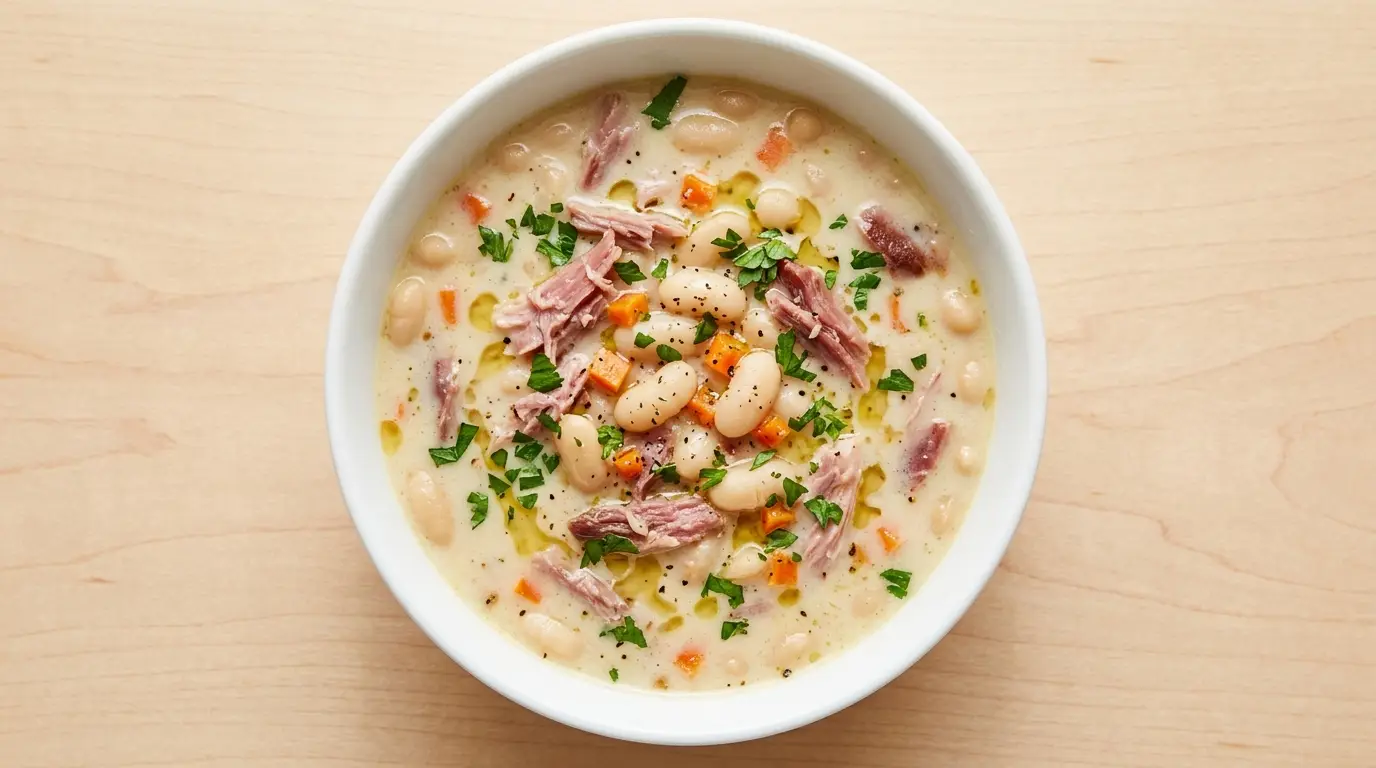
Navy Bean Soup Recipe: Classic Ham and Bean Soup
Ingredients
- 1 pound dried navy beans - 450 g, sorted, rinsed, soaked overnight in cold water (8 to 12 hours), then drained
- 2 tablespoons extra virgin olive oil - 30 ml
- 1 large yellow onion - about 10 ounces / 285 g, diced into ½-inch (1.25 cm) pieces
- 2 medium carrots - about 6 ounces / 170 g, peeled and diced into ½-inch (1.25 cm) pieces
- 2 stalks celery - about 4 ounces / 115 g, diced into ½-inch (1.25 cm) pieces
- 4 cloves garlic - about 12 g, minced
- 1 teaspoon dried thyme - 1 g
- 1 smoked ham hock - about 1 pound / 450 g
- 8 cups low-sodium chicken broth - 1.9 L
- 2 cups water - 475 ml
- 2 bay leaves
- 1½ cups fully cooked ham - 225 g, cut into ½-inch (1.25 cm) cubes
- ¼ cup fresh flat-leaf parsley - 15 g, finely chopped
- ½ teaspoon freshly ground black pepper - 1 g
- ½ teaspoon kosher salt - 3 g, starting with ½ teaspoon and adding more to taste at the end
Equipment
- Large bowl - at least 4 quarts / 3.8 L, for soaking the beans overnight
- Dutch oven - 6-quart / 5.7 L or larger, with a lid
- Chef’s knife - sharp, for dicing the vegetables and ham
- Cutting board - large enough to hold a pile of diced onion
- Colander - for draining and rinsing the soaked beans
- Wooden spoon - for stirring and scraping the bottom of the pot
- Soup Ladle - for skimming foam and serving
- Measuring cups and measuring spoons
- Vegetable peeler - for the carrots
- Tongs and two forks - for lifting and shredding the ham hock
- Potato masher - or an immersion blender, for thickening the broth
Method
- Rinse the soaked beans under cold running water and discard the soaking liquid. Dice the onion, carrots, and celery into ½-inch pieces, mince the garlic, chop the parsley, and cube the cooked ham.
- Heat the olive oil in the Dutch oven over medium heat, then cook the onion, carrots, and celery for 6 to 8 minutes until soft and translucent. Stir in the garlic and thyme and cook for 30 seconds until fragrant.
- Add the drained beans, ham hock, bay leaves, chicken broth, and water. Bring to a boil, skim any gray foam from the surface, and do not add salt at this stage.
- Reduce the heat to low, set the lid slightly ajar, and simmer for 1 hour 15 minutes to 1 hour 30 minutes, stirring every 20 minutes and adding hot water if the liquid drops below the beans. Taste a few beans for tenderness.
- Lift out the ham hock, cool briefly, then shred the meat and discard the skin, fat, and bone. Remove the bay leaves, return the shredded meat and cubed ham to the pot, and simmer gently for 10 minutes.
- Mash about 1 cup of the beans against the side of the pot with a potato masher, or pulse an immersion blender 3 or 4 times. Stir well and simmer for 5 minutes to thicken the broth.
- Stir in the black pepper and ½ teaspoon of kosher salt, then taste and add more salt ¼ teaspoon at a time as needed. Stir in the parsley, rest off the heat for 5 minutes, and ladle into warm bowls.
Nutrition
Notes
- Sort the beans on a light plate and remove pebbles, split beans, and shriveled ones before soaking; cover with about 3 inches (7.5 cm) of cold water since they roughly double in size.
- If the soak runs past 12 hours, refrigerate the bowl so the beans do not ferment. For a quick soak, cover with 2 inches (5 cm) of water, boil 2 minutes, cover, and stand 1 hour, then drain and rinse.
- Check the bag date on the beans; older beans can need 30 to 40 extra minutes of simmering.
- Keep the simmer gentle and hold the salt until the end, since the ham hock and chicken broth both add sodium.
- Use a heavy Dutch oven rather than a thin stockpot to avoid scorching the beans, and skim the gray foam as the pot comes to a boil.
- Keep the beans covered with hot water at all times, and delay acidic ingredients like tomatoes, vinegar, or lemon juice until the beans are tender.
- Mash only about 1 cup of beans rather than blending the whole pot, so the soup thickens while plenty of whole beans remain.
- For a vegetarian version, skip the ham hock and cubed ham, use vegetable broth, and add 1 teaspoon (2 g) smoked paprika with the garlic.
- Cool the soup quickly in shallow containers and refrigerate up to 4 days; freeze portions up to 3 months, leaving 1 inch (2.5 cm) of headspace.
- Reheat gently over medium-low heat with a splash of water or broth, since the beans keep absorbing liquid and a hard boil turns the soup pasty.
Private Notes
Tried this recipe?
Let us know how it was!Final Thoughts
A pot of navy beans and a smoked ham hock turns into something thick and deeply savory with very little effort.
Make it on a quiet afternoon and let the leftovers do the work later in the week.
Give this navy bean soup a try and tell me how it turned out in the comments. If it earns a spot at your table, share it with a friend who loves ham and beans.
Recommended:
- Best Lentil Soup Recipes
- Italian Wedding Soup
- Chicken Soup
- Slow Cooker Chili
- Honey Glazed Ham
- Slow Cooker Ham
- Crockpot Fall Recipes
- Roasted Butternut Squash Soup
- Tomato Soup