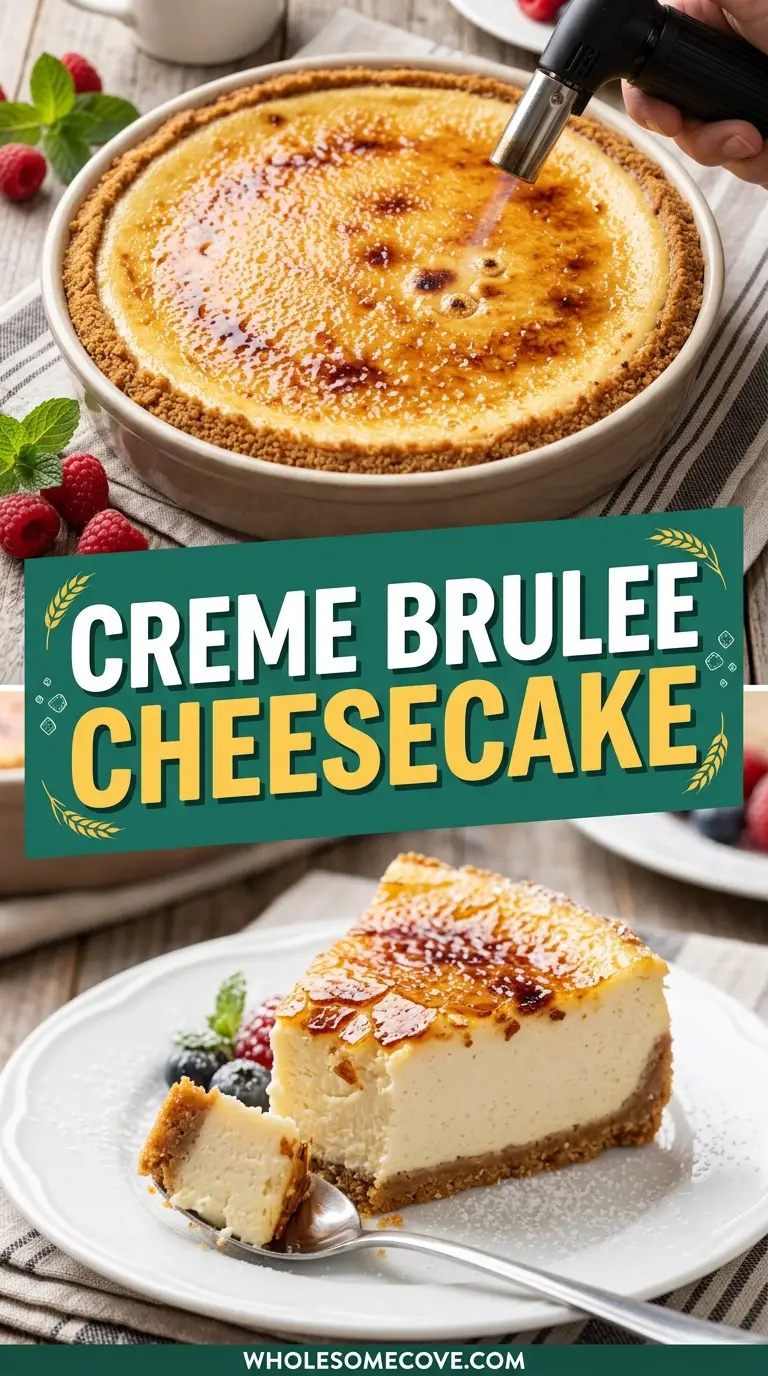
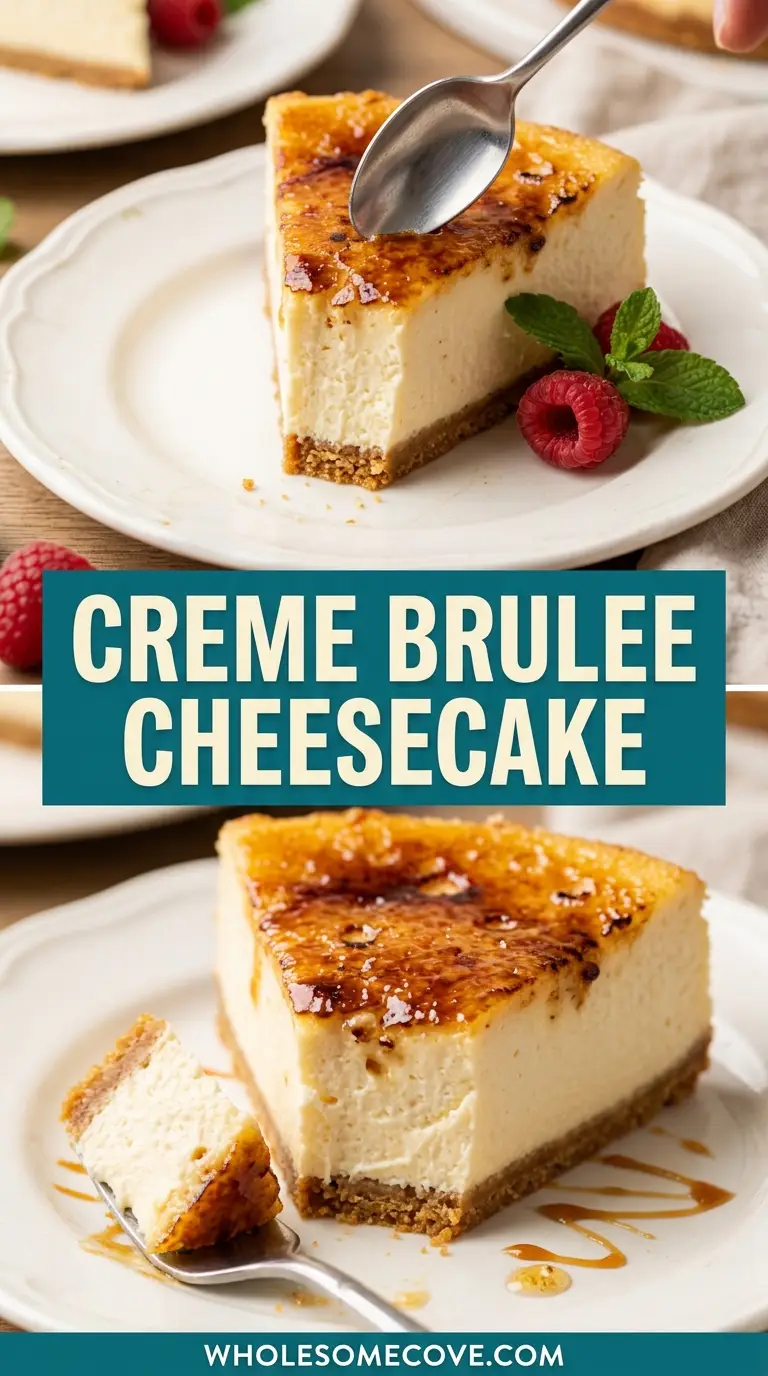
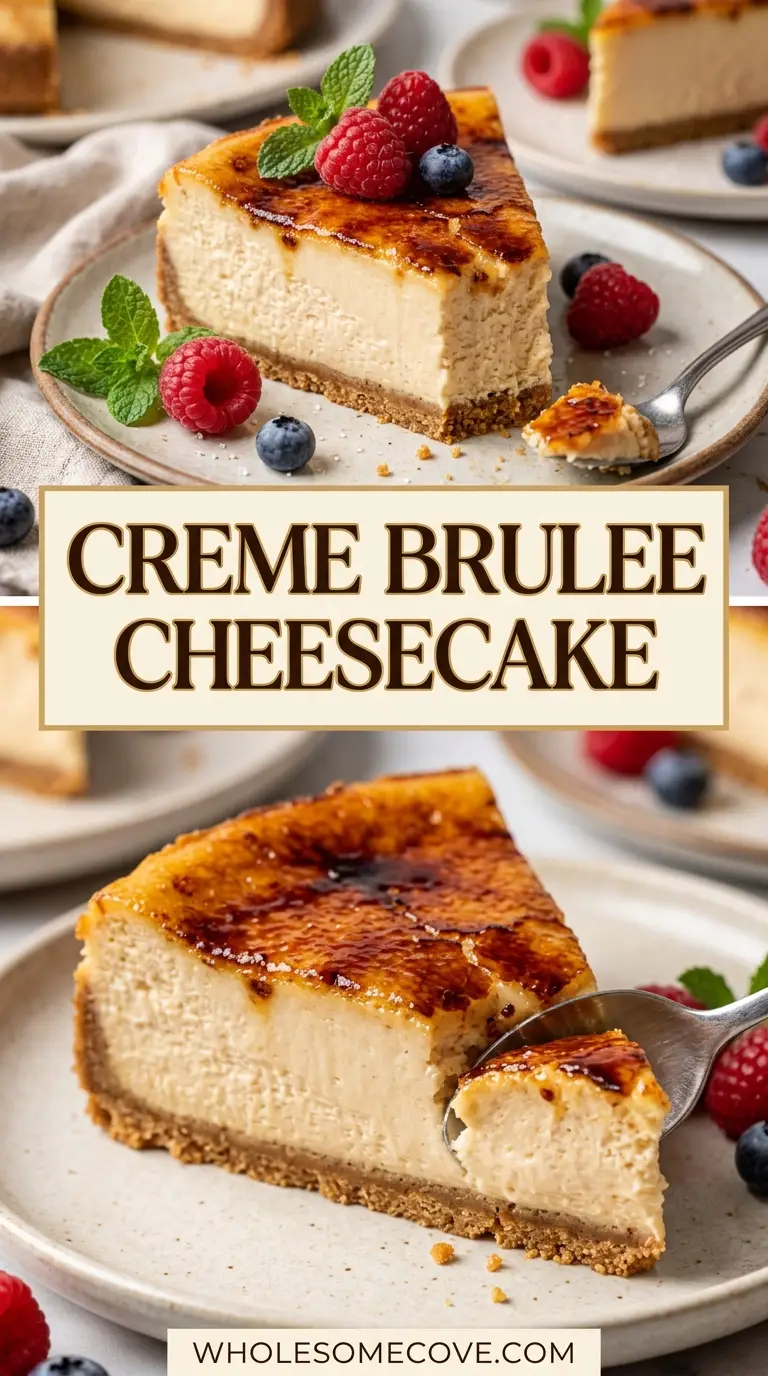
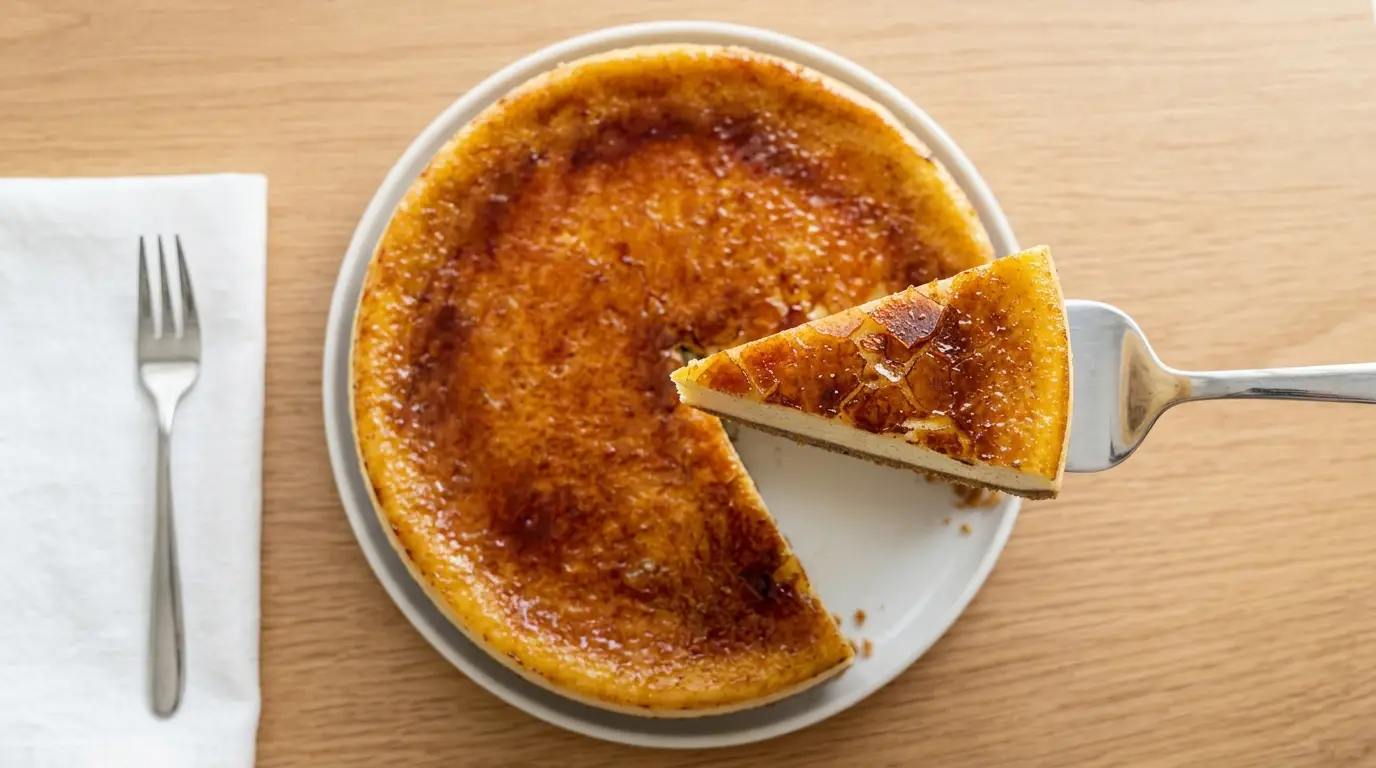
This creme brulee cheesecake recipe gives you two desserts in one slice, a dense tangy baked cheesecake hiding under a thin sheet of caramelized sugar.
That sugar top shatters when your spoon taps it. Underneath, the filling stays cold and silky.
Most versions crack down the middle. That usually comes from overbeaten batter or a skipped water bath.
This one bakes low and slow, then cools gradually, so the surface stays smooth. A smooth surface is what holds that glassy shell in place.
The filling uses four 8-ounce blocks of full-fat cream cheese plus two extra egg yolks. Those yolks and a spoon of sour cream give it the custard flavor of real creme brulee.
Vanilla bean paste adds the tiny black flecks and deep vanilla you expect. It makes 12 slices and needs an overnight chill.
The torch work takes about two minutes, right before serving.
| Quick Recipe Summary | |
|---|---|
| Prep Time | 30 minutes |
| Cook Time | 1 hour 15 minutes |
| Chill Time | 6 hours (or overnight) |
| Total Time | 7 hours 45 minutes |
| Servings | 12 slices |
| Difficulty Level | Intermediate |
For the original custard that started it all, see Classic Creme Brulee.
Why You’ll Love This Creme Brulee Cheesecake Recipe
This is the dessert that gets a reaction at the table when the first spoon cracks the top. It looks like a restaurant plate but runs on pantry staples and one gadget.
Here is what makes it worth the chill time:
- Two textures in one bite. The brittle caramel shell gives way to a cold, custard-soft filling, and the temperature difference is the whole appeal.
- Real creme brulee flavor, not just a topping. Extra egg yolks and vanilla bean paste push the filling toward custard instead of plain vanilla cheesecake.
- A crack-free surface. The low bake and slow cool keep the top smooth, which matters because you need a flat surface to torch.
- A genuine make-ahead. You bake and chill a day early, then add the sugar top in the final two minutes before serving.
- Feeds a crowd. One 9-inch cake cuts into 12 clean slices, enough for a dinner party or holiday table.
- Simple ingredient list. Cream cheese, sugar, eggs, cream, and graham crackers do most of the work.
Read Also: Creme Brulee French Toast
Ingredients
Everything here is easy to find, with the cream cheese and vanilla bean paste doing the heavy lifting for flavor. Use full-fat, block-style cream cheese and let it sit out until it is soft, or the filling will turn out lumpy.
For the graham cracker crust:
- 1½ cups (150g) graham cracker crumbs, about 12 full sheets
- 2 tablespoons (25g) granulated sugar
- 6 tablespoons (85g) unsalted butter, melted
- 1 pinch fine salt
For the cheesecake filling:
- 32 oz (900g) full-fat block cream cheese, room temperature (four 8-ounce blocks)
- 1 cup (200g) granulated sugar
- 1 tablespoon (8g) cornstarch
- ½ cup (120g) sour cream, room temperature
- ⅓ cup (80ml) heavy cream, room temperature
- 1 tablespoon vanilla bean paste, or 1 vanilla bean scraped
- 3 large eggs, room temperature
- 2 large egg yolks, room temperature
For the caramelized top:
- ⅓ cup (65g) granulated sugar or turbinado sugar, for torching
I’ve found block cream cheese sets firmer than the tub kind, which stayed loose no matter how long I chilled it. The tubs carry extra water that keeps the filling from firming up.
You might also enjoy: Pumpkin Cheesecake
Kitchen Equipment Needed
A cheesecake this rich needs even heat and a leakproof setup, so the pan and torch matter more than anything else. None of it is fancy, but the springform and torch are worth owning if you bake often.
Here is what to have ready:
- A 9-inch springform pan for clean release
- A butane kitchen torch for the caramel top
- A hand or stand mixer to beat the filling smooth
- A food processor for grinding graham crackers
- A large roasting pan to hold the water bath
- Heavy-duty aluminum foil to wrap the pan
- An offset spatula for smoothing the top
- A rubber spatula for scraping the bowl
- A kettle for boiling water bath water
I keep a cheap oven thermometer clipped to the rack because my oven runs about 15°F hot. That extra heat is enough to brown a cheesecake top before the center sets.
A related recipe worth saving is Red Velvet Cheesecake Cake.
Recommended Products for This Recipe
These are the tools and ingredients I reach for whenever I make this cake. Each one solves a specific problem that comes up with cheesecake.
1. Butane Kitchen Torch
A weak torch drags out the caramelizing step, and by the time the sugar browns, the filling underneath has started to melt. A proper butane torch with an adjustable flame gets the sugar to amber in seconds, so the cake stays cold. Look for one with a safety lock and a wide flame for even coverage.
2. Leakproof Springform Pan
Cheap springform pans let water bath water seep in and turn the crust to mush. A well-sealed 9-inch pan with a tight gasket keeps the crust dry and releases the sides without dragging.
3. Nielsen-Massey Vanilla Bean Paste
Plain extract gives you vanilla flavor but none of the flecks that make this look like creme brulee. A good vanilla bean paste delivers both the seeds and a deeper, rounder vanilla note.
4. Full-Fat Block Cream Cheese
Spreadable tub cream cheese has extra water and stabilizers that keep the filling loose. Full-fat blocks give you a firm, sliceable set and a cleaner tang.
5. Turbinado Sugar
Turbinado has larger crystals and a hint of molasses, so it caramelizes into a thicker, more amber shell. It gives a louder crack than fine white sugar.
For a different showpiece dessert, see Authentic Italian Tiramisu.
Step-by-Step Instructions: How to Make Creme Brulee Cheesecake
Follow these steps in order and you’ll have a smooth, crack-free cheesecake ready for its sugar top.
Step 1: Prep the Pan and Oven
- Heat your oven to 325°F (163°C) and set a rack in the lower third.
- Butter the inside of a 9-inch springform pan and line the base with parchment.
- Wrap the outside of the pan with two or three layers of heavy-duty foil, running it at least 2 inches up the sides. This blocks the water bath from leaking in.
- Boil a full kettle of water and set it aside for later.
Step 2: Make the Graham Cracker Crust
- Pulse the graham crackers in a food processor until they turn into fine, sandy crumbs, about 1½ cups (150g).
- Add the 2 tablespoons (25g) granulated sugar and a pinch of salt, then pulse to mix.
- Pour in the 6 tablespoons (85g) melted butter and pulse until the crumbs look like wet sand.
- Tip the mixture into the pan and press it firmly across the base and about ½ inch up the sides, using the flat bottom of a measuring cup.
Step 3: Pre-Bake the Crust
- Bake the crust for 8 to 10 minutes, until it smells toasty and looks set.
- Set it on a rack to cool while you make the filling.
- Leave the oven on at 325°F (163°C).
Step 4: Beat the Cream Cheese and Sugar
- Beat the 32 oz (900g) softened cream cheese on low speed until completely smooth, scraping the bowl often.
- Add the 1 cup (200g) granulated sugar and the 1 tablespoon (8g) cornstarch, then beat on low until just combined.
- Keep the speed low the whole time, since beating air into the batter is what causes cracks.
Step 5: Add the Dairy and Vanilla
- Mix in the ½ cup (120g) sour cream and ⅓ cup (80ml) heavy cream on low until smooth.
- Add the 1 tablespoon vanilla bean paste and beat just until the flecks spread through the batter.
- Scrape the bowl down one more time to catch any hidden lumps of cream cheese.
Step 6: Add the Eggs and Yolks
- Add the 3 whole eggs and 2 egg yolks one at a time, mixing on low after each just until it disappears.
- Stop mixing the moment the last yolk blends in.
- If the batter looks airy, tap the bowl on the counter a few times to release bubbles.
Step 7: Set Up the Water Bath
- Pour the filling over the cooled crust and smooth the top with an offset spatula.
- Set the foil-wrapped pan inside a large roasting pan.
- Pour the hot kettle water into the roasting pan until it reaches halfway up the springform sides.
Step 8: Bake
- Bake at 325°F (163°C) for 1 hour to 1 hour 15 minutes.
- The edges should look set while the center still wobbles slightly when you nudge the pan.
- Avoid opening the door for the first 50 minutes, since a temperature drop can crack the top.
Step 9: Cool Gradually
- Turn off the oven and crack the door open a few inches.
- Leave the cheesecake inside for 1 hour to cool slowly.
- Lift the pan out of the water bath, remove the foil, and let it finish cooling on the counter to room temperature.
Step 10: Chill
- Cover the pan loosely and refrigerate for at least 6 hours, or overnight for the cleanest slices.
- Keep the top uncovered for the first hour of chilling so condensation does not collect on the surface.
- A dry, cold surface is what you need for the sugar to caramelize properly.
Step 11: Brulee the Top
- Just before serving, run a thin knife around the edge and release the springform ring.
- Blot the surface dry with a paper towel, then sprinkle the ⅓ cup (65g) sugar in a thin, even layer.
- Hold the torch a few inches away and move it in small circles until the sugar melts and turns deep amber.
- Let the caramel set for 2 to 3 minutes until it hardens, then slice and serve.
For a bite-sized version of this flavor, check out Creme Brulee Cookies.
Tips for The Best Creme Brulee Cheesecake
A few small habits make the difference between a smooth, showpiece cake and a cracked, weepy one. Most of them come down to temperature and patience.
Keep these in mind:
- Start with truly soft cream cheese. Cold cream cheese leaves lumps that no amount of mixing will fix once the eggs go in.
- Mix on low from start to finish. High speed whips in air, and air bubbles rise and split the surface as the cake bakes.
- Do not skip the water bath. The steam keeps the bake gentle and the top flat, which you need for the sugar shell.
- Torch a dry surface. I ruined my first brulee cheesecake by torching it straight from the fridge with a damp top, and the sugar turned to syrup instead of glass.
- Sprinkle sugar in a thin, even layer. Thick patches burn on top before the bottom melts, leaving a bitter taste.
- Torch right before serving. The caramel starts softening within a couple of hours, so add it at the last minute for the loudest crack.
- Warm the knife between cuts. Dip your knife in hot water and wipe it dry before each slice for clean edges.
For a lighter option, try: Coconut Cream Pie
What to Serve with Creme Brulee Cheesecake
This cake is rich, so the best pairings are either bright and fruity or warm and a little bitter to balance the sweetness. A small slice goes a long way, and a good coffee or a spoon of tart fruit rounds it out.
Try serving it alongside:
- Fresh raspberries or blackberries scattered over the plate for a tart contrast
- A drizzle of Strawberry Sauce for color and acidity
- A warm ribbon of Caramel Sauce for extra richness
- Spiced Poached Pears on the side for a grown-up plate
- A hot Pumpkin Spice Latte in cooler months
- A mug of Hot Chocolate for a cozy dessert course
- A shot of espresso to cut through the cream
- A glass of sparkling wine or a late-harvest dessert wine
For another make-ahead dessert to round out a spread, see Fruit Tart.
Variations of Creme Brulee Cheesecake
Once you have the base down, the flavor is easy to adjust. The caramelized top works over almost any cheesecake filling.
Here are some directions to take it:
- Espresso brulee cheesecake. Dissolve 1 tablespoon instant espresso into the heavy cream before mixing for a coffee-tinged filling.
- Salted caramel version. Swirl a few spoonfuls of thick caramel into the batter and finish the torched top with flaky salt.
- Vanilla bean and citrus. Add the zest of one orange to brighten the custard flavor.
- Bourbon brulee. Stir 1 tablespoon bourbon into the filling for a warm, boozy note under the caramel.
- Mini brulee cheesecakes. Bake the filling in ramekins or a muffin tin for individual portions, cutting the bake time roughly in half.
- Chocolate-bottom brulee. Use crushed chocolate wafers in place of graham crumbs for a darker, richer base.
- Pumpkin brulee cheesecake. Fold ½ cup pumpkin puree and a teaspoon of pumpkin spice into the batter for fall.
For a festive twist, see Pecan Pie.
Storage and Reheating
Cheesecake keeps well, which is part of why it is such a good make-ahead. The one rule is to store it without the sugar top, since the caramel does not survive the fridge.
Here is how to keep it at its best:
- Refrigerator (un-torched): Cover the plain chilled cheesecake and keep it for up to 5 days. Torch each slice as you serve it.
- Refrigerator (torched): A caramelized top holds its crack for about 12 to 18 hours before softening, so torch only what you plan to eat that day.
- Freezer: Wrap the un-torched, fully chilled cheesecake tightly in plastic and foil, then freeze for up to 2 months.
- Thawing: Move it to the fridge overnight, then blot the surface dry and torch just before serving.
- Slicing to freeze: Freeze individual slices on a tray first, then wrap them, so you can thaw one at a time.
- No reheating needed: This dessert is served cold, so there is no reheating step. Simply add the sugar top at the last minute.
For another dessert that keeps for days, see Creme Brulee French Toast Casserole.
Nutritional Facts
Values are estimates for one slice, based on 12 slices per 9-inch cake. Actual numbers will vary with brands and portion size.
| Nutrient | Per Slice (approx.) |
|---|---|
| Calories | 485 kcal |
| Total Fat | 34 g |
| Saturated Fat | 20 g |
| Carbohydrates | 38 g |
| Sugar | 30 g |
| Protein | 8 g |
| Sodium | 320 mg |
| Cholesterol | 165 mg |
For a fruit-forward finish to a meal, see Apple Pie.
Health Benefits of Key Ingredients
This is a dessert, so it is a treat first. That said, a few of the core ingredients bring real nutritional value along with the flavor.
Here is what the key ingredients contribute:
- Cream cheese provides protein and calcium, along with vitamin A that supports vision and immune function.
- Eggs and egg yolks deliver high-quality protein, plus choline, which plays a role in brain and liver health.
- Heavy cream and sour cream add fat-soluble vitamins A and D, and the fat helps your body absorb them.
- Vanilla bean contains small amounts of antioxidant compounds that come from natural vanillin.
- Graham crackers made with whole grain flour offer a little fiber in the crust.
- Sugar contributes quick energy, though it is best enjoyed in the modest portions this rich cake naturally encourages.
For a classic fall dessert, see Pumpkin Pie.
FAQs About Creme Brulee Cheesecake
1. Do I really need a water bath?
A water bath is strongly recommended for this cake. The steam keeps the oven gentle and moist, which stops the top from drying out and cracking.
Without one, the edges tend to overbake before the center sets. Since you need a smooth top for the sugar shell, the water bath is worth the extra step.
2. Can I use a broiler instead of a kitchen torch?
Yes, a broiler works in a pinch. Sprinkle the sugar, then slide the cold cake under a hot broiler and watch it constantly until it bubbles and turns amber.
Keep the cake as cold as possible and pull it the second the sugar caramelizes. A torch is easier to control, but the broiler gets you there.
3. Why did my cheesecake crack?
Cracks usually come from too much air in the batter, a skipped water bath, or cooling the cake too fast. Mixing on low speed and cooling it slowly in the turned-off oven both help.
A crack is not the end of the world here. The sugar topping hides small surface cracks completely.
4. When should I torch the sugar top?
Torch it right before serving, ideally within an hour of slicing. The caramel shell starts softening and turning chewy after a couple of hours in the fridge.
If you want to serve slices over time, torch each one individually as it goes onto the plate. That keeps every serving with a fresh, crisp crack.
5. Can I make this cheesecake ahead of time?
Yes, and it is better for it. Bake and chill the cheesecake up to two days ahead, keeping it covered in the fridge without the sugar top.
Add the caramelized sugar only when you are ready to serve. This makes it a good choice for holidays and dinner parties.
6. What sugar is best for the caramelized top?
Both granulated white sugar and turbinado sugar work well. White sugar melts fast and gives a thin, even glass, while turbinado melts a little slower into a thicker, more amber shell.
Turbinado gives a thicker, more amber crack than white sugar in my tests, though it takes a few more passes of the torch. Either way, keep the layer thin and even.
For a no-fuss cookie to bake alongside, see Sugar Cookies… actually, save that pairing. Read Also: Cheesecake Ice Cream Cake
Creme Brulee Cheesecake
Ingredients
- 1½ cups graham cracker crumbs - 150g, about 12 full sheets
- 2 tablespoons granulated sugar - 25g
- 6 tablespoons unsalted butter - 85g, melted
- 1 pinch fine salt
- 32 oz full-fat block cream cheese - 900g, room temperature (four 8-ounce blocks)
- 1 cup granulated sugar - 200g
- 1 tablespoon cornstarch - 8g
- ½ cup sour cream - 120g, room temperature
- ⅓ cup heavy cream - 80ml, room temperature
- 1 tablespoon vanilla bean paste - or 1 vanilla bean scraped
- 3 large eggs - room temperature
- 2 large egg yolks - room temperature
- ⅓ cup granulated sugar or turbinado sugar - 65g, for torching
Equipment
- 9-inch springform pan - for clean release
- Butane kitchen torch - for the caramel top
- Hand or stand mixer - to beat the filling smooth
- Food processor - for grinding graham crackers
- Large roasting pan - to hold the water bath
- Heavy-duty aluminum foil - to wrap the pan
- Offset spatula - for smoothing the top
- Rubber spatula - for scraping the bowl
- Kettle - for boiling water bath water
- Oven thermometer - (optional) to verify oven temperature
Method
- Heat oven to 325°F (163°C) and set a rack in the lower third. Butter the inside of a 9-inch springform pan and line the base with parchment. Wrap the outside with two or three layers of heavy-duty foil, running it at least 2 inches up the sides, then boil a full kettle of water and set it aside.
- Pulse the graham crackers in a food processor until fine and sandy, about 1½ cups (150g). Add the 2 tablespoons (25g) sugar and a pinch of salt and pulse to mix, then pour in the 6 tablespoons (85g) melted butter and pulse until the crumbs look like wet sand. Tip into the pan and press firmly across the base and about ½ inch up the sides using the flat bottom of a measuring cup.
- Bake the crust for 8 to 10 minutes, until it smells toasty and looks set. Set it on a rack to cool while you make the filling, leaving the oven on at 325°F (163°C).
- Beat the 32 oz (900g) softened cream cheese on low speed until completely smooth, scraping the bowl often. Add the 1 cup (200g) granulated sugar and the 1 tablespoon (8g) cornstarch, then beat on low until just combined, keeping the speed low the whole time since beating air into the batter is what causes cracks.
- Mix in the ½ cup (120g) sour cream and ⅓ cup (80ml) heavy cream on low until smooth. Add the 1 tablespoon vanilla bean paste and beat just until the flecks spread through the batter, then scrape the bowl down one more time to catch any hidden lumps of cream cheese.
- Add the 3 whole eggs and 2 egg yolks one at a time, mixing on low after each just until it disappears. Stop mixing the moment the last yolk blends in, and if the batter looks airy, tap the bowl on the counter a few times to release bubbles.
- Pour the filling over the cooled crust and smooth the top with an offset spatula. Set the foil-wrapped pan inside a large roasting pan, then pour the hot kettle water into the roasting pan until it reaches halfway up the springform sides.
- Bake at 325°F (163°C) for 1 hour to 1 hour 15 minutes. The edges should look set while the center still wobbles slightly when you nudge the pan, and avoid opening the door for the first 50 minutes since a temperature drop can crack the top.
- Turn off the oven and crack the door open a few inches. Leave the cheesecake inside for 1 hour to cool slowly, then lift the pan out of the water bath, remove the foil, and let it finish cooling on the counter to room temperature.
- Cover the pan loosely and refrigerate for at least 6 hours, or overnight for the cleanest slices. Keep the top uncovered for the first hour of chilling so condensation does not collect on the surface, since a dry, cold surface is what you need for the sugar to caramelize properly.
- Just before serving, run a thin knife around the edge and release the springform ring. Blot the surface dry with a paper towel, then sprinkle the ⅓ cup (65g) sugar in a thin, even layer. Hold the torch a few inches away and move it in small circles until the sugar melts and turns deep amber, then let the caramel set for 2 to 3 minutes until it hardens before slicing and serving.
Nutrition
Notes
- Start with truly soft cream cheese — cold cream cheese leaves lumps that no amount of mixing will fix once the eggs go in.
- Mix on low from start to finish — high speed whips in air, and air bubbles rise and split the surface as the cake bakes.
- Do not skip the water bath — the steam keeps the bake gentle and the top flat, which you need for the sugar shell.
- Torch a dry surface — torching a damp top turns the sugar to syrup instead of glass.
- Sprinkle sugar in a thin, even layer — thick patches burn on top before the bottom melts, leaving a bitter taste.
- Torch right before serving — the caramel starts softening within a couple of hours, so add it at the last minute for the loudest crack.
- Warm the knife between cuts — dip your knife in hot water and wipe it dry before each slice for clean edges.
- Store un-torched in the refrigerator for up to 5 days; torch each slice as you serve it.
- Freeze the un-torched, fully chilled cheesecake tightly wrapped for up to 2 months; thaw overnight in the fridge, blot dry, and torch just before serving.
- A caramelized top holds its crack for about 12 to 18 hours before softening, so torch only what you plan to eat that day.
Private Notes
Tried this recipe?
Let us know how it was!Final Thoughts
This creme brulee cheesecake is the kind of dessert that makes an ordinary dinner feel like an occasion. The cracked sugar top does most of the talking.
It takes a little planning and an overnight chill, but the hands-on work is short. Most of the time is just waiting for the fridge to do its job.
If you make it, I’d love to hear how your caramel top turned out. Drop a comment below and share it with a friend who loves cheesecake.
Recommended:
- Red Velvet Cake
- Easy Carrot Cake
- Chocolate Chip Cookies
- No Bake Cookies
- Fudge
- Eggnog
- Pumpkin Roll
- Hot Chocolate Bombs
- Coconut Cream Pie