A great peanut butter cookies recipe lives or dies on the balance between flour and fat. Too much flour and the cookies turn dry and sandy, falling apart before they reach your mouth.
This version keeps the flour modest at 1¼ cups and leans on brown sugar for moisture, so the centers stay soft and chewy while the fork-pressed edges crisp.
You get 24 cookies from ten simple ingredients, start to finish in under 30 minutes. No chilling, no mixer gymnastics, just the signature crisscross top everyone recognizes.
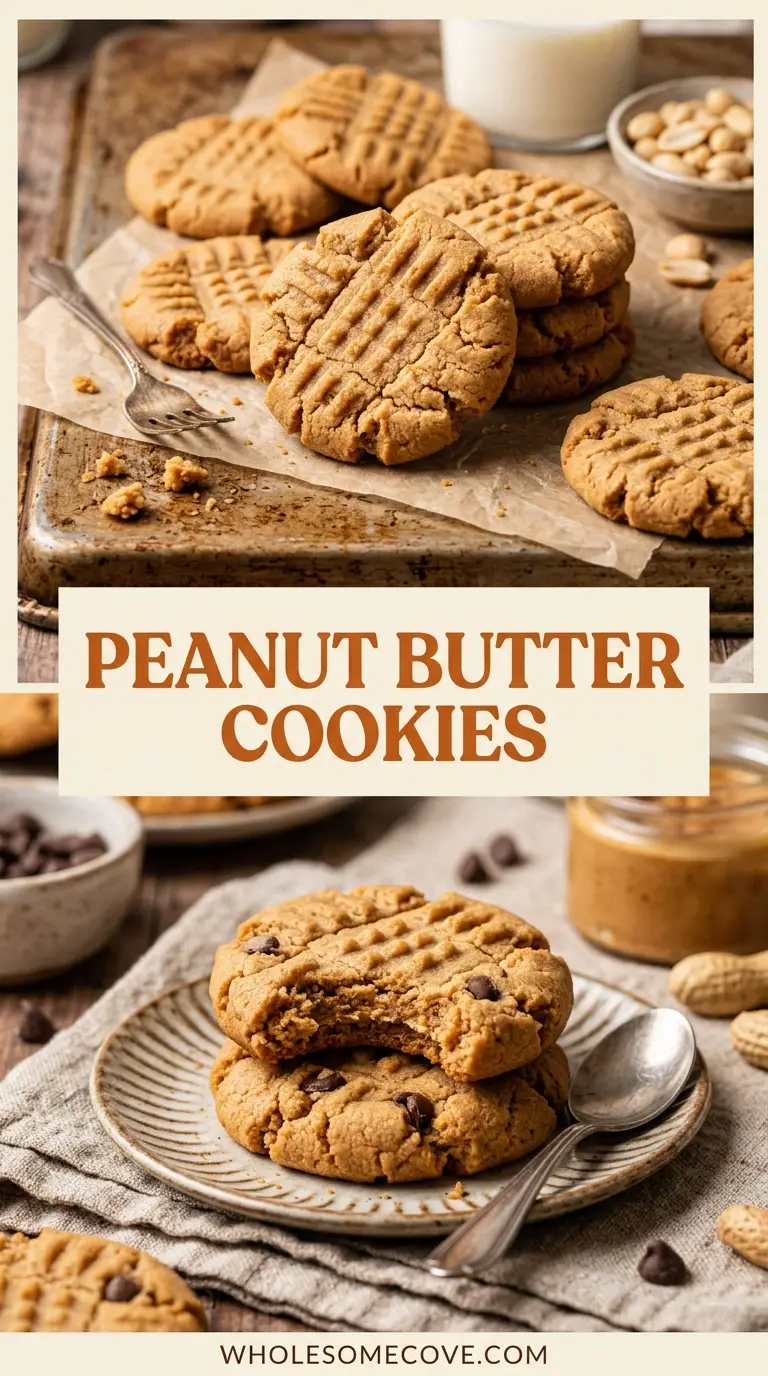
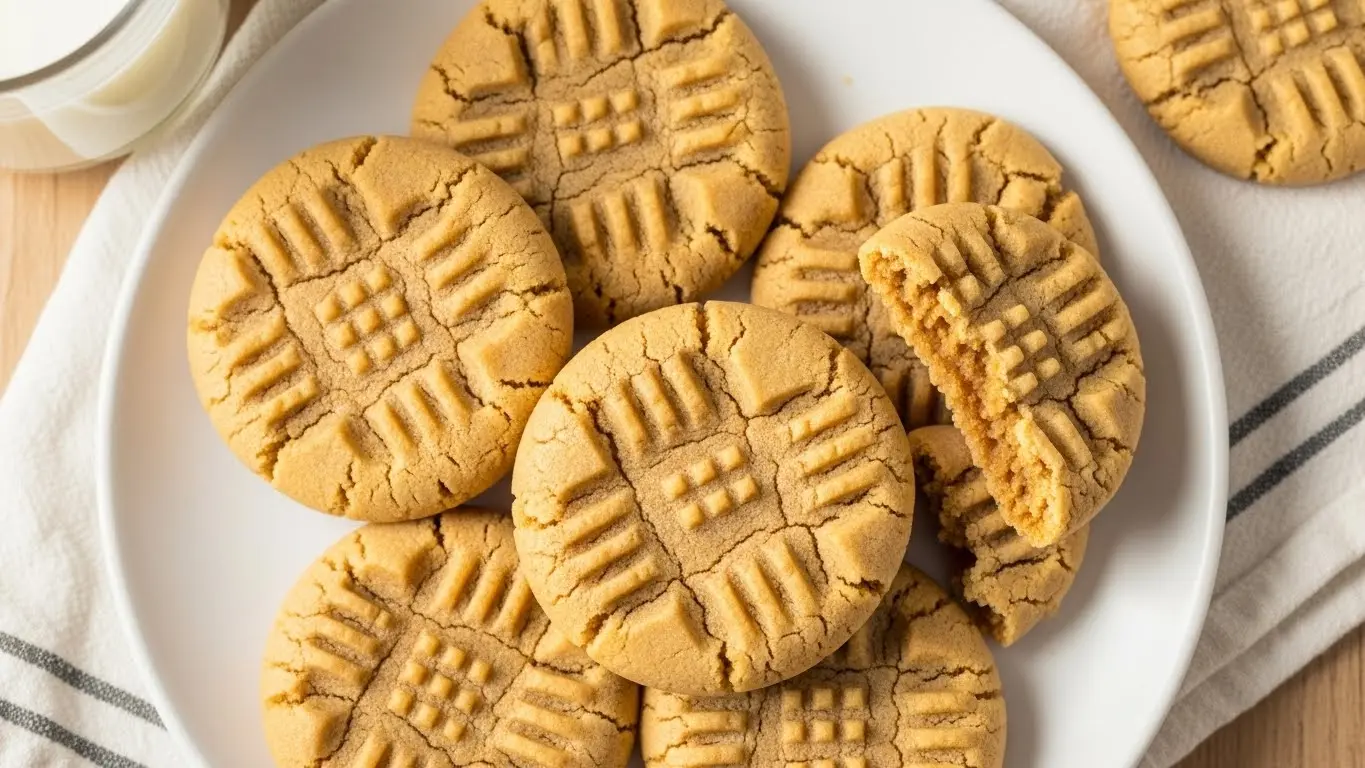
The dough comes together in one bowl and holds its shape in the oven, which is exactly why the fork marks matter. Peanut butter dough is dense and barely spreads, so pressing it flat with a fork helps each cookie bake evenly from edge to center.
| Quick Recipe Summary | |
|---|---|
| Prep Time | 15 minutes |
| Cook Time | 12 minutes |
| Total Time | 27 minutes |
| Servings | 24 cookies |
| Difficulty Level | Easy |
For a different cookie to keep in rotation, see Chocolate Chip Cookies.

Why You’ll Love This Peanut Butter Cookies Recipe
These cookies hit the sweet spot between soft and sturdy, with real peanut flavor that does not get buried under sugar. The recipe is forgiving enough for a first-time baker and fast enough for a weeknight craving.
Here is what makes them worth the pantry raid:
- Ready in under 30 minutes. From measuring to the first bite, the whole process takes about 27 minutes with no chilling step required.
- One bowl, one whisk, one mixer. Minimal cleanup and no fussy equipment.
- Soft, chewy centers. Brown sugar and a full cup of peanut butter keep the middle tender instead of dry.
- Crisp fork-marked edges. The crosshatch top bakes into slightly crisp ridges for texture contrast.
- Ten everyday ingredients. Nothing exotic, and most of it is already in your kitchen.
- Beginner-friendly. The dough is easy to handle and shapes into neat balls without sticking.
- Easy to scale. The recipe doubles cleanly for a bake sale or a holiday tray.
You might also enjoy: Oatmeal Cookies
Ingredients
Every ingredient here earns its place, and the ratios are what keep the cookies chewy rather than crumbly. Measure the flour by spooning it into the cup and leveling it off, or weigh it, since scooping packs in too much.
- ½ cup (115 g) unsalted butter, softened to room temperature
- 1 cup (250 g) creamy peanut butter, at room temperature. Use a no-stir brand like creamy peanut butter for the most reliable texture
- ½ cup (100 g) granulated sugar, plus 3 tablespoons extra for coating and pressing
- ½ cup (110 g) packed light brown sugar, or dark brown for deeper flavor. Keep light brown sugar on hand
- 1 large egg, at room temperature
- 1 teaspoon pure vanilla extract, ideally a real pure vanilla extract
- 1¼ cups (160 g) all-purpose flour
- ¾ teaspoon baking soda, such as baking soda
- ½ teaspoon baking powder, such as baking powder
- ¼ teaspoon salt
I’ve found natural peanut butter needs a very thorough stir and about a tablespoon less flour, because the separated oil shifts the moisture balance compared with a no-stir brand. If your dough feels oily or cracks when you press it, that separation is usually the reason.
Read Also: Peanut Butter Fudge
Kitchen Equipment Needed
You do not need anything specialized for these cookies. A mixer speeds up the creaming step, but a sturdy bowl and a wooden spoon will also do the job.
- Electric mixer: a hand or stand mixer makes creaming the butter and sugars quick
- Mixing bowls: at least two, one for wet and one for dry, like these mixing bowls
- Baking sheets: two rimmed baking sheets so you can rotate batches
- Parchment paper: keeps cookies from sticking and makes cleanup easy, such as parchment paper
- Cookie scoop: a 1.5-tablespoon cookie scoop gives you evenly sized cookies
- Wire cooling rack: a cooling rack lets air circulate so bottoms stay crisp
- Fork: for the crosshatch pattern, one with long flat tines works best
- Whisk and spatula: for the dry mix and for scraping the bowl
For another simple bake, try: Sugar Cookies
Recommended Products for This Recipe
These are the products I reach for when I want the cookies to turn out the same way every time. Each one solves a specific problem I ran into while testing.
1. Nordic Ware Natural Aluminum Baking Sheets
Thin, dark pans scorch the bottoms of peanut butter cookies before the tops finish setting, which is a common reason the edges taste bitter. These heavy aluminum sheets heat evenly and stay flat in the oven, so the cookies brown on a schedule instead of burning in spots.
2. OXO Good Grips Medium Cookie Scoop
Uneven dough balls bake unevenly, leaving some cookies raw in the middle while others overbake. A spring-release scoop portions the dough identically every time, which is the simplest way to get a uniform batch.
3. Nielsen-Massey Pure Vanilla Extract
Imitation vanilla can leave a faintly chemical aftertaste that competes with the peanut butter. A real extract rounds out the sweetness and lets the nutty flavor stay front and center.
4. Smucker’s Natural Creamy Peanut Butter
If you prefer a natural peanut butter, this one grinds smooth and has a strong roasted flavor. Just stir it well and hold back a tablespoon of flour to keep the dough from turning oily.
5. Silicone Baking Mat
A reusable silicone mat gives the cookies a gentle, even bottom and keeps them from spreading too thin on a well-seasoned pan. It also saves you from going through a roll of parchment during a big bake.
A related recipe worth bookmarking is No Bake Cookies.

Step-by-Step Instructions: How to Make Peanut Butter Cookies
Follow these steps and you will have a batch of peanut butter cookies cooling on the rack in under half an hour.
Step 1. Preheat the Oven and Prep Your Pans
- Position a rack in the center of the oven and preheat to 350°F (175°C).
- Line two baking sheets with parchment paper or silicone mats.
- Pour 3 tablespoons of granulated sugar into a small shallow bowl and set it near your work area for coating and pressing later.
Step 2. Whisk the Dry Ingredients
- In a medium bowl, whisk together the 1¼ cups flour, ¾ teaspoon baking soda, ½ teaspoon baking powder, and ¼ teaspoon salt.
- Whisk for about 20 seconds so the leaveners are evenly distributed, then set the bowl aside.
Step 3. Cream the Butter and Sugars
- In a large bowl, beat the ½ cup softened butter, ½ cup granulated sugar, and ½ cup brown sugar on medium speed.
- Keep beating for 2 to 3 minutes until the mixture looks pale and fluffy, scraping down the sides once.
Step 4. Add the Peanut Butter, Egg, and Vanilla
- Add the full 1 cup of peanut butter and beat until it is fully blended and smooth, about 30 seconds.
- Add the egg and 1 teaspoon vanilla, then beat just until combined and the batter looks glossy.
Step 5. Combine Wet and Dry
- Add the dry ingredients to the peanut butter mixture in two additions.
- Mix on low speed just until no streaks of flour remain. Stop as soon as the dough comes together, since overmixing toughens the cookies.
Step 6. Scoop and Roll
- Scoop level 1.5-tablespoon portions of dough and roll each one into a smooth ball between your palms.
- Roll each ball in the bowl of granulated sugar until lightly coated, then place them on the lined sheets about 2 inches (5 cm) apart.
Step 7. Press the Crosshatch
- Dip the tines of a fork in the sugar, then press down firmly on a dough ball to flatten it slightly.
- Rotate the fork 90 degrees and press again to make the crisscross pattern. Repeat with the rest, dipping the fork in sugar between cookies.
I keep that little dish of sugar right beside the tray and dip the fork before every press, which stops the tines from dragging and tearing the soft dough.
Step 8. Bake
- Bake one sheet at a time for 10 to 12 minutes, until the edges are set and the tops look slightly puffed and dry.
- The centers should still look a touch underdone. Pulling them at this point is what keeps the middle chewy as they finish setting on the hot pan.
Step 9. Cool
- Let the cookies rest on the baking sheet for 5 minutes, since they are fragile while hot.
- Transfer them to a wire rack with a thin spatula and cool completely before stacking.
Read Also: Oatmeal Raisin Cookies
Tips for The Best Peanut Butter Cookies
Small adjustments make the difference between a dry, forgettable cookie and a chewy one with real peanut flavor. These are the habits that keep my batches consistent.
- Measure flour carefully. I ruined my first batch by packing in extra flour to firm up sticky dough, and the cookies baked up dry and sandy. Spoon the flour into the cup and level it, or weigh it at 160 g.
- Soften the butter and peanut butter. Room-temperature fats cream together smoothly and trap air, which keeps the texture light. Cold ingredients lead to a stiff, crumbly dough.
- Do not overbake. Peanut butter cookies go from soft to dry in a minute or two, so trust the clock and pull them when the centers still look slightly wet.
- Use the right peanut butter. No-stir creamy brands give the most predictable results. Natural styles work but need a hard stir and slightly less flour.
- Chill only if needed. The dough does not require chilling, but if your kitchen is warm and the fork marks keep disappearing, rest the dough in the fridge for 15 minutes.
- Rotate the pan. If your oven has hot spots, turn the sheet halfway through baking for even color.
- Bake one sheet at a time. Center-rack baking gives the most even heat and uniform edges.
You might also enjoy: Gingerbread Cookies
What to Serve with Peanut Butter Cookies
Peanut butter cookies are rich and a little salty, so they pair well with anything cold and creamy or warm and chocolatey. Here are the pairings I come back to most.
- A tall glass of cold milk, the classic partner for dunking
- A mug of Hot Chocolate for a cozy afternoon treat
- A warm Pumpkin Spice Latte in the fall
- A Coffee Smoothie for a morning indulgence
- A thick Peanut Butter Banana Smoothie to double down on the peanut flavor
- A scoop of vanilla ice cream pressed between two cookies for an instant sandwich
- Fresh sliced strawberries or banana for a lighter contrast
- A drizzle of melted dark chocolate for dipping the edges
Read Also: Fudge Brownies
Variations of Peanut Butter Cookies
Once you have the base down, the recipe takes well to small changes. Each of these starts from the same dough, so you only adjust one or two things.
- Chocolate chip peanut butter: Fold in ¾ cup semisweet or milk chocolate chips after the flour.
- Peanut butter blossoms: Skip the fork marks and press a chocolate kiss into each cookie the moment they come out of the oven.
- Chunky peanut butter: Swap the creamy for crunchy to add bits of chopped peanut throughout.
- Flourless three-ingredient: For a quick fix, use 1 cup peanut butter, 1 cup sugar, and 1 egg, then bake as directed. The texture is softer and more fragile.
- Double peanut: Stir in ½ cup chopped salted peanuts for extra crunch and a saltier edge.
- Chocolate drizzle: Dip or drizzle cooled cookies with melted chocolate and let them set.
- Honey-sweetened: Replace part of the granulated sugar with 2 tablespoons honey for a mellow, floral note.
- Oatmeal peanut butter: Add ½ cup quick oats and 2 extra tablespoons of peanut butter for a heartier cookie.
For a lighter take on a classic, see Healthy Chocolate Chip Cookies.
Storage and Reheating
Peanut butter cookies dry out faster than most, so sealing them up quickly is the key to keeping them soft. The dough and the baked cookies both freeze well, which makes this an easy recipe to bake ahead.
- Room temperature: Store cooled cookies in an airtight container for up to 5 days. Tuck in a slice of sandwich bread to keep them soft.
- Refrigerator: Not recommended, since the cold air speeds up drying. If you must refrigerate, wrap tightly and bring to room temperature before serving.
- Freezing baked cookies: Layer them between parchment in a freezer bag and freeze for up to 3 months. Thaw at room temperature for about 20 minutes.
- Freezing dough: Scoop and shape the balls, freeze them solid on a tray, then transfer to a bag. Bake from frozen, adding 1 to 2 minutes to the time.
- Make-ahead note: The dough keeps in the fridge for up to 3 days if you want to bake in shifts. Let it sit out for 15 minutes so it is soft enough to shape.
- Refreshing: Warm a cookie in the microwave for 8 to 10 seconds to bring back that just-baked softness.
For another make-ahead treat, try: Fudge
Nutritional Facts
Values are estimated per cookie, based on a yield of 24 cookies. Actual numbers will vary with the brand of peanut butter and any add-ins.
| Nutrient | Amount per Cookie |
|---|---|
| Calories | 140 kcal |
| Total Fat | 8 g |
| Saturated Fat | 2.5 g |
| Cholesterol | 13 mg |
| Sodium | 110 mg |
| Total Carbohydrates | 15 g |
| Sugars | 9 g |
| Protein | 4 g |
| Fiber | 1 g |
Read Also: Peanut Butter Overnight Oats
Health Benefits of Key Ingredients
While these are a treat, a few of the main ingredients bring genuine nutritional value to the table. Peanut butter in particular does more than add flavor.
- Peanut butter: A good source of plant-based protein and healthy monounsaturated fats, which help with satiety. It also supplies vitamin E, magnesium, and niacin.
- Eggs: Provide complete protein along with choline, which supports brain and cell function. They also add structure so the cookies hold together.
- Butter: Delivers fat-soluble vitamins A and D in small amounts and gives the cookies their tender crumb.
- Brown sugar: Carries trace minerals from its molasses content and adds the moisture that keeps the centers chewy.
- Vanilla extract: Contains small amounts of antioxidant compounds and deepens flavor so you can use less added sugar overall.
- Peanuts in general: Linked in research to heart health when eaten in moderation, thanks to their unsaturated fat and fiber.
Another option worth trying is Peanut Butter Smoothie.
FAQs About Peanut Butter Cookies
1. Why are my peanut butter cookies dry and crumbly?
The two most common causes are too much flour and overbaking. Spoon and level your flour or weigh it, and pull the cookies while the centers still look slightly underdone.
Cold butter can also leave the dough stiff and sandy. Let your butter and peanut butter come to room temperature first.
2. Why do peanut butter cookies have fork marks?
The dough is dense and does not spread much on its own. Pressing it flat with a fork helps each cookie bake evenly instead of staying raw in the middle.
The crisscross pattern also became the traditional signature after it appeared in cookbooks in the 1930s. It is now the look most people expect.
3. Can I use natural peanut butter?
Yes, but stir it very well first so the oil is fully blended back in. You may also want to hold back about a tablespoon of flour, since natural styles can make the dough oilier.
4. Do I need to chill the dough?
Not for this recipe, since the flour-to-fat ratio keeps the dough firm enough to shape right away. If your kitchen is warm and the fork marks keep flattening out, chill the dough for 15 minutes.
5. Can I make these without flour?
You can make a three-ingredient version with 1 cup peanut butter, 1 cup sugar, and 1 egg. The cookies are softer and more fragile, and they lack the chew that the flour-based version gives.
6. How do I keep them soft for days?
Store them in an airtight container as soon as they cool completely. A slice of sandwich bread tucked into the container helps hold in moisture.
You might also enjoy: Creme Brulee Cookies
Peanut Butter Cookies
Ingredients
- ½ cup unsalted butter - 115 g, softened to room temperature
- 1 cup creamy peanut butter - 250 g, at room temperature; use a no-stir brand for the most reliable texture
- ½ cup granulated sugar - 100 g, plus 3 tablespoons extra for coating and pressing
- ½ cup packed light brown sugar - 110 g, or dark brown for deeper flavor
- 1 large egg - at room temperature
- 1 teaspoon pure vanilla extract - ideally a real pure vanilla extract
- 1¼ cups all-purpose flour - 160 g, spooned and leveled or weighed
- ¾ teaspoon baking soda
- ½ teaspoon baking powder
- ¼ teaspoon salt
- granulated sugar - 3 tablespoons, for coating and pressing the cookies
- milk - for serving, optional
- vanilla ice cream - for serving, optional
Equipment
- Electric mixer - hand or stand mixer
- Mixing bowls - at least two, one for wet and one for dry
- Baking sheets - two rimmed sheets so you can rotate batches
- Parchment paper - keeps cookies from sticking
- Cookie scoop - 1.5-tablespoon size
- Fork - long flat tines work best for the crosshatch pattern
- Whisk and spatula - for the dry mix and scraping the bowl
Method
- Position a rack in the center of the oven and preheat to 350°F (175°C). Line two baking sheets with parchment paper or silicone mats and pour 3 tablespoons of granulated sugar into a small shallow bowl.
- In a medium bowl, whisk together the flour, baking soda, baking powder, and salt for about 20 seconds so the leaveners are evenly distributed. Set aside.
- In a large bowl, beat the softened butter, granulated sugar, and brown sugar on medium speed for 2 to 3 minutes until pale and fluffy, scraping down the sides once.
- Add the peanut butter and beat until fully blended and smooth, about 30 seconds. Add the egg and vanilla, then beat just until combined and glossy.
- Add the dry ingredients to the peanut butter mixture in two additions and mix on low speed just until no streaks of flour remain. Stop as soon as the dough comes together.
- Scoop level 1.5-tablespoon portions of dough and roll each into a smooth ball. Roll each ball in the granulated sugar until lightly coated, then place on the lined sheets about 2 inches (5 cm) apart.
- Dip the tines of a fork in the sugar, press down firmly on a dough ball to flatten it slightly, then rotate the fork 90 degrees and press again. Repeat with the rest, dipping the fork in sugar between cookies.
- Bake one sheet at a time for 10 to 12 minutes, until the edges are set and the tops look slightly puffed and dry. The centers should still look a touch underdone.
- Let the cookies rest on the baking sheet for 5 minutes, then transfer to a wire rack with a thin spatula and cool completely before stacking.
Nutrition
Notes
- Measure flour carefully. Spoon the flour into the cup and level it, or weigh it at 160 g. Packing in extra flour makes the cookies dry and sandy.
- Soften the butter and peanut butter. Room-temperature fats cream together smoothly and trap air, which keeps the texture light. Cold ingredients lead to a stiff, crumbly dough.
- Do not overbake. Peanut butter cookies go from soft to dry in a minute or two. Pull them when the centers still look slightly wet.
- Use the right peanut butter. No-stir creamy brands give the most predictable results. Natural styles work but need a hard stir and about a tablespoon less flour.
- Chill only if needed. The dough does not require chilling, but if your kitchen is warm and the fork marks keep disappearing, rest the dough in the fridge for 15 minutes.
- Rotate the pan. If your oven has hot spots, turn the sheet halfway through baking for even color.
- Bake one sheet at a time. Center-rack baking gives the most even heat and uniform edges.
- Storage: Store cooled cookies in an airtight container for up to 5 days. Tuck in a slice of sandwich bread to keep them soft. Freeze baked cookies between parchment for up to 3 months.
- Make-ahead: Scoop and shape dough balls, freeze solid on a tray, then transfer to a bag. Bake from frozen, adding 1 to 2 minutes to the time.
- Refreshing: Warm a cookie in the microwave for 8 to 10 seconds to bring back that just-baked softness.
Private Notes
Tried this recipe?
Let us know how it was!Final Thoughts
These peanut butter cookies prove that the simplest recipes are often the ones you make again and again. With chewy centers, crisp fork-marked edges, and real peanut flavor, they earn their spot in any cookie jar.
Give this batch a try the next time a craving hits, and tweak the add-ins to make it your own. If you bake them, leave a comment to share how they turned out, and pass the recipe along to a fellow peanut butter fan.
Recommended:
- Chocolate Peanut Butter Banana Smoothie
- Peanut Butter Oatmeal Smoothie
- Pumpkin Chocolate Chip Cookies
- Pumpkin Cookies
- Funnel Cake Bites
- Easy Banana Bread
- Hot Chocolate Bombs
- Peanut Butter Jelly Smoothie
- Apple Crisp