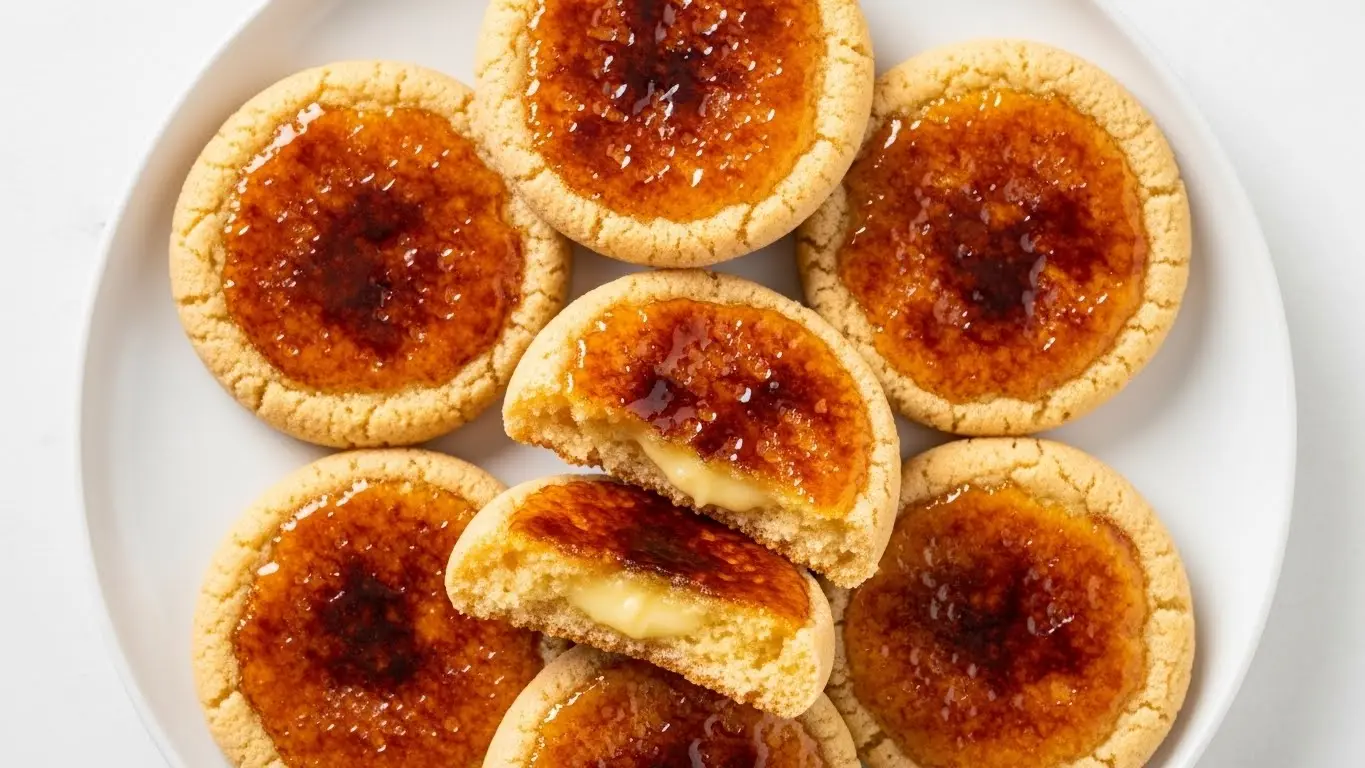
A spoon tapped against the top of these cookies makes the same thin crackle you hear with classic custard. That glassy sugar shell is the whole point.
This creme brulee cookies recipe gets that shell right on a soft, buttery vanilla base. No pastry cream, no water bath, no springform pan.
The topping is where most home versions fall flat. Brown sugar whipped into cream cheese brings the caramel-custard note that plain frosting never reaches.
You need ten everyday ingredients and about an hour from start to finish. The dough needs no chilling, so you can go straight from bowl to oven.
The cookie stays soft while the sugar on top shatters. That contrast is exactly what the crème brûlée name promises.
| Quick Recipe Summary | |
|---|---|
| Prep Time | 20 minutes |
| Cook Time | 12 minutes |
| Total Time | 1 hour (includes cooling and decorating) |
| Servings | 24 cookies |
| Difficulty Level | Easy |
For the dessert that started it all, see Creme Brulee.

Why You’ll Love This Creme Brulee Cookies Recipe
These cookies turn a restaurant dessert into something you can make in a single afternoon. Here is what makes them worth the torch.
- That signature crack. The torched sugar sets into a brittle sheet that snaps when you bite it, just like the top of a real custard.
- A soft, bakery-style cookie. The base stays tender and slightly chewy for days, not crumbly or dry.
- A topping with real caramel flavor. Brown sugar in the cream cheese layer mimics the deep, toasty notes of torched custard. I’ve found it beats a white-sugar topping every time, since white sugar just tastes sweet without that molasses depth.
- No special pan. You skip the ramekins, the water bath, and the careful oven-watching that scare people away from stovetop crème brûlée.
- Ten ingredients. Most of them are already in your kitchen, and none require a specialty store.
- Make-ahead friendly. You can bake and frost early, then torch right before serving for the best texture.
- Crowd pleaser for parties. They look impressive on a dessert table and travel well before the sugar goes on top.
- Easy to scale. The dough doubles cleanly if you need a bigger batch for a holiday spread.
You might also enjoy: Creme Brulee Cheesecake
Ingredients
Everything here is grouped into three short lists so you know exactly what belongs to the cookie, the topping, and the brûlée finish. Measure the flour by spooning it into the cup and leveling it off, or use a scale for the most reliable result.
For the cookies:
- 1 cup (226 g) unsalted butter, softened to room temperature
- 1 cup (200 g) granulated sugar
- 1 large egg, at room temperature
- 2 teaspoons pure vanilla extract
- 2 ½ cups (313 g) all-purpose flour
- 1 teaspoon baking powder
- ½ teaspoon baking soda
- ½ teaspoon salt
For the brown sugar cream cheese topping:
- 8 oz (226 g) cream cheese, softened to room temperature
- ¼ cup (57 g) unsalted butter, softened
- ½ cup (100 g) light brown sugar, packed
- 1 teaspoon pure vanilla extract
- Pinch of salt
For the brûlée finish:
- ⅓ cup (about 70 g) granulated sugar, for torching (roughly 1 teaspoon per cookie)
If you want a deeper vanilla flavor, swap the extract for 2 teaspoons of vanilla bean paste in the cookie dough. The flecks of real bean also make the cookies look a little more like the custard they are named after.
Read Also: Sugar Cookies Recipe
Kitchen Equipment Needed
You do not need much specialized gear, but one tool is non-negotiable: a torch. The rest you likely already own.
- A stand mixer or a handheld electric hand mixer for creaming the butter and whipping the topping
- A set of stainless steel mixing bowls
- Measuring cups and spoons, or a kitchen scale for accuracy
- Two half sheet baking pans
- Parchment paper or a silicone baking mat
- A cookie scoop for evenly sized dough balls
- A wire cooling rack
- An offset spatula or a piping bag and tips for the topping
- A kitchen torch for caramelizing the sugar
- A heatproof, flame-safe surface to torch on
A broiler can stand in for the torch in a pinch, but it is harder to control. More on that in the FAQ.
If you like a classic buttery cookie base, you will recognize the method in this Chocolate Chip Cookies Recipe.
Recommended Products for This Recipe
These are the items I reach for when I make this recipe, chosen because each one solved a specific problem during testing. They are optional, but they take a lot of the guesswork out of the brûlée step and the topping.
1. Nielsen-Massey Pure Vanilla
Vanilla is the backbone of anything brûlée, and a thin, imitation extract gets lost under the torched sugar. A pure, well-rounded vanilla carries through both the cookie and the topping so the flavor reads as custard, not just sweet.
2. Sondiko Kitchen Torch
A dollar-store grill lighter left half my sugar raw and scorched the other half in seconds. A proper culinary torch with an adjustable flame and a wide nozzle gave me an even melt across the whole cookie without chasing the flame around.
3. Nordic Ware Baking Sheets
Thin, dark pans baked the bottoms too fast and left me with brown edges before the centers set. Heavy, light-colored sheet pans spread the heat evenly, which keeps these cookies pale and soft the way they should be.
4. Wilton Piping Tips Set
An offset spatula works fine, but a piping bag with a round or star tip gives you a clean, even layer of topping that catches the torch flame uniformly. A tidy swirl also leaves a flat enough surface for the sugar to pool and set into a smooth shell.
For another torched treat, try: Creme Brulee French Toast

Step-by-Step Instructions: How to Make Creme Brulee Cookies
Follow these steps in order and you will have a tray of torched, custard-topped cookies ready to serve in about an hour.
Step 1: Preheat and prep your pans
- Preheat the oven to 350°F (175°C).
- Line two baking sheets with parchment paper or silicone mats.
- Set out the butter, egg, and cream cheese ahead of time so they come to room temperature. Cold ingredients will not cream or whip smoothly.
Step 2: Cream the butter and sugar
- In a large bowl, beat the 1 cup (226 g) softened butter with the 1 cup (200 g) granulated sugar.
- Mix on medium speed for 2 to 3 minutes, until the mixture turns pale and fluffy.
- Scrape down the sides of the bowl once or twice so everything blends evenly.
Step 3: Add the egg and vanilla
- Beat in the egg until fully combined.
- Add the 2 teaspoons of vanilla extract and mix again.
- The batter should look smooth and slightly glossy at this point.
Step 4: Whisk and add the dry ingredients
- In a separate bowl, whisk together the 2 ½ cups (313 g) flour, 1 teaspoon baking powder, ½ teaspoon baking soda, and ½ teaspoon salt.
- Add the dry mixture to the wet ingredients in two additions.
- Mix on low speed just until no dry streaks remain. Overmixing makes the cookies tough.
Step 5: Scoop and shape
- Use a cookie scoop to portion the dough into balls, about 1 ½ tablespoons each.
- Place them on the lined sheets, leaving at least 2 inches (5 cm) between each one.
- Bake only 6 cookies per sheet, since they spread as they bake.
Step 6: Bake the cookies
- Bake for 10 to 12 minutes, until the edges are set and the centers look puffed but still pale.
- Do not wait for them to brown. These are meant to stay light in color.
- Let the cookies rest on the hot pan for 5 minutes before moving them.
Step 7: Cool completely
- Transfer the cookies to a wire rack and let them cool fully, about 20 minutes.
- They must be at room temperature before you add the topping. Two light passes with the torch later will not save a topping that slid off a warm cookie.
Step 8: Make the brown sugar cream cheese topping
- In a clean bowl, beat the 8 oz (226 g) cream cheese with the ¼ cup (57 g) butter until smooth.
- Add the ½ cup (100 g) packed brown sugar, the 1 teaspoon vanilla, and a pinch of salt.
- Whip on medium speed for 2 to 3 minutes, until the brown sugar dissolves and the mixture is no longer grainy.
Step 9: Frost the cookies
- Spread or pipe a generous layer of topping onto each cooled cookie.
- Keep the surface fairly flat and level, which helps the sugar melt into an even sheet.
- Leave a small border around the edge so the topping does not drip when torched.
Step 10: Sugar and torch
- Sprinkle about 1 teaspoon of granulated sugar evenly over the topping of each cookie.
- Hold the torch a few inches above the surface and move it in slow passes until the sugar melts, bubbles, and turns amber.
- Work in two light passes rather than one long blast, so the cream cheese underneath stays set.
- Let the torched sugar harden for a minute or two, then serve.
Another recipe that leans on a torched sugar finish is this Creme Brulee French Toast Casserole.

Tips for The Best Creme Brulee Cookies
A few small habits make the difference between a tidy, glassy top and a melted, sliding mess. Keep these in mind as you go.
- Cool the cookies all the way. My first few batches slid apart because I frosted them while they were still warm from the oven. Patience here is everything.
- Use room-temperature cream cheese and butter. Cold dairy leaves lumps that never fully smooth out, even with long whipping.
- Pack the brown sugar. Loosely measured brown sugar gives a weaker caramel flavor. Press it firmly into the cup.
- Torch just before serving. The shell is at its crispest within the first hour. After that it slowly softens as it absorbs moisture from the topping.
- Keep the flame moving. A still flame burns one spot black while leaving the rest raw. Slow, steady passes give an even amber color.
- Work on a heatproof surface. Torch over a metal sheet pan or a stone trivet, never directly on a countertop.
- Granulated sugar sets best. It caramelizes into a cleaner, glassier shell than powdered or raw sugar, which tend to clump or scorch unevenly.
- Chill briefly if the topping is soft. On a hot day, a 10-minute stint in the fridge firms the topping before torching so it holds its shape.
Read Also: Peanut Butter Cookies Recipe
What to Serve with Creme Brulee Cookies
These cookies are rich, so they pair best with something warm and not too sweet. The contrast of a hot drink against the cold, creamy topping is part of the fun. Here are pairings that work well on a dessert table or at the end of a meal.
- A mug of Hot Chocolate, with the warm chocolate playing off the caramelized sugar
- A Pumpkin Spice Latte for a cozy fall pairing
- A glass of chilled Eggnog during the holidays
- A simple espresso or black coffee to cut the sweetness
- A scoop of vanilla bean ice cream alongside for an extra-indulgent plate
- Fresh berries, especially raspberries or strawberries, for a tart contrast
- A pot of hot tea, such as Earl Grey or chamomile
- A small glass of dessert wine or tawny port for an adult gathering
You might also like: Pumpkin Cheesecake
Variations of Creme Brulee Cookies
Once you have the base down, there are easy ways to change the flavor without reworking the whole recipe. Try one of these the next time around.
- Coffee brûlée: Dissolve 1 teaspoon of espresso powder into the topping for a mocha-leaning twist.
- Citrus brûlée: Add the zest of one orange or lemon to the cream cheese layer for brightness against the caramel.
- Chocolate base: Swap ¼ cup of the flour for cocoa powder to turn the cookie into a chocolate version.
- Maple topping: Replace half the brown sugar in the topping with 2 tablespoons of pure maple syrup for a woodsy note.
- Spiced: Stir ½ teaspoon of cinnamon or a pinch of nutmeg into the dough for a warmer, holiday feel.
- Stuffed: Press a small spoonful of thick custard or pastry cream into the center of each dough ball before baking for a true filled cookie.
- Vanilla bean: Use vanilla bean paste in both the cookie and topping for visible flecks and a stronger aroma. I keep a jar of paste on hand just for recipes like this, since the specks sell the custard look better than extract alone.
For a seasonal cookie in the same spirit, try the Eggnog Cookies Recipe.
Storage and Reheating
The cookies themselves keep well, but the torched sugar shell is a short-lived thing. Plan your timing around when you want to serve. Here is how to handle each stage.
- Room temperature: Frosted and torched cookies hold for up to 2 days in an airtight container. The sugar shell softens over time but the cookies still taste great.
- Refrigerator: Because of the cream cheese topping, store them in the fridge if keeping longer than a day. They will last up to 5 days chilled.
- Best practice: Bake and frost ahead, then store un-torched. Add the sugar and torch within an hour of serving for the crispest shell.
- Freezing the cookies: Freeze the plain, unfrosted baked cookies in a freezer bag for up to 3 months. Thaw at room temperature before frosting.
- Freezing the dough: Scoop dough balls and freeze them on a tray, then transfer to a bag. Bake from frozen, adding 1 to 2 minutes to the time.
- Re-crisping the top: You cannot truly reheat the sugar shell. If the top has softened, add a fresh pinch of sugar and give it a quick torch again.
- Avoid the microwave: Warming these melts the topping and ruins the shell entirely.
For a make-ahead treat, see: No Bake Cookies Recipe
Nutritional Facts
The values below are an estimate for one cookie, based on a batch of 24. Actual numbers will vary with brands and the exact amount of topping and sugar you use.
| Nutrient | Amount per cookie |
|---|---|
| Calories | 245 kcal |
| Total Fat | 13 g |
| Saturated Fat | 8 g |
| Cholesterol | 42 mg |
| Sodium | 130 mg |
| Total Carbohydrates | 30 g |
| Sugars | 21 g |
| Protein | 2 g |
Read Also: Gingerbread Cookie Recipe
Health Benefits of Key Ingredients
These are a treat, plain and simple, but a few of the core ingredients do bring something to the table beyond flavor. Here is what the main components contribute.
- Eggs: The single egg adds a small amount of complete protein along with choline, which supports normal cell function.
- Dairy from butter and cream cheese: Both supply fat-soluble vitamins like vitamin A, and cream cheese contributes a little calcium.
- Vanilla: Pure vanilla contains trace antioxidant compounds and, more importantly, lets you feel satisfied with less added flavoring.
- Flour: All-purpose flour provides carbohydrates for energy and, when enriched, small amounts of iron and B vitamins.
- Brown sugar: It carries trace minerals from molasses that white sugar lacks, though the amount is minor.
- Portion control built in: Because each cookie is small and rich, one is usually enough, which naturally keeps the serving modest.
A simple everyday cookie worth bookmarking is this Oatmeal Cookies Recipe.
FAQs About Creme Brulee Cookies
1. Can I make creme brulee cookies without a torch?
Yes, though a torch gives the best control. Place the sugared cookies on a baking sheet and run them under a hot broiler for 1 to 2 minutes.
Watch them constantly, since the sugar goes from melted to burnt in seconds. The cookies may soften slightly from the broiler heat, so let them cool before serving.
2. Why did my topping melt when I torched the cookies?
This usually means the flame sat in one place too long or got too close. Hold the torch a few inches away and keep it moving in slow passes.
It can also happen if the cookies were not fully chilled or cooled. A firm, cold topping holds up far better under the flame.
3. What kind of sugar is best for the brûlée top?
Plain granulated sugar is the most reliable choice. It melts evenly and sets into a smooth, glassy sheet.
Coarse or raw sugars take longer to melt and can scorch before they fully caramelize. Powdered sugar burns too quickly and is not recommended.
4. Can I make these ahead of time?
You can, with one key step saved for last. Bake and frost the cookies up to a day ahead and keep them chilled.
Add the sugar and torch the tops within an hour of serving. This keeps the shell crisp instead of letting it dissolve into the topping.
5. Why did my cookies spread too much?
The most common cause is butter that was too soft or even partly melted. It should be soft enough to dent but still cool to the touch.
Baking too many cookies close together also forces them to spread into each other. Give each one at least 2 inches of space.
6. Do these cookies get soggy?
The sugar shell softens over several hours as it draws moisture from the topping. The cookie itself stays soft and pleasant.
For the signature crackle, torch right before serving. Any leftovers are still delicious, just without the crisp top.
Read Also: Another classic to bookmark is this Authentic Italian Tiramisu Recipe.
Creme Brulee Cookies
Ingredients
- 1 cup unsalted butter - 226g, softened to room temperature
- 1 cup granulated sugar - 200g
- 1 large egg - at room temperature
- 2 teaspoons pure vanilla extract - or 2 teaspoons vanilla bean paste for deeper flavor
- 2 ½ cups all-purpose flour - 313g, spooned and leveled
- 1 teaspoon baking powder
- ½ teaspoon baking soda
- ½ teaspoon salt
- 8 oz cream cheese - 226g, softened to room temperature
- ¼ cup unsalted butter - 57g, softened
- ½ cup light brown sugar - 100g, packed
- 1 teaspoon pure vanilla extract
- salt - a pinch
- ⅓ cup granulated sugar - about 70g, for torching, roughly 1 teaspoon per cookie
Equipment
- Stand mixer or electric hand mixer - For creaming the butter and whipping the topping
- Stainless steel mixing bowls - One large bowl for the dough and a separate bowl for the dry ingredients
- Measuring cups and spoons - Or a kitchen scale for accuracy
- Half sheet baking pans - Two pans, light-colored for even baking
- Parchment paper or silicone baking mat - For lining the baking sheets
- Cookie scoop - About 1 ½ tablespoons, for evenly sized dough balls
- Wire cooling rack - For cooling the cookies completely
- Offset spatula or piping bag and tips - For spreading or piping the topping
- Kitchen torch - Essential for caramelizing the sugar topping; a broiler can stand in but is harder to control
- Heatproof, flame-safe surface - A metal sheet pan or stone trivet to torch on
Method
- Preheat the oven to 350°F (175°C) and line two baking sheets with parchment paper or silicone mats. Set out the butter, egg, and cream cheese ahead of time so they come to room temperature.
- In a large bowl, beat the softened butter with the granulated sugar on medium speed for 2 to 3 minutes, until pale and fluffy, scraping down the sides as needed.
- Beat in the egg until fully combined, then add the vanilla extract and mix again until the batter looks smooth and slightly glossy.
- In a separate bowl, whisk together the flour, baking powder, baking soda, and salt. Add the dry mixture to the wet ingredients in two additions, mixing on low just until no dry streaks remain.
- Use a cookie scoop to portion the dough into balls about 1 ½ tablespoons each, placing them on the lined sheets with at least 2 inches between each one and only 6 cookies per sheet.
- Bake for 10 to 12 minutes, until the edges are set and the centers look puffed but still pale. Do not wait for them to brown.
- Let the cookies rest on the hot pan for 5 minutes, then transfer to a wire rack and cool fully, about 20 minutes, before adding the topping.
- In a clean bowl, beat the cream cheese with the butter until smooth, then add the brown sugar, vanilla, and a pinch of salt. Whip on medium speed for 2 to 3 minutes, until the brown sugar dissolves and the mixture is no longer grainy.
- Spread or pipe a generous, fairly flat layer of topping onto each cooled cookie, leaving a small border around the edge so it does not drip when torched.
- Sprinkle about 1 teaspoon of granulated sugar evenly over each topping, then hold a torch a few inches above and move it in slow passes until the sugar melts, bubbles, and turns amber. Work in two light passes and let the sugar harden for a minute or two before serving.
Nutrition
Notes
- Cool the cookies all the way: Frosting warm cookies makes the topping slide off. Wait until they are completely at room temperature.
- Use room-temperature dairy: Cold cream cheese and butter leave lumps that never fully smooth out, even with long whipping.
- Pack the brown sugar: Press it firmly into the measuring cup; loosely measured brown sugar gives a weaker caramel flavor.
- Torch just before serving: The sugar shell is at its crispest within the first hour, then slowly softens as it absorbs moisture from the topping.
- Keep the flame moving: A still flame burns one spot black while leaving the rest raw. Slow, steady passes give an even amber color.
- Work on a heatproof surface: Torch over a metal sheet pan or a stone trivet, never directly on a countertop.
- Granulated sugar sets best: It caramelizes into a cleaner, glassier shell than powdered or raw sugar, which tend to clump or scorch unevenly.
- Make-ahead: Bake and frost up to a day ahead and keep chilled, then add the sugar and torch within an hour of serving.
- Storage: Store frosted and torched cookies in an airtight container at room temperature for up to 2 days, or in the fridge for up to 5 days because of the cream cheese topping.
- Freezing: Freeze plain, unfrosted baked cookies for up to 3 months, or freeze scooped dough balls and bake from frozen, adding 1 to 2 minutes to the bake time.
- No torch? Run the sugared cookies under a hot broiler for 1 to 2 minutes, watching constantly, since the sugar goes from melted to burnt in seconds.
Private Notes
Tried this recipe?
Let us know how it was!Final Thoughts
Crème brûlée always felt like a dessert you had to order out. These cookies prove you can get that same torched-sugar moment at home with a mixing bowl and a torch.
The soft cookie, the tangy brown sugar topping, and the shattering shell come together into something that feels far fancier than the effort it takes. That gap between how easy they are and how impressive they look is exactly why they are worth making.
Give this creme brulee cookies recipe a try the next time you want to wow a table without the stress. Torch one, tap the top, and listen for that crack.
If you make them, I would love to hear how they turned out. Leave a comment below and share the recipe with a friend who loves crème brûlée as much as you do.
Recommended:
- Oatmeal Raisin Cookie Recipe
- Healthy Chocolate Chip Cookies Recipe
- Fudge Recipe
- Fudge Brownie Recipe
- Coconut Cream Pie Recipe
- Red Velvet Cake Recipe
- Pecan Pie Recipe
- Apple Pie Recipe
- Pumpkin Pie Recipe
- Hot Chocolate Mix Recipe