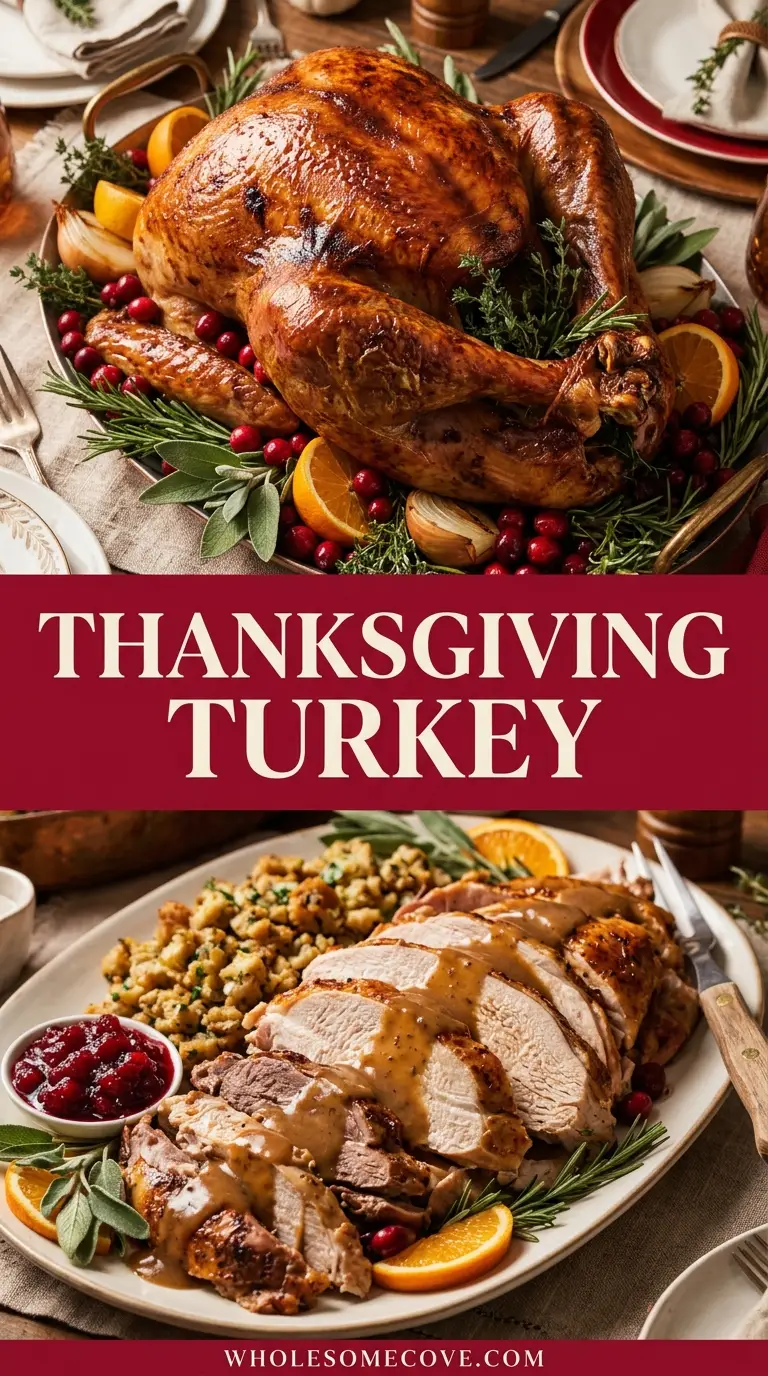
A dry breast is the classic roast turkey problem. White meat is done at 165°F, while thighs taste best closer to 175°F.
This Thanksgiving turkey recipe fixes that with a full cup of herb butter pushed under the skin, directly against the breast meat.
Foil goes over the bird once the skin turns golden, so the breast coasts while the dark meat catches up. A 14 to 16 pound bird roasts at 325°F in about 4 hours, and a 30-minute rest finishes the job.
The seasoning is the classic mix of sage, thyme, rosemary, garlic, and lemon zest. No brine bucket, no oven bag, and no special equipment beyond a good thermometer.
| Quick Recipe Summary | |
|---|---|
| Prep Time | 30 minutes |
| Cook Time | 4 hours 30 minutes (4-hour roast plus 30-minute rest) |
| Total Time | 5 hours |
| Servings | 14 servings |
| Difficulty Level | Easy |
Read Also: Roast Chicken Recipe
Why You’ll Love This Thanksgiving Turkey Recipe
This turkey follows the standard 325°F roasting method, so the timing is predictable. The herb butter handles both the seasoning and the browning.
- Juicy breast meat: Butter spread directly on the meat under the skin keeps the lean breast from drying out while the thighs finish cooking.
- Traditional flavor: Sage, thyme, rosemary, garlic, and lemon give the turkey the taste most people expect at a Thanksgiving table.
- Predictable timing: A 14 to 16 pound unstuffed bird needs about 4 hours at 325°F, followed by a 30-minute rest.
- Feeds a crowd: One pound of turkey per person is the standard guideline, so this bird serves 14 with a little extra.
- Gravy built in: The carrots, celery, and broth in the pan turn into a flavorful base for gravy while the turkey roasts.
- Make-ahead friendly: The herb butter keeps in the refrigerator for up to 3 days, which removes one job from Thanksgiving morning.
- Everyday ingredients: Everything comes from a regular grocery store, and no brining or cheesecloth is needed.
A similar herb-and-butter approach works on Honey Butter Chicken Recipe.
Ingredients
Measure the herbs after chopping, and pull the butter out of the refrigerator an hour before you start so it spreads easily. The turkey must be fully thawed before you begin, because frozen skin will not hold the herb butter.
For the turkey:
- 1 whole turkey, 14 to 16 pounds (6.4 to 7.3 kg), fully thawed (allow 3 to 4 days in the refrigerator), giblets and neck removed
- 1 large lemon, zested first, then cut in half
- 1 large yellow onion (about 300 g), quartered
- 1 head garlic, cut in half crosswise
- 2 celery ribs, quartered, for the cavity
- 4 sprigs fresh thyme
- 4 sprigs fresh sage
- 2 sprigs fresh rosemary
- 2 tablespoons (about 17 g) kosher salt, divided: 1 tablespoon goes in the herb butter, ½ tablespoon in the cavity, and ½ tablespoon on the skin (use half as much if your salt is Morton)
- 1½ teaspoons (about 3 g) freshly ground black pepper, divided: 1 teaspoon goes in the herb butter and ½ teaspoon in the cavity
For the herb butter:
- 1 cup (2 sticks, 227 g) Kerrygold unsalted butter, softened
- 2 tablespoons (about 8 g) fresh sage, finely chopped
- 2 tablespoons (about 6 g) fresh thyme leaves, finely chopped
- 1 tablespoon (about 3 g) fresh rosemary, finely chopped
- 4 garlic cloves (about 12 g), minced
- Zest of 1 large lemon (about 1 tablespoon)
For the roasting pan:
- 2 large carrots (about 200 g), cut into 2-inch (5 cm) chunks
- 2 celery ribs (about 100 g), cut into 2-inch (5 cm) chunks
- 2 cups (480 ml) low-sodium chicken broth, plus up to 1 cup (240 ml) more if the pan runs dry
Plan ahead: The turkey needs 3 to 4 days to thaw in the refrigerator, at about 24 hours for every 4 to 5 pounds. That time is not included in the summary above.
You might also enjoy: Honey Butter Recipe
Kitchen Equipment Needed
You do not need much, but a few tools turn a guessing game into a predictable result. A sturdy pan and a real thermometer matter most, and the rest is standard kitchen gear.
- Roasting pan with rack: A sturdy pan about 16 x 13 inches (40 x 33 cm) with a rack keeps the turkey off the pan bottom so the underside roasts instead of stews.
- Instant-read meat thermometer: This is the only reliable way to confirm 165°F in the breast, thigh, and wing.
- Butcher’s twine: Used to tie the legs together so the bird roasts evenly and holds its shape.
- Microplane zester: Takes the lemon zest off without the bitter white pith.
- Turkey baster: Pulls pan juices up for basting without tipping the hot pan.
- Heavy-duty aluminum foil: For tenting the breast and for covering the turkey while it rests.
- Carving board with juice groove: Catches the juices released during carving so they stay off the counter.
- Heat-resistant oven mitts: A 15 pound bird in a full pan is heavy and hot, so thin towels will not cut it.
- Digital kitchen timer: Keeps the baste schedule and the rest time honest while you handle everything else.
- Large mixing bowl and fork: For mashing the herb butter until smooth.
- Paper towels: For drying the turkey inside and out.
- Cutting board and chef’s knife: For chopping the herbs and quartering the onion.
Read Also: Prime Rib Recipe
Recommended Products for This Recipe
These are my personal recommendations, chosen because each one solves a specific turkey problem, from undercooked thighs to a roasting pan that buckles under a heavy bird.
1. ThermoWorks Thermapen ONE
The biggest cause of dry turkey is guessing. This thermometer reads in about a second, so you can check the breast, thigh, and wing without leaving the oven door open long enough to drop the temperature.
2. ThermoWorks ChefAlarm Leave-In Probe Thermometer
A leave-in probe in the thickest part of the thigh lets you watch the temperature climb from the counter. It also means you open the oven far less often, which keeps the heat steady and the skin crisp.
3. All-Clad Stainless Steel Roasting Pan with Rack
Thin disposable pans flex when you lift a full turkey, which is how drippings end up on the oven floor. This heavy pan stays rigid, and the rack holds the bird above the broth for even browning.
4. Wüsthof Classic Carving Knife Set
A dull knife shreds turkey breast instead of slicing it. A long, thin carving blade and a sturdy fork let you take off whole slices that stay intact on the platter.
5. OXO Good Grips Fat Separator
Pan drippings from a butter-rubbed turkey carry a lot of fat. A separator pours the flavorful juices out from under the fat in one step, which gives you a cleaner base for gravy.
For another holiday main that relies on a thermometer for doneness, see Honey Glazed Ham Recipe.
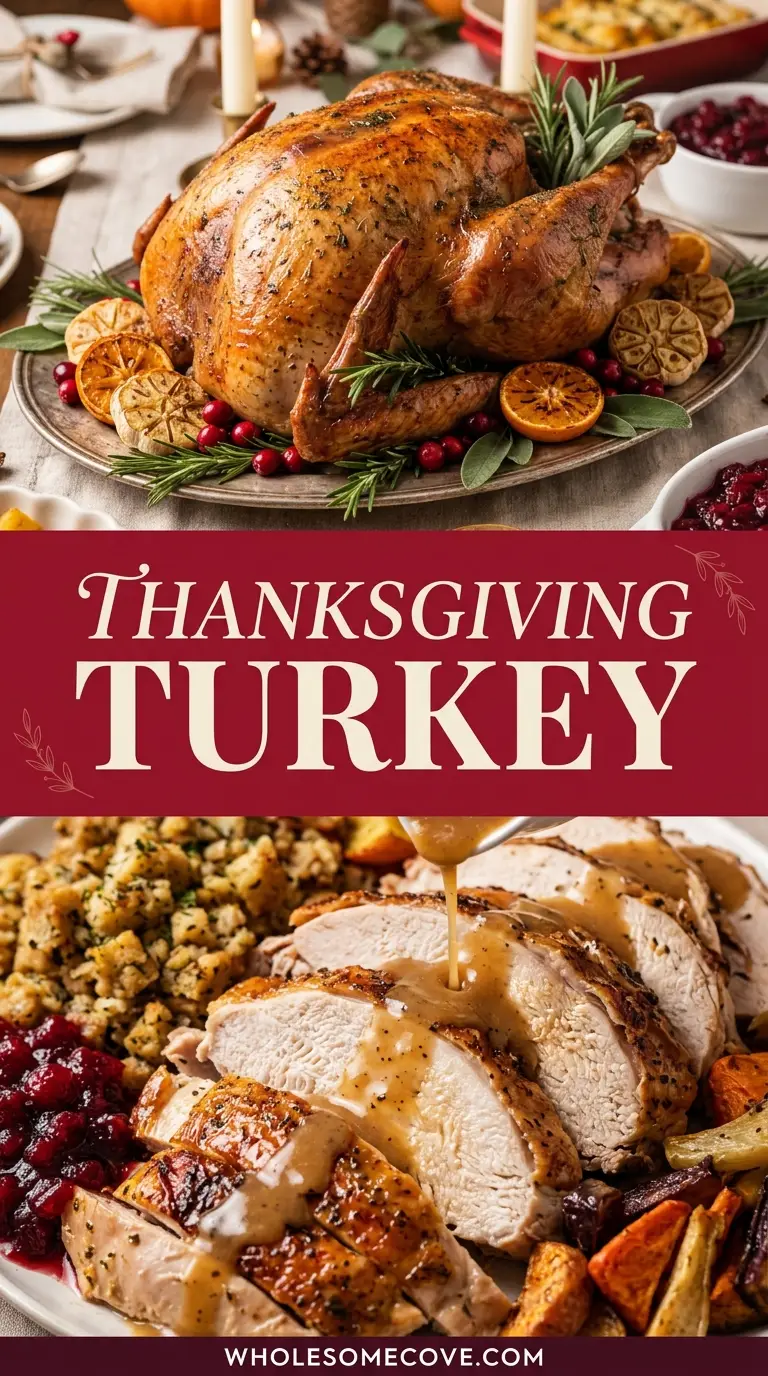
Step-by-Step Instructions: How to Make Thanksgiving Turkey
Follow these steps in order and you will have a juicy, golden turkey on the table without any guesswork.
1. Prepare the Oven and the Turkey
- Move one oven rack to the lowest position and remove the other racks so the turkey fits.
- Preheat the oven to 325°F (165°C).
- Unwrap the thawed turkey and remove the neck and giblet bag from both the main cavity and the neck cavity. Save them for gravy or discard them.
- Pat the turkey completely dry, inside and out, with paper towels. Do not rinse it, because the USDA advises against washing raw poultry.
- Leave the turkey on the counter for about 30 minutes while you make the herb butter. Dry skin browns better than damp skin.
2. Make the Herb Butter
- Zest the lemon into a large bowl using a microplane, then set the zested lemon aside for the cavity.
- Add the softened butter, sage, thyme, rosemary, minced garlic, 1 tablespoon of the kosher salt, and 1 teaspoon of the black pepper.
- Mash everything together with a fork until the butter is smooth and evenly speckled with herbs.
- Divide the herb butter in half. One half goes under the skin and the other half goes on the outside.
3. Season and Butter the Turkey
- Place the turkey breast side up on the rack in the roasting pan.
- Sprinkle ½ tablespoon of kosher salt and ½ teaspoon of black pepper inside the main cavity.
- Slide your fingers between the skin and the breast meat, starting at the cavity opening. Loosen the skin over the breast and down over the thighs without tearing it.
- Spread half of the herb butter directly onto the meat under the skin, pressing it evenly over each breast and thigh.
- Rub the remaining herb butter all over the outside of the turkey, including the legs and wings.
- Sprinkle the remaining ½ tablespoon of kosher salt over the skin.
4. Fill the Cavity and Truss the Bird
- Place the onion quarters, the zested lemon halves, the halved garlic head, the 2 quartered celery ribs, the thyme sprigs, the sage sprigs, and the rosemary sprigs inside the main cavity. Do not pack them tightly.
- Tuck the wing tips behind the turkey’s back so they do not burn.
- Tie the legs together with butcher’s twine.
5. Set Up the Roasting Pan
- Scatter the carrot chunks and the 2 chopped celery ribs around the turkey in the bottom of the pan.
- Pour 2 cups (480 ml) of chicken broth into the pan, pouring it around the turkey rather than over it so the herb butter stays on the skin.
6. Roast the Turkey
- Put the pan in the oven and roast uncovered at 325°F (165°C) for about 1½ hours, until the skin begins to turn golden.
- Baste the turkey with the pan juices at the 1½ hour mark, and then every 45 minutes after that.
- When the skin is a deep golden brown, usually after 2 to 2½ hours, cover the breast loosely with a tent of foil.
- If the pan looks dry, add up to 1 cup (240 ml) more chicken broth.
- Begin checking the temperature at the 3-hour mark. Insert the thermometer into the thickest part of the breast, the innermost part of the thigh, and the wing, without touching bone.
- Remove the turkey when the breast and thigh both read at least 165°F (74°C). A 14 to 16 pound bird usually takes 3¾ to 4¼ hours in total.
7. Rest, Carve, and Serve
- Lift the turkey onto a carving board, tilting it slightly so the juices in the cavity run into the pan.
- Tent the turkey loosely with foil and let it rest for 30 minutes before carving. Use this time to make gravy and finish the side dishes.
- Pour the pan juices through a fine strainer into a fat separator and save them for gravy.
- Remove the legs and thighs first, then the wings, then slice the breast across the grain.
For the pan drippings, try: Giblet Gravy Recipe
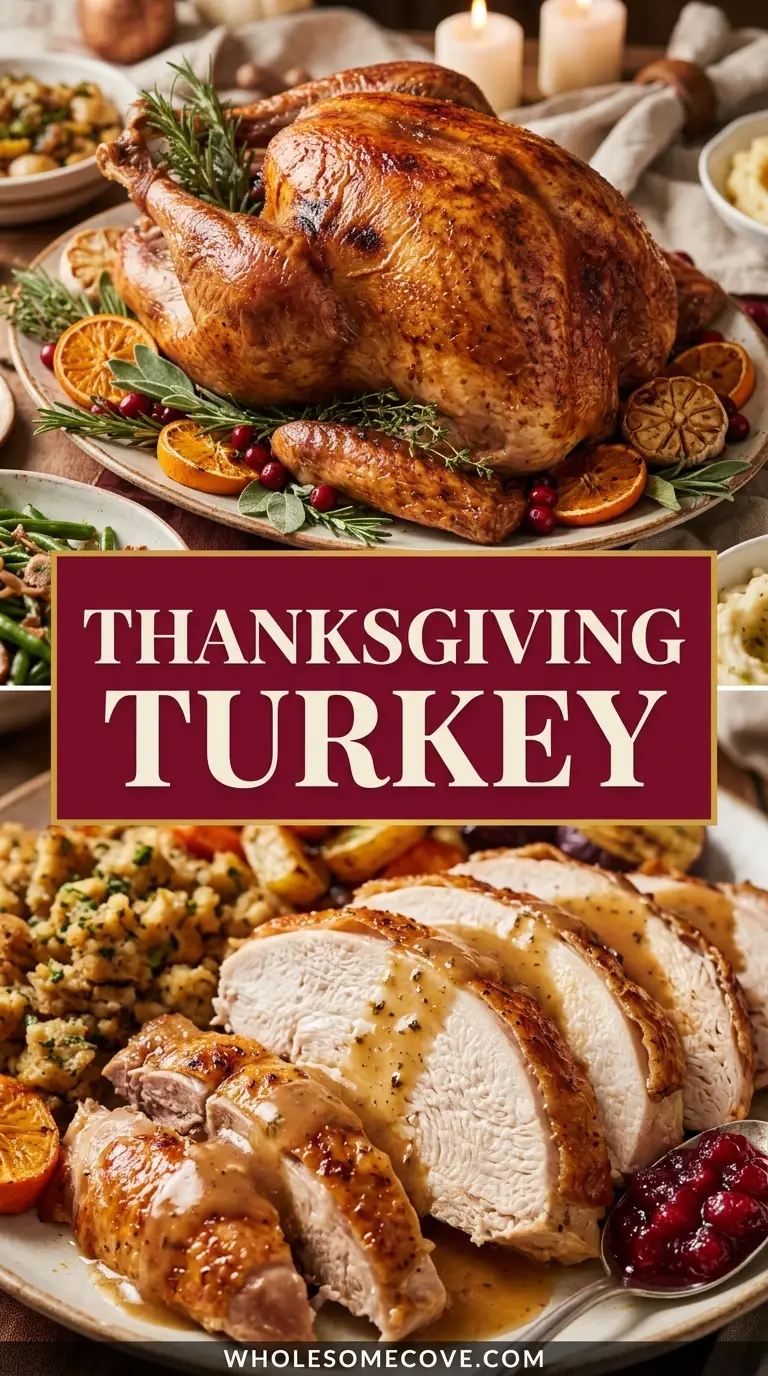
Tips for The Best Thanksgiving Turkey
These habits make the biggest difference between a good turkey and a great one, and most of them cost nothing.
- Thaw early and in the refrigerator. The USDA recommends about 24 hours per 4 to 5 pounds, so a 15 pound turkey goes in the refrigerator on Sunday for a Thursday dinner. A thawed turkey can then wait in the fridge 1 to 2 days.
- Dry the skin completely. Wet skin steams instead of browning, so pat the turkey well before you add the herb butter.
- Baste less often than you think. I ruined the skin on an early bird by basting every 20 minutes, because the repeated door-opening dropped the oven temperature and left the skin soft. Basting every 45 minutes fixed it.
- Mince the sage fine. Sage scorches faster than thyme or rosemary when it sits on top of the skin, so chop it small and work it into the butter rather than tucking whole leaves on the surface.
- Trust the thermometer, not the clock. The roasting times are estimates, and your oven, the turkey’s shape, and the starting temperature all shift them.
- Place the probe correctly. The thickest part of the breast and the innermost part of the thigh are the slowest to heat. Keep the tip away from bone, which reads hotter than the meat.
- Keep a leave-in probe in the thigh. I’ve found that a leave-in probe beats a hand-held one for this job, since the oven stays closed and the temperature stays steady.
- Store the twine with the roasting pan. I keep a roll of butcher’s twine in the same cabinet because trussing takes under two minutes and keeps the legs from splaying and drying out.
- Do not skip the rest. Thirty minutes under foil lets the juices settle, so the slices stay moist on the platter.
- Make the herb butter ahead. It keeps in the refrigerator for up to 3 days, so soften it on the counter an hour before you need it.
Read Also: Best Gravy Recipes
What to Serve with Thanksgiving Turkey
A turkey this classic goes with the full holiday spread, and each of these sides works with the sage, thyme, and rosemary in the herb butter. The pairings below cover starch, vegetables, something tart, and a finish.
- Mashed Potatoes: Smooth and buttery, and they catch the pan gravy.
- Turkey Gravy: Built from the strained pan juices and a quick roux.
- Thanksgiving Stuffing: Baked in a separate dish so the turkey cooks evenly and safely.
- Cranberry Sauce: The tartness cuts through the butter.
- Green Bean Casserole: A classic holiday side with crisp onion topping.
- Sweet Potato Casserole: Sweet and soft next to the savory herbs.
- Dinner Rolls: For mopping up gravy and building leftover sandwiches.
- Roasted Brussels Sprouts with Bacon: Salty and caramelized, with a bit of bite.
- Maple Glazed Carrots: A sweet, tender vegetable that balances the plate.
- Creamed Spinach: Rich and creamy, and a good way to get greens on the table.
- Pumpkin Pie: The traditional dessert to finish the meal.
- Mulled Apple Cider: A warm, spiced drink that suits the herbs and fall flavors.
- Dry white wine, such as Chardonnay or Pinot Gris, for guests who prefer wine.
Another table favorite: Cranberry Jello Salad Recipe
Variations of Thanksgiving Turkey
Once you have the classic version down, a few changes alter the flavor or the cooking method without changing the basic approach.
- Dry-brined turkey: Rub the thawed bird with kosher salt (about 1 tablespoon per 4 pounds) and refrigerate it uncovered for 1 to 3 days before roasting. Skip the extra salt on the skin and in the cavity if you do this.
- Wet-brined turkey: Soak the turkey in a saltwater brine for 12 to 24 hours. In an Allrecipes roundup, seven of eight chefs named brining as their secret to a juicy bird.
- Cheesecloth turkey: Soak a double layer of cheesecloth in melted butter and drape it over the breast. Remove it for the last 45 minutes or so so the skin can brown.
- Spatchcock turkey: Remove the backbone and flatten the bird. It shortens roasting time considerably and browns the skin more evenly, but it needs its own timing and temperature.
- Citrus-herb turkey: Swap the lemon for an orange in the cavity and add orange zest to the herb butter.
- Maple-butter finish: Brush the turkey with a mix of 2 tablespoons melted butter and 2 tablespoons maple syrup during the last 30 minutes of roasting.
A different holiday centerpiece with a sweet glaze is Spiral Ham Recipe.
Storage and Reheating
Cooked turkey needs to move to the refrigerator quickly, and leftovers keep better if you carve them off the bone first.
- Cool quickly: Refrigerate leftover turkey within 2 hours of coming out of the oven. Discard turkey that has sat at room temperature longer than that.
- Carve before storing: Cut the meat off the bones and store it in shallow airtight containers. The bones make good stock.
- Refrigerator: Leftovers keep for 3 to 4 days.
- Freezer: Wrap slices tightly or freeze them in a little broth. They keep their best quality for 2 to 3 months.
- Reheat in the oven: Place the turkey in a baking dish with a splash of broth, cover, and heat at 325°F (165°C).
- Reheat in the microwave: Cover the turkey, rotate it for even heating, and let it stand briefly.
- Check the temperature: Reheat all turkey to an internal temperature of 165°F (74°C).
For leftover turkey, try: Turkey Wild Rice Soup Recipe
Nutritional Facts
These values are estimates for one serving of about 6 ounces (170 g) of cooked turkey with skin and a share of the herb butter. Actual numbers vary with the turkey, the portion, and how much butter you eat.
| Nutrition per Serving (Estimated) | |
|---|---|
| Calories | 410 kcal |
| Protein | 46 g |
| Total Fat | 23 g |
| Saturated Fat | 8 g |
| Carbohydrates | 1 g |
| Fiber | 0 g |
| Sugar | 0 g |
| Cholesterol | 170 mg |
| Sodium | 450 mg |
Read Also: Healthy Pumpkin Pie Recipe
Health Benefits of Key Ingredients
Most of the nutrition in this meal comes from the turkey itself, with the herbs, garlic, and vegetables adding small amounts of vitamins and plant compounds.
- Turkey: A strong source of lean protein, and it supplies B vitamins such as niacin and B6, along with selenium and zinc.
- Garlic: Contains sulfur compounds, including allicin, that form when it is chopped or crushed.
- Sage, thyme, and rosemary: These herbs contain polyphenols, which are plant antioxidants, and they add flavor without adding calories.
- Lemon: Provides vitamin C, and the zest carries aromatic oils that brighten the butter.
- Onion: Adds quercetin, a flavonoid found in onions, along with a little fiber.
- Carrots: Rich in beta-carotene, which the body converts to vitamin A.
- Celery: Adds fiber, potassium, and vitamin K with very few calories.
- Butter: Contains vitamin A, though it is high in saturated fat, so the herb butter is worth enjoying in moderation.
Another seasonal recipe worth a look is Roasted Butternut Squash Soup Recipe.
FAQs About Thanksgiving Turkey
1. How long does it take to cook a 15-pound turkey?
A 14 to 16 pound unstuffed turkey needs roughly 3¾ to 4¼ hours at 325°F. Start checking the temperature about 30 minutes before the low end of that range.
2. Should I cover the turkey with foil while it roasts?
Yes, but only after the skin turns golden, usually around the 2 to 2½ hour mark. Foil too early traps moisture against the skin and keeps it from crisping.
3. Do I need to wash the turkey before cooking?
No, the USDA advises against washing raw poultry because splashing can spread bacteria around your kitchen. Pat the turkey dry with paper towels instead.
4. How much turkey do I need per person?
Plan on 1 pound of whole turkey per person, or 1½ pounds if you want leftovers. A 14 to 16 pound bird covers 14 people with a little extra.
5. How long does it take to thaw a turkey?
Thaw in the refrigerator at 40°F or below, allowing about 24 hours for every 4 to 5 pounds. A 14 to 16 pound turkey needs 3 to 4 days.
6. Can I cook a turkey from frozen?
Yes, the USDA says it is safe, but plan on at least 50 percent more cooking time. The herb butter will not work under frozen skin, so this recipe is best with a thawed bird.
7. What temperature is a turkey done?
The USDA minimum is 165°F in the thickest part of the breast, the innermost thigh, and the wing. Many cooks let thighs climb to 175°F for more tender dark meat.
8. How long should a turkey rest before carving?
Rest the turkey for 30 minutes, tented loosely with foil. The juices settle during that time, and the meat slices cleanly instead of falling apart.
More seasonal ideas: Fall Dinner Recipes
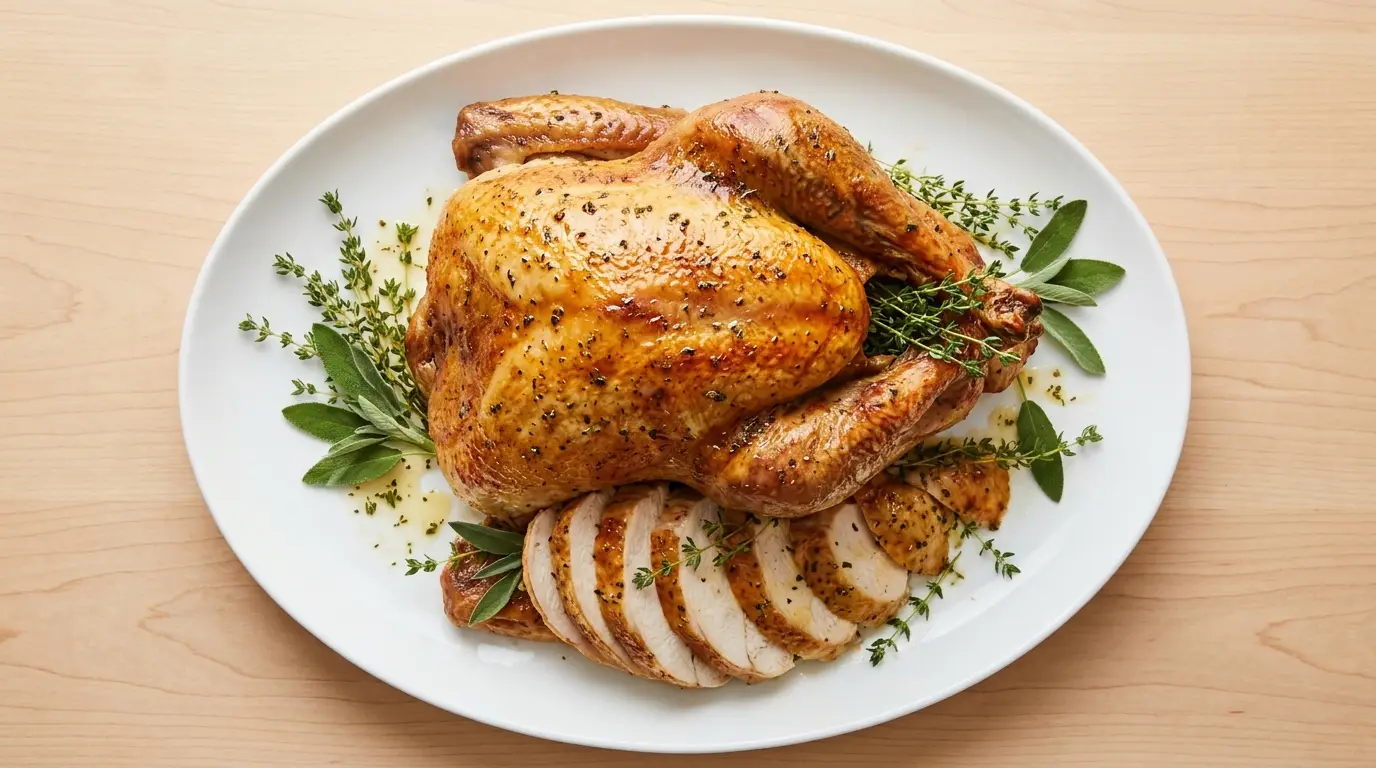
Thanksgiving Turkey
Ingredients
- 1 whole turkey - 14 to 16 pounds (6.4 to 7.3 kg), fully thawed, giblets and neck removed
- 1 large lemon - zested first, then cut in half
- 1 large yellow onion - about 300 g, quartered
- 1 head garlic - cut in half crosswise
- 2 ribs celery - quartered, for the cavity
- 4 sprigs fresh thyme
- 4 sprigs fresh sage
- 2 sprigs fresh rosemary
- 2 tablespoons kosher salt - about 17 g, divided; use half as much if using Morton
- 1½ teaspoons freshly ground black pepper - about 3 g, divided
- 1 cup Kerrygold unsalted butter - 2 sticks, 227 g, softened
- 2 tablespoons fresh sage - about 8 g, finely chopped
- 2 tablespoons fresh thyme leaves - about 6 g, finely chopped
- 1 tablespoon fresh rosemary - about 3 g, finely chopped
- 4 cloves garlic - about 12 g, minced
- 1 tablespoon lemon zest - zest of 1 large lemon
- 2 large carrots - about 200 g, cut into 2-inch (5 cm) chunks
- 2 ribs celery - about 100 g, cut into 2-inch (5 cm) chunks
- 2 cups low-sodium chicken broth - 480 ml, plus up to 1 cup (240 ml) more if the pan runs dry
Equipment
- Roasting pan with rack - Sturdy pan about 16 x 13 inches (40 x 33 cm) with a rack to keep the turkey off the pan bottom
- Instant-read meat thermometer - To confirm 165°F in the breast, thigh, and wing
- Butcher’s twine - For tying the legs together
- Microplane zester - For removing lemon zest without the bitter white pith
- Turkey baster - For basting with pan juices
- Heavy-duty aluminum foil - For tenting the breast and covering the turkey while it rests
- Carving board with juice groove - Catches juices released during carving
- Heat-resistant oven mitts - For handling the heavy, hot roasting pan
- Digital kitchen timer - Keeps the baste schedule and rest time on track
- Large mixing bowl and fork - For mashing the herb butter until smooth
- Paper towels - For drying the turkey inside and out
- Cutting board and chef’s knife - For chopping the herbs and quartering the onion
Method
- Move one oven rack to the lowest position, remove the other racks, and preheat the oven to 325°F (165°C).
- Unwrap the thawed turkey, remove the neck and giblet bag from both cavities, and pat it completely dry inside and out with paper towels (do not rinse).
- Leave the turkey on the counter for about 30 minutes while you make the herb butter.
- Zest the lemon into a large bowl using a microplane, then set the zested lemon aside for the cavity.
- Add the softened butter, sage, thyme, rosemary, minced garlic, 1 tablespoon kosher salt, and 1 teaspoon black pepper; mash with a fork until smooth and evenly speckled.
- Divide the herb butter in half, reserving one half for under the skin and the other for the outside.
- Place the turkey breast side up on the rack in the roasting pan and sprinkle ½ tablespoon kosher salt and ½ teaspoon black pepper inside the main cavity.
- Slide your fingers between the skin and breast meat, loosening the skin over the breast and down over the thighs without tearing it.
- Spread half of the herb butter directly onto the meat under the skin, pressing it evenly over each breast and thigh.
- Rub the remaining herb butter all over the outside of the turkey, including the legs and wings, then sprinkle the remaining ½ tablespoon kosher salt over the skin.
- Place the onion quarters, zested lemon halves, halved garlic head, quartered celery ribs, thyme, sage, and rosemary inside the main cavity without packing tightly.
- Tuck the wing tips behind the turkey’s back so they do not burn, then tie the legs together with butcher’s twine.
- Scatter the carrot chunks and chopped celery ribs around the turkey in the bottom of the pan.
- Pour 2 cups (480 ml) chicken broth into the pan around the turkey, not over it, so the herb butter stays on the skin.
- Roast uncovered at 325°F (165°C) for about 1½ hours, until the skin begins to turn golden.
- Baste the turkey with pan juices at the 1½ hour mark, then every 45 minutes after that.
- When the skin is deep golden brown, usually after 2 to 2½ hours, loosely tent the breast with foil, and add up to 1 cup (240 ml) more broth if the pan looks dry.
- Begin checking the temperature at the 3-hour mark, inserting the thermometer into the thickest part of the breast, the innermost part of the thigh, and the wing without touching bone.
- Remove the turkey when the breast and thigh both read at least 165°F (74°C); a 14 to 16 pound bird usually takes 3¾ to 4¼ hours in total.
- Lift the turkey onto a carving board, tilting it slightly so the cavity juices run into the pan.
- Tent the turkey loosely with foil and let it rest for 30 minutes before carving, using the time to make gravy and finish side dishes.
- Pour the pan juices through a fine strainer into a fat separator and save them for gravy.
- Remove the legs and thighs first, then the wings, then slice the breast across the grain.
Nutrition
Notes
- Thaw early in the refrigerator: Allow about 24 hours per 4 to 5 pounds, so a 15 pound turkey goes in the fridge on Sunday for a Thursday dinner. A thawed turkey can wait 1 to 2 days in the fridge.
- Dry the skin completely: Wet skin steams instead of browning, so pat the turkey well before adding the herb butter.
- Baste every 45 minutes, not more: Repeated door-opening drops the oven temperature and leaves the skin soft.
- Mince the sage fine: Sage scorches faster than thyme or rosemary on the surface, so chop it small and work it into the butter.
- Trust the thermometer, not the clock: Roasting times are estimates; oven, turkey shape, and starting temperature all shift them.
- Place the probe correctly: Use the thickest part of the breast and innermost part of the thigh, keeping the tip away from bone.
- Make the herb butter ahead: It keeps in the refrigerator for up to 3 days; soften on the counter an hour before use.
- Do not skip the rest: Thirty minutes under foil lets juices settle so slices stay moist.
- Storage: Refrigerate leftovers within 2 hours, carved off the bone, for 3 to 4 days; freeze for 2 to 3 months.
- Reheating: Reheat covered with a splash of broth at 325°F or in the microwave to an internal temperature of 165°F (74°C).
- Variations: Dry-brine with about 1 tablespoon kosher salt per 4 pounds for 1 to 3 days, swap lemon for orange, or brush with a maple-butter finish during the last 30 minutes.
Private Notes
Tried this recipe?
Let us know how it was!Final Thoughts
This Thanksgiving turkey is the classic version done carefully: herb butter under the skin, a steady 325°F oven, and a thermometer that decides when it is ready.
Once you have made it, the method feels familiar every year.
Give it a try this Thanksgiving and let me know how it turns out in the comments. If it made your table, share it with someone who is cooking their first turkey.
Recommended:
- Apple Pie Recipe
- Pecan Pie Recipe
- Sausage Balls Recipe
- Cheese Ball Recipe
- Deviled Eggs Recipe
- Scalloped Potatoes Recipe
- Au Gratin Potatoes Recipe
- Hashbrown Casserole Recipe
- Pumpkin Roll Recipe