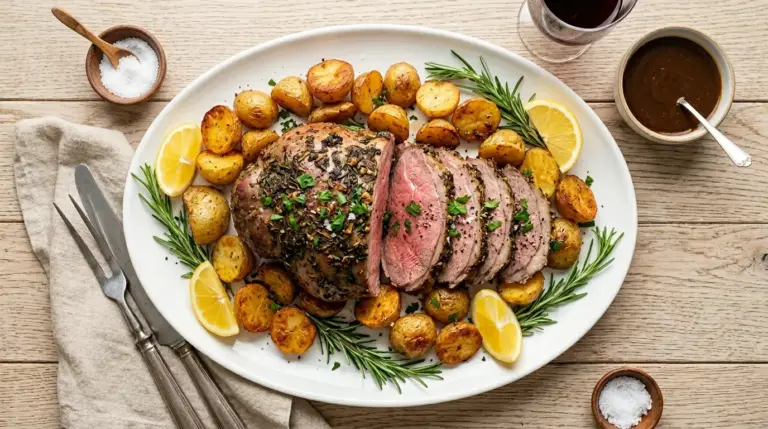
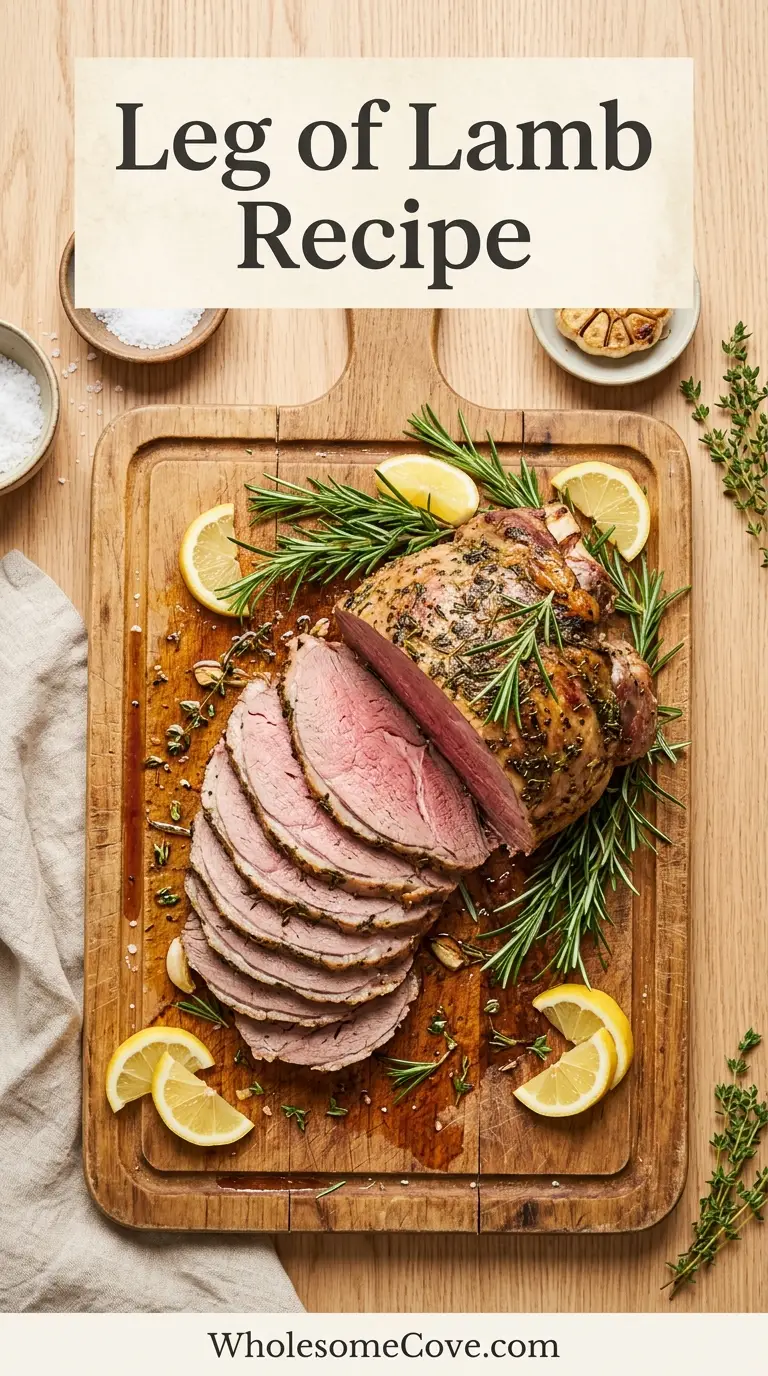
My family’s Easter table has had the same showstopper centerpiece for as long as I can remember: a perfectly roasted leg of lamb recipe that fills the whole house with the most incredible aroma of garlic, rosemary, and sizzling lamb fat. I still remember the first time I tried to make it on my own.
I had watched my grandmother do it dozens of times, so I figured I knew everything. I skipped the step where she rubbed the garlic paste deep into slits cut across the meat, and I paid for it — the outside was beautifully browned but the flavor barely made it past the surface. That one mistake taught me more about cooking lamb than any recipe ever could.
These days, I’ve dialed in every detail, from the garlic-rosemary rub to the resting time, and I’m sharing everything I know so you can skip the trial and error entirely.
A bone-in leg of lamb is my go-to because the bone adds so much depth of flavor to the meat as it roasts. The garlic and fresh rosemary aren’t optional here — they’re the heart of the whole dish.
| Quick Recipe Summary | |
|---|---|
| Prep Time | 20 minutes (plus 1 hour to bring to room temperature) |
| Cook Time | 1 hour 45 minutes to 2 hours |
| Rest Time | 20 minutes |
| Total Time | Approximately 3 hours |
| Servings | 6–8 servings |
| Difficulty Level | Intermediate |
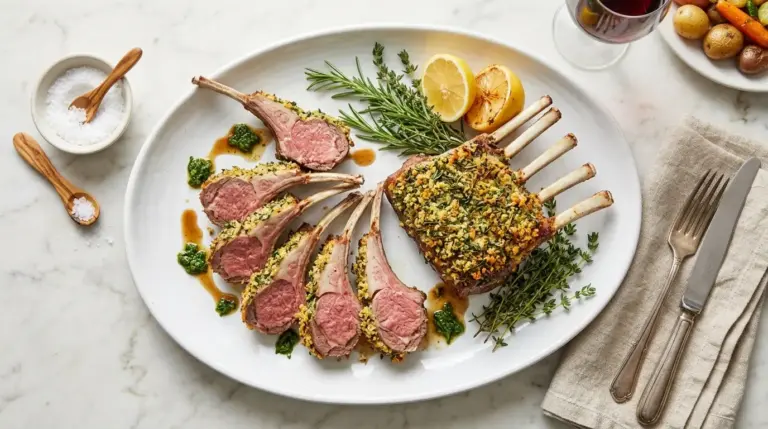
If you love lamb as much as I do, you’ll want to bookmark my Rack of Lamb Recipe too — it’s another elegant cut that deserves a spot on your holiday table.
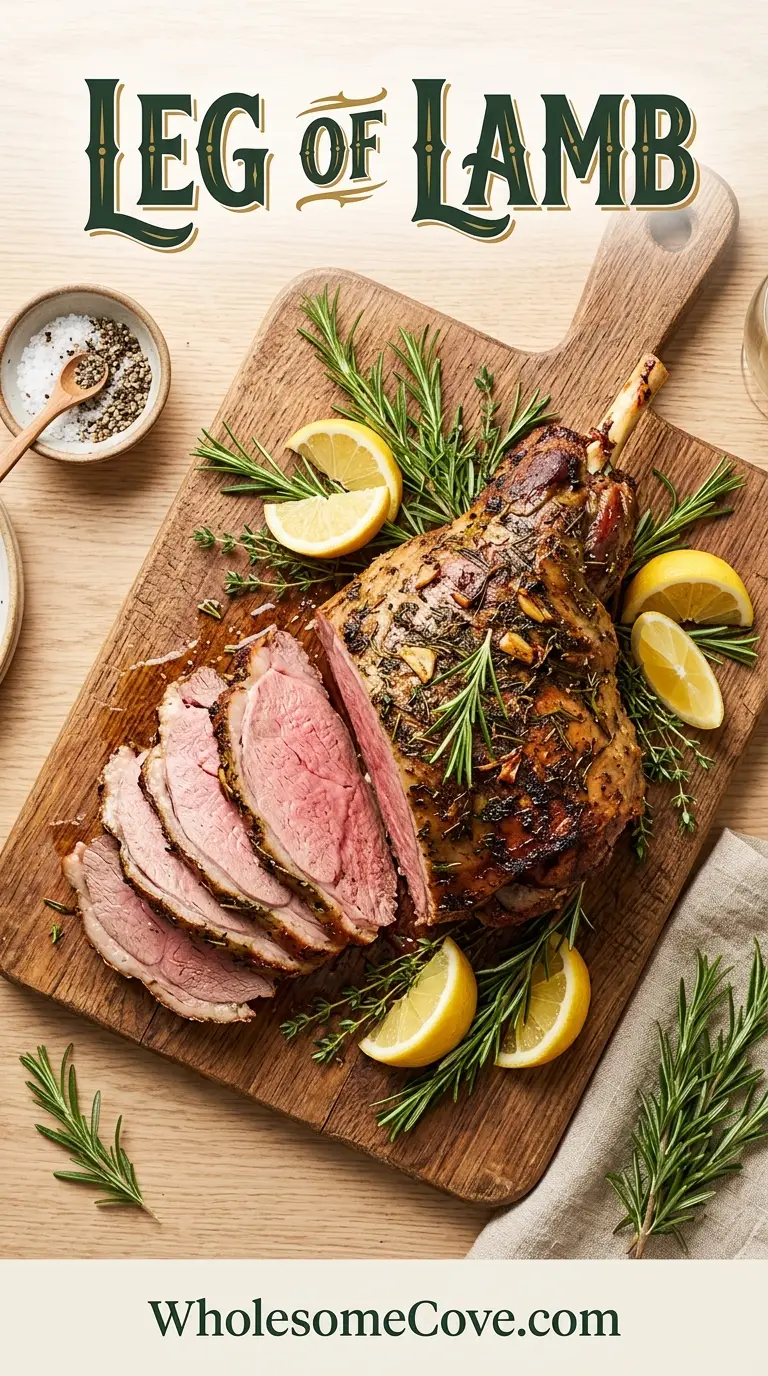
Why You’ll Love This Leg of Lamb Recipe
This leg of lamb recipe is the kind of dish that makes people stop mid-conversation at the dinner table. It’s stunning to look at, deeply flavorful, and surprisingly achievable for a home cook.
You only need a handful of pantry staples to make something that tastes genuinely extraordinary. The garlic-rosemary paste does all the heavy lifting for the flavor.
It’s a flexible recipe whether you’re feeding a crowd at Easter or a cozy Sunday family dinner. A single leg serves 6 to 8 people generously, which means plenty of leftovers for the next day.
The roasting process is mostly hands-off once it’s in the oven. You get to spend that time with your guests instead of stressing in the kitchen.
- A dramatic centerpiece: A whole leg of lamb on a carving board looks like a restaurant-level presentation with minimal effort.
- Deep, complex flavor: The combination of garlic, rosemary, lemon zest, and olive oil creates layers of savory, aromatic flavor that can’t be rushed.
- Beginner-friendly with a meat thermometer: All the guesswork disappears once you have an instant-read thermometer — no need to cross your fingers.
- Minimal active cook time: You prep the rub, get it in the oven, and let the oven do the work for nearly 2 hours.
- Incredible leftovers: Cold sliced lamb in a sandwich with tzatziki sauce the next day is honestly one of the best lunches in existence.
- Crowd-pleasing classic: Even people who say they “don’t like lamb” tend to change their minds with this recipe — the flavors are bold but not gamey.
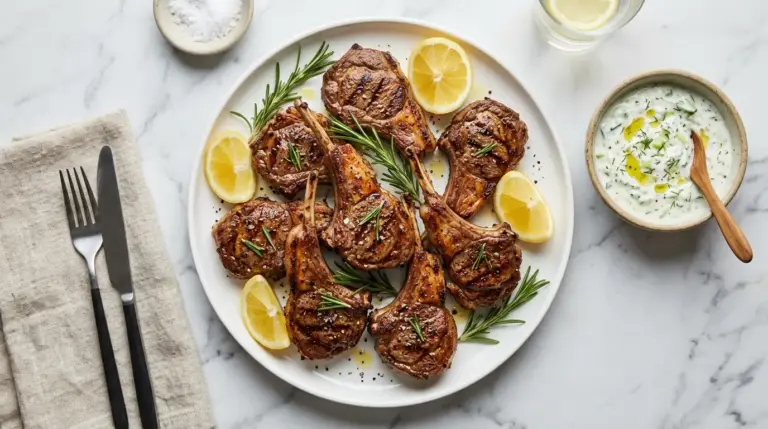
Read Also: Lamb Chops Recipe
Ingredients
The ingredient list here is intentionally simple — quality ingredients do the work. A good bone-in leg of lamb from a reputable butcher shop makes an enormous difference in the final flavor, so don’t cut corners there if you can help it.
- 1 bone-in leg of lamb (5–7 lbs / 2.3–3.2 kg), at room temperature
- 8 cloves of garlic (6 sliced into slivers, 2 minced into a paste)
- 3 tablespoons (45 ml) extra virgin olive oil, divided
- 2 tablespoons (6 g) fresh rosemary leaves, finely chopped
- 1 tablespoon (3 g) fresh thyme leaves
- Zest of 1 lemon
- 1 tablespoon (15 ml) Dijon mustard
- 1½ teaspoons (9 g) kosher salt (or more, to taste — roughly ½ teaspoon per pound)
- 1 teaspoon (2 g) freshly ground black pepper
- ½ teaspoon (1 g) smoked paprika
- 1 cup (240 ml) low-sodium chicken or beef broth
- ½ cup (120 ml) dry white wine (optional but highly recommended)
- Fresh rosemary sprigs and lemon wedges for garnish
You might also enjoy: Lamb Stew Recipe
Kitchen Equipment Needed
Nothing fancy is required here, but a few key tools will make the process smoother and more reliable. The meat thermometer is non-negotiable — it’s truly the only way to guarantee your lamb is perfectly cooked.
- Roasting pan with rack (at least 13×9 inches / 33×23 cm)
- Instant-read meat thermometer — absolutely essential for nailing the right doneness
- Sharp paring knife for making incisions in the lamb
- Cast iron roasting pan or heavy-duty roasting pan (for even heat distribution)
- Small mixing bowl for the rub
- Aluminum foil (for tenting during the rest)
- Cutting board (large enough to carve the leg)
- Carving knife and fork set
- Kitchen twine (if using a boneless leg that needs trussing)
- Basting brush or spoon
Read Also: Shepherds Pie Recipe
Recommended Products for This Recipe
These are products I personally reach for when I make this roast lamb, based on real experience cooking it again and again. They’re not required, but they genuinely make a difference.
1. Instant-Read Meat Thermometer (ThermoPop or ThermoWorks Style)
A quality instant-read thermometer removes all the guesswork from roasting lamb. Without one, you’re essentially hoping for the best — with one, you know exactly when to pull it out of the oven for a perfect blush-pink center.
2. Heavy-Duty Roasting Pan with V-Rack
A sturdy roasting pan with a V-rack lifts the lamb off the bottom so heat circulates underneath evenly. Cheap, thin roasting pans can cause hot spots and uneven browning — a heavy-duty pan eliminates that completely.
3. Fresh Rosemary Herb Plant
If you don’t already grow rosemary at home, it’s the single herb that transforms this dish. Fresh rosemary has a piney, resinous punch that dried rosemary just can’t replicate — it’s a night-and-day difference in this recipe.
4. Le Creuset Enameled Cast Iron Roaster
This is my favorite splurge item for large roasts. The enameled cast iron distributes heat so evenly that the lamb browns beautifully all around, and the depth of the pan captures all those incredible pan drippings you’ll want for gravy.
5. Dijon Mustard (Maille or Grey Poupon)
A quality Dijon mustard is part of my rub for this lamb, and it adds a subtle sharpness and helps the herb crust adhere to the meat beautifully. Don’t use yellow mustard here — Dijon’s smooth, tangy depth is what you need.
Another great recipe for a special dinner: Filet Mignon Recipe
Step-by-Step Instructions: How to Make Leg of Lamb
Step 1: Take the Lamb Out of the Refrigerator Early
- Remove the leg of lamb from the refrigerator at least 1 hour before you plan to roast it — ideally 1.5 hours for a larger leg.
- This is one of the most important steps and one people often skip. Cold meat going into a hot oven cooks unevenly, leaving you with overcooked outer layers and an undercooked center.
- Set the lamb on a clean cutting board or plate and allow it to come to room temperature at room temperature (around 68–72°F / 20–22°C).
- Pat the entire surface of the lamb very dry with paper towels. Moisture on the surface will steam the lamb instead of roasting it, preventing a good brown crust from forming.
Step 2: Prepare the Garlic-Herb Rub
- Mince 2 cloves of garlic as finely as possible, then sprinkle a small pinch of kosher salt over the minced garlic.
- Use the flat side of your knife to press and smear the garlic and salt together repeatedly, working it into a paste. This technique releases more garlic flavor than simply mincing alone.
- In a small bowl, combine the garlic paste, 2 tablespoons (30 ml) of olive oil, the finely chopped fresh rosemary, fresh thyme, lemon zest, Dijon mustard, 1½ teaspoons (9 g) kosher salt, and 1 teaspoon (2 g) black pepper.
- Add the smoked paprika and stir everything together into a thick, fragrant paste. The mixture should be spreadable but not runny.
- Taste the paste — it should taste boldly of garlic, herbs, and a slight tang from the mustard and lemon.
Step 3: Stud the Lamb with Garlic Slivers
- Take the remaining 6 cloves of garlic and slice each one into 3–4 thin slivers. You should have around 18–24 garlic slivers in total.
- Using a sharp paring knife, make deep incisions all over the surface of the lamb leg — aim for about 20 incisions in total, evenly distributed across the top, sides, and underside of the leg.
- Each incision should be about ¾ inch (2 cm) deep and just wide enough to fit a garlic sliver.
- Push one garlic sliver deep into each incision. The goal is to get the garlic inside the meat so it perfumes the whole roast from the inside out as it cooks.
- Don’t rush this step — garlic slivers placed only at the surface tend to burn in the oven.
Step 4: Apply the Rub and Rest (Optional Marinate)
- Drizzle the remaining 1 tablespoon (15 ml) of olive oil over the lamb first, rubbing it all over so every surface is lightly coated.
- Spoon the garlic-herb paste onto the lamb and use your hands to rub it firmly into every surface — the top, bottom, sides, and around the exposed bone end.
- Work the paste into the scored incisions as much as possible so the garlic slivers inside are surrounded by the herb mixture.
- For the most flavorful result, cover the lamb loosely with plastic wrap and refrigerate it for 4–12 hours (or even overnight). This step is optional but highly recommended.
- If you’re short on time, let the rubbed lamb sit at room temperature while the oven preheats — even 30 minutes makes a noticeable difference.
Step 5: Preheat the Oven and Prepare the Roasting Pan
- Preheat your oven to 450°F (230°C). Allow at least 20–25 minutes for the oven to fully preheat.
- Place the roasting rack inside the roasting pan.
- Pour the broth and white wine (if using) into the bottom of the roasting pan — not over the lamb, just into the bottom of the pan.
- The liquid in the bottom of the pan will prevent the drippings from burning and create a flavorful base for pan drippings or a quick gravy.
Step 6: Sear the Lamb at High Heat
- Place the lamb leg on the roasting rack, fat side facing up. The fat melts downward as it roasts, self-basting the meat constantly.
- Slide the pan into the preheated 450°F (230°C) oven on the middle rack.
- Roast at this high temperature for exactly 20 minutes. You’ll hear sizzling and see the outside of the lamb beginning to brown deeply — this high-heat blast creates the flavorful crust.
- Don’t open the oven during this time.
Step 7: Reduce Heat and Roast to Perfection
- After 20 minutes at high heat, reduce the oven temperature to 325°F (165°C) without opening the oven door if possible (or only briefly to check).
- Continue roasting the lamb at this lower temperature for approximately 20–25 minutes per pound, until the internal temperature reaches your desired doneness.
- Use your instant-read meat thermometer inserted into the thickest part of the leg, making sure it is not touching the bone (the bone conducts heat and will give you a falsely high reading).
- Target temperatures:
- Rare: 120–125°F (49–52°C)
- Medium-rare: 130–135°F (54–57°C) — this is the sweet spot for leg of lamb, giving you a beautiful blush-pink interior
- Medium: 140–145°F (60–63°C)
- Well done: 155–160°F (68–71°C) — not recommended as the meat can become dry
- For a 6 lb (2.7 kg) bone-in leg, medium-rare will take roughly 1 hour 20–40 minutes at 325°F after the initial high-heat sear.
- Check the pan liquid level halfway through — if the drippings are getting dry, add another splash of broth to the bottom.
Step 8: Rest the Lamb Before Carving
- Once the lamb reaches your target internal temperature, remove it from the oven immediately.
- Transfer the lamb to a cutting board (ideally a large one with a groove around the edge to catch juices).
- Tent the lamb loosely with a sheet of aluminum foil — not tightly wrapped, just draped over the top to retain warmth without trapping steam.
- Allow the lamb to rest for a minimum of 20 minutes, or up to 30 minutes for a larger leg. This resting period is essential: the internal temperature will continue to rise by about 5°F (3°C) as it rests, and the juices will redistribute throughout the meat.
- Skipping the rest is the most common reason home-cooked roasts turn out dry — don’t skip it.
Step 9: Carve and Serve
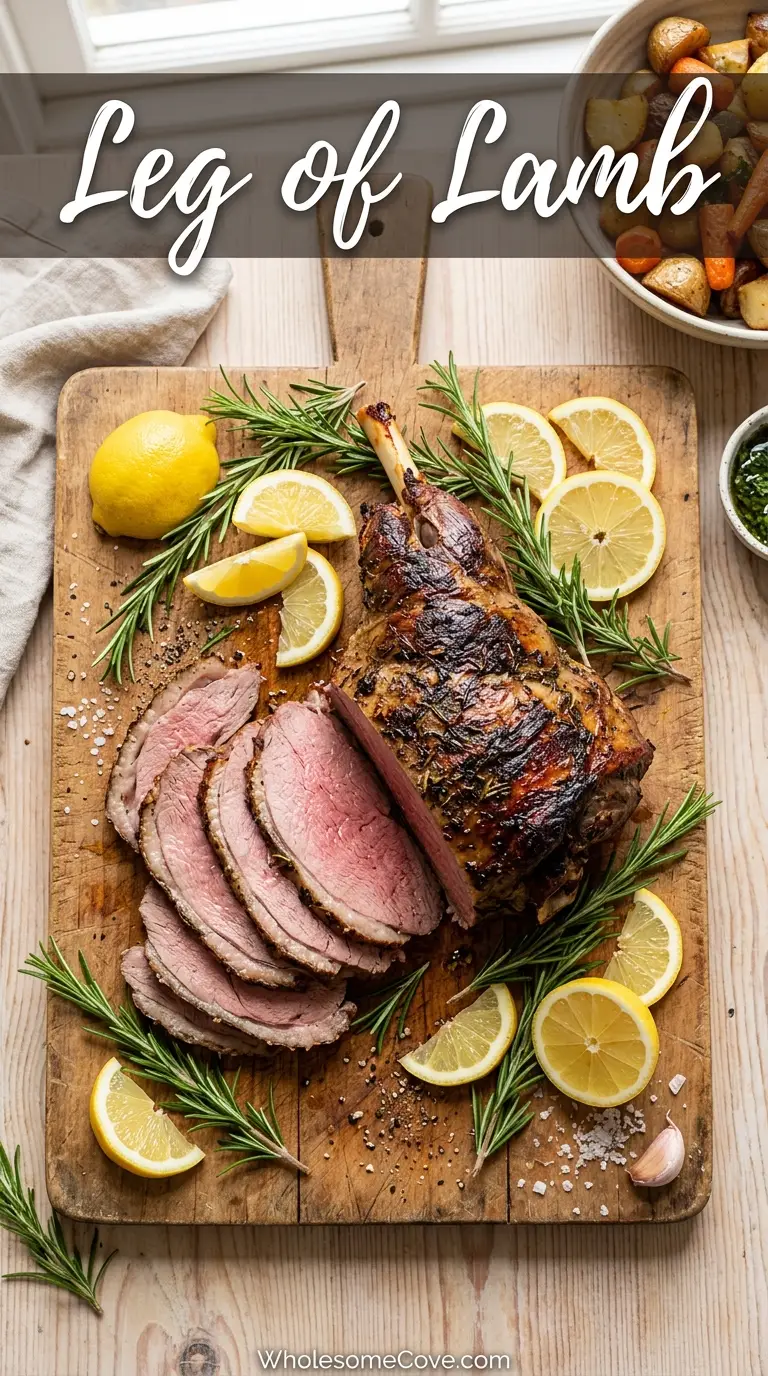
- Hold the shank bone with a clean kitchen towel (or grip it with a carving fork) and position the lamb with the fat side up.
- Using a sharp carving knife, slice the lamb against the grain into slices about ½ inch (1.25 cm) thick.
- For a bone-in leg, angle your knife as you work around the central bone — slicing on a diagonal and then working from both sides of the bone.
- Arrange the carved slices on a warm serving platter and pour any accumulated resting juices over the top.
- Garnish with fresh rosemary sprigs and lemon wedges and serve immediately.
I love pairing this with my Mashed Potatoes Recipe — the rich, buttery potatoes are the perfect pairing for the savory lamb drippings.
Tips for The Best Leg of Lamb
A few lessons learned from years of making this roast that will save you from the same mistakes I made early on.
- Never skip the garlic sliver step. Rubbing garlic paste on the outside is good — but studding the meat with slivers means garlic flavor infuses every slice from within. It’s a game-changing technique.
- Always use a meat thermometer. The difference between perfect medium-rare and overdone lamb can be as little as 10°F. A quality instant-read thermometer is the only reliable way to hit that target.
- Bring the lamb to room temperature before roasting. Cold lamb hitting a hot oven cooks unevenly. One hour on the counter makes a significant difference in how evenly the meat cooks from edge to center.
- Score the fat cap before roasting. Use a sharp knife to lightly score a crosshatch pattern through the fat layer on top of the lamb. This allows the fat to render out more efficiently and helps the rub penetrate deeper.
- Don’t skip the high-heat blast at the start. The first 20 minutes at 450°F (230°C) creates a beautifully browned, flavorful crust. Skipping it and going straight to low heat results in a paler, less flavorful exterior.
- Use pan drippings to make a quick gravy. Once the lamb comes out of the oven, place the roasting pan over two burners on medium heat, add a splash of broth, and scrape up all the browned bits. Whisk in a teaspoon of flour and cook until thickened — it takes 5 minutes and tastes incredible.
- Let the lamb rest for at least 20 minutes. Carving too soon causes all the juices to run out onto the cutting board rather than staying in the meat.
- Fresh herbs always over dried. Fresh rosemary and thyme make a noticeably more vibrant, aromatic rub than dried. If you must use dried herbs, reduce the quantity by half since dried herbs are more concentrated.
- Buy from a reputable butcher. The quality of the lamb matters enormously. Ask your butcher to trim the lamb and remove the pelvic bone for easier carving.
Read Also: Prime Rib Recipe
What to Serve with Leg of Lamb
Lamb this flavorful deserves sides that complement it without competing. I lean into classic Mediterranean and European pairings that have stood the test of time.
Starchy sides are where this roast really shines — the savory drippings soak into potatoes or rice beautifully, making every bite richer than the last.
- Roasted Potatoes: Classic crispy roasted potatoes are the quintessential lamb side. Toss them in olive oil, garlic, and rosemary and roast them in the oven alongside the lamb for the last 45 minutes.
- Mashed Potatoes: Creamy, buttery mashed potatoes with a ladle of pan drippings poured over the top is one of those pairings that just works every single time.
- Tzatziki Sauce: The cool, garlicky yogurt cucumber sauce cuts through the richness of the lamb brilliantly. Serve it in a bowl on the side for dipping or drizzling.
- Green Bean Casserole: A classic holiday table side that pairs comfortably with lamb.
- Deviled Eggs: A wonderful make-ahead appetizer to serve while the lamb finishes resting.
- Broccoli Salad: A cool, crunchy salad that provides a nice textural contrast to the rich, tender meat.
- Scalloped Potatoes: Creamy, cheesy layers of potato baked into a golden casserole — a wonderful indulgent pairing for a holiday lamb dinner.
- Dinner Rolls: Soft, pillowy rolls are perfect for mopping up the pan drippings and gravy.
- Mint jelly or mint sauce: A classic British accompaniment to roast lamb — the sweet, herby mint contrasts the savory meat perfectly.
- Simple green salad with lemon vinaigrette: A light, acidic salad helps balance the richness of the roast.
You might also enjoy: Coleslaw Recipe
Variations of Leg of Lamb
The classic garlic and rosemary roast is a perfect starting point, but there are some beautiful regional variations worth exploring once you’ve mastered the base recipe.
- Greek-Style Leg of Lamb: Add dried oregano, a generous squeeze of fresh lemon juice, and a splash of white wine to the rub. Roast the lamb over a bed of quartered potatoes, onions, and lemon slices. The potatoes absorb the lamb juices and become something extraordinary.
- Slow-Roasted Leg of Lamb (Fall-Apart Tender): For a completely different texture, roast the lamb at 325°F (165°C) for 4–5 hours until the internal temperature reaches around 175–185°F (79–85°C). At this temperature, the collagen breaks down fully and the meat pulls apart effortlessly with tongs. This version is outstanding for sandwiches.
- Moroccan-Spiced Leg of Lamb: Replace the rosemary and thyme with ras el hanout, cumin, coriander, cinnamon, and smoked paprika. Add a tablespoon of honey to the rub for a subtle sweetness that plays beautifully against the warm spices.
- Butterflied Leg of Lamb (Grilled): Ask your butcher to butterfly the boneless leg — opening it flat. Marinate it in the garlic-herb rub for several hours and grill it over high heat for 20–25 minutes. The faster cook time and charred, caramelized exterior make this version irresistible in summer.
- French Provençal Leg of Lamb: Incorporate herbs de Provence (lavender, thyme, savory, marjoram) into the rub and add a splash of Herbes de Provence white wine. Serve with ratatouille for a full Provençal feast.
- Stuffed Leg of Lamb: Ask your butcher to bone the leg fully, leaving a pocket. Fill it with a stuffing of toasted pine nuts, chopped sun-dried tomatoes, fresh mint, garlic, and feta cheese. Roll and tie it with kitchen twine, then roast as normal.
Read Also: Irish Stew Recipe
Storage and Reheating
Leftover leg of lamb is genuinely wonderful the next day, and knowing how to store and reheat it properly makes sure none of that beautiful roast goes to waste.
- Refrigerator storage: Allow the lamb to cool to room temperature before placing it in an airtight container. Refrigerate for up to 3–4 days. Slice only what you need and store the remainder as a larger piece rather than pre-slicing everything — larger pieces retain moisture better.
- Freezer storage: Sliced or chopped leftover lamb can be frozen for up to 3 months. Wrap individual portions tightly in aluminum foil first, then place in a zip-top freezer bag with as much air removed as possible. Label with the date.
- Reheating in the oven: Wrap leftover lamb slices in a double layer of aluminum foil. Place in a 325°F (165°C) oven for 10–15 minutes until warmed through. This is the best method as it prevents drying out.
- Reheating in a skillet: Place lamb slices in a skillet over medium-low heat with a splash of broth or water. Cover with a lid and heat for 5–7 minutes, turning once. The steam from the liquid keeps the lamb moist.
- Avoid the microwave for thick slices: The microwave tends to overcook the edges while leaving the center cold. If you must use it, cover with a damp paper towel and heat in short 30-second bursts on medium power.
- Best leftover uses: Cold lamb is incredible sliced thin and served in a pita with tzatziki and cucumber (like a gyro), shredded into a hash with potatoes and herbs, or chopped and added to a grain bowl with roasted vegetables.
Another great way to use leftover lamb: Lamb Stew Recipe
Nutritional Facts
The following is an approximate nutritional breakdown per serving (based on 8 servings from a 6 lb / 2.7 kg bone-in leg of lamb using the ingredients in this recipe). These values are estimates and can vary based on exact cut, cooking method, and serving size.
| Nutrient | Per Serving (approx. 5 oz / 140g cooked lamb) | ||| | Calories | 340 kcal | | Total Fat | 18 g | | Saturated Fat | 6 g | | Unsaturated Fat | 11 g | | Cholesterol | 130 mg | | Protein | 42 g | | Carbohydrates | 2 g | | Fiber | 0.3 g | | Sodium | 520 mg | | Iron | 15% DV | | Zinc | 45% DV | | Vitamin B12 | 60% DV |
Note: Values account for the olive oil rub and garlic but not for sides or gravy.
Read Also: Healthy Shepherds Pie Recipe
Health Benefits of Key Ingredients
Leg of lamb isn’t just delicious — it’s genuinely nutritious when enjoyed as part of a balanced diet. The key ingredients in this recipe each bring something meaningful to the table beyond just flavor.
This is a protein-rich, micronutrient-dense meal that can absolutely fit into a healthy lifestyle.
- Lamb meat: Lamb is an outstanding source of complete protein, providing all nine essential amino acids. It’s also one of the richest dietary sources of zinc (critical for immune function and wound healing) and vitamin B12 (essential for nerve function and red blood cell production). Grass-fed lamb tends to have a better omega-3 to omega-6 fatty acid ratio than conventionally raised animals.
- Garlic: Fresh garlic contains allicin, a sulfur compound that has been studied for its anti-inflammatory and antimicrobial properties. Regular garlic consumption is associated with cardiovascular benefits, including modest reductions in blood pressure.
- Fresh rosemary: Rosemary is rich in rosmarinic acid and carnosic acid, both of which have antioxidant properties. Studies suggest rosemary may support digestive health, reduce inflammation, and even have mild cognitive benefits.
- Olive oil: Extra virgin olive oil is the cornerstone of the Mediterranean diet. It’s high in oleic acid (a monounsaturated fat) and polyphenols that support heart health and reduce oxidative stress.
- Fresh thyme: Thyme contains thymol, a natural compound with antimicrobial properties. It’s also a source of vitamin C and vitamin A, supporting immune function and skin health.
- Lemon zest: The zest contains concentrated flavonoids and limonene, compounds found in citrus peel that have antioxidant and anti-inflammatory effects. It also adds vitamin C without adding significant calories or sodium.
- Dijon mustard: Mustard seeds contain selenium and glucosinolates, compounds that may have anticancer properties. Dijon mustard adds bold flavor with minimal calories.
Read Also: Mediterranean Lentil Soup Recipe
FAQs About Leg of Lamb
1. Should I use a bone-in or boneless leg of lamb?
Both work well, but bone-in is my personal preference for flavor. The bone contributes richness to the roasting juices and helps the meat stay juicier during the long cook time.
Boneless is easier to carve and tends to cook slightly faster, but you’ll want to truss it with kitchen twine to ensure even cooking.
2. How do I know when the leg of lamb is done cooking?
An instant-read thermometer is the only reliable method. Insert it into the thickest part of the leg, making sure it’s not touching the bone.
For medium-rare (the recommended doneness), aim for 130–135°F (54–57°C) before resting — it will rise about 5°F as it rests.
3. Can I marinate the lamb overnight?
Yes, and I actually recommend it. An overnight marinade deepens the flavor considerably, especially the garlic and herbs.
Just make sure to bring the marinated lamb out of the refrigerator at least 1 hour before roasting so it has time to come to room temperature.
4. Can I make leg of lamb in a slow cooker?
Absolutely. For a fall-apart tender result, place the rubbed lamb in a slow cooker with the broth and cook on low for 7–8 hours or high for 4–5 hours.
The slow cooker version won’t develop a browned crust, so I recommend searing the lamb in a hot skillet for 3–4 minutes per side before placing it in the slow cooker.
5. What’s the best way to use leftover leg of lamb?
Leftover lamb is incredibly versatile. Thinly sliced cold lamb stuffed into a warm pita with tzatziki, cucumber, and tomato makes an incredible next-day lunch.
You can also shred it and use it as a filling for Shepherd’s Pie, stir it into a lamb hash, or add it to a grain bowl with roasted vegetables and a tahini dressing.
Read Also: Beef Stew Recipe
Leg of Lamb Recipe
Ingredients
- 1 bone-in leg of lamb - 5–7 lbs / 2.3–3.2 kg, at room temperature
- 6 cloves garlic - sliced into thin slivers, for studding the meat
- 2 cloves garlic - minced into a paste with a pinch of salt
- 3 tbsp extra virgin olive oil - 45 ml, divided (2 tbsp for rub, 1 tbsp for coating)
- 2 tbsp fresh rosemary leaves - about 6g, finely chopped
- 1 tbsp fresh thyme leaves - about 3g
- 1 lemon - zested only
- 1 tbsp Dijon mustard - 15 ml
- 1½ tsp kosher salt - 9g, or about ½ tsp per pound of lamb
- 1 tsp freshly ground black pepper - 2g
- ½ tsp smoked paprika - 1g
- 1 cup low-sodium chicken or beef broth - 240 ml; adds moisture and prevents drippings from burning
- ½ cup dry white wine - 120 ml, optional but recommended for deeper pan flavor
- fresh rosemary sprigs - for garnish
- lemon wedges - for garnish and serving
Equipment
- Roasting pan with rack - At least 13×9 inches / 33×23 cm
- Instant-read meat thermometer - Essential for checking doneness accurately
- Sharp paring knife - For making incisions in the lamb
- Cast iron roasting pan - Or heavy-duty roasting pan for even heat distribution
- Small mixing bowl - For preparing the herb rub
- Aluminum foil - For tenting the lamb during the rest period
- Large cutting board - Large enough to carve the full leg; one with a juice groove is ideal
- Carving knife and fork set - For slicing the roasted lamb
- Kitchen twine - (optional) Only needed if using a boneless leg that requires trussing
- Basting brush or spoon - For applying the herb rub and basting during roasting
Method
- Remove the leg of lamb from the refrigerator at least 1 hour before roasting (up to 1.5 hours for a larger leg). Pat the entire surface completely dry with paper towels to ensure a good crust forms.
- Mince 2 garlic cloves with a pinch of salt and use the flat of your knife to smear them into a paste. In a small bowl, combine the garlic paste, 2 tbsp olive oil, rosemary, thyme, lemon zest, Dijon mustard, kosher salt, black pepper, and smoked paprika; stir into a thick, spreadable paste.
- Slice the remaining 6 garlic cloves into 3–4 thin slivers each. Using a sharp paring knife, cut about 20 deep incisions (¾ inch / 2 cm deep) all over the lamb and push one garlic sliver deep into each incision.
- Rub the remaining 1 tbsp olive oil all over the lamb, then coat every surface thoroughly with the garlic-herb paste, pressing it into the scored incisions. For best results, cover and refrigerate for 4–12 hours; otherwise let it sit at room temperature while the oven preheats.
- Preheat the oven to 450°F (230°C) for at least 20–25 minutes. Place the roasting rack in the pan and pour the broth and white wine (if using) into the bottom of the pan.
- Place the lamb fat side up on the roasting rack and roast at 450°F (230°C) for exactly 20 minutes, until a deep brown crust forms on the outside. Do not open the oven during this time.
- Reduce the oven to 325°F (165°C) and continue roasting for 20–25 minutes per pound, checking the internal temperature with an instant-read thermometer inserted into the thickest part away from the bone. Pull the lamb at 130–135°F (54–57°C) for medium-rare.
- Transfer the lamb to a large cutting board and tent loosely with aluminum foil. Rest for at least 20 minutes — the internal temperature will rise about 5°F and the juices will redistribute throughout the meat.
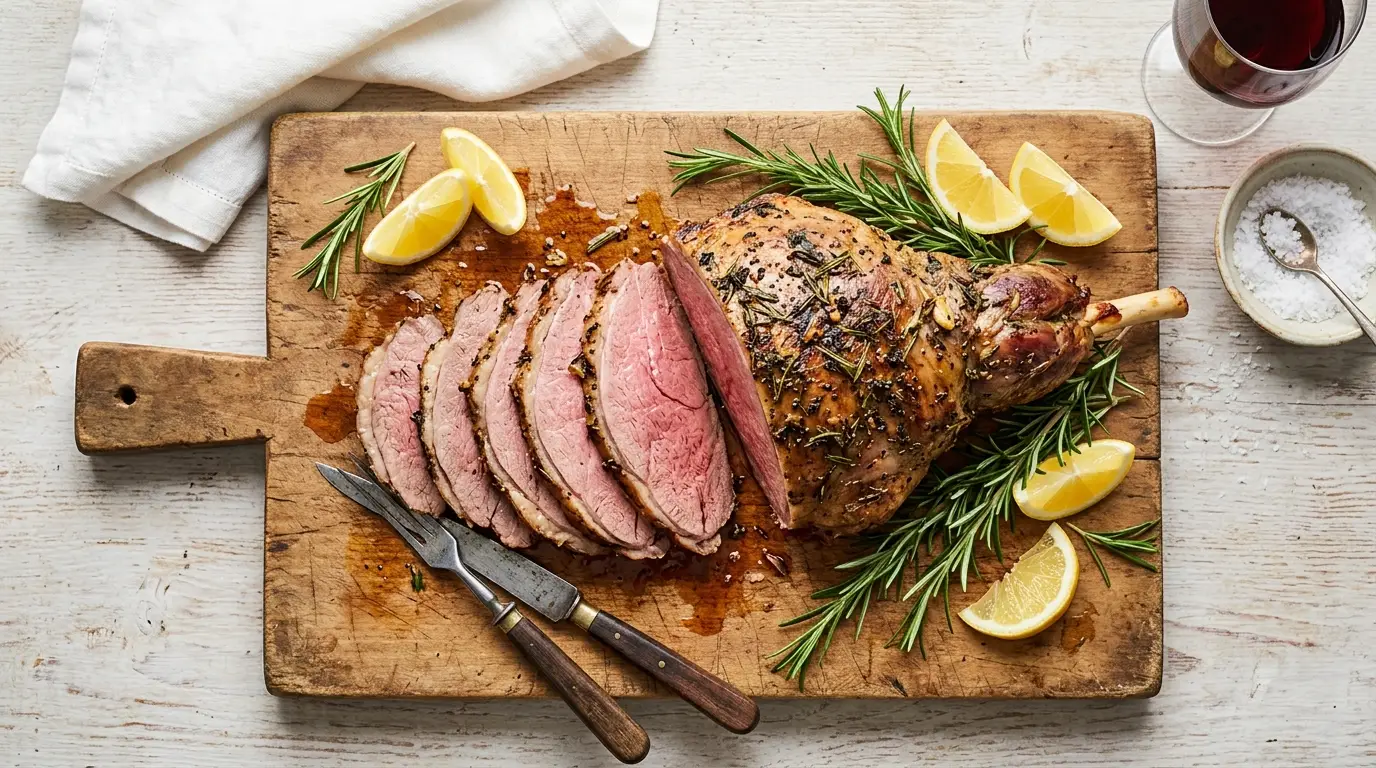
- Using a sharp carving knife, slice against the grain into ½-inch (1.25 cm) thick slices, working around the bone on a diagonal. Arrange on a warm platter, pour over the resting juices, and garnish with fresh rosemary sprigs and lemon wedges.
Nutrition
Notes
- Always use an instant-read meat thermometer — it’s the only reliable way to hit your target doneness. For medium-rare, pull the lamb at 130–135°F (54–57°C) before resting.
- Bring the lamb to room temperature for at least 1 hour before roasting. Cold lamb cooks unevenly, resulting in overdone edges and an undercooked center.
- The overnight marinade is optional but highly recommended — it deepens the garlic and herb flavors significantly throughout the meat.
- Don’t skip the high-heat blast at 450°F (230°C) at the start. It creates the flavorful browned crust that makes this roast so impressive.
- Score the fat cap in a crosshatch pattern before roasting to help the fat render out efficiently and allow the rub to penetrate deeper into the meat.
- If pan drippings look dry halfway through roasting, add another splash of broth to the bottom of the pan to prevent burning.
- To make a quick pan gravy: after removing the lamb, place the roasting pan over two burners on medium heat, add a splash of broth, scrape up the browned bits, and whisk in 1 tsp of flour. Cook for 5 minutes until thickened.
- Leftover lamb keeps in the refrigerator for 3–4 days or freezes well for up to 3 months. Reheat wrapped in foil at 325°F (165°C) for best results.
- Use fresh rosemary and thyme, not dried — the difference in aroma and flavor is substantial in this recipe. If using dried herbs, reduce quantities by half.
- For a fall-apart tender version, roast at 325°F (165°C) for 4–5 hours until the internal temperature reaches 175–185°F (79–85°C). Perfect for shredding and serving in sandwiches or shepherd’s pie.
Private Notes
Tried this recipe?
Let us know how it was!Final Thoughts
A leg of lamb recipe done right is one of the most rewarding things you can put on a dinner table. The combination of garlic, rosemary, and perfectly roasted lamb is timeless for a reason.
My biggest advice is to trust the process and trust your thermometer. The rest takes care of itself.
I hope this recipe gives your next holiday dinner exactly the kind of showstopping centerpiece it deserves. If you try it, I’d love to hear how it went in the comments below — leave a rating, share your own tips, or let me know what sides you paired it with!
Recommended:
- Rack of Lamb Recipe
- Lamb Chops Recipe
- Lamb Stew Recipe
- Irish Stew Recipe
- Mushroom Gravy Recipe
- Roasted Sweet Potato Recipe
- Cranberry Sauce Recipe
- Greek Chicken Gyros Recipe
- Scalloped Potatoes Recipe
- Sweet Potato Casserole Recipe