Leg of Lamb Recipe

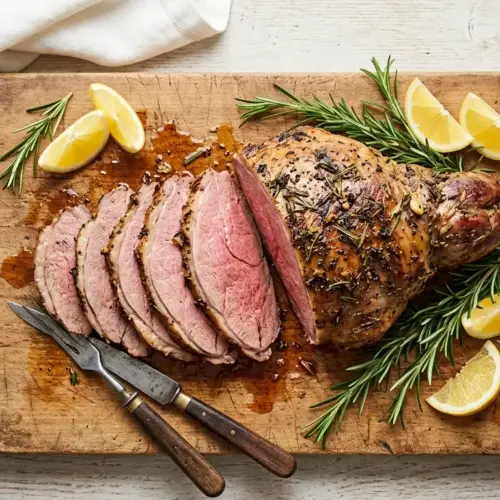
This classic roasted leg of lamb is the ultimate showstopping centerpiece for Easter, the holidays, or any special family dinner. A bone-in leg is studded with slivers of fresh garlic and coated in a bold garlic-rosemary-Dijon herb paste, then roasted at high heat to develop a deeply browned, aromatic crust before finishing low and slow to a perfect blush-pink medium-rare. Juicy, flavorful, and surprisingly hands-off once it hits the oven, this is the kind of recipe that earns a permanent spot in your dinner rotation.
Equipment
- Roasting pan with rack - At least 13x9 inches / 33x23 cm
- Instant-read meat thermometer - Essential for checking doneness accurately
- Sharp paring knife - For making incisions in the lamb
- Cast iron roasting pan - Or heavy-duty roasting pan for even heat distribution
- Small mixing bowl - For preparing the herb rub
- Aluminum foil - For tenting the lamb during the rest period
- Large cutting board - Large enough to carve the full leg; one with a juice groove is ideal
- Carving knife and fork set - For slicing the roasted lamb
- Kitchen twine - (optional) Only needed if using a boneless leg that requires trussing
- Basting brush or spoon - For applying the herb rub and basting during roasting
Ingredients
For the Lamb
- 1 bone-in leg of lamb - 5–7 lbs / 2.3–3.2 kg, at room temperature
- 6 cloves garlic - sliced into thin slivers, for studding the meat
For the Garlic-Herb Rub
- 2 cloves garlic - minced into a paste with a pinch of salt
- 3 tbsp extra virgin olive oil - 45 ml, divided (2 tbsp for rub, 1 tbsp for coating)
- 2 tbsp fresh rosemary leaves - about 6g, finely chopped
- 1 tbsp fresh thyme leaves - about 3g
- 1 lemon - zested only
- 1 tbsp Dijon mustard - 15 ml
- 1½ tsp kosher salt - 9g, or about ½ tsp per pound of lamb
- 1 tsp freshly ground black pepper - 2g
- ½ tsp smoked paprika - 1g
For the Roasting Pan
- 1 cup low-sodium chicken or beef broth - 240 ml; adds moisture and prevents drippings from burning
- ½ cup dry white wine - 120 ml, optional but recommended for deeper pan flavor
For Garnish
- fresh rosemary sprigs - for garnish
- lemon wedges - for garnish and serving
Instructions
- Remove the leg of lamb from the refrigerator at least 1 hour before roasting (up to 1.5 hours for a larger leg). Pat the entire surface completely dry with paper towels to ensure a good crust forms.
- Mince 2 garlic cloves with a pinch of salt and use the flat of your knife to smear them into a paste. In a small bowl, combine the garlic paste, 2 tbsp olive oil, rosemary, thyme, lemon zest, Dijon mustard, kosher salt, black pepper, and smoked paprika; stir into a thick, spreadable paste.
- Slice the remaining 6 garlic cloves into 3–4 thin slivers each. Using a sharp paring knife, cut about 20 deep incisions (¾ inch / 2 cm deep) all over the lamb and push one garlic sliver deep into each incision.
- Rub the remaining 1 tbsp olive oil all over the lamb, then coat every surface thoroughly with the garlic-herb paste, pressing it into the scored incisions. For best results, cover and refrigerate for 4–12 hours; otherwise let it sit at room temperature while the oven preheats.
- Preheat the oven to 450°F (230°C) for at least 20–25 minutes. Place the roasting rack in the pan and pour the broth and white wine (if using) into the bottom of the pan.
- Place the lamb fat side up on the roasting rack and roast at 450°F (230°C) for exactly 20 minutes, until a deep brown crust forms on the outside. Do not open the oven during this time.
- Reduce the oven to 325°F (165°C) and continue roasting for 20–25 minutes per pound, checking the internal temperature with an instant-read thermometer inserted into the thickest part away from the bone. Pull the lamb at 130–135°F (54–57°C) for medium-rare.
- Transfer the lamb to a large cutting board and tent loosely with aluminum foil. Rest for at least 20 minutes — the internal temperature will rise about 5°F and the juices will redistribute throughout the meat.
- Using a sharp carving knife, slice against the grain into ½-inch (1.25 cm) thick slices, working around the bone on a diagonal. Arrange on a warm platter, pour over the resting juices, and garnish with fresh rosemary sprigs and lemon wedges.
Notes
- Always use an instant-read meat thermometer — it's the only reliable way to hit your target doneness. For medium-rare, pull the lamb at 130–135°F (54–57°C) before resting.
- Bring the lamb to room temperature for at least 1 hour before roasting. Cold lamb cooks unevenly, resulting in overdone edges and an undercooked center.
- The overnight marinade is optional but highly recommended — it deepens the garlic and herb flavors significantly throughout the meat.
- Don't skip the high-heat blast at 450°F (230°C) at the start. It creates the flavorful browned crust that makes this roast so impressive.
- Score the fat cap in a crosshatch pattern before roasting to help the fat render out efficiently and allow the rub to penetrate deeper into the meat.
- If pan drippings look dry halfway through roasting, add another splash of broth to the bottom of the pan to prevent burning.
- To make a quick pan gravy: after removing the lamb, place the roasting pan over two burners on medium heat, add a splash of broth, scrape up the browned bits, and whisk in 1 tsp of flour. Cook for 5 minutes until thickened.
- Leftover lamb keeps in the refrigerator for 3–4 days or freezes well for up to 3 months. Reheat wrapped in foil at 325°F (165°C) for best results.
- Use fresh rosemary and thyme, not dried — the difference in aroma and flavor is substantial in this recipe. If using dried herbs, reduce quantities by half.
- For a fall-apart tender version, roast at 325°F (165°C) for 4–5 hours until the internal temperature reaches 175–185°F (79–85°C). Perfect for shredding and serving in sandwiches or shepherd's pie.
Nutrition
Serving: 1ServingCalories: 340kcalCarbohydrates: 2gProtein: 42gFat: 18gSaturated Fat: 6gPolyunsaturated Fat: 1gMonounsaturated Fat: 10gCholesterol: 130mgSodium: 520mgPotassium: 480mgVitamin A: 2IUVitamin C: 4mgCalcium: 3mgIron: 15mg
Tried this recipe?Let us know how it was!