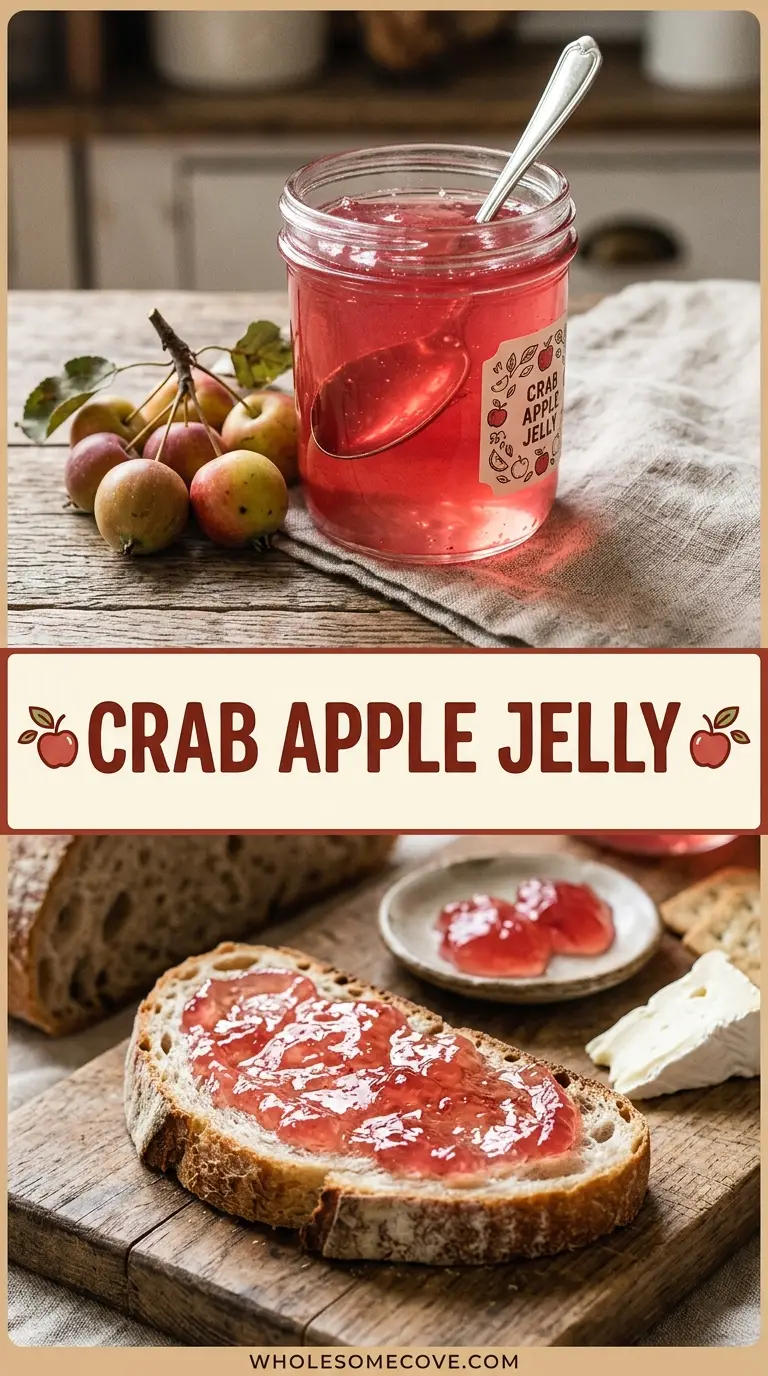
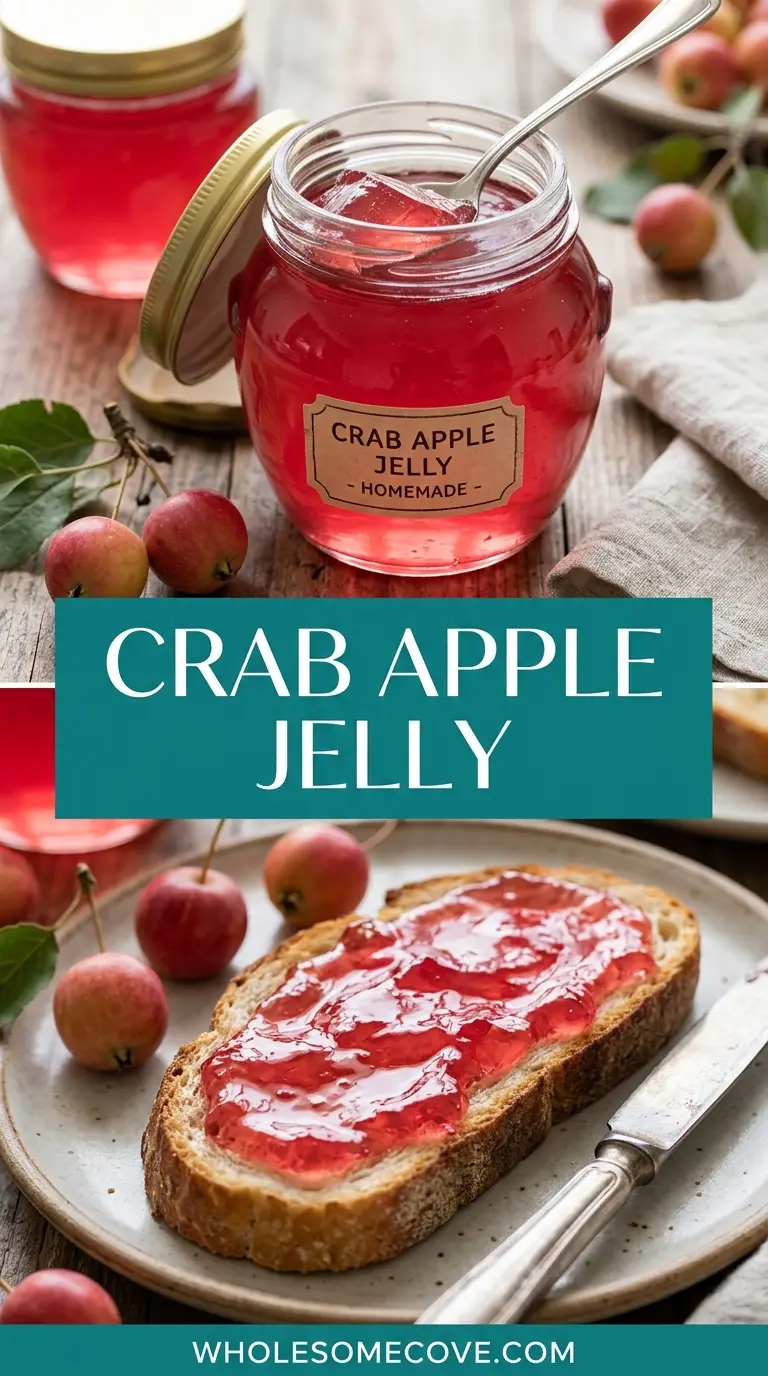
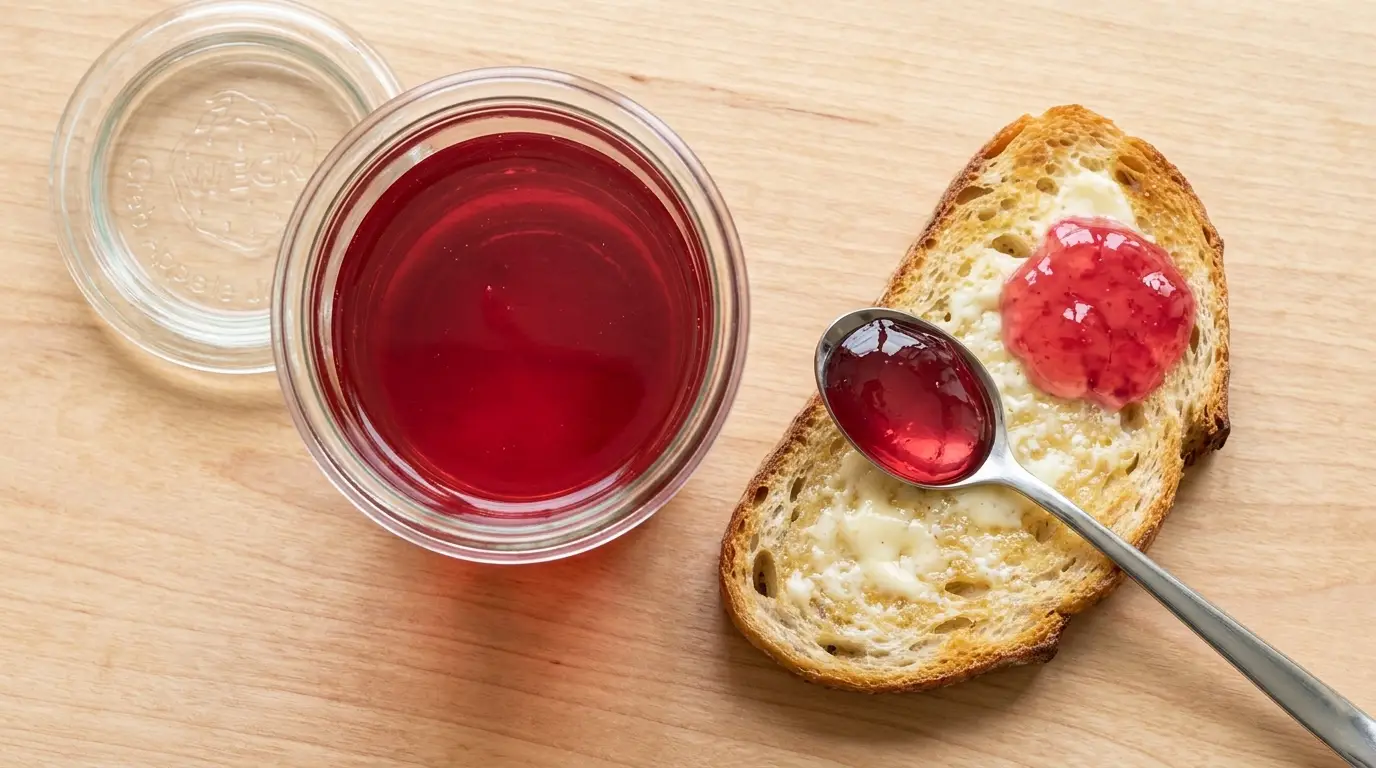
Making this crab apple jelly recipe turns a bowl of tart, thumb-sized fruit into a jar of clear, ruby-pink spread that sets firm enough to hold its shape on a spoon. The color alone is worth the effort, glowing somewhere between rose and garnet when you hold a jar up to the light.
Most first attempts fail for one reason: the cook squeezes the straining bag to rush the juice, and the jelly turns cloudy instead of jewel-clear. This version keeps the juice crystal clear by letting it drip untouched, and it leans on the crab apple’s own natural pectin so you never need a box of commercial pectin.
Three ingredients do the heavy lifting here: crab apples, sugar, and a little lemon for a dependable set. The setting point lands at 220°F (105°C), which is the single number that decides whether you get spreadable jelly or sweet syrup.
| Quick Recipe Summary | |
|---|---|
| Prep Time | 20 minutes |
| Cook Time | 55 minutes |
| Total Time | 1 hour 15 minutes (plus overnight straining) |
| Servings | About 4 cups (four 8 oz / 250 ml jars) |
| Difficulty Level | Intermediate |
For another way to preserve orchard fruit, take a look at the Peach Jam.
Why You’ll Love This Crab Apple Jelly Recipe
This is one of those preserving projects that rewards patience with a result that looks like it came from a specialty shop. The payoff is a firm, glossy jelly with a bright tart edge that plain apple jelly never quite matches.
- No commercial pectin needed. Crab apples are naturally high in pectin, so the fruit and sugar set on their own without a pectin packet.
- Only three core ingredients. Crab apples, sugar, and lemon are all you need, plus water for cooking.
- A stunning natural color. Red-skinned crab apples release a pink-to-ruby tint into the juice with no added coloring.
- A flexible harvest recipe. It works with almost any variety of crab apple, which makes it ideal for foraged or backyard fruit.
- Endlessly useful. The finished jelly works on toast, alongside cheese, and melted down as a glaze for pork or chicken.
- Long shelf life. Properly canned, it keeps in a cool, dark cupboard for up to a year.
Read Also: Peach Butter
Ingredients
The short ingredient list is deceptive, because the ratio of sugar to juice is what actually controls the set. Measure your strained juice before you commit to a sugar amount, since the yield changes depending on how juicy your fruit is.
- 3 lb (about 1.4 kg) crab apples, any red-skinned variety, stems and beards removed, washed, and halved. Use roughly 75% ripe fruit and 25% slightly underripe for the best pectin and flavor balance.
- 3 cups (720 ml) water, or just enough to nearly cover the fruit.
- 3 to 4 cups (600 to 800 g) granulated sugar, measured after straining at a ratio of 1 cup sugar per 1 cup of juice.
- 2 tablespoons (30 ml) fresh lemon juice, for extra pectin, brightness, and a more reliable set.
- 1 cinnamon stick or 4 to 6 whole cloves (optional), tied in a spice bag, if you want a warm, spiced version.
For a lighter spread option, try: Honey Butter
Kitchen Equipment Needed
None of this is exotic, but a couple of pieces make the difference between clear jelly and a frustrating afternoon. A reliable thermometer matters most, because the setting point is a specific temperature you cannot eyeball.
- A large, heavy-based pot or preserving pan for cooking the fruit and boiling the juice.
- A jelly bag with a stand, or a large colander lined with several layers of cheesecloth.
- A candy or jam thermometer to read the 220°F (105°C) setting point accurately.
- A potato masher to break down the fruit as it softens.
- A large measuring cup for measuring strained juice before adding sugar.
- A canning funnel and ladle for filling jars cleanly.
- Glass canning jars with lids in the 8 oz (250 ml) size.
- A few small plates chilled in the freezer for the wrinkle test.
For a smaller preserving project, see Homemade Cinnamon Applesauce.
Recommended Products for This Recipe
These are the tools and ingredients I reach for whenever I make a batch, chosen because each one solves a specific problem that trips people up with homemade jelly.
1. Jelly Bag with Stand
Balancing a cheesecloth purse on a wooden spoon over a stockpot works, but it tips over at the worst moment. A dedicated jelly bag on a stand holds itself steady overnight so the juice drips without supervision or spills.
2. Digital Jam Thermometer
The gap between syrup and set jelly is only a few degrees, and a cheap thermometer that reads slowly costs you that window. A fast digital probe gives an instant read on the 220°F setting point so you pull the pot at the right second.
3. Wide-Mouth Canning Funnel
Ladling hot jelly straight into a jar means sticky rims that stop lids from sealing properly. A wide-mouth funnel keeps the threads clean, which is the difference between a jar that seals with a satisfying pop and one that spoils.
4. Stainless Steel Preserving Pan
A shallow, wide pan lets the juice boil off faster and reach the setting point sooner, which protects the fresh fruit flavor and color. The heavy base also guards against scorching, a real risk once the sugar goes in.
Read Also: Peach BBQ Sauce
Step-by-Step Instructions: How to Make Crab Apple Jelly
Follow these steps in order and you’ll have clear, firmly set crab apple jelly ready for the pantry.
Step 1: Prepare the Crab Apples
- Remove the stems and the small dried tuft (the beard) from the blossom end of each crab apple, then wash the fruit well under cool running water.
- Discard any fruit with insect damage, bruising, or soft rot, since these affect both flavor and set.
- Cut each crab apple in half. There is no need to peel or core them, because the skins and cores hold much of the natural pectin you want in the jelly.
Step 2: Cook the Fruit
- Place the halved crab apples into your large heavy-based pot and pour in the 3 cups (720 ml) of water, adding just a little more only if the fruit is not nearly covered.
- Bring the pot to a boil over high heat, then reduce to a steady simmer over medium heat.
- Simmer for 25 to 30 minutes, using a potato masher to crush the fruit against the side of the pot every 10 minutes or so.
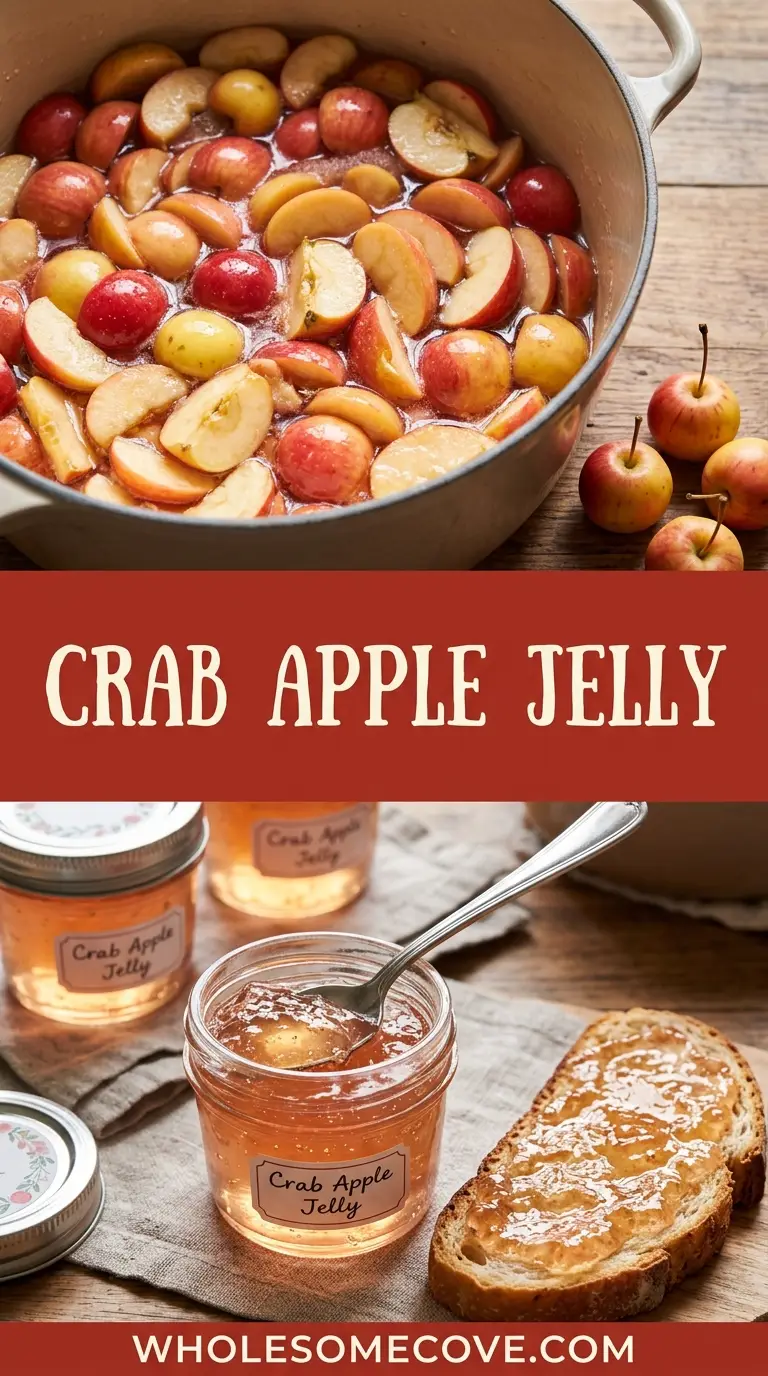
- The crab apples are ready when they are completely soft, pulpy, and have collapsed into a rough mash.
Step 3: Strain the Juice
- Set up your jelly bag on its stand, or line a large colander with several layers of dampened cheesecloth set over a deep bowl.
- Carefully ladle the hot fruit and its liquid into the bag or lined colander.
- Let the juice drip through on its own, ideally overnight or for at least several hours.
- Do not squeeze or press the bag, no matter how tempting it is. Pressing forces pulp through and turns the finished jelly cloudy instead of clear.
Step 4: Measure and Combine
- Once dripping has finished, measure the strained juice in a large measuring cup and note the exact volume.
- Add 1 cup of granulated sugar for every 1 cup of juice you collected. For a typical batch this lands around 3 to 4 cups of juice and the same amount of sugar.
- Pour the measured juice into your clean preserving pan and stir in the 2 tablespoons (30 ml) of lemon juice.
- If you want a spiced jelly, add the cinnamon stick or the tied bag of cloves now.
Step 5: Dissolve the Sugar
- Set the pan over low heat and add the measured sugar.
- Stir gently and constantly until every grain of sugar has fully dissolved. You should not feel any grittiness when you drag the spoon across the bottom.
- Do not let the mixture boil until the sugar is completely dissolved, or the jelly can turn grainy.
Step 6: Boil to the Setting Point
- Turn the heat to high and bring the mixture to a full, rolling boil that cannot be stirred down.
- Boil hard, stirring often so it does not boil over, and clip on your thermometer.
- Cook until the jelly reaches 220°F (105°C) at sea level. Above sea level, subtract 1°F for every 500 feet of elevation.
- If you added spices, remove the cinnamon stick or clove bag once the setting point is reached.
Step 7: Test the Set
- Turn off the heat and spoon a small puddle of jelly onto one of your chilled plates.
- Wait about 30 seconds, then push a fingertip through the puddle.
- If the surface wrinkles and holds its line, the jelly is set. If it floods back into the gap, return the pan to the boil and test again every few minutes.
Step 8: Skim and Jar
- Once the set is confirmed, skim off any foam or scum from the surface with a slotted spoon to keep the jelly clear.
- Using a canning funnel and ladle, fill hot sterilized jars, leaving 1/4 inch (5 mm) of headspace at the top.
- Wipe the rims clean, apply the lids, and screw the bands on until fingertip tight.
Step 9: Process and Cool
- For pantry storage, process the filled jars in a boiling-water canner for 10 minutes, adjusting for your altitude.
- Remove the jars and let them sit undisturbed for 12 to 24 hours.
- Check that each lid has sealed by pressing the center. A sealed lid stays down and does not flex.
For another fruit spread made the low-and-slow way, see Peach Compote.
Tips for The Best Crab Apple Jelly
Small details separate a firm, clear batch from a cloudy or runny one. These are the habits that made the biggest difference in my own kitchen.
- Mix ripe and underripe fruit. I’ve found that folding in about a quarter underripe crab apples gives a noticeably firmer set, because pectin drops as the fruit ripens.
- Freeze your test plates first. I keep three small plates in the freezer before I start boiling, so I always have a cold surface ready for the wrinkle test without pausing the cook.
- Trust the thermometer over the clock. Boiling times swing wildly depending on how much water your fruit released, so 220°F is the real signal, not a set number of minutes.
- Never wring the bag. The first batch I rushed came out murky because I squeezed the cheesecloth. Letting it drip untouched fixed the clarity completely.
- Rescue a runny batch. If the jelly hasn’t set after 24 hours, tip it back into the pot, add a splash more lemon juice, and reboil to 220°F.
- Watch for overripe fruit. Very ripe or oversized crab apples carry less pectin, so a batch that refuses to set often traces back to the fruit rather than your technique.
- Sterilize jars while the juice boils. Timing the jars to be hot and ready at jarring time prevents cracking and helps the seal.
You might also enjoy: Peach Chutney
What to Make with Crab Apple Jelly
Crab apple jelly is a base and a building block as much as a spread, so it slots into both sweet and savory cooking. Its firm set and tart-sweet balance make it a natural glaze, filling, and finishing touch across a whole range of dishes.
- Melt it into a glossy glaze for a Roast Chicken in the last stretch of roasting.
- Brush it over pork, such as Apple Cider Glazed Pork Chops, for a sweet-tart lacquer.
- Spoon it alongside a Cheese Ball or a cheese board with sharp cheddar and crackers.
- Warm it slightly and drizzle it over pancakes or a Waffle as a quick syrup.
- Swirl it into the center of Peach Muffins before baking for a jammy pocket.
- Spread it thinly inside Peach Scones or split biscuits.
- Serve it with a Homemade Biscuit and butter for a simple breakfast.
- Use it as the glossy fruit layer on a Fruit Tart.
- Fold a spoonful into a pan sauce for lamb, such as Lamb Chops, to cut the richness.
- Pair it with warm Dinner Rolls on a holiday table.
A similar sweet-tart approach works in this Peach French Toast.
Variations of Crab Apple Jelly
Once you have the basic method down, the plain jelly becomes a canvas. These are the most popular ways cooks tweak a standard batch without changing the core technique.
- Crab Apple Hot Pepper Jelly (Crabanero). Add two seeded, finely chopped habaneros with the sugar for a sweet-hot jelly that shines with cream cheese.
- Spiced Crab Apple Jelly. Simmer a cinnamon stick and a few whole cloves in the juice for a warm, mulled flavor, then remove before jarring.
- Ginger Crab Apple Jelly. Add a few slices of fresh ginger to the boiling juice for a bright, spicy kick.
- Herb-Infused Jelly. Steep a sprig of rosemary, thyme, or sage in the juice for a savory jelly built for cheese and meat.
- Crab Apple and Rose. Stir in a teaspoon of rosewater at the end for a floral note that plays off the pink color.
- Vanilla Crab Apple Jelly. Add the scraped seeds of half a vanilla bean for a rounder, dessert-leaning spread.
- Mixed Orchard Jelly. Replace up to a quarter of the crab apples with regular tart apples if your harvest runs short.
Read Also: Peach Pie Filling
Storage and Reheating
Because this is a canned preserve rather than a cooked dish, storage is really about sealing and shelf life rather than reheating. Handled properly, a batch will outlast the season it was made in.
- Sealed pantry storage. Properly processed and sealed jars keep in a cool, dark cupboard for up to one year.
- Unsealed jars. Any jar that did not seal should go straight into the refrigerator and be used within a few months.
- After opening. Once opened, keep the jar in the fridge and use it within four to six weeks.
- Refrigerator-only method. If you skip water-bath canning, treat every jar as refrigerator jelly and store it cold from the start.
- Freezing. You can freeze the jelly in freezer-safe containers with headspace for up to a year, though the texture softens slightly on thawing.
- Serving from cold. To loosen jelly for use as a glaze, warm a few spoonfuls gently in a small pan or microwave until pourable.
You might also enjoy: Peach Popsicles
Nutritional Facts
| Nutrition Per 1 Tablespoon (approx. 20 g) | |
|---|---|
| Calories | 50 kcal |
| Total Fat | 0 g |
| Sodium | 1 mg |
| Total Carbohydrates | 13 g |
| Sugars | 12 g |
| Protein | 0 g |
| Vitamin C | 2% Daily Value |
These figures are estimates and will shift with your exact sugar-to-juice ratio. For another fruit-based breakfast option, check out Peach Baked Oatmeal.
Tips for Using Crab Apple Jelly Like a Pro
Getting the jelly into the jar is only half the story. Knowing how to handle it afterward, and how to troubleshoot a difficult batch, is what turns a good cook into a confident one.
- Thin it for glazing. Whisk a tablespoon of warm water or juice into a few spoonfuls of jelly to reach a brushable consistency for meats.
- Fix a set that’s too firm. If a jar sets rubbery, gently rewarm it with a splash of water and re-jar, or simply use it as a glaze rather than a spread.
- Fix a runny jar. Reboil the contents with extra lemon juice back up to 220°F, then re-jar and reseal.
- Keep it clear. Always strain slowly and skim foam thoroughly, since clarity is the mark of a professional-looking jelly.
- Balance sweetness. Taste your juice before adding sugar. If your fruit is very tart, the standard 1:1 ratio is perfect, but very sweet fruit benefits from an extra squeeze of lemon.
- Label with the date. Write the batch date on each lid so you rotate your pantry stock and use the oldest jars first.
- Match the jar to the use. I fill small 4 oz jars for gifting and glazing, and larger jars for everyday toast, so I’m not reopening a big jar for one glaze.
Read Also: Cranberry Sauce
FAQs About Crab Apple Jelly
1. Do I need to add pectin to crab apple jelly?
No, you do not. Crab apples are naturally rich in pectin, especially in their skins and cores, so the jelly sets with just fruit, sugar, and a little lemon juice.
2. Why is my crab apple jelly not setting?
The most common cause is not reaching the 220°F (105°C) setting point, so a thermometer solves most cases. Overripe or oversized fruit also carries less pectin, which can leave a batch loose no matter how long you boil.
3. Can I fix jelly that didn’t set?
Yes, a runny batch is usually rescuable. Pour it back into the pot, add a tablespoon or two of lemon juice, and reboil to 220°F before jarring and testing the set again.
4. Why is my crab apple jelly cloudy?
Cloudiness almost always comes from squeezing or pressing the straining bag. Let the juice drip on its own and skim the foam well, and you’ll get a clear, jewel-like result.
5. Do I have to peel or core the crab apples?
No, and you shouldn’t. The skins and cores hold much of the natural pectin and, in red-skinned varieties, most of the color, so you simply halve the whole fruit.
6. What kind of crab apples work best?
Almost any variety works, though tart, red-skinned crab apples give the best color and pectin. A mix of mostly ripe fruit with some slightly underripe fruit gives the most reliable set.
7. Is crab apple jelly the same as apple jelly?
They are close cousins but not identical. Crab apple jelly has a sharper, more tart flavor and usually a deeper pink color, and it needs no added pectin thanks to the fruit’s high natural content.
For more fruit-forward inspiration, take a look at Peach Danish.
Crab Apple Jelly
Ingredients
- 3 lb crab apples - about 1.4 kg, any red-skinned variety, stems and beards removed, washed, and halved; use roughly 75% ripe fruit and 25% slightly underripe
- 3 cups water - 720 ml, or just enough to nearly cover the fruit
- 3 to 4 cups granulated sugar - 600 to 800 g, measured after straining at a ratio of 1 cup sugar per 1 cup of juice
- 2 tablespoons fresh lemon juice - 30 ml, for extra pectin, brightness, and a more reliable set
- 1 cinnamon stick - optional, or 4 to 6 whole cloves, tied in a spice bag, if you want a warm, spiced version
Equipment
- Large heavy-based pot or preserving pan - For cooking the fruit and boiling the juice
- Jelly bag with stand - Or a large colander lined with several layers of cheesecloth
- Candy or jam thermometer - To read the 220°F (105°C) setting point accurately
- Potato masher - To break down the fruit as it softens
- Large measuring cup - For measuring strained juice before adding sugar
- Canning funnel and ladle - For filling jars cleanly
- Glass canning jars with lids - 8 oz (250 ml) size
- Small plates - Chilled in the freezer for the wrinkle test
- Boiling-water canner - For processing filled jars for pantry storage
- Slotted spoon - For skimming foam or scum from the surface
Method
- Remove the stems and the small dried tuft (the beard) from each crab apple, wash the fruit well under cool running water, and discard any fruit with insect damage, bruising, or soft rot.
- Cut each crab apple in half. There is no need to peel or core them, because the skins and cores hold much of the natural pectin and color.
- Place the halved crab apples into a large heavy-based pot and pour in the 3 cups (720 ml) of water, adding just a little more only if the fruit is not nearly covered. Bring to a boil over high heat, then reduce to a steady simmer over medium heat.
- Simmer for 25 to 30 minutes, using a potato masher to crush the fruit against the side of the pot every 10 minutes or so, until the crab apples are completely soft, pulpy, and have collapsed into a rough mash.
- Set up your jelly bag on its stand, or line a large colander with several layers of dampened cheesecloth set over a deep bowl. Carefully ladle the hot fruit and its liquid into the bag or lined colander.
- Let the juice drip through on its own, ideally overnight or for at least several hours. Do not squeeze or press the bag, no matter how tempting it is, because pressing forces pulp through and turns the finished jelly cloudy instead of clear.
- Once dripping has finished, measure the strained juice in a large measuring cup and note the exact volume. Add 1 cup of granulated sugar for every 1 cup of juice you collected.
- Pour the measured juice into your clean preserving pan and stir in the 2 tablespoons (30 ml) of lemon juice. If you want a spiced jelly, add the cinnamon stick or the tied bag of cloves now.
- Set the pan over low heat and add the measured sugar. Stir gently and constantly until every grain of sugar has fully dissolved. You should not feel any grittiness when you drag the spoon across the bottom. Do not let the mixture boil until the sugar is completely dissolved, or the jelly can turn grainy.
- Turn the heat to high and bring the mixture to a full, rolling boil that cannot be stirred down. Boil hard, stirring often so it does not boil over, and clip on your thermometer.
- Cook until the jelly reaches 220°F (105°C) at sea level. Above sea level, subtract 1°F for every 500 feet of elevation. If you added spices, remove the cinnamon stick or clove bag once the setting point is reached.
- Turn off the heat and spoon a small puddle of jelly onto one of your chilled plates. Wait about 30 seconds, then push a fingertip through the puddle. If the surface wrinkles and holds its line, the jelly is set.
- If the jelly floods back into the gap, return the pan to the boil and test again every few minutes.
- Once the set is confirmed, skim off any foam or scum from the surface with a slotted spoon to keep the jelly clear. Using a canning funnel and ladle, fill hot sterilized jars, leaving 1/4 inch (5 mm) of headspace at the top.
- Wipe the rims clean, apply the lids, and screw the bands on until fingertip tight.
- For pantry storage, process the filled jars in a boiling-water canner for 10 minutes, adjusting for your altitude. Remove the jars and let them sit undisturbed for 12 to 24 hours.
- Check that each lid has sealed by pressing the center. A sealed lid stays down and does not flex.
Notes
- Mix ripe and underripe fruit. Folding in about a quarter underripe crab apples gives a noticeably firmer set, because pectin drops as the fruit ripens.
- Freeze your test plates first. Keep three small plates in the freezer before you start boiling, so you always have a cold surface ready for the wrinkle test without pausing the cook.
- Trust the thermometer over the clock. Boiling times swing wildly depending on how much water your fruit released, so 220°F is the real signal, not a set number of minutes.
- Never wring the bag. Squeezing or pressing the cheesecloth forces pulp through and turns the jelly cloudy. Letting it drip untouched keeps it clear.
- Rescue a runny batch. If the jelly hasn’t set after 24 hours, tip it back into the pot, add a splash more lemon juice, and reboil to 220°F.
- Watch for overripe fruit. Very ripe or oversized crab apples carry less pectin, so a batch that refuses to set often traces back to the fruit rather than your technique.
- Sterilize jars while the juice boils. Timing the jars to be hot and ready at jarring time prevents cracking and helps the seal.
- Storage: Properly processed and sealed jars keep in a cool, dark cupboard for up to one year. Unsealed jars should go straight into the refrigerator and be used within a few months. Once opened, keep the jar in the fridge and use within four to six weeks.
- Refrigerator-only method: If you skip water-bath canning, treat every jar as refrigerator jelly and store it cold from the start.
- Freezing: You can freeze the jelly in freezer-safe containers with headspace for up to a year, though the texture softens slightly on thawing.
Private Notes
Tried this recipe?
Let us know how it was!Final Thoughts
There is a quiet satisfaction in turning a tree full of overlooked little apples into a row of glowing jars. Crab apple jelly is proof that the simplest ingredients, handled with a bit of care, can become something genuinely special.
If you have access to a crab apple tree or a generous farmers market, this is the recipe to start with. Take your time with the straining and trust the thermometer, and the set will follow.
I’d love to hear how your batch turns out. Leave a comment with your favorite variation, and share this recipe with anyone lucky enough to have a crab apple tree nearby.
Recommended:
- Apple Crisp
- Poached Pear
- Peach Tart
- Peach Galette
- Peach Crumble
- Mulled Apple Cider
- Amish Apple Cake
- Peach Turnovers
- Peach Hand Pies