Crab Apple Jelly

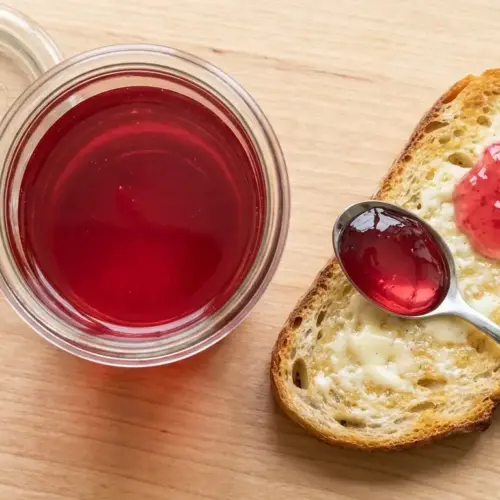
This crab apple jelly recipe turns tart, thumb-sized fruit into a jar of clear, ruby-pink spread that sets firm enough to hold its shape on a spoon, with no commercial pectin needed.
Equipment
- Large heavy-based pot or preserving pan - For cooking the fruit and boiling the juice
- Jelly bag with stand - Or a large colander lined with several layers of cheesecloth
- Candy or jam thermometer - To read the 220°F (105°C) setting point accurately
- Potato masher - To break down the fruit as it softens
- Large measuring cup - For measuring strained juice before adding sugar
- Canning funnel and ladle - For filling jars cleanly
- Glass canning jars with lids - 8 oz (250 ml) size
- Small plates - Chilled in the freezer for the wrinkle test
- Boiling-water canner - For processing filled jars for pantry storage
- Slotted spoon - For skimming foam or scum from the surface
Ingredients
- 3 lb crab apples - about 1.4 kg, any red-skinned variety, stems and beards removed, washed, and halved; use roughly 75% ripe fruit and 25% slightly underripe
- 3 cups water - 720 ml, or just enough to nearly cover the fruit
- 3 to 4 cups granulated sugar - 600 to 800 g, measured after straining at a ratio of 1 cup sugar per 1 cup of juice
- 2 tablespoons fresh lemon juice - 30 ml, for extra pectin, brightness, and a more reliable set
- 1 cinnamon stick - optional, or 4 to 6 whole cloves, tied in a spice bag, if you want a warm, spiced version
Instructions
- Remove the stems and the small dried tuft (the beard) from each crab apple, wash the fruit well under cool running water, and discard any fruit with insect damage, bruising, or soft rot.
- Cut each crab apple in half. There is no need to peel or core them, because the skins and cores hold much of the natural pectin and color.
- Place the halved crab apples into a large heavy-based pot and pour in the 3 cups (720 ml) of water, adding just a little more only if the fruit is not nearly covered. Bring to a boil over high heat, then reduce to a steady simmer over medium heat.
- Simmer for 25 to 30 minutes, using a potato masher to crush the fruit against the side of the pot every 10 minutes or so, until the crab apples are completely soft, pulpy, and have collapsed into a rough mash.
- Set up your jelly bag on its stand, or line a large colander with several layers of dampened cheesecloth set over a deep bowl. Carefully ladle the hot fruit and its liquid into the bag or lined colander.
- Let the juice drip through on its own, ideally overnight or for at least several hours. Do not squeeze or press the bag, no matter how tempting it is, because pressing forces pulp through and turns the finished jelly cloudy instead of clear.
- Once dripping has finished, measure the strained juice in a large measuring cup and note the exact volume. Add 1 cup of granulated sugar for every 1 cup of juice you collected.
- Pour the measured juice into your clean preserving pan and stir in the 2 tablespoons (30 ml) of lemon juice. If you want a spiced jelly, add the cinnamon stick or the tied bag of cloves now.
- Set the pan over low heat and add the measured sugar. Stir gently and constantly until every grain of sugar has fully dissolved. You should not feel any grittiness when you drag the spoon across the bottom. Do not let the mixture boil until the sugar is completely dissolved, or the jelly can turn grainy.
- Turn the heat to high and bring the mixture to a full, rolling boil that cannot be stirred down. Boil hard, stirring often so it does not boil over, and clip on your thermometer.
- Cook until the jelly reaches 220°F (105°C) at sea level. Above sea level, subtract 1°F for every 500 feet of elevation. If you added spices, remove the cinnamon stick or clove bag once the setting point is reached.
- Turn off the heat and spoon a small puddle of jelly onto one of your chilled plates. Wait about 30 seconds, then push a fingertip through the puddle. If the surface wrinkles and holds its line, the jelly is set.
- If the jelly floods back into the gap, return the pan to the boil and test again every few minutes.
- Once the set is confirmed, skim off any foam or scum from the surface with a slotted spoon to keep the jelly clear. Using a canning funnel and ladle, fill hot sterilized jars, leaving 1/4 inch (5 mm) of headspace at the top.
- Wipe the rims clean, apply the lids, and screw the bands on until fingertip tight.
- For pantry storage, process the filled jars in a boiling-water canner for 10 minutes, adjusting for your altitude. Remove the jars and let them sit undisturbed for 12 to 24 hours.
- Check that each lid has sealed by pressing the center. A sealed lid stays down and does not flex.
Notes
- Mix ripe and underripe fruit. Folding in about a quarter underripe crab apples gives a noticeably firmer set, because pectin drops as the fruit ripens.
- Freeze your test plates first. Keep three small plates in the freezer before you start boiling, so you always have a cold surface ready for the wrinkle test without pausing the cook.
- Trust the thermometer over the clock. Boiling times swing wildly depending on how much water your fruit released, so 220°F is the real signal, not a set number of minutes.
- Never wring the bag. Squeezing or pressing the cheesecloth forces pulp through and turns the jelly cloudy. Letting it drip untouched keeps it clear.
- Rescue a runny batch. If the jelly hasn't set after 24 hours, tip it back into the pot, add a splash more lemon juice, and reboil to 220°F.
- Watch for overripe fruit. Very ripe or oversized crab apples carry less pectin, so a batch that refuses to set often traces back to the fruit rather than your technique.
- Sterilize jars while the juice boils. Timing the jars to be hot and ready at jarring time prevents cracking and helps the seal.
- Storage: Properly processed and sealed jars keep in a cool, dark cupboard for up to one year. Unsealed jars should go straight into the refrigerator and be used within a few months. Once opened, keep the jar in the fridge and use within four to six weeks.
- Refrigerator-only method: If you skip water-bath canning, treat every jar as refrigerator jelly and store it cold from the start.
- Freezing: You can freeze the jelly in freezer-safe containers with headspace for up to a year, though the texture softens slightly on thawing.
Nutrition
Serving: 1TablespoonCalories: 50kcalCarbohydrates: 13gSodium: 1mgSugar: 12gVitamin C: 2mg
Tried this recipe?Let us know how it was!