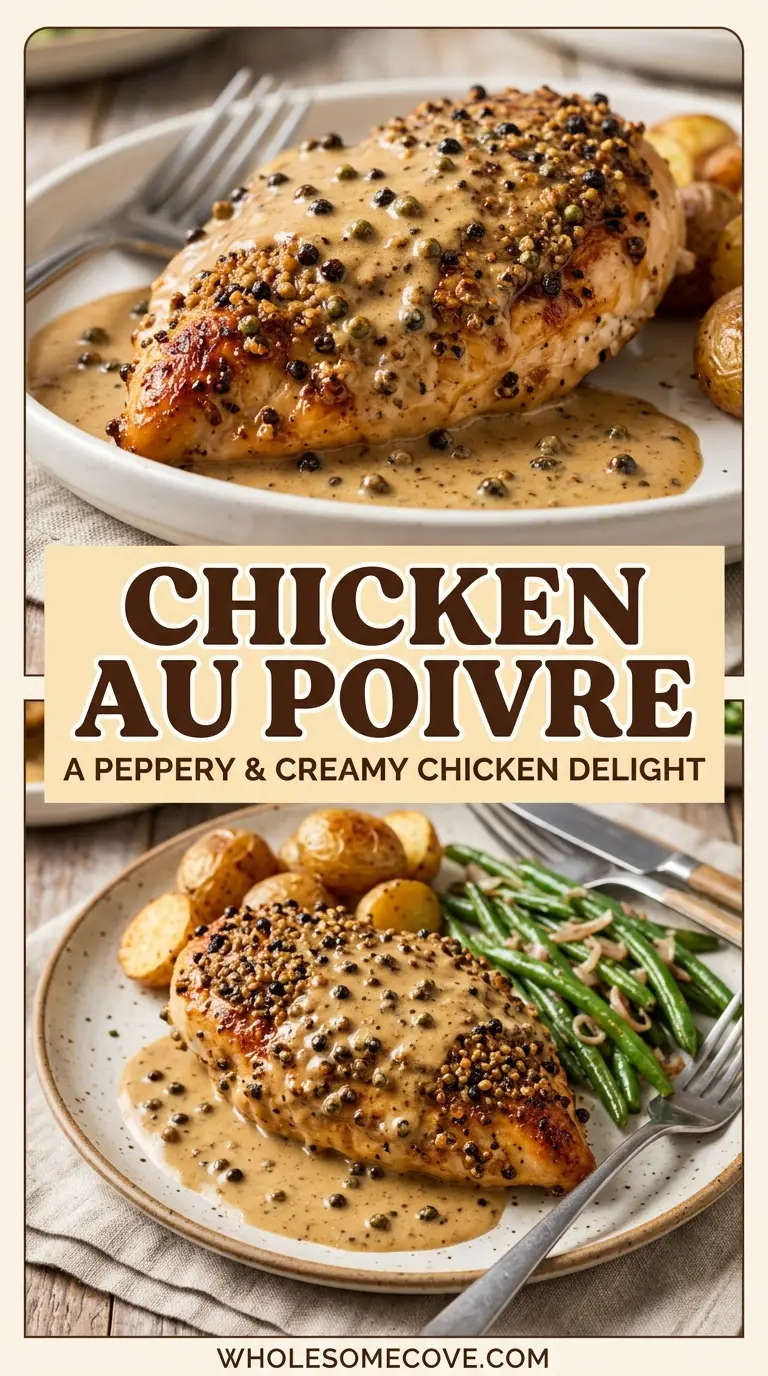
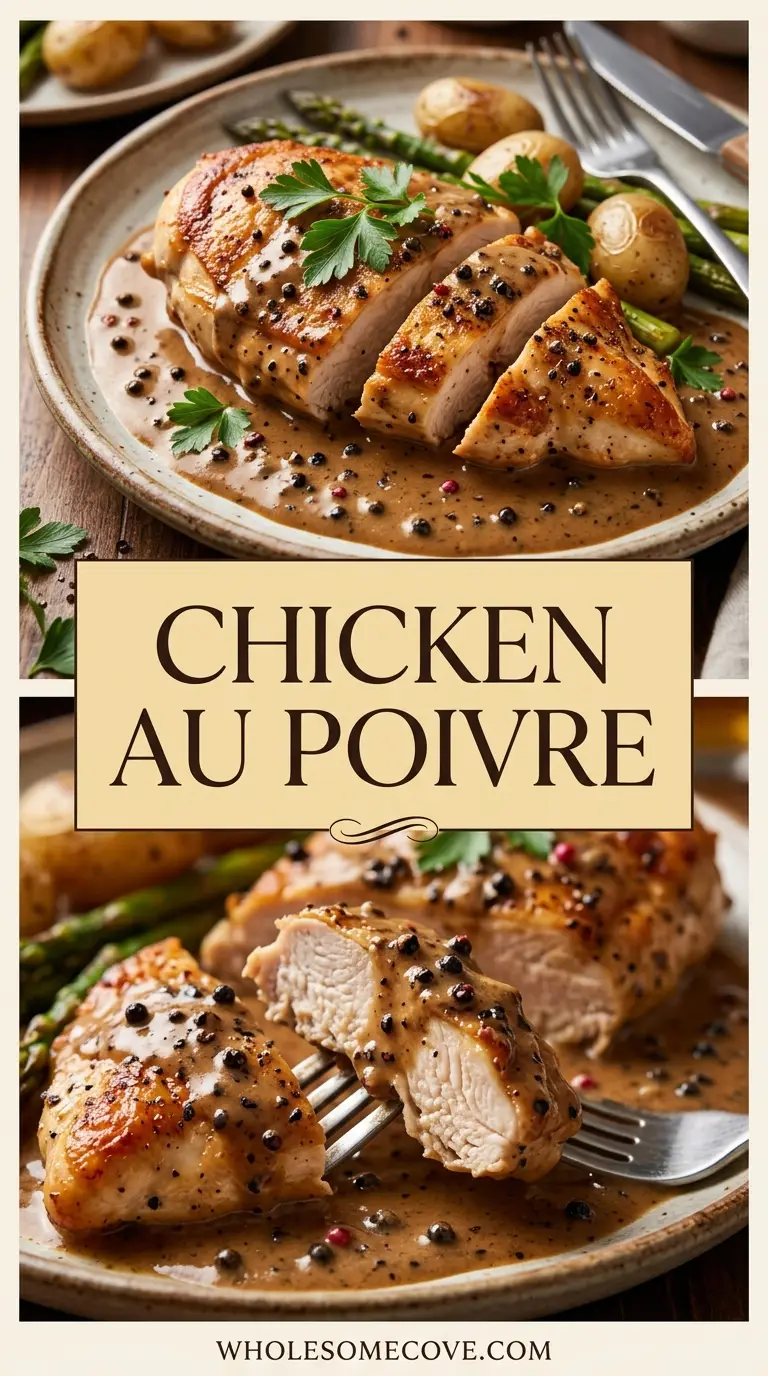
This chicken au poivre recipe takes the peppery, glossy cream sauce from the classic steakhouse dish and spoons it over golden, pan-seared chicken instead. You get the same coarse-cracked pepper bite and Cognac-spiked sauce, ready in about 35 minutes with a single skillet.
The one detail most people get wrong is the pepper itself. Fine pepper from a grinder turns the sauce dusty and one-note, while coarsely cracked whole peppercorns leave little toasted pockets of heat that define the dish.
Searing the chicken first leaves browned fond stuck to the pan. That fond is what gives the sauce its deep, savory backbone once you deglaze with Cognac.
A spoonful of Dijon and a pour of heavy cream soften the sharp edge of the pepper without burying it. Four chicken breasts, one skillet, and a handful of pantry staples turn a plain weeknight into something that tastes like a reservation.
| Quick Recipe Summary | |
|---|---|
| Prep Time | 15 minutes |
| Cook Time | 20 minutes |
| Total Time | 35 minutes |
| Servings | 4 servings |
| Difficulty Level | Easy |
For another peppery main built around cracked pepper, see Pepper Steak.
Why You’ll Love This Chicken au Poivre Recipe
This is the kind of dish that feels far more involved than it actually is, and that gap is exactly why it earns a spot in your rotation. The technique is simple, but the payoff reads as restaurant-level.
- It comes together in one pan. The chicken, the fond, and the sauce all happen in the same skillet, so cleanup stays minimal.
- The sauce does the heavy lifting. A peppercorn cream sauce with Cognac tastes luxurious, yet it relies on pantry staples and about ten minutes of simmering.
- It fits a weeknight or a date night. Thirty-five minutes total makes it doable on a Tuesday, while the presentation holds up for company.
- It’s naturally low in carbs. With no breading or flour dredge, the whole plate leans protein-forward and keto-friendly.
- You control the heat. Coarsely cracked peppercorns give warmth and texture, and you can scale the pepper up or down without changing anything else.
- It reheats gently. The sauce loosens back to silky with a splash of stock, so leftovers stay good the next day.
You might also enjoy: Marry Me Chicken
Ingredients
Everything here is either a pantry staple or a quick grab from the store, with the peppercorns and Cognac doing most of the flavor work. Measurements are given in both imperial and metric so the recipe works wherever you cook.
For the chicken:
- 4 boneless, skinless chicken breasts (about 1.5 lb / 680 g total), pounded to an even 1/2-inch (1.3 cm) thickness
- 2 tablespoons (14 g) whole black peppercorns, coarsely cracked, divided
- 1 teaspoon kosher salt
- 2 tablespoons (30 ml) extra-virgin olive oil
- 1 tablespoon (14 g) unsalted butter
For the peppercorn sauce:
- 2 tablespoons (28 g) unsalted butter
- 2 medium shallots, finely minced (about 1/3 cup / 50 g)
- 3 cloves garlic, minced
- 1/3 cup (80 ml) Cognac or brandy
- 1 cup (240 ml) beef stock, or low-sodium chicken broth
- 3/4 cup (180 ml) heavy cream
- 1 tablespoon (15 g) Dijon mustard
- 3 sprigs fresh thyme
- Flaky salt to taste, such as Maldon
- 2 tablespoons fresh parsley, chopped, for garnish
I ruined my first attempt by grinding the pepper fine in a mill, which turned the sauce gritty and dull instead of leaving the cracked bits you actually want to bite into. A quick crush under the bottom of a heavy pan fixes that in seconds.
Read Also: Chicken Parmesan
Kitchen Equipment Needed
You don’t need specialty gear for this one, but a few tools make the searing and the sauce far easier. Most of it is already in a standard kitchen.
- A wide stainless steel skillet or heavy sauté pan, which browns the chicken and builds fond better than nonstick
- A meat mallet or a heavy rolling pin for pounding the breasts to an even thickness
- An instant-read meat thermometer to catch the chicken at the right internal temperature
- A fine mesh strainer if you prefer a smoother sauce
- A pair of kitchen tongs for turning and basting the chicken
- A splatter screen to keep the searing stage tidy
The same pan-searing technique carries over to Filet Mignon.
Recommended Products for This Recipe
These are the items I reach for when I want this dish to taste its best, chosen because each one solves a specific problem that comes up while cooking it. They are personal picks based on what has actually improved the results.
1. Tellicherry Peppercorns
Standard peppercorns work, but Tellicherry berries are larger and more aromatic, which matters when pepper is the headline flavor and not just a background seasoning. They crack into satisfying coarse pieces and bring a fruity warmth that plain table pepper can’t reach.
2. All-Clad Stainless Steel Skillet
Nonstick pans skip the browned fond that makes this sauce taste like a bistro, so a tri-ply stainless pan is worth the upgrade here. It heats evenly, holds a steady sear, and releases every bit of that flavor when you deglaze with Cognac.
3. Granite Mortar and Pestle
A pepper mill grinds too fine for au poivre, and chasing runaway peppercorns across a cutting board gets old fast. A heavy granite mortar crushes whole berries into the coarse, uneven texture the dish depends on, with no mess.
4. Thermapen Instant-Read Thermometer
Chicken breast has a narrow window between juicy and dry, and guessing is what pushes it over the edge. A fast, accurate thermometer lets you pull the meat at exactly the right moment so it finishes cooking in the residual heat of the sauce.
For a bigger bird night, try: Roast Chicken
Step-by-Step Instructions: How to Make Chicken au Poivre
Follow these steps in order and you’ll have a glossy, peppery chicken dinner on the table in about half an hour.
Step 1: Prep and Season the Chicken
- Place each chicken breast between two sheets of plastic wrap or parchment.
- Pound with a meat mallet until each piece is an even 1/2-inch (1.3 cm) thick, which helps them cook quickly and evenly.
- Pat the chicken completely dry with paper towels, since surface moisture is the enemy of a good sear.
- Season both sides with the kosher salt.
- Press most of the coarsely cracked peppercorns firmly into both sides of the chicken, reserving about 1 teaspoon for the sauce.
Step 2: Sear the Chicken
- Heat the olive oil and 1 tablespoon (14 g) butter in your skillet over medium-high heat until the butter foams and the oil shimmers.
- Add the chicken in a single layer, working in batches if needed so the pan isn’t crowded.
- Sear undisturbed for 4 to 5 minutes, until a deep golden crust forms and the chicken releases easily.
- Flip and cook another 3 to 4 minutes, until the internal temperature reaches 160°F (71°C).
- Transfer the chicken to a plate and tent loosely with foil. It will finish cooking to 165°F (74°C) as it rests.
Pressing the cracked pepper into the chicken before searing holds up far better than stirring it all into the sauce, because the crust toasts in the pan and loses that raw, dusty edge.
Step 3: Build the Aromatic Base
- Lower the heat to medium and add the 2 tablespoons (28 g) butter to the same skillet, without wiping it out.
- Add the minced shallots and cook for 2 minutes, stirring, until softened and translucent.
- Stir in the garlic and cook for 30 seconds, just until fragrant, so it doesn’t scorch.
Step 4: Deglaze with Cognac
- Pull the skillet off the heat before adding the Cognac, which keeps any flare-up in check.
- Pour in the Cognac or brandy and return the pan to the heat.
- Scrape the bottom of the pan with a wooden spoon to lift all the browned fond into the liquid.
- Let the Cognac simmer for about 1 minute, until slightly reduced and the sharp alcohol smell cooks off.
Step 5: Simmer the Sauce
- Pour in the beef stock and bring to a simmer, letting it reduce by about half over 3 to 4 minutes.
- Stir in the heavy cream, Dijon mustard, thyme sprigs, and the reserved cracked peppercorns.
- Simmer gently for 4 to 5 minutes, stirring often, until the sauce coats the back of a spoon.
- Keep the heat moderate rather than high, so the cream stays smooth and doesn’t split.
- Taste and adjust with flaky salt.
Step 6: Finish and Serve
- Remove the thyme sprigs from the sauce.
- Return the chicken and any resting juices to the skillet.
- Spoon the sauce over the chicken and let everything warm together for 2 minutes, basting the tops.
- Scatter chopped parsley over the top and serve immediately, with extra sauce spooned across each piece.
Read Also: Chicken Caprese Skillet

Tips for The Best Chicken au Poivre
Small choices make the difference between a good version and one that tastes like it came from a bistro kitchen. These are the details worth paying attention to.
- Crack, don’t grind. Coarse peppercorns give texture and bloom; fine pepper turns the sauce muddy and harsh.
- Dry the chicken well. A dry surface is what lets the pepper crust brown instead of steam.
- Don’t crowd the pan. Searing in batches keeps the heat high enough to build fond, which is the flavor engine of the sauce.
- Deglaze off the heat. Adding Cognac away from the flame is safer and gives you a controlled simmer.
- Watch the cream. A gentle simmer keeps the sauce glossy, while a hard boil can cause it to break.
- Rest the chicken. Pulling it at 160°F (71°C) and letting it finish in the sauce prevents dry, overcooked breasts.
I’ve found beef stock gives the sauce a deeper, steakhouse backbone than chicken broth, so I keep a carton of it on hand just for this even though the dish itself is chicken.
For a lighter, herb-forward chicken dinner, see Grilled Lemon Herb Chicken.
What to Serve with Chicken au Poivre
The sauce is the star, so the best sides are the ones that catch every drop of it. Think soft, starchy anchors and simple vegetables that won’t compete with the pepper.
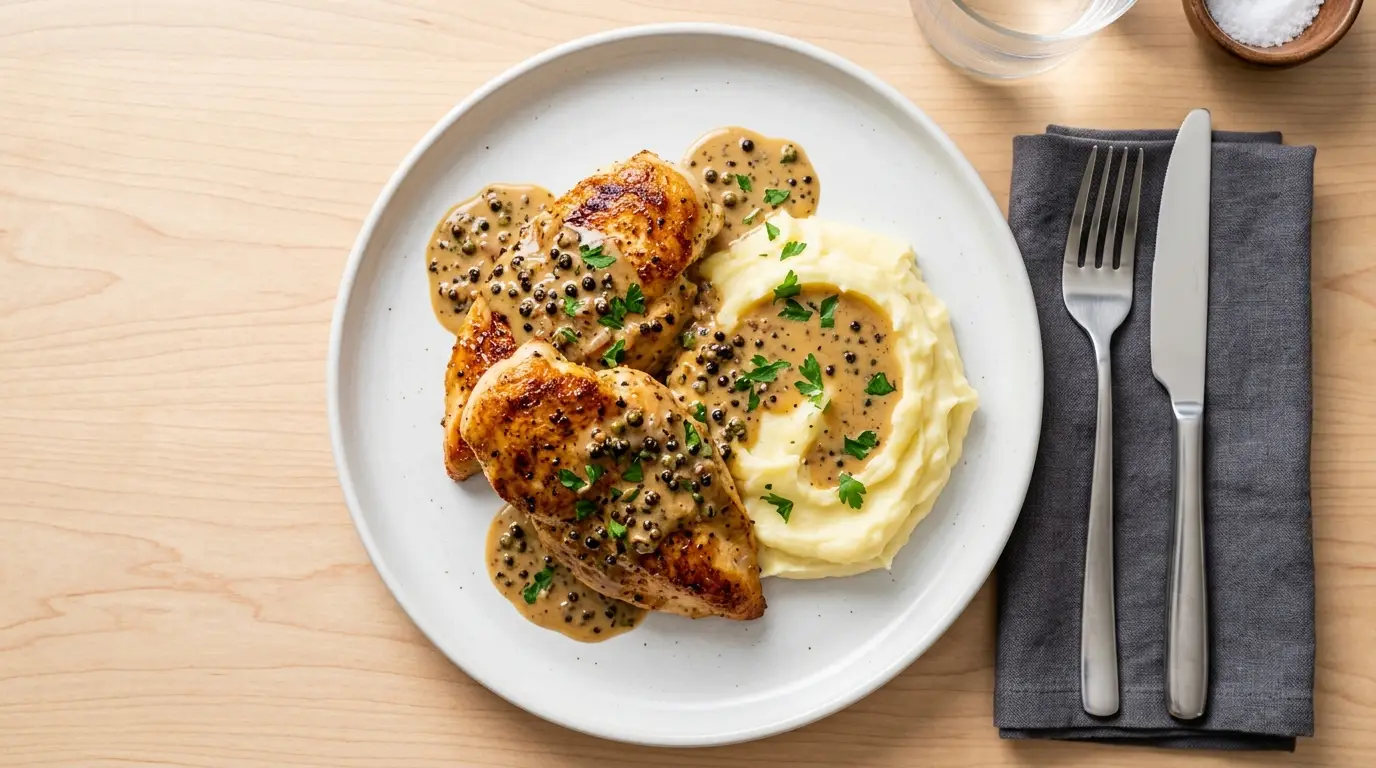
- Mashed Potatoes, the classic pairing, since the sauce pools into them beautifully
- Roasted Potatoes for crisp edges that scoop up the cream
- Au Gratin Potatoes when you want a richer, special-occasion plate
- Buttered egg noodles, a quick and traditional base for the sauce
- Creamed Spinach for a steakhouse-style vegetable side
- Maple Glazed Carrots, whose sweetness balances the pepper
- Roasted Brussels Sprouts with Bacon for a savory, textured contrast
- Green Bean Casserole for a comforting, familiar side
- Dinner Rolls or crusty bread for mopping the plate clean
- A crisp green salad with a sharp vinaigrette to cut the richness
- A glass of dry red wine, such as a Bordeaux or Pinot Noir
To lean further into the bistro theme, try: French Onion Soup
Variations of Chicken au Poivre
The base recipe is flexible, and small swaps let you match it to what you have or the mood you’re in. Here are the versions worth trying.
- Chicken thighs: Swap in boneless, skinless thighs for a juicier, more forgiving result, adding a couple of minutes to the cook time.
- Green peppercorn sauce: Stir in a tablespoon of brined green peppercorns for a milder, brighter heat.
- Non-alcoholic: Replace the Cognac with extra stock plus a teaspoon of sherry vinegar or lemon juice to mimic its acidity.
- Mushroom au poivre: Sauté sliced cremini mushrooms with the shallots for an earthy, heartier sauce.
- Peppercorn medley: Use a blend of black, white, and pink peppercorns for a more complex, layered pepper flavor.
- Lighter sauce: Use half-and-half in place of heavy cream for a thinner, less rich finish.
- Bone-in, skin-on: Sear skin-on breasts or thighs for extra flavor, adjusting the timing so they cook through.
Read Also: Chinese Pepper Steak
Storage and Reheating
This dish keeps well, which makes it a smart candidate for leftovers or light meal prep. The key is reheating gently so the sauce and chicken both stay tender.
- Refrigerate: Store the chicken and sauce together in an airtight container for up to 3 days.
- Freeze with caution: Cream sauces can separate when frozen, so freezing isn’t ideal, but you can freeze the chicken and sauce for up to 2 months if needed.
- Reheat on the stovetop: Warm slowly over low heat, adding a splash of stock or cream to loosen the sauce back to silky.
- Avoid the microwave when possible: High microwave heat can toughen the chicken and split the sauce, so low and slow on the stove is better.
- Make ahead: You can sear the chicken and build the sauce a few hours in advance, then reheat and combine just before serving.
- Store sauce separately: For meal prep, keeping the sauce apart from the chicken helps both reheat more evenly.
Another creamy skillet dinner worth keeping in rotation is Chicken Alfredo.
Nutritional Facts
Values are estimates per serving, based on four servings and using beef stock and heavy cream. Actual numbers vary with brands and portion sizes.
| Nutrient | Amount per Serving |
|---|---|
| Calories | 540 kcal |
| Total Fat | 36 g |
| Saturated Fat | 17 g |
| Cholesterol | 180 mg |
| Sodium | 620 mg |
| Total Carbohydrates | 6 g |
| Dietary Fiber | 1 g |
| Sugars | 2 g |
| Protein | 41 g |
For a lighter weeknight option, try: Healthy Chicken Parmesan
Health Benefits of Key Ingredients
Beyond tasting like a splurge, this dish leans on a few ingredients that bring real nutritional value. Here’s what the main components contribute.
- Chicken breast: A lean, complete protein that supports muscle maintenance and keeps you full, with relatively little fat before the sauce.
- Black peppercorns: Contain piperine, a compound studied for its antioxidant properties and its ability to help the body absorb other nutrients.
- Garlic: Provides sulfur compounds linked to heart health and immune support, even in small amounts.
- Shallots: Offer fiber, vitamin B6, and antioxidants, along with a gentler flavor than standard onions.
- Thyme: A herb rich in vitamin C and aromatic oils that have traditionally been valued for their antibacterial qualities.
- Olive oil: Supplies monounsaturated fats that are considered heart-healthy when used in place of heavier cooking fats.
- Parsley: More than a garnish, it delivers vitamin K, vitamin C, and a fresh, mineral-rich finish.
Read Also: Teriyaki Grilled Chicken
FAQs About Chicken au Poivre
1. What does “au poivre” mean?
The phrase is French for “with pepper,” and it refers to the coarsely cracked peppercorns at the center of the dish. It signals a peppery, cream-based pan sauce built on that cracked-pepper flavor.
The name comes straight from steak au poivre, the bistro original. This chicken version borrows the same sauce and technique.
2. Can I use chicken breasts or thighs?
Both work well, so the choice comes down to preference. Breasts are leaner and cook fast, while thighs stay juicier and are more forgiving if you overshoot the timing.
If you use thighs, add a couple of minutes to the cook time. Pounding either cut to an even thickness helps them cook through evenly.
3. What can I substitute for Cognac?
Brandy is the closest swap and works exactly the same way. If you’d rather skip alcohol entirely, use extra stock with a teaspoon of sherry vinegar or lemon juice to replace the acidity and depth.
The Cognac mainly adds complexity as it deglazes the pan. You’ll still get a flavorful sauce without it, just a slightly simpler one.
4. Why did my cream sauce split or curdle?
The usual cause is heat that’s too high once the cream goes in. Boiling cream hard can cause it to separate into a greasy, grainy texture.
Keep the sauce at a gentle simmer and stir often. If it does start to break, pull it off the heat and whisk in a splash of cold cream to bring it back.
5. How spicy is chicken au poivre?
It has a noticeable warmth from the black pepper, but it reads more as aromatic than fiery. The cream and stock round off the sharpness so it stays balanced.
You can easily adjust it to taste. Use less pepper for a mild version, or more if you like a stronger kick.
6. Can I make chicken au poivre ahead of time?
Yes, and it reheats nicely when done gently. Cook the chicken and sauce, cool them, and store together in the fridge for up to 3 days.
Reheat slowly on the stovetop with a splash of stock or cream to loosen the sauce. Avoid high heat, which can dry the chicken and split the sauce.
7. Do I have to use whole peppercorns?
For the best result, yes, because coarsely cracked whole peppercorns give the dish its signature texture and bloom. Pre-ground pepper turns the sauce dusty and flat.
If whole peppercorns are all you have to crush, a mortar and pestle or the base of a heavy pan does the job. Aim for coarse, uneven pieces rather than a fine powder.
To finish the meal with something French, see Creme Brulee.
Chicken au Poivre
Ingredients
- 4 boneless skinless chicken breasts - about 1.5 lb or 680g total, pounded to an even 1/2-inch or 1.3cm thickness
- 2 tablespoons whole black peppercorns - 14g, coarsely cracked, divided
- 1 teaspoon kosher salt
- 2 tablespoons extra-virgin olive oil - 30ml
- 1 tablespoon unsalted butter - 14g
- 2 tablespoons unsalted butter - 28g
- 2 medium shallots - finely minced, about 1/3 cup or 50g
- 3 cloves garlic - minced
- 1/3 cup Cognac or brandy - 80ml
- 1 cup beef stock - 240ml, or low-sodium chicken broth
- 3/4 cup heavy cream - 180ml
- 1 tablespoon Dijon mustard - 15g
- 3 sprigs fresh thyme
- flaky salt - to taste, such as Maldon
- 2 tablespoons fresh parsley - chopped, for garnish
Equipment
- Stainless steel skillet or heavy sauté pan - Wide pan for searing chicken and building fond
- Meat mallet or heavy rolling pin - For pounding chicken breasts to even thickness
- Instant-read meat thermometer - To check chicken internal temperature
- Fine-mesh strainer - (optional) For a smoother sauce
- Kitchen tongs - For turning and basting the chicken
- Splatter screen - (optional) To keep searing stage tidy
- Mortar and pestle - (optional) For coarsely cracking peppercorns
Method
- Pound each chicken breast between plastic wrap to an even 1/2-inch (1.3cm) thickness, pat completely dry, season both sides with kosher salt, and press most of the cracked peppercorns firmly into both sides, reserving about 1 teaspoon for the sauce.
- Heat olive oil and 1 tablespoon butter in a skillet over medium-high until butter foams and oil shimmers, then sear chicken in a single layer for 4 to 5 minutes per side until deep golden and internal temperature reaches 160°F (71°C). Transfer to a plate and tent with foil.
- Lower heat to medium and add 2 tablespoons butter to the same skillet, then cook minced shallots for 2 minutes until softened and translucent before stirring in garlic for 30 seconds until fragrant.
- Pull the skillet off the heat, pour in Cognac or brandy, return to heat, and scrape the bottom of the pan with a wooden spoon to lift all the browned fond, letting it simmer for about 1 minute until slightly reduced and the sharp alcohol smell cooks off.
- Pour in beef stock and bring to a simmer, reducing by about half over 3 to 4 minutes, then stir in heavy cream, Dijon mustard, thyme sprigs, and reserved cracked peppercorns, simmering gently for 4 to 5 minutes until the sauce coats the back of a spoon.
- Remove thyme sprigs, return chicken and any resting juices to the skillet, spoon sauce over the chicken and let everything warm together for 2 minutes while basting the tops, then scatter chopped parsley over the top and serve immediately.
Nutrition
Notes
- Crack, don’t grind: Coarse peppercorns give texture and bloom; fine pepper turns the sauce muddy and harsh. Use a mortar and pestle or the bottom of a heavy pan to crack whole peppercorns into coarse, uneven pieces.
- Dry the chicken well: A dry surface is what lets the pepper crust brown instead of steam, so pat the chicken completely dry with paper towels before seasoning.
- Don’t crowd the pan: Sear the chicken in batches if needed to keep the heat high enough to build fond, which is the flavor engine of the sauce.
- Deglaze off the heat: Adding Cognac away from the flame is safer and gives you a controlled simmer.
- Watch the cream: A gentle simmer keeps the sauce glossy, while a hard boil can cause it to break. If it starts to split, pull it off the heat and whisk in a splash of cold cream.
- Rest the chicken: Pulling it at 160°F (71°C) and letting it finish in the sauce prevents dry, overcooked breasts.
- Beef stock over chicken broth: Beef stock gives the sauce a deeper, steakhouse backbone than chicken broth, so keep a carton on hand just for this dish.
- Make-ahead: You can sear the chicken and build the sauce a few hours in advance, then reheat and combine just before serving. Store chicken and sauce together in an airtight container in the fridge for up to 3 days.
- Reheating: Warm slowly over low heat on the stovetop, adding a splash of stock or cream to loosen the sauce back to silky. Avoid the microwave, which can toughen the chicken and split the sauce.
- Substitutions: Brandy works exactly like Cognac. For a non-alcoholic version, replace Cognac with extra stock plus a teaspoon of sherry vinegar or lemon juice. Use half-and-half in place of heavy cream for a lighter sauce.
Private Notes
Tried this recipe?
Let us know how it was!Final Thoughts
Chicken au poivre proves that a genuinely impressive dinner can come from one skillet and thirty-five minutes. The peppery, glossy sauce is the kind of thing you’ll want to spoon over everything on the plate.
Once you’ve made it once, the rhythm of sear, deglaze, and simmer becomes second nature. It quietly turns into a recipe you reach for whenever you want something special without the fuss.
Give it a try the next time you want dinner to feel like an occasion. If you make it, leave a comment below to share how it turned out, and pass the recipe along to someone who’d love it.
Recommended:
- Ratatouille
- Beef Tenderloin
- Prime Rib
- Tandoori Chicken
- Chicken Adobo
- Marry Me Chicken Pasta
- Poached Pear
- French Toast
- Slow Cooker Pepper Steak
- Panda Express Black Pepper Steak