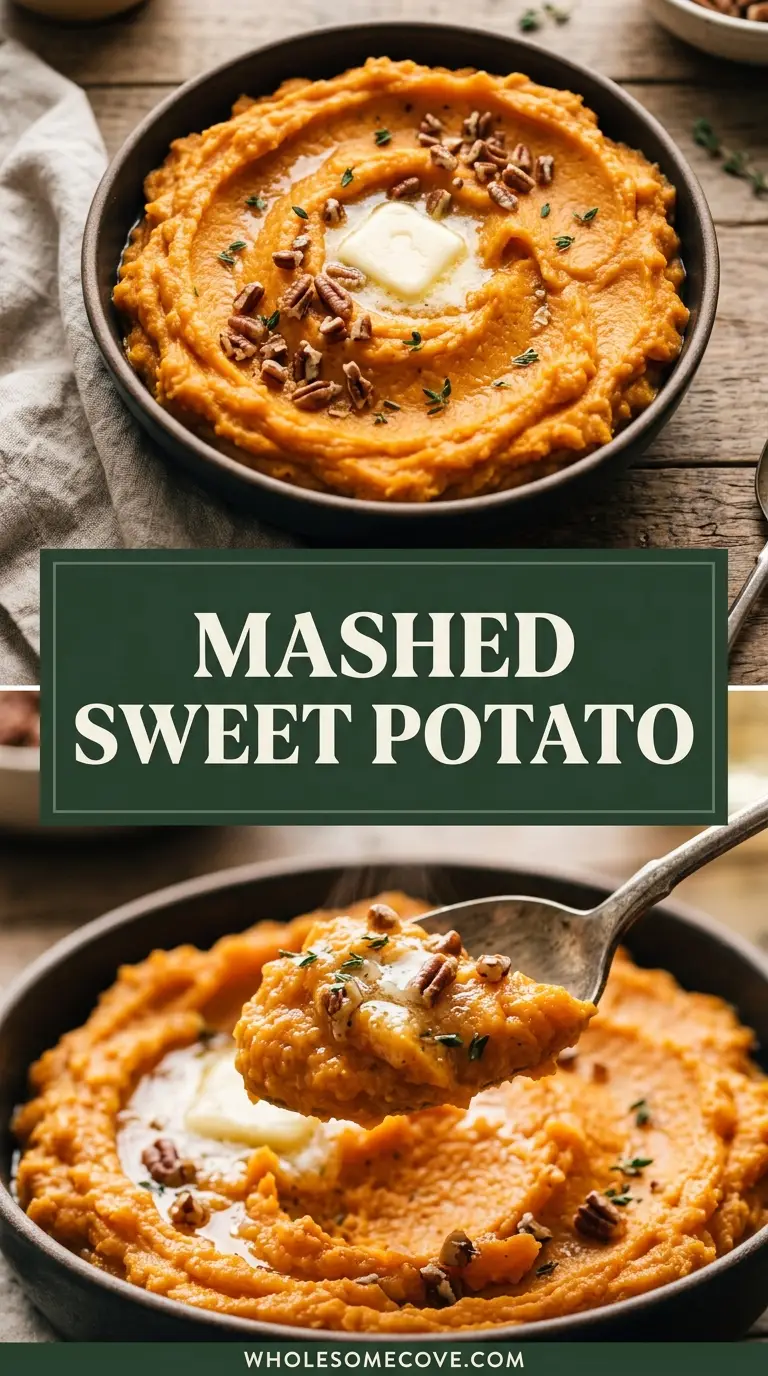
This mashed sweet potato recipe uses seven ingredients, one pot, and 35 minutes from the first cube to the table.
Most boiled versions turn out loose and watery because the cubes soak up cooking water.
Here, the drained potatoes go back into the hot pot for two minutes so the leftover moisture steams off before any dairy goes in.
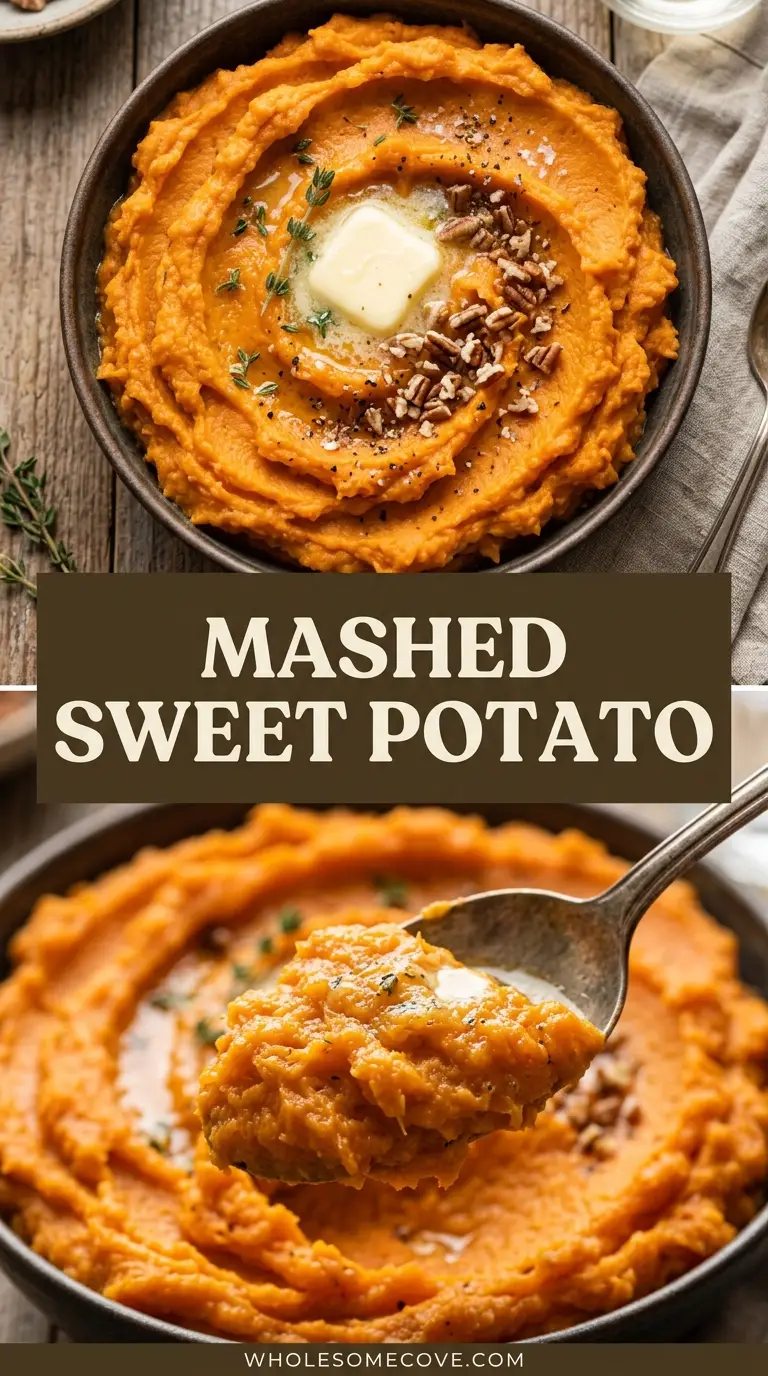
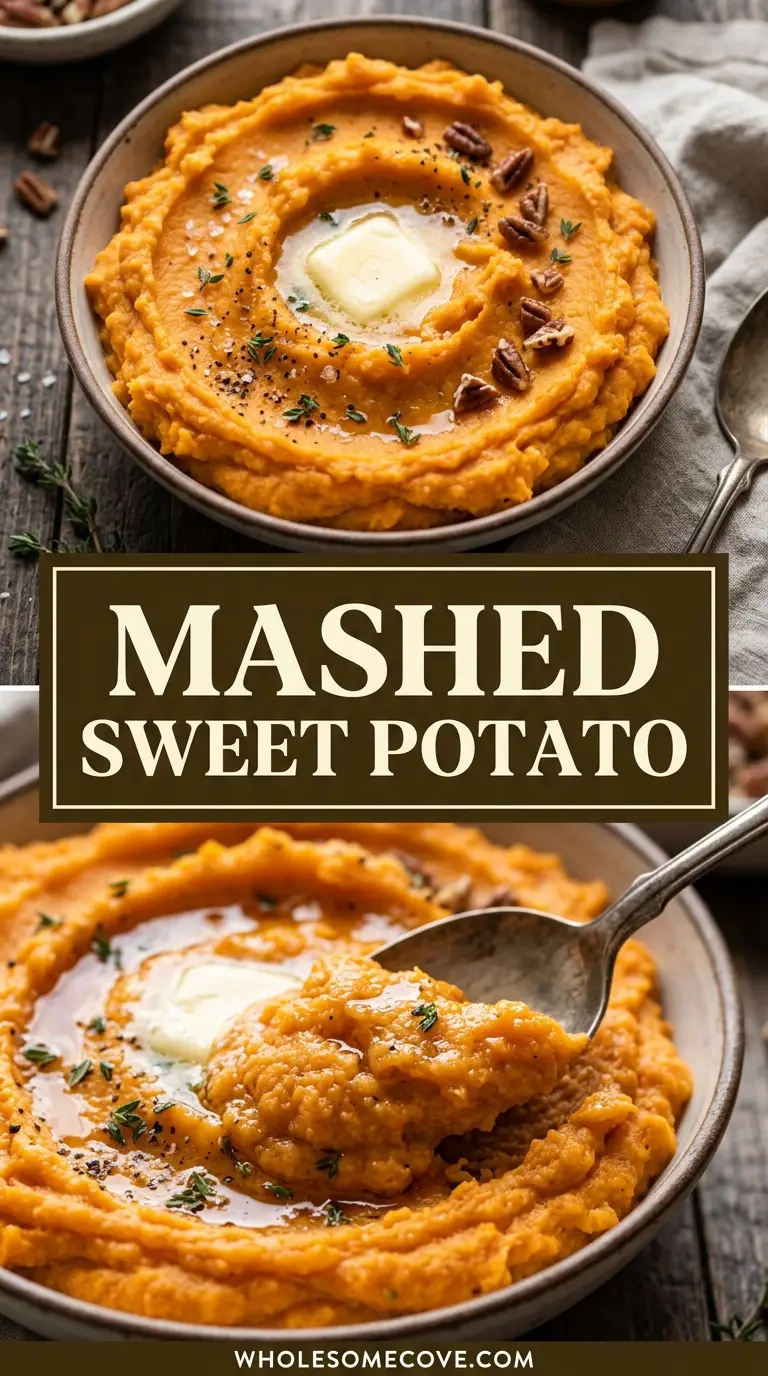
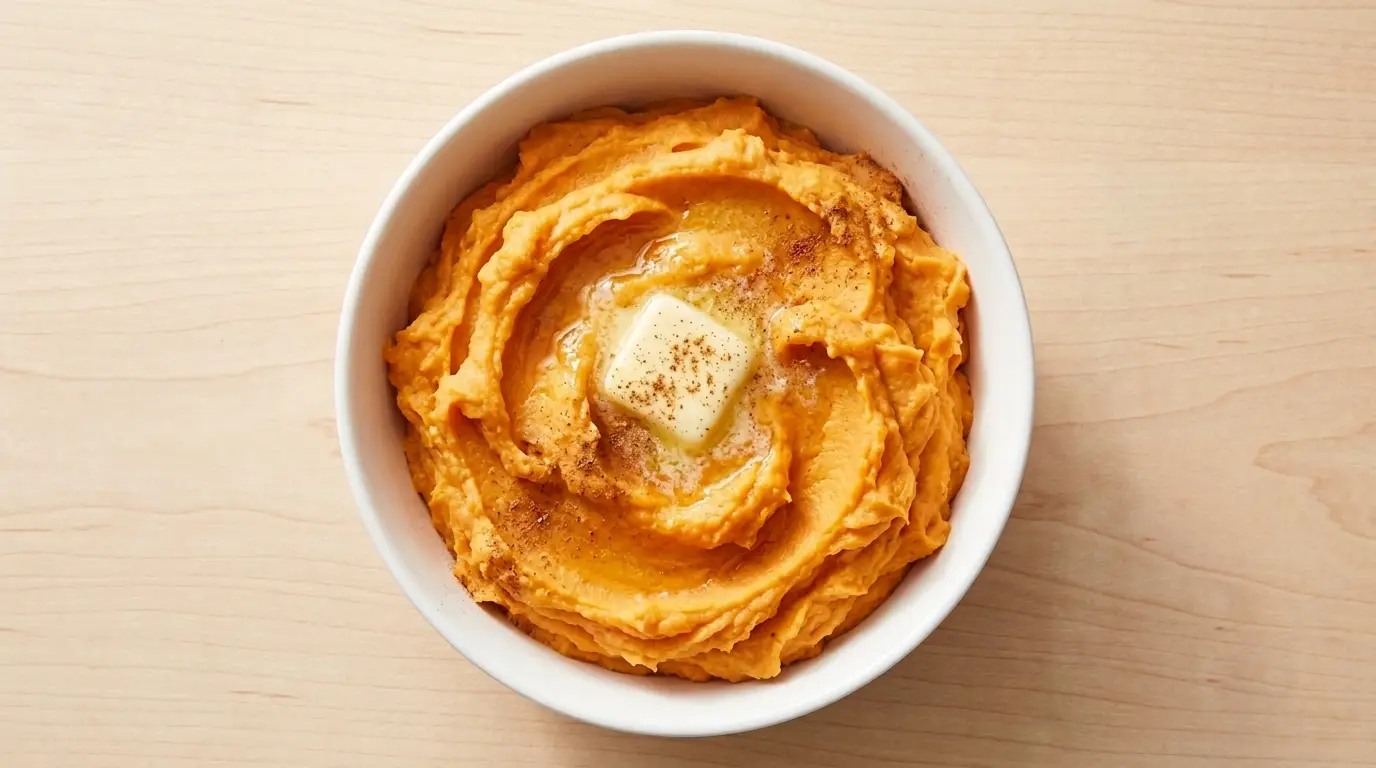
Butter melts in the residual heat, half-and-half goes in a splash at a time, and the mash stays glossy, orange, and thick enough to hold a spoon upright.
A quarter cup of maple syrup and a pinch of nutmeg sit underneath the natural sweetness instead of covering it.
| Quick Recipe Summary | |
|---|---|
| Prep Time | 10 minutes |
| Cook Time | 25 minutes |
| Total Time | 35 minutes |
| Servings | 6 servings (about 3/4 cup each) |
| Difficulty Level | Easy |
Read Also: Sweet Potato Recipes
Why You’ll Love This Mashed Sweet Potato Recipe
This mashed sweet potato recipe sits right between a savory side and a dessert-leaning one. The maple and spice are light enough that it still works next to roast meat and gravy.
- Seven ingredients, one pot. You boil, dry, and mash in the same pot, so cleanup is a masher and a serving bowl.
- Thick, not watery. The two-minute steam-dry step drives off surface moisture, which is the main reason boiled sweet potato mash goes runny.
- Lightly sweetened. Only 1/4 cup (60 ml) of maple syrup goes into 3 pounds (1.4 kg) of sweet potatoes, so the potato flavor stays in front.
- Fast. Ten minutes of prep and 25 minutes of cooking gets you a full side dish, with no oven space needed.
- Easy to scale. Doubling the recipe works in a bigger pot, and the cooking time stays almost the same as long as the cubes stay the same size.
- Holds well. The mash keeps warm in a covered pot for up to 30 minutes, which helps when the turkey, rolls, and gravy all land at once.
- Flexible texture. A potato masher leaves a rustic, slightly lumpy mash, while a ricer gives you something close to velvet.
- Beginner friendly. The only skill involved is knowing when a fork slides in without resistance.
For a plain-potato comparison, see Mashed Potatoes Recipe.
Ingredients
Every ingredient below is used in the steps, so read the list once before you start peeling. The sweet potatoes should be the orange-fleshed kind sold in most U.S. stores, often labeled as yams.
- 3 pounds (1.4 kg) orange-fleshed sweet potatoes, such as Beauregard, Jewel, or Garnet, about 4 large or 6 medium, peeled and cut into 1 1/2-inch (4 cm) cubes
- Cold water, enough to cover the cubes by 1 inch (2.5 cm)
- 1 1/2 teaspoons kosher salt, divided (1 teaspoon for the cooking water and 1/2 teaspoon for the mash)
- 5 tablespoons (70 g) unsalted butter, divided (4 tablespoons for mashing and 1 tablespoon for the top)
- 1/2 cup (120 ml) half-and-half, at room temperature or slightly warm, plus 1 to 2 tablespoons more if needed
- 1/4 cup (60 ml) pure maple syrup
- 1/2 teaspoon ground cinnamon
- 1/4 teaspoon ground nutmeg
Ingredient notes:
- Sweet potato variety: Beauregard and Jewel have orange flesh and a soft, moist texture that mashes smoothly. Pale or white-fleshed varieties are drier and less sweet, so they need more half-and-half.
- Dairy swap: Whole milk works in place of half-and-half and gives a slightly lighter mash. Heavy cream makes it richer, so start with 6 tablespoons and add more only if the mash seems stiff.
- Butter: Unsalted butter lets you control the salt. If you only have salted butter, cut the salt in the mash to 1/4 teaspoon and taste before adding more.
- Maple syrup: Use real maple syrup, not pancake syrup. Dark amber or very dark grades give a deeper flavor.
A little hands-on advice for the produce aisle: choose firm sweet potatoes with smooth skin and no soft spots, and keep them at room temperature in a dark cupboard rather than the fridge, since cold storage can give them a hard center when cooked.
You might also enjoy: Healthy Mashed Potatoes Recipe
Kitchen Equipment Needed
You do not need much for this recipe. A pot, a masher, and something to drain with will cover it.
- Large pot or stockpot: A 5 to 6 quart (about 5 liter) pot holds the cubes with room to simmer without boiling over, and it doubles as your mixing bowl.
- Colander: A fine-mesh or wide-hole colander drains the cubes in about a minute. Set it in the sink before the timer ends.
- Vegetable peeler: A Y-shaped peeler removes sweet potato skin faster than a swivel peeler and wastes less flesh.
- Chef’s knife and cutting board: Use a sharp 8-inch knife, since raw sweet potatoes are dense. Place a damp towel under the board so it does not slide.
- Potato masher: A wide, flat-faced masher gives a fluffy, slightly rustic texture and takes about two minutes of work.
- Potato ricer: Optional, but it removes the fibrous strings that a masher can leave behind. I’ve found that a ricer gets rid of those threads in a way no amount of extra mashing does.
- Measuring cups and measuring spoons: Needed for the maple syrup, half-and-half, and the small amounts of spice.
- Serving bowl: Warm it with hot tap water for a minute so the mash stays hot at the table.
- Glass storage containers: For leftovers. Glass will not stain orange the way plastic does.
For a broader set of potato sides, see Potato Side Dish Recipes.
Recommended Products for This Recipe
These are my personal recommendations, chosen for the specific problems they solve in this recipe. None of them are required, but each one fixes a common frustration.
1. OXO Good Grips Potato Ricer
Sweet potatoes can carry fibrous strands that survive a masher and turn into stringy bites. Pressing the cooked cubes through a ricer holds those fibers back and gives a smooth, fluffy mash with no extra effort.
2. Dark Amber Pure Maple Syrup
Light syrups can disappear behind the sweet potato. A dark amber syrup has a deeper, slightly toasty flavor that holds up in a small 1/4 cup amount, so you get maple character without adding more sugar.
3. Whole Nutmeg and Microplane Grater
Pre-ground nutmeg loses its aroma within months, and the difference shows in a mild dish like this. Grating whole nutmeg takes ten seconds and gives a warm, floral edge that the jarred version lacks.
4. Pyrex Glass Food Storage Containers
Orange mash stains plastic quickly and holds onto odors. Glass containers with snap lids go from fridge to microwave without transferring, which makes reheating leftovers simple.
5. Cuisinart Stainless Steel Stockpot
Thin pots scorch the bottom layer of sweet potato when you steam-dry it. A heavy, even-heating stockpot lets you dry the cubes over low heat without sticking, and it is large enough to mash right in the pot.
Read Also: Best Potato Recipes
Step-by-Step Instructions: How to Make Mashed Sweet Potato
Follow these steps and a full pot of mash will be ready in about 35 minutes.
1. Peel and Cut the Sweet Potatoes
- Scrub the sweet potatoes under cool running water to remove any dirt, then pat them dry.
- Peel all of the skin off with a vegetable peeler, cutting away any dark spots or bruises.
- Cut each sweet potato in half lengthwise, then into thick planks, then into cubes about 1 1/2 inches (4 cm) wide.
- Aim for similar sizes. Small pieces turn mushy while large ones stay hard in the middle.
- Place the cubes in a large pot as you cut them so they do not dry out on the board.
2. Boil the Sweet Potatoes
- Pour enough cold water into the pot to cover the cubes by 1 inch (2.5 cm).
- Stir in 1 teaspoon of the kosher salt. Starting in cold water helps the cubes cook evenly from the outside in.
- Set the pot over high heat and bring the water to a boil, which takes about 8 minutes.
- Reduce the heat to medium so the water simmers gently. A hard, rolling boil breaks the edges and waterlogs the cubes.
- Cook for 15 to 20 minutes, until a fork slides into the center of a cube with no resistance.
3. Drain and Steam-Dry
- Carry the pot to the sink and pour the cubes into a colander. Let them drain for 1 minute, shaking the colander once or twice.
- Return the empty pot to the stove over low heat, then tip the cubes back in.
- Stir gently for about 2 minutes, until a light film of moisture steams off and the cubes look dry on the surface.
- I ruined my first batch by skipping this step, and the mash turned loose and puddled on the plate within ten minutes.
- Turn off the heat once the cubes look dry.
4. Add the Butter and Mash
- Add 4 tablespoons of the butter to the hot cubes. Cut it into pieces so it melts faster.
- Mash with a potato masher or press the cubes through a ricer back into the pot.
- Mash until most of the large pieces are gone, but stop before the mash looks gluey. Sweet potatoes need less mashing than white potatoes.
5. Stir in the Half-and-Half, Maple Syrup, and Spices
- Pour in the 1/2 cup (120 ml) of half-and-half a splash at a time, stirring after each addition.
- Add the 1/4 cup (60 ml) of maple syrup, the 1/2 teaspoon of cinnamon, the 1/4 teaspoon of nutmeg, and the remaining 1/2 teaspoon of salt.
- Stir until the mash is smooth and creamy. If it feels stiff, add 1 to 2 more tablespoons of half-and-half.
- Taste and adjust. Add a small pinch more salt if the sweetness feels flat.
6. Serve
- Spoon the mash into a warm serving bowl.
- Make a small well in the center and add the remaining 1 tablespoon of butter.
- Serve right away while the butter is still melting.
For an oven-based version of the same vegetable, try: Baked Sweet Potato Recipe
Tips for The Best Mashed Sweet Potato
A few small habits make the difference between a thick, silky mash and a thin, stringy one. These are the ones that matter most.
- Cut the cubes evenly. Uneven pieces cook at different speeds, and you end up with lumps in the finished mash.
- Start in cold salted water. Dropping cubes into boiling water cooks the outside before the center softens.
- Keep the simmer gentle. A rolling boil beats up the edges and lets the cubes soak up more water.
- Steam-dry the cubes. Two minutes over low heat after draining is the single best fix for watery mash.
- Mash before adding liquid. Break down the cubes with butter first, then add half-and-half in small splashes so you can stop at the right thickness.
- Take the chill off the dairy. I pull the half-and-half out of the fridge before I start peeling so it goes in near room temperature and does not cool the mash.
- Use a ricer for smooth results. A masher keeps some texture, and a ricer removes strings. Choose based on what you like.
- Skip the blender and food processor. The fast blades overwork the starch and turn the mash gummy and sticky.
- Salt in two stages. Salt in the cooking water seasons the potato from the inside, and the salt at the end brings out the sweetness.
- Add acid if the mash tastes heavy. A teaspoon of orange juice or a few drops of lemon juice brightens the flavor without making it sour.
- Cut the sweetness for savory meals. Reduce the maple syrup to 2 tablespoons and add an extra 1/4 teaspoon of salt and a pinch of black pepper.
- Make it ahead. Cool the mash, refrigerate it for up to 2 days, and reheat it with a splash of milk.
- Hold it warm. Cover the pot and set it over the lowest heat, or put it in a slow cooker on warm, and stir every 10 minutes.
A similar approach works in Roasted Sweet Potato Recipe.
What to Serve with Mashed Sweet Potato
This is a standalone side dish, so it fits next to almost any main that benefits from a little sweetness. Roasted poultry, pork, and holiday meats are the most natural matches.
- Roast turkey: The classic holiday partner. Try Thanksgiving Turkey with the mash on the same plate.
- Glazed ham: Salty ham and sweet potato balance each other well. Honey Glazed Ham is a natural fit.
- Roast chicken: A simple weeknight pairing, and the pan juices pour over the mash nicely. Try Roast Chicken.
- Meatloaf: The sweetness cuts through a savory, tomato-glazed slice. See Meatloaf.
- Pork chops: Apple and pork are a classic pair, and the mash catches the sauce. Try Apple Cider Glazed Pork Chops.
- Pot roast: Mash replaces the usual potatoes and soaks up the braising liquid. See Slow Cooker Pot Roast.
- Green beans: The crisp, savory casserole contrasts with the soft, sweet mash. Try Green Bean Casserole.
- Brussels sprouts: Smoky bacon and charred edges balance the sweetness. See Roasted Brussels Sprouts with Bacon.
- Creamed spinach: A rich, salty green next to the orange mash makes a colorful plate. Try Creamed Spinach.
- Sparkling cider or a dry white wine: Both are crisp enough to cut through the butter and syrup.
Another side worth pairing: Sweet Potato Casserole
Variations of Mashed Sweet Potato
The base recipe is flexible, and each change below swaps in or adds a few ingredients. Add them at the end of step 5 unless noted.
- Brown butter and sage: Brown 4 tablespoons of butter in a small pan with 6 fresh sage leaves until it smells nutty, then use it in place of the plain butter and skip the cinnamon.
- Brown sugar version: Replace the maple syrup with 2 tablespoons of light brown sugar. Pure maple syrup holds up better than brown sugar here because it adds flavor without the faint molasses edge, but brown sugar is a fine substitute.
- Savory garlic and herb: Leave out the maple syrup, cinnamon, and nutmeg. Stir in 2 cloves of grated garlic, 1 tablespoon of chopped chives, and 1/2 teaspoon of black pepper.
- Chipotle: Stir in 1 to 2 teaspoons of minced chipotle in adobo and a squeeze of lime juice for a smoky, sweet-hot mash.
- Roasted version: Pierce 3 pounds (1.4 kg) of whole sweet potatoes, bake at 400°F (200°C) for 45 to 60 minutes until soft, peel, and mash with the same ingredients. This adds about an hour to the total time and gives a deeper flavor.
- Dairy-free: Use 1/2 cup (120 ml) of full-fat coconut milk in place of the half-and-half and 4 tablespoons of olive oil or vegan butter in place of the dairy butter.
- Orange and ginger: Add 1 teaspoon of orange zest and 1/2 teaspoon of ground ginger for a bright, warm finish.
- Bourbon pecan: Stir in 1 tablespoon of bourbon and top with 1/4 cup (30 g) of toasted chopped pecans.
- Cream cheese: Add 2 ounces (55 g) of softened cream cheese to the mash for a tangy, extra-thick texture.
- Marshmallow topped: Spread the mash in a greased 8-inch (20 cm) baking dish, cover with 1 cup of mini marshmallows, and broil for 1 to 2 minutes until golden.
- Shepherd’s pie topping: Use the savory garlic and herb version as a topping for a meat and vegetable pie filling, then bake until the peaks turn golden.
Read Also: Shepherds Pie Recipe
Storage and Reheating
Mashed sweet potatoes store and reheat better than most mashed vegetables, because the natural sugars and starch keep the texture creamy. Cool the mash for about 30 minutes before storing so condensation does not build up inside the container.
- Refrigerator: Store in an airtight container for up to 4 days.
- Freezer: Freeze in a sealed container or freezer bag for up to 3 months. Press the bag flat so it thaws quickly.
- Single portions: Freezing single portions in a muffin tin, then moving the frozen pucks to a bag, makes it easy to thaw only what you need.
- Thawing: Move frozen mash to the fridge the night before, or reheat straight from frozen over low heat with a splash of milk.
- Microwave reheating: Heat covered in 30-second bursts, stirring between each, until hot. Add 1 tablespoon of milk per cup if it looks dry.
- Stovetop reheating: Warm in a saucepan over low heat with a splash of milk or half-and-half, stirring often, for 5 to 8 minutes.
- Oven reheating: Place in a greased oven-safe dish, cover with foil, and bake at 350°F (175°C) for 20 to 25 minutes.
- Make-ahead tip: Mash up to 2 days ahead, refrigerate, and reheat the day of serving. Add the topping butter only once it is hot.
- Do not refreeze: Once thawed and reheated, finish the mash rather than freezing it again.
For a quicker method that uses the same ingredient, try: Air Fryer Sweet Potato Recipe
Nutritional Facts
The numbers below are estimates for one serving, which is about 3/4 cup of mash. Actual values vary by brand and by the size of your sweet potatoes.
| Nutrition per Serving (approximate) | |
|---|---|
| Calories | 315 kcal |
| Carbohydrates | 50 g |
| Protein | 4 g |
| Total Fat | 12 g |
| Saturated Fat | 7 g |
| Cholesterol | 32 mg |
| Sodium | 320 mg |
| Potassium | 650 mg |
| Fiber | 6 g |
| Sugar | 18 g |
A thinner, spoonable use for the same vegetable is Sweet Potato Soup Recipe.
Health Benefits of Key Ingredients
Sweet potatoes do most of the nutritional work in this dish, with help from a few smaller ingredients. Here is what each one brings.
- Sweet potatoes (beta-carotene): The orange color comes from beta-carotene, which the body converts to vitamin A. A single medium sweet potato delivers well over the daily recommended amount, and vitamin A supports vision and immune function.
- Sweet potatoes (fiber): The skin-free flesh still provides several grams of fiber per serving, which supports digestion and helps you feel full.
- Sweet potatoes (potassium): They supply more potassium per serving than many people expect, and potassium helps regulate blood pressure and muscle function.
- Sweet potatoes (vitamin C and manganese): Both nutrients survive boiling in reasonable amounts and support skin, bone, and metabolic health.
- Butter: Beta-carotene is fat-soluble, so a little butter in the mash helps the body absorb more of it. Butter also adds vitamin A and vitamin E.
- Half-and-half: It adds a small amount of calcium and protein. Whole milk can replace it for a lower-fat version.
- Maple syrup: It contains trace amounts of manganese, zinc, and riboflavin. It is still a sugar, so keep the amount modest.
- Cinnamon: It adds flavor without sugar and lets you lower the sweetener slightly without the mash tasting flat.
- Nutmeg: Used in tiny amounts, it adds aroma and warmth, which helps the dish taste sweeter than it is.
Read Also: Japanese Sweet Potato Recipe
FAQs About Mashed Sweet Potato
1. Is it better to boil or bake sweet potatoes for mashing?
Boiling is the standard method for this recipe.
It is faster and gives a creamier, more even mash, while baking concentrates the sugars for a deeper flavor.
Baked sweet potatoes take 45 to 60 minutes in a 400°F (200°C) oven, compared with about 20 minutes of simmering. Choose boiling for speed and baking for flavor.
2. Why are my mashed sweet potatoes stringy?
Sweet potatoes naturally contain fibrous strands, and some varieties and larger, older potatoes have more of them. A masher cannot break those strands apart.
Pressing the cooked cubes through a potato ricer or food mill removes most of them. Choosing medium potatoes with smooth skin also helps.
3. Why are my mashed sweet potatoes watery?
Boiled cubes absorb water, and that water seeps out once you mash them. Draining well and drying the cubes over low heat for about 2 minutes fixes most of the problem.
Adding too much liquid at once is the other cause. Pour the half-and-half in a little at a time and stop when the mash looks creamy but holds its shape.
4. Are yams and sweet potatoes the same thing?
In most U.S. stores, the orange vegetable labeled “yam” is actually a soft-fleshed sweet potato. True yams are a different, starchy tuber that is rarely sold in regular supermarkets.
For this recipe, use the orange-fleshed sweet potatoes in the produce aisle, whatever the label says.
5. Can I use a blender or food processor to make them smoother?
It is better to avoid them. The fast blades break down the starch and turn the mash sticky and gummy.
A ricer or food mill gives a smooth result without that problem.
A handheld electric mixer on low for a few seconds also works.
6. Can I make mashed sweet potatoes ahead of time?
Yes, it keeps well for up to 2 days in an airtight container in the fridge.
Reheat it on the stovetop or in the microwave with a splash of milk.
Add the topping butter once the mash is hot.
7. Can I make them dairy-free or with less sugar?
Dairy-free works well with full-fat coconut milk and olive oil or vegan butter. The mash will taste slightly different but stay creamy.
For less sugar, cut the maple syrup to 1 or 2 tablespoons.
The cinnamon and the potato’s own sweetness carry the flavor, and a little extra salt keeps it balanced.
You might also enjoy: Sweet Potato Pie Recipe
Mashed Sweet Potato
Ingredients
- 3 pounds orange-fleshed sweet potatoes - 1.4 kg, such as Beauregard, Jewel, or Garnet, about 4 large or 6 medium, peeled and cut into 1 1/2-inch (4 cm) cubes
- cold water - Enough to cover the cubes by 1 inch (2.5 cm)
- 1 1/2 teaspoons kosher salt - Divided (1 teaspoon for the cooking water and 1/2 teaspoon for the mash)
- 5 tablespoons unsalted butter - 70 g, divided (4 tablespoons for mashing and 1 tablespoon for the top)
- 1/2 cup half-and-half - 120 ml, at room temperature or slightly warm, plus 1 to 2 tablespoons more if needed
- 1/4 cup pure maple syrup - 60 ml, use real maple syrup, not pancake syrup
- 1/2 teaspoon ground cinnamon
- 1/4 teaspoon ground nutmeg
Equipment
- Large pot or stockpot - 5 to 6 quart (about 5 liter), holds cubes with room to simmer and doubles as mixing bowl
- Colander - Fine-mesh or wide-hole, drains cubes in about a minute
- Vegetable peeler - Y-shaped peeler removes skin faster and wastes less flesh
- Chef’s knife and cutting board - Sharp 8-inch knife; place damp towel under board to prevent sliding
- Potato masher - Wide, flat-faced masher gives fluffy, slightly rustic texture
- Potato ricer - (optional) Removes fibrous strings that a masher can leave behind
- Measuring cups and measuring spoons - For maple syrup, half-and-half, and small amounts of spice
- Serving bowl - Warm with hot tap water for a minute so mash stays hot at the table
- Glass storage containers - For leftovers; glass will not stain orange the way plastic does
Method
- Scrub sweet potatoes under cool running water, pat dry, and peel off all skin. Cut each in half lengthwise, then into thick planks, then into 1 1/2-inch (4 cm) cubes, aiming for similar sizes. Place cubes in a large pot as you cut them.
- Pour enough cold water into the pot to cover the cubes by 1 inch (2.5 cm). Stir in 1 teaspoon kosher salt. Bring to a boil over high heat, about 8 minutes, then reduce to medium so water simmers gently. Cook 15 to 20 minutes, until a fork slides into the center of a cube with no resistance.
- Pour the cubes into a colander and drain for 1 minute, shaking once or twice. Return the empty pot to the stove over low heat, tip the cubes back in, and stir gently for about 2 minutes until a light film of moisture steams off and the cubes look dry on the surface. Turn off the heat.
- Add 4 tablespoons of butter to the hot cubes, cut into pieces so it melts faster. Mash with a potato masher or press through a ricer back into the pot until most large pieces are gone, but stop before the mash looks gluey.
- Pour in the 1/2 cup half-and-half a splash at a time, stirring after each addition. Add the 1/4 cup maple syrup, 1/2 teaspoon cinnamon, 1/4 teaspoon nutmeg, and remaining 1/2 teaspoon salt. Stir until smooth and creamy; add 1 to 2 more tablespoons half-and-half if stiff. Taste and adjust salt.
- Spoon the mash into a warm serving bowl. Make a small well in the center and add the remaining 1 tablespoon of butter. Serve right away while the butter is still melting.
Nutrition
Notes
- Sweet potato variety: Beauregard and Jewel have orange flesh and a soft, moist texture that mashes smoothly. Pale or white-fleshed varieties are drier and less sweet, so they need more half-and-half.
- Dairy swap: Whole milk works in place of half-and-half and gives a slightly lighter mash. Heavy cream makes it richer, so start with 6 tablespoons and add more only if the mash seems stiff.
- Butter: Unsalted butter lets you control the salt. If you only have salted butter, cut the salt in the mash to 1/4 teaspoon and taste before adding more.
- Steam-dry step: Two minutes over low heat after draining is the single best fix for watery mash. Skipping this step causes the mash to turn loose and puddle on the plate.
- Mashing method: A masher keeps some texture, and a ricer removes fibrous strings. Avoid a blender or food processor, as the fast blades overwork the starch and turn the mash gummy and sticky.
- Make it ahead: Cool the mash, refrigerate for up to 2 days, and reheat with a splash of milk. Add the topping butter only once the mash is hot.
- Storage: Store in an airtight container in the refrigerator for up to 4 days, or freeze for up to 3 months. Freeze single portions in a muffin tin, then move frozen pucks to a bag.
- Reheating: Microwave covered in 30-second bursts, stirring between each, until hot. Add 1 tablespoon of milk per cup if it looks dry. Or warm on the stovetop over low heat with a splash of milk for 5 to 8 minutes.
- Savory variation: Reduce the maple syrup to 2 tablespoons and add an extra 1/4 teaspoon of salt and a pinch of black pepper for a more savory side.
- Dairy-free variation: Use 1/2 cup full-fat coconut milk in place of the half-and-half and 4 tablespoons olive oil or vegan butter in place of the dairy butter.
Private Notes
Tried this recipe?
Let us know how it was!Final Thoughts
This mashed sweet potato recipe works on a weeknight and still looks right on a holiday table.
The steam-dry step and the splash-by-splash dairy are the two habits that matter most.
Try it next time you need a quick side, then adjust the maple, spice, and texture to suit your table.
If you make it, leave a comment with your favorite variation. Share the recipe with anyone planning a holiday menu.
Recommended:
- Sweet Potato Fries Recipe
- Chicken and Sweet Potato Recipe
- Sweet Potato Bread Recipe
- Stuffed Sweet Potato Recipe
- Sweet Potato and Black Bean Bowls Recipe
- Kale and Sweet Potato Soup Recipe
- Pork and Sweet Potato Stew Recipe
- Fall Dinner Recipes
- Thanksgiving Stuffing Recipe
- Cranberry Sauce Recipe