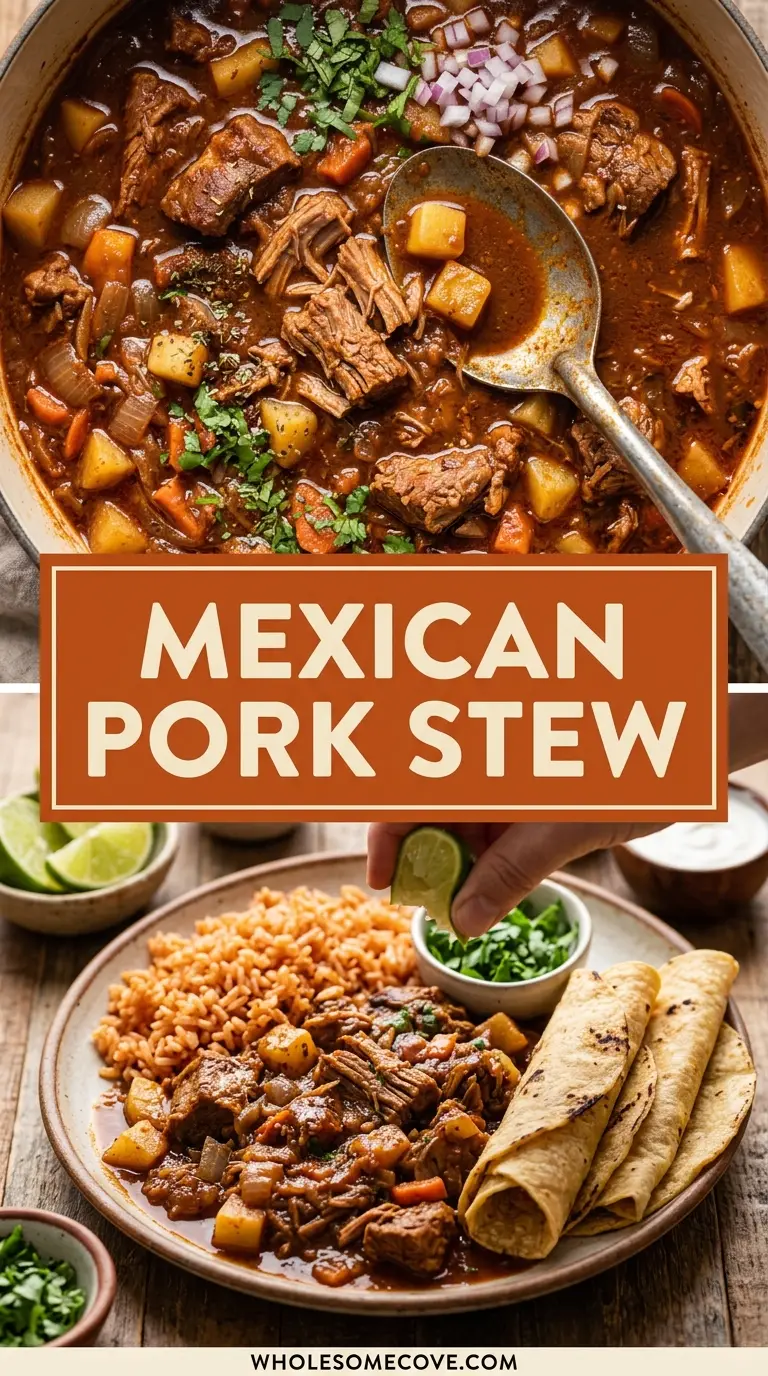
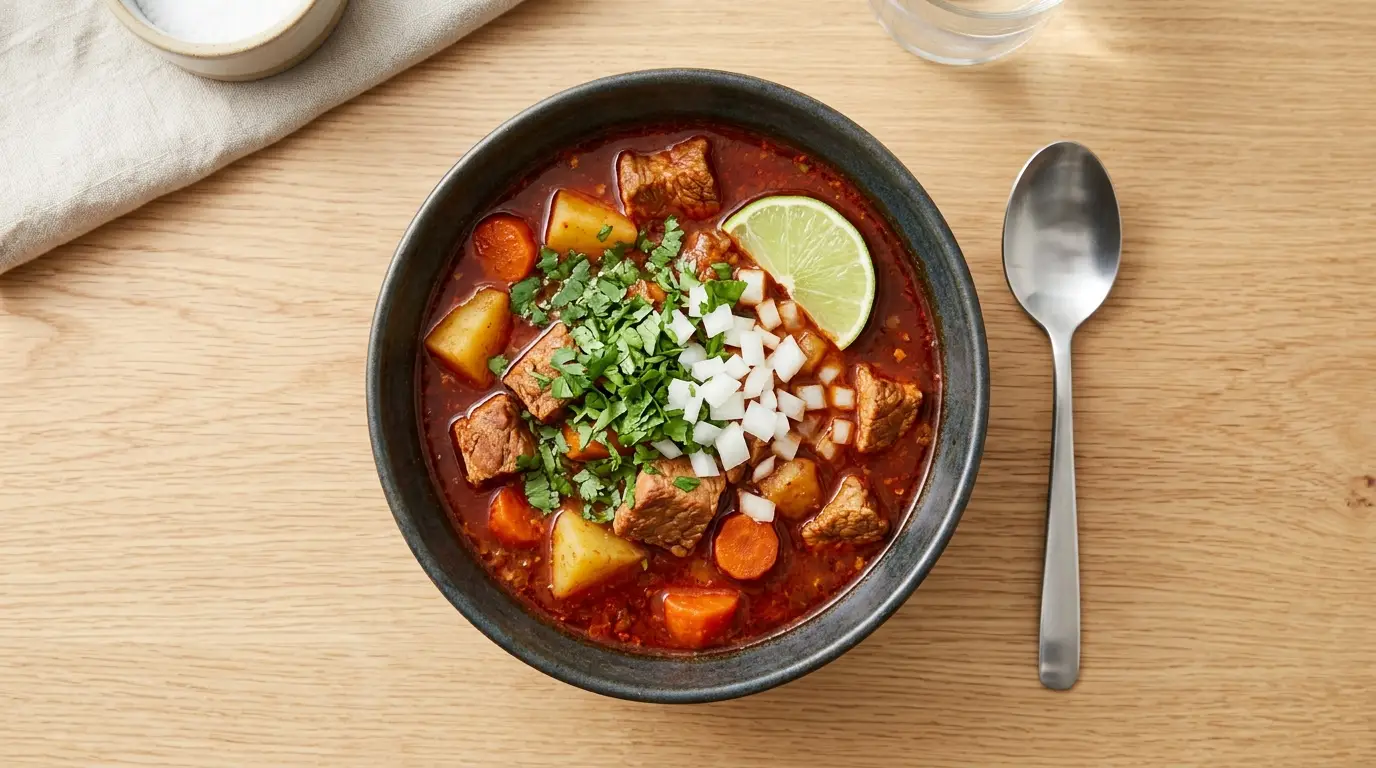
The color gives it away first, a deep brick red pulled from guajillo and ancho chiles.
This Mexican pork stew recipe blends those dried chiles right into the broth instead of leaning on chili powder. That one swap is what gives the sauce its smoky, layered depth.
Tender chunks of pork shoulder anchor the pot, braised until they fall apart against a spoon. Potatoes and carrots cook right in the broth, soaking up all that chile color.
Most rushed versions come out thin and flat because they reach for a jar of salsa. Toasting and soaking a couple of chiles adds ten minutes and changes everything about the flavor.
Plan on about two and a half hours, though most of that is quiet simmering time. It makes enough to feed six, and it tastes even better reheated the next day.
| Quick Recipe Summary | |
|---|---|
| Prep Time | 25 minutes |
| Cook Time | 2 hours 10 minutes |
| Total Time | 2 hours 35 minutes |
| Servings | 6 servings |
| Difficulty Level | Intermediate |
For the classic, milder cousin without the chile sauce, take a look at Pork Stew.

Why You’ll Love This Mexican Pork Stew Recipe
This is a stew built for patience and payoff, where a little chile work up front carries the whole pot. The flavor tastes like it simmered all day, even though most of the time is hands-off.
Here is what makes it worth the effort:
- The chile sauce does the heavy lifting. Blended guajillo and ancho chiles create a broth with real depth, not just heat, so the sauce tastes smoky and slightly fruity rather than sharp.
- Pork shoulder stays tender. Slow braising breaks down the connective tissue, leaving meat that pulls apart with a fork instead of drying into tough cubes.
- It’s a full meal in one pot. Potatoes and carrots cook right in the broth, which means fewer dishes and a stew that stands on its own without extra sides.
- The heat is easy to control. Guajillo and ancho are mild chiles, so you decide whether to keep it gentle or add a hotter chile to the blend.
- Leftovers get better. The chile flavor deepens overnight, making day-two bowls even richer than the first serving.
- It scales and freezes well. Double the batch and freeze half, and you have a comforting dinner ready weeks later.
If you like a green version instead, here is a good one to bookmark: Green Chile Pork Stew.
Ingredients
Everything here is built around a homemade red chile sauce and a well-marbled cut of pork. The dried chiles are the one item worth seeking out, and most well-stocked grocery stores carry them in the Latin foods aisle.
For the pork and stew base:
- 3 lbs (1.4 kg) boneless pork shoulder, cut into 1.5-inch (4 cm) cubes
- 1.5 tsp fine salt, for seasoning the pork
- 1 tsp freshly ground black pepper
- 3 tbsp (45 ml) vegetable oil, divided
- 1 large yellow onion, diced
- 6 garlic cloves, minced
- 1 lb (450 g) Yukon Gold potatoes, cut into 1-inch (2.5 cm) chunks
- 2 medium carrots, sliced into 1/2-inch (1 cm) rounds
- 4 cups (960 ml) chicken broth
- 2 bay leaves
For the red chile sauce:
- 4 dried guajillo chiles, stemmed and seeded
- 2 dried ancho chiles, stemmed and seeded
- 2 cups (480 ml) hot water, for soaking the chiles
- 1 can (14.5 oz / 411 g) fire-roasted diced tomatoes
- 1 tbsp (15 ml) tomato paste
- 2 tsp ground cumin
- 1 tbsp Mexican oregano
- 1 tsp smoked paprika
For serving:
- Fresh cilantro, roughly chopped
- Lime wedges
- Diced white onion and sliced radishes, optional
Read Also: Slow Cooker Pork Stew
Kitchen Equipment Needed
You do not need anything unusual, but a heavy pot and a blender make a real difference in how this stew turns out. The right pot holds heat evenly so the pork sears instead of steaming.
Here is what to have ready:
- A large Dutch oven or heavy-bottomed pot, 6 quarts or larger
- A blender or food processor for the chile sauce
- A fine-mesh strainer to smooth out the sauce
- A sharp chef’s knife for cubing the pork
- A sturdy cutting board
- A dry skillet for toasting the chiles
- Tongs for turning the pork as it browns
- A ladle for serving
- Measuring cups and spoons
For a hands-off route using the same flavors, here is a helpful reference: Instant Pot Pork Stew.
Recommended Products for This Recipe
These are the tools and ingredients I keep coming back to when making this stew. Each one solves a problem I ran into while testing the recipe.
1. Lodge Enameled Cast Iron Dutch Oven
A thin pot lets the bottom scorch before the pork ever browns, which leaves the whole stew tasting slightly burnt. This enameled Dutch oven holds steady heat for the long braise and moves straight from stovetop searing to a low simmer without fuss.
2. Dried Chile Variety Pack
Tracking down guajillo and ancho separately can mean two trips to two stores. A variety pack keeps both on hand, so the sauce is never held up by a missing chile, and the sealed bags stay fresh far longer than loose chiles in a bin.
3. High-Speed Blender
A weak blender leaves the chile sauce gritty, with bits of skin that never fully break down. A high-speed blender purees the soaked chiles into a smooth, pourable sauce, which means less time pushing it through a strainer.
4. Instant-Read Thermometer
Guessing when pork shoulder is done usually leads to meat that is either chewy or falling into shreds too soon. An instant-read thermometer takes the doubt out of it and helps you catch the pork at the tender, sliceable stage.
You might also enjoy: Beef Stew
Step-by-Step Instructions: How to Make Mexican Pork Stew
Follow these steps in order and you will have a rich, chile-red stew on the table with tender pork and vegetables cooked right in.
1. Season and Prep the Pork
- Pat the pork cubes dry with paper towels, since dry meat browns far better than wet.
- Season the pork all over with the 1.5 teaspoons of salt and 1 teaspoon of black pepper.
- Let the seasoned pork sit at room temperature for about 15 minutes while you prep the chiles.
2. Toast and Soak the Chiles
- Stem and seed the 4 guajillo and 2 ancho chiles, tearing them into flat pieces.
- Heat a dry skillet over medium heat and toast the chile pieces for about 30 seconds per side, pressing them flat, until they smell nutty and turn slightly darker.
- Transfer the toasted chiles to a bowl and pour the 2 cups of hot water over them.
- Let them soak for 20 minutes, until softened and pliable.
3. Blend the Red Chile Sauce
- Lift the softened chiles into the blender, reserving the soaking water.
- Add the can of fire-roasted diced tomatoes, tomato paste, cumin, Mexican oregano, smoked paprika, and 1 cup (240 ml) of the reserved soaking liquid.
- Blend on high for 1 to 2 minutes, until completely smooth.
- Pour the sauce through the fine-mesh strainer into a bowl, pressing with a spoon to leave any skins and grit behind. Set the strained sauce aside.
4. Sear the Pork
- Heat 2 tablespoons of the oil in the Dutch oven over medium-high heat until it shimmers.
- Add the pork in a single layer, working in two or three batches so the pot is never crowded.
- Sear each batch for 3 to 4 minutes per side, until deeply browned, then transfer to a plate.
- Do not clean the pot, since those browned bits carry a lot of flavor.
5. Build the Aromatic Base
- Lower the heat to medium and add the last tablespoon of oil to the pot.
- Add the diced onion and cook for 4 to 5 minutes, stirring often, until softened and translucent.
- Stir in the minced garlic and cook for 1 minute more, until fragrant.
6. Cook Down the Chile Sauce
- Pour the strained chile sauce into the pot with the onions and garlic.
- Cook the sauce for 5 to 6 minutes, stirring frequently, until it darkens and thickens slightly.
- Scrape the bottom of the pot as you stir to lift the browned bits into the sauce.
7. Braise the Pork
- Return the seared pork and any juices on the plate back to the pot.
- Pour in the 4 cups of chicken broth and drop in the 2 bay leaves.
- Bring everything to a gentle boil, then lower the heat to maintain a slow simmer.
- Cover partially and simmer for 1 hour and 30 minutes, stirring occasionally, until the pork is nearly fork-tender.
8. Add the Vegetables
- Stir in the potato chunks and carrot rounds.
- Simmer uncovered for another 30 to 40 minutes, until the vegetables are tender and the pork pulls apart easily.
- If the stew looks too thick, add a splash of broth or water to loosen it.
9. Finish and Serve
- Remove and discard the bay leaves.
- Taste the broth and add more salt if needed.
- Ladle into bowls and top with chopped cilantro, a squeeze of lime, and diced onion or radishes if you like.
For another slow-braised option, here is one worth trying: Pork and Sweet Potato Stew.

Tips for The Best Mexican Pork Stew
A few small habits make the gap between a good pot and a great one. Most of them come down to how you treat the chiles and the pork.
- Do not skip toasting the chiles. I ruined my first batch by soaking the chiles cold and unroasted, and the sauce came out raw and slightly bitter instead of smoky. Thirty seconds a side in a dry pan fixes that completely.
- Choose the right potato. Yukon Gold potatoes hold their shape through the long simmer far better than russets, which broke down into mush the one time I swapped them in.
- Buy well-marbled pork. I’ve found bone-in pork shoulder gives a richer broth than pre-cubed stew meat, which tends to dry out before it turns tender.
- Sear in batches. Crowding the pot traps steam and the pork will gray instead of browning, so give each piece room.
- Strain the sauce. Pushing the blended chiles through a strainer removes the tough skins and leaves a silky broth.
- Let it rest. Ten minutes off the heat before serving lets the flavors settle and the broth thicken slightly.
- Adjust the heat late. Add a rehydrated árbol or chipotle chile to the blend only if you want more kick, and taste as you go.
Read Also: Chicken Stew
What to Serve with Mexican Pork Stew
This stew is filling enough to stand alone, but a few simple sides turn it into a spread. Think of soft, starchy, and fresh elements that soak up or cut through the rich chile broth.
Here are the pairings that work best:
- Warm corn or flour tortillas for scooping up the broth
- A scoop of Basmati Rice to spoon the stew over
- Creamy Refried Beans on the side
- A bowl of Mexican Street Corn for a sweet, charred contrast
- Fresh Guacamole with chips to start
- A batch of Street Tacos if you are feeding a crowd
- A crisp Cheese Quesadilla for the kids at the table
- A simple green salad with lime vinaigrette to lighten the plate
- Pickled jalapeños or a spoonful of salsa verde for extra brightness
For a lighter Mexican-inspired bowl on another night, try: Mexican Chicken Soup
Variations of Mexican Pork Stew
Once you have the base down, this stew bends easily to what you have on hand. The chile sauce is the constant, and almost everything else can shift.
Try one of these directions:
- Green chile version: Swap the red chiles and tomatoes for roasted tomatillos and green chiles for a tangy, brighter stew.
- Hominy stew: Add a can of drained hominy in the last 20 minutes to move it closer to a pozole style.
- Extra spicy: Blend in one or two dried árbol chiles or a chipotle in adobo for real heat.
- Sweet potato swap: Trade the Yukon Golds for sweet potatoes for a mellow, slightly sweet finish.
- Slow cooker method: Sear the pork, then transfer everything except the vegetables to a slow cooker and cook on low for 7 to 8 hours, adding the potatoes and carrots in the final 2 hours.
- Pressure cooker method: Sear and build the sauce in the pot, then pressure cook the pork for 45 minutes before adding vegetables for a natural release.
- Extra vegetables: Stir in zucchini, corn, or green beans in the last 20 minutes for a heartier pot.
You might also enjoy: Cowboy Stew
Storage and Reheating
This is one of those dishes that rewards making ahead, since the chile flavor deepens overnight. It keeps well in both the fridge and freezer with a little care.
Here is how to store and reheat it:
- Refrigerate: Cool the stew to room temperature, then store it in an airtight container for up to 4 days.
- Freeze: Ladle cooled stew into freezer-safe containers, leaving an inch of headspace, and freeze for up to 3 months.
- Freezer note: The potatoes soften a little after freezing, so leave them slightly firm if you plan to freeze the batch.
- Thaw: Move frozen stew to the fridge overnight before reheating for the smoothest results.
- Reheat on the stovetop: Warm it in a covered pot over medium-low heat, stirring now and then, adding a splash of broth if it has thickened.
- Reheat in the microwave: Heat single portions in 1-minute bursts, stirring between each, until steaming throughout.
- Refresh the flavor: A fresh squeeze of lime and new cilantro brings reheated bowls right back to life.
For a make-ahead classic in the same spirit, here is a good one: Irish Stew
Nutritional Facts
The numbers below are estimates for one of six servings, made with the ingredients listed and no optional toppings. Actual values will shift with the exact cut of pork and portion size.
| Nutrient | Amount per Serving |
|---|---|
| Calories | 445 kcal |
| Protein | 38 g |
| Total Fat | 24 g |
| Saturated Fat | 8 g |
| Carbohydrates | 21 g |
| Fiber | 4 g |
| Sugars | 5 g |
| Sodium | 780 mg |
| Cholesterol | 115 mg |
Read Also: Lamb Stew
Health Benefits of Key Ingredients
Beyond being comforting, this stew leans on ingredients that bring real nutritional value. The pork, chiles, and vegetables each earn their place in the pot.
Here is what the key ingredients offer:
- Pork shoulder: A strong source of complete protein plus B vitamins like thiamine and B12, which support energy and nerve function.
- Guajillo and ancho chiles: Rich in vitamin A and antioxidants, and the compound that gives chiles their warmth has been studied for anti-inflammatory properties.
- Tomatoes: Provide lycopene and vitamin C, both of which act as antioxidants in the body.
- Onion and garlic: Contain sulfur compounds linked to heart and immune support, and they add depth without extra salt.
- Carrots: Loaded with beta-carotene, which the body converts to vitamin A for eye and skin health.
- Potatoes: Offer potassium and fiber, especially when the skins are left on, and they make the stew more filling.
- Cumin and oregano: Contribute small amounts of iron and antioxidants along with their flavor.
For a lighter baked Mexican dinner another night, here is one to save: Chicken Enchilada Casserole
FAQs About Mexican Pork Stew
1. What cut of pork is best for Mexican pork stew?
Pork shoulder, also sold as pork butt, is the top choice for this stew. Its marbling and connective tissue break down over a long simmer into tender, juicy meat.
Leaner cuts like pork loin dry out and turn stringy during braising. If you can only find loin, cut back the cook time and watch it closely.
2. Is Mexican pork stew spicy?
Made with only guajillo and ancho chiles, this stew is warm and smoky rather than truly hot. Both are mild chiles prized for flavor over fire.
If you want more heat, blend in a dried árbol chile or a spoonful of chipotle in adobo. You control the spice entirely through the chiles you add.
3. Can I make this stew in a slow cooker or Instant Pot?
Yes, and both work well as long as you sear the pork and build the chile sauce first. That searing step is where much of the flavor starts.
For a slow cooker, cook on low for 7 to 8 hours and add the vegetables in the last 2 hours. In an Instant Pot, pressure cook the pork for 45 minutes before adding potatoes and carrots.
4. What is the difference between this stew and pozole or chile verde?
Pozole is built around hominy and is more of a brothy soup than a thick stew. This dish skips the hominy and stays chunky with pork and vegetables.
Chile verde uses a green sauce of tomatillos and green chiles instead of red dried chiles. This recipe is the red-sauce counterpart, deeper in color and a little smokier.
5. How do I thicken Mexican pork stew?
The easiest way is to let it simmer uncovered for the last stretch so the broth reduces naturally. The potatoes also release starch that thickens the pot as they cook.
For a faster fix, mash a few of the cooked potato pieces against the side of the pot and stir them in. A small slurry of cornstarch and water also works in a pinch.
6. Can I freeze Mexican pork stew?
It freezes very well and keeps for up to 3 months in an airtight container. The chile flavor actually deepens during storage.
Keep in mind that potatoes soften slightly after freezing and thawing. Leaving them a touch firm before freezing helps them hold up.
7. What can I use if I cannot find guajillo or ancho chiles?
Dried New Mexico chiles are the closest stand-in for guajillo, offering a similar mild, earthy flavor. Pasilla chiles work in place of ancho for that deep, raisin-like note.
If dried chiles are truly out of reach, use 3 tablespoons of a good pure chile powder blended with the tomatoes. The flavor will be simpler but still solid.
For a cozy soup to round out your rotation, here is one more idea: Taco Soup
Mexican Pork Stew
Ingredients
- 3 lbs boneless pork shoulder - 1.4 kg, cut into 1.5-inch (4 cm) cubes
- 1.5 tsp fine salt - For seasoning the pork
- 1 tsp freshly ground black pepper
- 3 tbsp vegetable oil - 45 ml, divided
- 1 large yellow onion - Diced
- 6 cloves garlic - Minced
- 1 lb Yukon Gold potatoes - 450 g, cut into 1-inch (2.5 cm) chunks
- 2 medium carrots - Sliced into 1/2-inch (1 cm) rounds
- 4 cups chicken broth - 960 ml
- 2 bay leaves
- 4 dried guajillo chiles - Stemmed and seeded
- 2 dried ancho chiles - Stemmed and seeded
- 2 cups hot water - 480 ml, for soaking the chiles
- 1 can fire-roasted diced tomatoes - 14.5 oz / 411 g
- 1 tbsp tomato paste - 15 ml
- 2 tsp ground cumin
- 1 tbsp Mexican oregano
- 1 tsp smoked paprika
- fresh cilantro - Roughly chopped
- lime wedges
- diced white onion - Optional
- sliced radishes - Optional
Equipment
- Large Dutch oven or heavy-bottomed pot - 6 quarts or larger
- Blender or food processor - For the chile sauce
- Fine-mesh strainer - To smooth out the sauce
- Sharp chef’s knife - For cubing the pork
- Sturdy cutting board
- Dry skillet - For toasting the chiles
- Tongs - For turning the pork as it browns
- Ladle - For serving
Method
- Pat the pork cubes dry, season all over with salt and pepper, and let sit at room temperature for about 15 minutes while you prep the chiles.
- Stem and seed the guajillo and ancho chiles, toast them in a dry skillet for about 30 seconds per side until nutty and slightly darker, then soak in hot water for 20 minutes until softened.
- Blend the softened chiles with the diced tomatoes, tomato paste, cumin, oregano, smoked paprika, and 1 cup of the soaking liquid until smooth, then strain through a fine-mesh strainer and set aside.
- Heat 2 tablespoons of oil in the Dutch oven over medium-high heat and sear the pork in batches for 3 to 4 minutes per side until deeply browned, then transfer to a plate.
- Lower the heat to medium, add the last tablespoon of oil, and cook the diced onion for 4 to 5 minutes until softened, then stir in the garlic and cook for 1 minute more.
- Pour the strained chile sauce into the pot and cook for 5 to 6 minutes, stirring frequently and scraping the bottom, until it darkens and thickens slightly.
- Return the seared pork and juices to the pot, pour in the chicken broth, add the bay leaves, bring to a gentle boil, then lower to a slow simmer, cover partially, and cook for 1 hour and 30 minutes until the pork is nearly fork-tender.
- Stir in the potatoes and carrots and simmer uncovered for another 30 to 40 minutes until the vegetables are tender and the pork pulls apart easily, adding a splash of broth if too thick.
- Remove and discard the bay leaves, taste and adjust salt, then ladle into bowls and top with chopped cilantro, a squeeze of lime, and diced onion or radishes if you like.
Nutrition
Notes
- Do not skip toasting the chiles; 30 seconds per side in a dry pan removes any raw, bitter flavor and builds a smoky base for the sauce.
- Yukon Gold potatoes hold their shape through the long simmer far better than russets, which break down into mush.
- Bone-in pork shoulder gives a richer broth than pre-cubed stew meat; well-marbled pork stays tender instead of drying out.
- Sear the pork in batches so the pot is never crowded; crowding traps steam and the meat will gray instead of brown.
- Strain the blended chile sauce to remove tough skins and leave a silky, smooth broth.
- Let the stew rest off the heat for 10 minutes before serving so the flavors settle and the broth thickens slightly.
- For a green chile version, swap the red chiles and tomatoes for roasted tomatillos and green chiles.
- Add a can of drained hominy in the last 20 minutes to move it closer to a pozole style.
- Refrigerate in an airtight container for up to 4 days, or freeze for up to 3 months; leave potatoes slightly firm if freezing.
- Reheat on the stovetop over medium-low heat with a splash of broth, or in the microwave in 1-minute bursts, and refresh with lime and cilantro.
Private Notes
Tried this recipe?
Let us know how it was!Final Thoughts
This Mexican pork stew is the kind of pot that fills the kitchen with warm chile aroma and pulls everyone toward the table. The work is mostly waiting, and the reward is a bowl of tender pork in a rich, ruby broth.
Make it once and you will start to trust the rhythm of toasting chiles and browning pork. It only gets easier and better each time you cook it.
If you give this stew a try, I would love to hear how it turned out for you. Leave a comment below and share it with a friend who loves a good bowl of comfort.
Recommended:
- Crockpot Beef Stew
- Seafood Stew
- Venison Stew
- Brunswick Stew
- Authentic Mexican Refried Beans
- Chicken Quesadilla
- Enchilada Sauce
- Chipotle Guacamole
- Mexican Chicken Salad