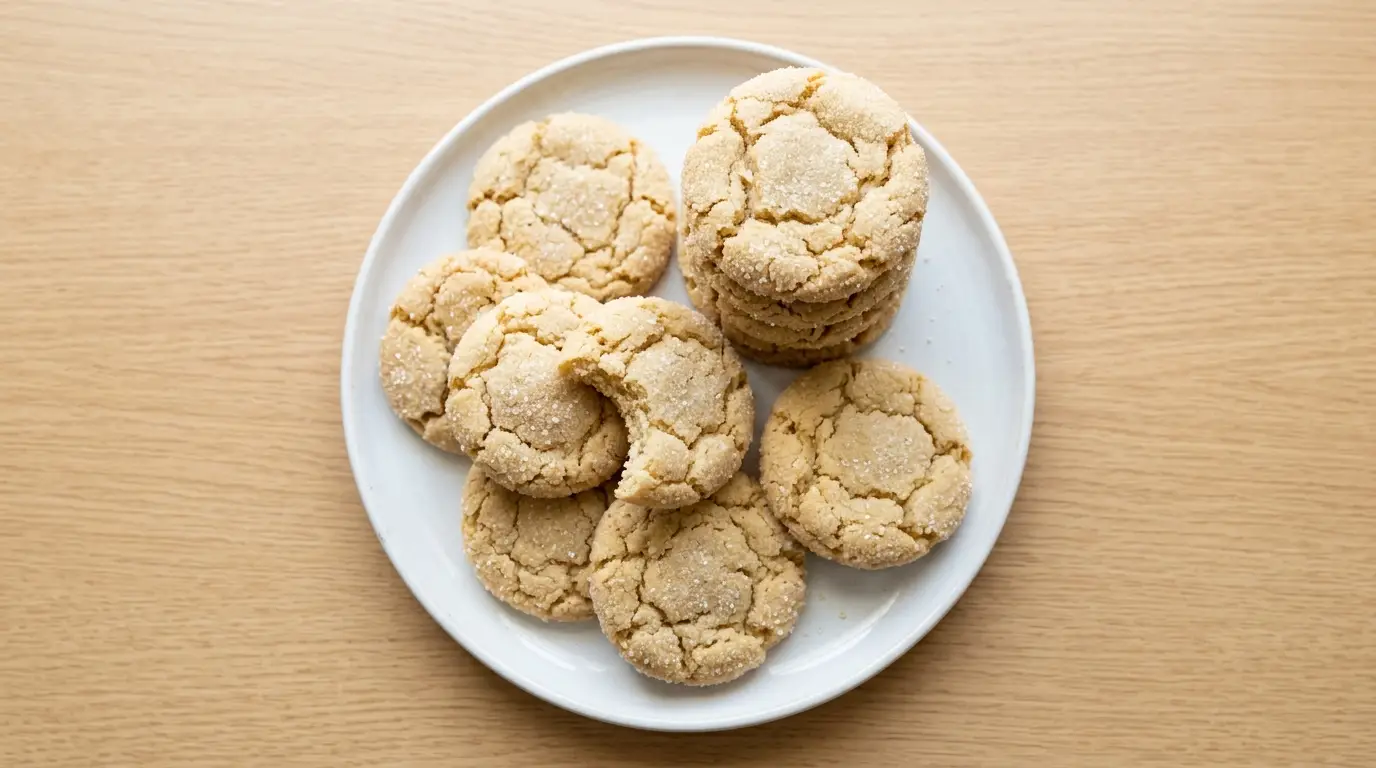
This sugar cookies recipe turns out soft in the center with lightly crisp, sparkly edges every single time. Each dough ball gets rolled in granulated sugar before baking, which is what gives the tops that signature crackle and shine.
Most batches go flat and greasy because the butter is too warm when it hits the bowl. Here the butter is softened just enough to dent under a finger, so the cookies hold their height instead of spreading into one sheet.
Eight pantry ingredients and about 27 minutes stand between you and two dozen bakery-style cookies. No chilling, no rolling pin, and no cookie cutters required.
| Quick Recipe Summary | |
|---|---|
| Prep Time | 15 minutes |
| Cook Time | 12 minutes |
| Total Time | 27 minutes |
| Servings | 24 cookies |
| Difficulty Level | Easy |
Read Also: Chocolate Chip Cookies Recipe

Why You’ll Love This Sugar Cookies Recipe
These are the kind of cookies that disappear off the cooling rack before they are fully cool. The texture is the main draw, and the method is forgiving enough for a first-time baker.
Here is what makes this version worth bookmarking:
- No chilling required. The dough is firm enough to scoop and bake right away, so you go from bowl to oven in about 15 minutes.
- Soft centers, crisp edges. A mix of baking powder and baking soda gives you lift in the middle and just enough spread for a delicate crackle at the rim.
- One bowl of flavor. Real vanilla carries the whole cookie, and an optional splash of almond extract adds that bakery-style depth.
- The sugar coating does double duty. Rolling each ball in granulated sugar before baking creates a crackled, sparkly top without any frosting.
- Beginner proof. There is no dough to roll out, no cutters to flour, and no tricky timing to manage.
- Easy to dress up. Leave them plain, press in sprinkles, or top with a simple glaze for the holidays.
- Great for a crowd. One batch makes 24 cookies, and the recipe doubles cleanly for cookie trays and bake sales.
A related recipe is Peanut Butter Cookies.
Ingredients
The ingredient list is short, and most of it is probably already in your kitchen. Quality matters more than quantity here, so use real butter and real vanilla if you can.
- 2¾ cups (345 g) all-purpose flour, spooned and leveled, or weighed for the most consistent results
- 1 teaspoon baking powder, check that it is fresh, since expired leavener causes flat cookies
- ½ teaspoon baking soda, works with the baking powder for a soft, lifted center
- ½ teaspoon fine salt, balances the sweetness and sharpens the vanilla
- 1 cup (226 g) unsalted butter, softened to room temperature, soft enough to dent but not greasy
- 1½ cups (300 g) granulated sugar, for the dough
- 1 large egg, at room temperature so it blends in smoothly
- 2 teaspoons pure vanilla extract, the main flavor, so avoid imitation if possible
- ½ teaspoon pure almond extract (optional), adds a subtle bakery-style note
- ¼ cup (50 g) granulated sugar, for rolling the dough balls before baking
For a different approach, see Gingerbread Cookie.
Kitchen Equipment Needed
You do not need anything fancy to pull these off. A hand whisk and a wooden spoon will work if you do not own a mixer, though a mixer makes the creaming step faster.
- Stand mixer or a sturdy bowl and spoon for creaming the butter and sugar
- Glass mixing bowls, one large for the dough, one small for the rolling sugar
- Measuring cups and spoons for accurate portions
- Parchment paper to line the sheets and prevent sticking
- Silicone baking mat as a reusable alternative to parchment
- Wire cooling rack so the bottoms do not steam and turn soggy
- Oven thermometer to confirm your oven runs at the true temperature
A similar setup works for Oatmeal Cookies.
Recommended Products for This Recipe
These are the tools and ingredients I reach for whenever I bake a batch. Each one solves a specific problem that used to trip me up.
1. Nielsen-Massey Pure Vanilla Extract
Sugar cookies have almost nowhere to hide flavor, so a flat, artificial vanilla leaves them tasting like sweetened flour. A rounded, true vanilla like this one is the single biggest upgrade you can make to a plain cookie, and a little goes a long way.
2. OXO Good Grips Cookie Scoop
Uneven dough balls bake at different rates, which leaves you with some cookies raw and others overdone on the same sheet. A spring-loaded scoop portions every cookie to the same size so the whole tray finishes at once.
3. Nordic Ware Baking Sheets
Thin, dark pans scorch the bottoms before the centers set, and they warp with a loud pop in a hot oven. Heavy natural aluminum sheets heat evenly and stay flat, which gives you pale, tender bottoms instead of burnt ones.
4. Escali Digital Kitchen Scale
Scooping flour straight from the bag packs in extra ounces, and too much flour is a leading cause of dry, crumbly sugar cookies. Weighing the flour removes the guesswork and makes every batch behave the same way.
You might also enjoy: No Bake Cookies

Step-by-Step Instructions: How to Make Sugar Cookies
Follow these simple steps and you will have a tray of soft sugar cookies ready in no time.
1. Preheat and Prep Your Pans
- Position a rack in the center of the oven and preheat to 350°F (175°C).
- Line two baking sheets with parchment paper or silicone baking mats.
- Pour the ¼ cup (50 g) of granulated sugar for rolling into a small shallow bowl and set it near your work area.
2. Whisk the Dry Ingredients
- In a medium bowl, whisk together the 2¾ cups (345 g) all-purpose flour, 1 teaspoon baking powder, ½ teaspoon baking soda, and ½ teaspoon salt.
- Whisk for a full 20 to 30 seconds so the leaveners and salt are evenly distributed through the flour.
- Set this bowl aside while you work on the butter mixture.
3. Cream the Butter and Sugar
- Add the 1 cup (226 g) softened butter and the 1½ cups (300 g) granulated sugar to a large bowl or the bowl of a stand mixer.
- Beat on medium speed for 2 to 3 minutes until the mixture is pale, light, and noticeably fluffy.
- Stop and scrape down the sides of the bowl at least once so everything blends evenly. I ruined my first batch by creaming the butter straight from the fridge, which left grainy streaks that never smoothed out and cookies that baked up dense.
4. Add the Egg and Extracts
- Add the room-temperature egg, 2 teaspoons vanilla extract, and the ½ teaspoon almond extract if using.
- Beat on medium just until the mixture looks smooth and uniform, about 30 to 45 seconds. Room-temperature eggs blend in faster than cold ones, which keeps you from overmixing the dough at this stage.
- Scrape down the bowl one more time to catch any butter clinging to the sides.
5. Combine Wet and Dry
- Add the flour mixture to the wet ingredients in two additions.
- Mix on low speed, or fold by hand, just until no dry flour streaks remain.
- Stop as soon as the dough comes together, since overmixing develops the flour and toughens the cookies.
6. Shape and Coat
- Scoop the dough into balls of about 1.5 tablespoons each, roughly 24 total.
- Roll each ball between your palms until smooth, then roll it through the bowl of granulated sugar to coat.
- Place the sugared balls on the lined sheets, spacing them about 2 inches (5 cm) apart to allow for spread.
7. Bake
- Bake one sheet at a time for 10 to 12 minutes, until the edges are set and the tops look puffed with faint cracks.
- The centers should still look slightly soft and underdone, which is what keeps them tender after cooling.
- Avoid baking past the point where the edges turn golden, or the cookies will firm up too much.
8. Cool and Set
- Let the cookies rest on the hot baking sheet for 5 minutes so they finish setting.
- Transfer them to a wire rack to cool completely.
- Repeat with the second sheet, re-sugaring any dough balls that have sat long enough to absorb their coating.
Another option worth trying is Creme Brulee Cookies.

Tips for The Best Sugar Cookies
Small details make the difference between flat, greasy cookies and bakery-worthy ones. Keep these pointers in mind before you preheat.
- Measure flour correctly. Spoon it into the cup and level it off, or weigh it. I’ve found that weighing the flour makes a bigger difference in this recipe than in almost any other cookie, because there are no chips or oats to hide a heavy hand.
- Get the butter temperature right. It should be cool room temperature, soft enough to dent with a finger but not shiny or melty.
- Do not skip the creaming time. Beating the butter and sugar for a few minutes traps air, which is what lifts the cookies.
- Keep a bowl of sugar handy for re-rolling. I keep a small bowl of granulated sugar right next to the sheet pan, because dough balls that wait their turn soak up their first coat and need a quick second roll.
- Bake one sheet at a time. A single sheet on the center rack browns more evenly than two sheets fighting for heat.
- Pull them early. They will look underdone in the center, and that is correct. Carryover heat on the pan finishes them.
- Tap the pan for crackly tops. Gently rapping the sheet on the counter halfway through baking encourages that pretty crinkled surface.
- Rotate if needed. If your oven has hot spots, turn the pan front to back at the halfway mark.
For another take on this style of cookie, see Oatmeal Raisin Cookie.
What to Serve with Sugar Cookies
Sugar cookies are the ultimate pairing cookie because their mild sweetness works with almost any warm drink or dessert spread. Serve them on their own, or build a plate around them for a party or holiday table.
- A mug of Hot Chocolate for dunking on a cold afternoon
- A cozy Pumpkin Spice Latte during the fall months
- A chilled glass of Eggnog on a holiday cookie tray
- A simple glass of cold milk, the classic partner for a soft cookie
- A scoop of vanilla or strawberry ice cream turned into an ice cream sandwich
- Fresh berries and a dollop of whipped cream for a lighter plate
- Lemon curd or raspberry jam for spreading or sandwiching two cookies together
- A cheese and fruit board, where the plain cookies balance sharper flavors
- Coffee or black tea, which cut through the sweetness nicely
You might also enjoy: Fudge
Variations of Sugar Cookies
Once you have the base down, this dough becomes a blank canvas. Here are the ways I like to change it up throughout the year.
- Frosted sugar cookies. Top the cooled cookies with a simple powdered sugar glaze or buttercream, then add sprinkles.
- Sprinkle cookies (funfetti). Fold ½ cup of rainbow sprinkles into the dough before scooping for a festive look.
- Lemon sugar cookies. Add 1 tablespoon of lemon zest to the dough and a squeeze of lemon juice for a bright, citrusy twist.
- Cinnamon sugar cookies. Roll the dough balls in a mix of granulated sugar and ground cinnamon for a snickerdoodle-leaning version.
- Brown butter sugar cookies. Brown the butter first, then cool it until solid before creaming, for a nutty, caramel depth.
- Almond sugar cookies. Bump the almond extract to 1 teaspoon and top each cookie with a sliced almond.
- Chocolate-dipped. Dip half of each cooled cookie in melted chocolate and let it set on parchment.
- Holiday colors. Divide the rolling sugar and tint it with a drop of gel food coloring for red, green, or pastel cookies.
Read Also: Pumpkin Cookies
Storage and Reheating
These cookies keep well, which makes them a smart make-ahead treat for parties and gifting. Store them properly and they stay soft for days.
- Room temperature. Keep baked cookies in an airtight container for up to 5 days. A slice of sandwich bread tucked into the container helps them stay soft.
- Refrigerator. Storage in the fridge is not necessary and tends to dry the cookies out, so stick to the counter.
- Freeze the baked cookies. Layer cooled cookies between parchment in a freezer bag and freeze for up to 3 months. Thaw at room temperature for about 30 minutes.
- Freeze the dough. Scoop and roll the dough balls, freeze them solid on a tray, then transfer to a bag. Bake from frozen, adding 1 to 2 extra minutes.
- Make-ahead tip. The dough can be covered and refrigerated for up to 3 days. Let it sit out for 15 to 20 minutes before scooping if it is too firm.
- Reheating. Warm a cookie in the microwave for 8 to 10 seconds to bring back that fresh-from-the-oven softness.
A similar storage method works for Eggnog Cookies.
Nutritional Facts
Values are estimates per cookie, based on a batch of 24 cookies made without frosting. Actual numbers will vary with brands and any toppings you add.
| Nutrient | Amount per Cookie |
|---|---|
| Calories | 145 kcal |
| Total Fat | 6 g |
| Saturated Fat | 3.5 g |
| Cholesterol | 22 mg |
| Sodium | 95 mg |
| Total Carbohydrates | 22 g |
| Sugars | 13 g |
| Protein | 1.5 g |
For a lighter option, try: Healthy Chocolate Chip Cookies
Health Benefits of Key Ingredients
Sugar cookies are a treat, not a health food, but a few of the core ingredients do carry some nutritional value worth knowing. Enjoy them in moderation and the following notes still hold true.
- Eggs: Provide complete protein along with choline, which supports brain and nerve function, plus small amounts of vitamin B12 and vitamin D.
- Butter: Contributes fat-soluble vitamins A, D, E, and K, and its fat helps your body absorb those vitamins from the rest of a meal.
- All-purpose flour: Enriched flour is fortified with iron and B vitamins such as folate, thiamin, niacin, and riboflavin, which support energy metabolism.
- Vanilla extract: Contains trace antioxidant compounds like vanillin, and a high-quality extract lets you use less added flavoring overall.
- Almond extract: Carries the aromatic compounds of almonds, so even a small amount delivers a lot of flavor without extra sugar or fat.
- Sugar: Supplies quick carbohydrate energy, and portioning the dough into 24 cookies keeps each serving modest.
- Salt: Provides sodium, an electrolyte the body needs in small amounts, while also keeping the cookies from tasting flat.
A related treat is Pumpkin Chocolate Chip Cookies.
FAQs About Sugar Cookies
1. Why are my sugar cookies flat?
The most common reason is butter that was too soft or melted, which spreads fast in the oven. Expired baking powder or too little flour can also cause spreading, so check your leavener and measure carefully.
2. Do I need to chill this sugar cookie dough?
No, this particular dough is firm enough to scoop and bake right away. If your kitchen is very warm and the dough feels sticky, a quick 15 minutes in the fridge helps the cookies hold their shape.
3. Why is my sugar cookie dough crumbly?
Crumbly dough usually means too much flour or butter that was not creamed long enough. Try beating the butter and sugar a bit more, and add a teaspoon of milk at a time until the dough just holds together.
4. Can I freeze sugar cookies or the dough?
Yes to both. Baked cookies freeze well for up to 3 months, and scooped dough balls can be frozen and baked straight from the freezer with a couple of extra minutes added.
5. Why did my sugar cookies turn out hard?
Hard cookies are usually a sign of overbaking or too much flour. Pull them when the centers still look slightly underdone, and store them with a slice of bread to keep them soft.
6. Can I make these without a mixer?
Absolutely, a bowl and a sturdy spoon or whisk will do the job. Just make sure the butter is soft enough to beat easily, and give the creaming step a little extra elbow grease.
7. What is the difference between sugar cookies and shortbread?
Sugar cookies contain egg and leavening, which makes them soft and gives them lift. Shortbread has no egg or leavener, so it bakes up dense, crumbly, and buttery instead.
Read Also: Pecan Pie
Soft Sugar Cookies
Ingredients
- 2¾ cups all-purpose flour - 345 g, spooned and leveled or weighed
- 1 teaspoon baking powder - check that it is fresh
- ½ teaspoon baking soda
- ½ teaspoon fine salt
- 1 cup unsalted butter - 226 g, softened to room temperature, soft enough to dent but not greasy
- 1½ cups granulated sugar - 300 g, for the dough
- 1 large egg - at room temperature
- 2 teaspoons pure vanilla extract - avoid imitation if possible
- ½ teaspoon pure almond extract - optional, adds a subtle bakery-style note
- ¼ cup granulated sugar - 50 g, for rolling the dough balls before baking
Equipment
- Stand mixer - or a sturdy bowl and spoon for creaming the butter and sugar
- Glass mixing bowls - one large for the dough, one small for the rolling sugar
- Measuring cups and spoons - for accurate portions
- Parchment paper - to line the sheets and prevent sticking
- Silicone Baking Mat - as a reusable alternative to parchment (optional)
- Wire cooling rack - so the bottoms do not steam and turn soggy
- Oven thermometer - to confirm your oven runs at the true temperature (optional)
- Cookie scoop - 1.5 tablespoon size, for even portions (optional)
- Baking sheets - two sheets, heavy natural aluminum recommended
Method
- Position a rack in the center of the oven and preheat to 350°F (175°C). Line two baking sheets with parchment paper or silicone baking mats.
- Pour the ¼ cup (50 g) of granulated sugar for rolling into a small shallow bowl and set it near your work area.
- In a medium bowl, whisk together the flour, baking powder, baking soda, and salt for a full 20 to 30 seconds so the leaveners and salt are evenly distributed.
- Add the softened butter and granulated sugar to a large bowl or stand mixer. Beat on medium speed for 2 to 3 minutes until pale, light, and noticeably fluffy, scraping down the sides at least once.
- Add the room-temperature egg, vanilla extract, and almond extract if using. Beat on medium just until smooth and uniform, about 30 to 45 seconds, then scrape down the bowl.
- Add the flour mixture to the wet ingredients in two additions. Mix on low speed or fold by hand just until no dry flour streaks remain, stopping as soon as the dough comes together.
- Scoop the dough into balls of about 1.5 tablespoons each, roughly 24 total. Roll each ball smooth between your palms, then roll through the granulated sugar to coat.
- Place the sugared balls on the lined sheets, spacing them about 2 inches (5 cm) apart to allow for spread.
- Bake one sheet at a time for 10 to 12 minutes, until the edges are set and the tops look puffed with faint cracks. The centers should still look slightly soft and underdone.
- Let the cookies rest on the hot baking sheet for 5 minutes so they finish setting, then transfer to a wire rack to cool completely.
- Repeat with the second sheet, re-sugaring any dough balls that have sat long enough to absorb their coating.
Nutrition
Notes
- Measure flour correctly. Spoon it into the cup and level it off, or weigh it. Weighing the flour makes a bigger difference in this recipe than in almost any other cookie, because there are no chips or oats to hide a heavy hand.
- Get the butter temperature right. It should be cool room temperature, soft enough to dent with a finger but not shiny or melty.
- Do not skip the creaming time. Beating the butter and sugar for a few minutes traps air, which is what lifts the cookies.
- Keep a bowl of sugar handy for re-rolling. Dough balls that wait their turn soak up their first coat and need a quick second roll.
- Bake one sheet at a time. A single sheet on the center rack browns more evenly than two sheets fighting for heat.
- Pull them early. They will look underdone in the center, and that is correct. Carryover heat on the pan finishes them.
- Tap the pan for crackly tops. Gently rapping the sheet on the counter halfway through baking encourages that pretty crinkled surface.
- Rotate if needed. If your oven has hot spots, turn the pan front to back at the halfway mark.
- Storage: Keep baked cookies in an airtight container at room temperature for up to 5 days. A slice of sandwich bread tucked into the container helps them stay soft. Do not refrigerate, as it dries them out.
- Freezing: Baked cookies freeze well for up to 3 months layered between parchment. Scooped dough balls can be frozen solid on a tray, then bagged and baked from frozen with 1 to 2 extra minutes.
- Make-ahead: The dough can be covered and refrigerated for up to 3 days. Let it sit out for 15 to 20 minutes before scooping if it is too firm.
- Reheating: Warm a cookie in the microwave for 8 to 10 seconds to bring back that fresh-from-the-oven softness.
Private Notes
Tried this recipe?
Let us know how it was!Final Thoughts
Soft, sweet, and ready in under half an hour, these are the cookies I come back to whenever I want a sure thing. They are simple enough for a weeknight and pretty enough for a holiday tray.
Give this batch a try and let the sugared tops crackle in your own oven. If you make them, leave a comment below and share how you dressed yours up, plain, frosted, or somewhere in between.
Recommended:
- Apple Pie
- Pumpkin Pie
- Coconut Cream Pie
- Peanut Butter Fudge
- Pumpkin Snickerdoodle Cookies
- Hot Chocolate Mix
- Christmas Crack
- Fruit Tart
- Funnel Cake Bites