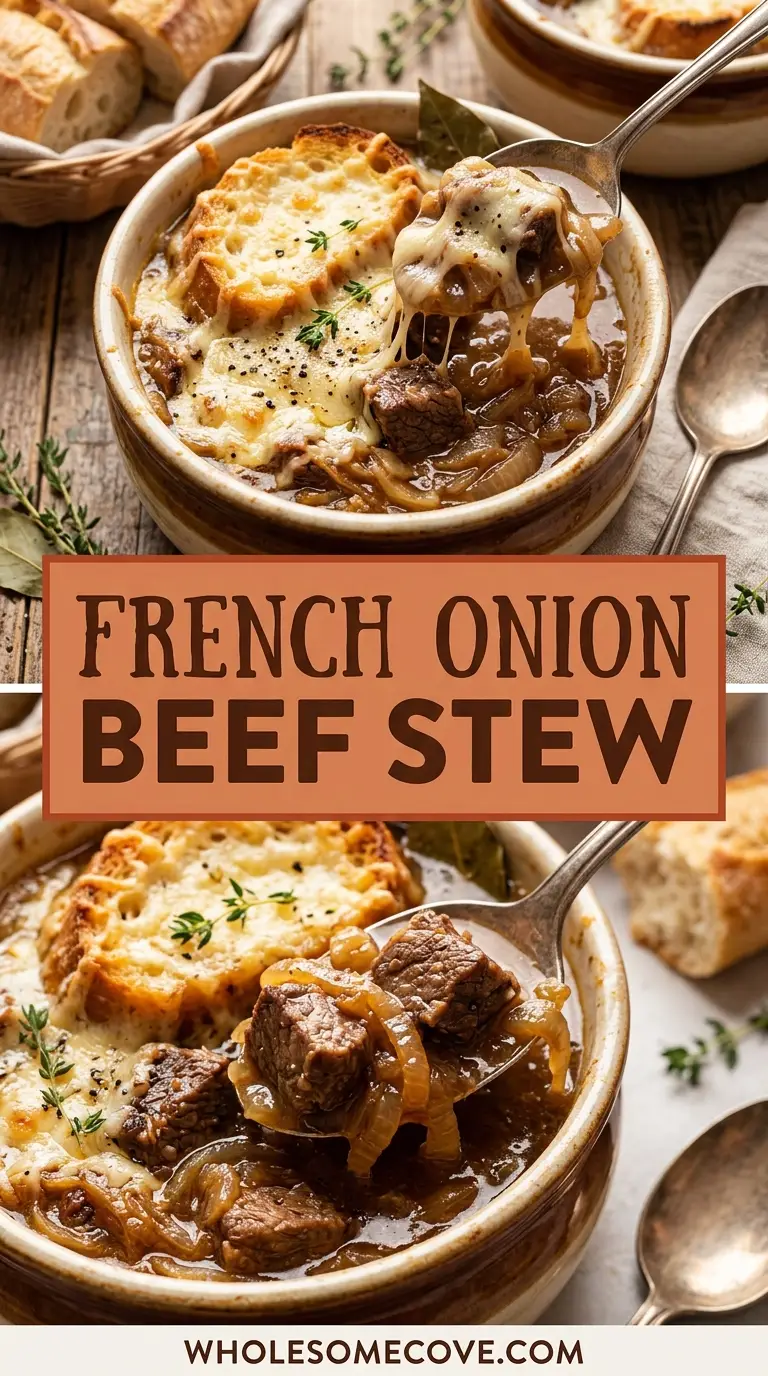
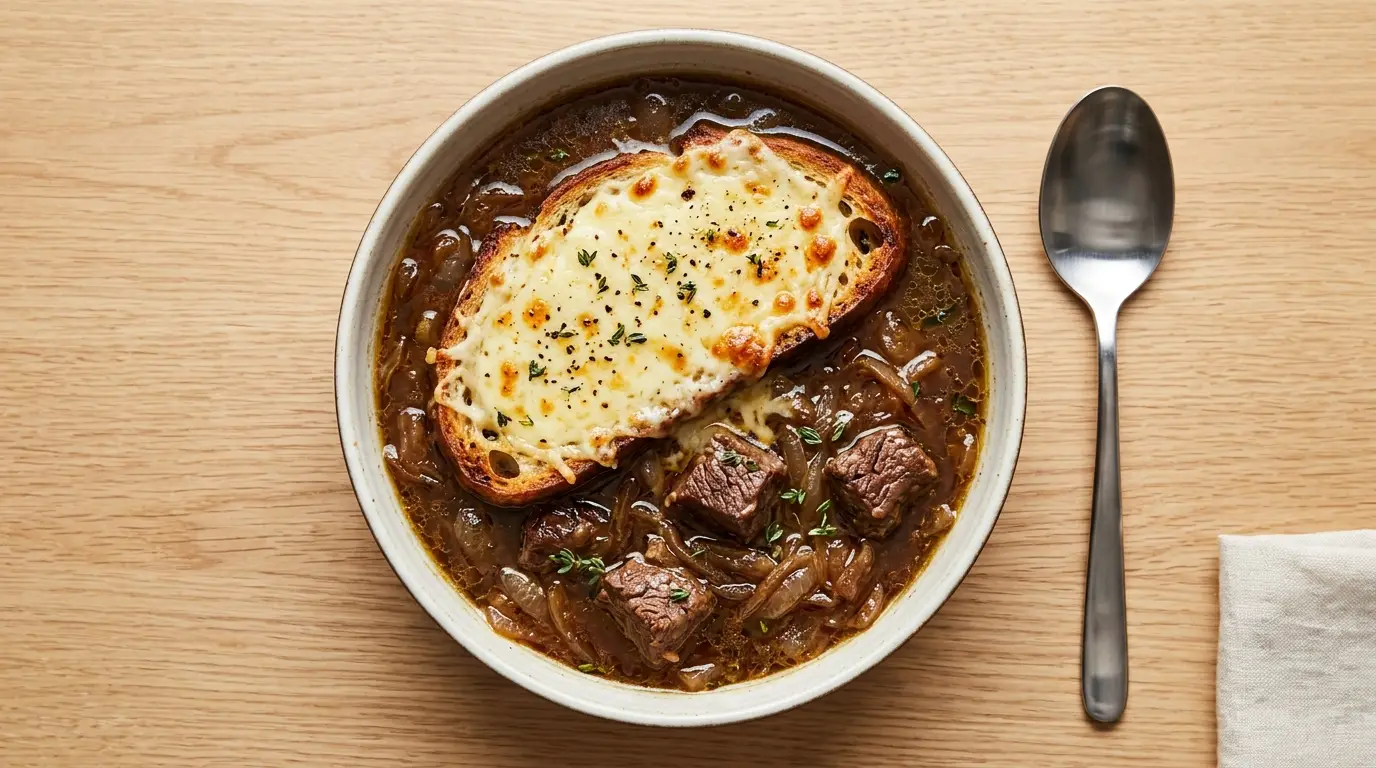
This French Onion Beef Stew recipe takes the caramelized onions and melty Gruyère toast from a bowl of French onion soup and folds them into a thick, spoon-coating beef stew. Chunks of chuck roast turn fork-tender after a slow braise, and the broth carries that same deep, savory-sweet onion flavor.
Most home versions come out thin and taste more like soup than stew. That usually happens because the onions get rushed and the broth never gets thickened.
The fix is two pounds of yellow onions cooked down slowly until they hit a real caramel brown, plus a few tablespoons of flour to give the base body. The onions do most of the heavy lifting here, so they get their own unhurried time in the pot.
You get about three pounds of beef, two pounds of onions, and enough broth for six generous bowls. Each one gets crowned with a broiled Gruyère toast for that classic pull.
| Quick Recipe Summary | |
|---|---|
| Prep Time | 25 minutes |
| Cook Time | 2 hours 35 minutes |
| Total Time | 3 hours |
| Servings | 6 bowls |
| Difficulty Level | Intermediate |
For a lighter, brothier cousin of this dish, see French Onion Soup.

Why You’ll Love This French Onion Beef Stew Recipe
This stew gives you two comfort-food classics in one pot, without asking you to make each separately. The flavor payoff comes from slow, patient cooking rather than a long list of ingredients.
Here is what makes it worth the afternoon:
- Deep caramelized onion flavor: Two pounds of yellow onions cook down to a fraction of their volume and turn sweet, jammy, and savory all at once.
- Fork-tender beef: Chuck roast has enough marbling to stay moist and pull apart after a couple of hours of gentle braising.
- A thick, hearty base: A few tablespoons of flour and a slow reduction give you stew consistency, not thin soup.
- That signature cheesy toast: Broiled Gruyère on crusty bread sits right on top of each bowl, exactly like the soup it borrows from.
- Even better the next day: The flavors settle and deepen overnight, so leftovers taste richer than the first serving.
- Make-ahead friendly: The stew base holds for days in the fridge and freezes well, so you can prep it well before company arrives.
- Naturally crowd-pleasing: One pot feeds six, which makes it a solid Sunday dinner or cold-weather gathering dish.
Read Also: French Onion Pot Roast
Ingredients
Gather everything before you start, since the caramelizing and searing happen back to back. The list splits into the stew itself and the cheesy toast topping.
For the stew:
- 3 lb (1.4 kg) boneless beef chuck roast, cut into 1.5-inch (4 cm) cubes
- 2 lb (900 g) yellow onions, halved and thinly sliced
- 4 tbsp (60 g) unsalted butter
- 2 tbsp (30 ml) olive oil, divided
- 4 cloves garlic, minced
- 3 tbsp (24 g) all-purpose flour
- 1/2 cup (120 ml) dry sherry or dry white wine
- 4 cups (960 ml) beef broth
- 2 tbsp (30 ml) Worcestershire sauce
- 1 tbsp (15 ml) balsamic vinegar
- 4 sprigs fresh thyme
- 2 bay leaves
- 1 tsp sugar
- 1.5 tsp salt, plus more to taste
- 1/2 tsp black pepper
For the Gruyère toasts:
- 1 small French baguette, sliced into 12 rounds
- 6 oz (170 g) Gruyère cheese, grated
- 2 tbsp (30 ml) olive oil, for brushing
For a more traditional braise, see Beef Stew.
Kitchen Equipment Needed
A heavy pot that goes from stovetop to oven makes this recipe far easier. Everything else you likely already own.
Here is what you will want on hand:
- A large enameled Dutch oven or heavy braising pot, 6 quarts or larger
- A sharp chef’s knife for slicing onions and cubing beef
- A wooden spoon for scraping up the browned bits
- A rimmed baking sheet for the toasts
- A box grater or rotary cheese grater
- Tongs for turning the beef as it sears
- Oven-safe soup bowls or crocks, if you want to broil the cheese right on the stew
- Paper towels for patting the beef dry
For another slow, oven-friendly beef dish, try: French Onion Beef Casserole
Recommended Products for This Recipe
These are the tools and ingredients I keep reaching for whenever I make this stew. Each one solved a specific problem I ran into along the way.
1. Enameled Cast Iron Dutch Oven
Thin pots scorch the onions and the fond long before the sugars actually caramelize. A heavy enameled Dutch oven holds steady, even heat, so the onions brown evenly instead of burning in patches, and the same pot goes straight into the oven for the braise.
2. Gruyère Cheese
Pre-shredded cheese blends never melt the same way because of the anti-caking coating. A proper wedge of Gruyère melts into that glossy, nutty layer on the toast, and a little goes a long way thanks to how bold it tastes.
3. Instant-Read Meat Thermometer
Guessing when chuck is tender wastes both time and good beef. I pull the stew when the meat probes soft with almost no resistance, and a quick-read thermometer takes the guesswork out of the searing stage too.
4. Fine Mesh Strainer
If your onions release a lot of liquid, a small strainer lets you separate and reserve it so the caramelizing stage moves faster. It also comes in handy for dusting flour evenly over the beef without clumps.
For a hands-off version of this flavor, check out Slow Cooker French Onion Soup.

Step-by-Step Instructions: How to Make French Onion Beef Stew
Follow these steps in order and you’ll end up with tender beef and deeply caramelized onions in one rich pot.
1. Caramelize the Onions
- Melt the butter with 1 tablespoon of olive oil in your Dutch oven over medium heat.
- Add all the sliced onions along with the sugar and a pinch of salt. Stir to coat them in the fat.
- Cook, stirring every few minutes, for 30 to 40 minutes until the onions collapse and turn a deep caramel brown.
- Lower the heat if they start to catch, and scrape the bottom of the pot as browned bits build up.
- Once fully caramelized, scoop the onions out into a bowl and set them aside.
I ruined my first pot by walking away during this stage, and the onions went from golden to bitter in under five minutes. Now I stay close and stir often once they start to color.
2. Sear the Beef
- Pat the beef cubes very dry with paper towels, then season them with the salt and pepper.
- Raise the heat to medium-high and add the remaining 1 tablespoon of olive oil to the same pot.
- Working in batches, sear the beef on all sides until deeply browned, about 4 to 6 minutes per batch.
- Give each piece space so it browns rather than steams, and transfer finished batches to a plate.
Crowding the pan is the fastest way to gray, flavorless meat, which I learned the hard way when I tried to sear all three pounds at once.
3. Build the Base
- Return all the beef to the pot and sprinkle the flour over it. Stir for about 1 minute so the flour coats everything and cooks off its raw taste.
- Pour in the sherry to deglaze, scraping up every bit of fond stuck to the bottom.
- Let the sherry bubble and reduce for about 2 minutes until nearly evaporated.
4. Simmer the Stew
- Stir the caramelized onions back into the pot, then add the garlic, beef broth, Worcestershire sauce, and balsamic vinegar.
- Tuck in the thyme sprigs and bay leaves, and bring everything to a gentle boil.
- Reduce the heat to low, cover, and simmer for 1 hour, stirring every 20 minutes.
- Uncover and continue simmering for another 45 minutes to 1 hour, until the beef is fork-tender and the broth has thickened.
- Fish out the thyme stems and bay leaves, then taste and adjust the salt.
5. Make the Gruyère Toasts
- Arrange the baguette slices on a rimmed baking sheet and brush them lightly with olive oil.
- Broil for 1 to 2 minutes until just golden, watching closely so they don’t burn.
- Pile the grated Gruyère onto each toast and broil again for 2 to 3 minutes until the cheese is melted and bubbling.
6. Serve
- Ladle the hot stew into bowls and float one or two cheesy toasts on top of each.
- For an even more soup-like finish, ladle the stew into oven-safe crocks, top with toast and extra Gruyère, and broil until the cheese browns.
Read Also: French Onion Beef and Noodles
Tips for The Best French Onion Beef Stew
Small adjustments make a big difference between a thin, flat stew and a rich one. These are the habits that consistently give the best results.
- Slice the onions evenly: Uniform slices caramelize at the same rate, so you avoid a mix of burnt and raw pieces.
- Don’t rush the caramelizing: The 30 to 40 minute mark is where the flavor lives. Anything faster leaves you with soft onions that taste sweet but flat.
- Dry the beef thoroughly: Surface moisture prevents browning, and a good sear is where a lot of the savory depth starts.
- Deglaze fully: Those stuck-on browned bits carry concentrated flavor, so scrape them all up when you add the sherry.
- Simmer uncovered at the end: Leaving the lid off during the last stretch reduces the broth and thickens it naturally.
- Salt in stages: Beef broth and Worcestershire already bring salt, so taste before adding more at the end.
- Rest before serving: Ten minutes off the heat lets the stew settle and the flavors round out.
I’ve found that a splash of balsamic vinegar right at the end brightens the whole pot far more than adding it early, when it just cooks away.
You might also enjoy: French Onion Beef and Rice Casserole
What to Serve with French Onion Beef Stew
This stew is rich and filling on its own, but a few simple sides round it into a full meal. Lean toward things that soak up the broth or cut through its richness.
Here are pairings that work well:
- Crusty bread or extra baguette for dipping into the broth
- Mashed Potatoes to spoon the stew over
- Soft Dinner Rolls for mopping the bowl
- A crisp green salad with a sharp vinaigrette to balance the richness
- Roasted Potatoes alongside for a heartier plate
- Maple Glazed Carrots for a touch of sweetness
- Roasted Brussels Sprouts with Bacon for a savory, crunchy contrast
- A glass of dry red wine to echo the deep beef flavor
Another option worth trying is Slow Cooker Pot Roast.
Variations of French Onion Beef Stew
Once you know the base method, the recipe bends easily to what you have and how much time you want to spend. These are the swaps that hold up best.
- Slow cooker version: Caramelize the onions and sear the beef first, then transfer everything to a slow cooker and cook on low for 7 to 8 hours.
- Add root vegetables: Stir in diced potatoes and carrots during the last hour for a more traditional stew feel.
- Mushroom boost: Add 8 ounces of quartered cremini mushrooms in the final 30 minutes for extra earthiness.
- Wine-forward: Swap the sherry for dry red wine to lean the flavor closer to a beef bourguignon.
- Different cheese: Swiss, provolone, or a sharp white cheddar all melt nicely if you can’t find Gruyère.
- Noodle stew: Stir in cooked egg noodles at the end to turn it into a heartier one-bowl meal.
- Extra onion depth: A tablespoon of French onion soup mix in the broth reinforces that signature flavor.
For a baked take on these flavors, try: French Onion Beef Short Rib Soup
Storage and Reheating
This stew stores beautifully, which is one of its best features. Keep the toasts separate so they don’t turn soggy.
Here is how to hold and revive it:
- Refrigerator: Store the stew, without the bread topping, in an airtight container for up to 3 to 4 days.
- Freezer: Freeze the stew base for up to 3 months in a freezer-safe container, leaving a little headspace for expansion.
- Thawing: Move frozen stew to the fridge overnight before reheating for the smoothest texture.
- Stovetop reheating: Warm gently over medium-low heat, stirring occasionally, and add a splash of broth if it has thickened too much.
- Microwave reheating: Heat in short bursts, stirring between them, until hot all the way through.
- Fresh toasts: Always broil new Gruyère toasts when serving leftovers, since day-old bread goes mushy in the broth.
I keep a small container of extra broth in the freezer just for loosening reheated stew, since it always thickens more than you expect overnight.
A related recipe is Crockpot Beef Stew.
Nutritional Facts
| Nutrition Per Serving (approximate, 1 of 6 servings) | |
|---|---|
| Calories | 560 kcal |
| Protein | 42 g |
| Carbohydrates | 28 g |
| Fat | 29 g |
| Saturated Fat | 13 g |
| Fiber | 3 g |
| Sugar | 8 g |
| Sodium | 980 mg |
Values will shift based on your exact cut of beef, broth, and how much cheese you pile on.
Read Also: Crockpot Fall Recipes
Health Benefits of Key Ingredients
Beyond the comfort factor, several ingredients in this stew bring real nutritional value. The core of the dish leans on whole, minimally processed foods.
Here is what the key ingredients offer:
- Beef chuck: A strong source of complete protein, iron, and vitamin B12, all of which support energy and muscle maintenance.
- Onions: Rich in antioxidants and natural compounds linked to heart health, and they add fiber once cooked down.
- Garlic: Contains sulfur compounds studied for their immune-supporting and anti-inflammatory properties.
- Thyme: Delivers small amounts of vitamin C and manganese along with aromatic antioxidant compounds.
- Beef broth: Provides minerals and adds moisture without many calories, especially when you use a low-sodium version.
- Gruyère cheese: Offers calcium and protein, though it is best enjoyed in the modest amounts this recipe uses.
You might also enjoy: Vegetarian French Onion Soup
FAQs About French Onion Beef Stew
1. What is the best cut of beef for French onion beef stew?
Boneless chuck roast is the top choice because its marbling and connective tissue break down during slow cooking. That gives you tender, moist beef rather than the dry, stringy result you get from leaner cuts.
If you’re short on time, pre-cut stew meat works, though the quality can vary. Cutting your own chuck into even cubes gives you the most reliable texture.
2. Why is my stew watery instead of thick?
The most common causes are skipping the flour and not reducing the broth long enough. Flour coats the beef and thickens the base as it simmers.
Leave the lid off during the final stretch of cooking so the liquid reduces and concentrates. If it’s still thin, stir in a slurry of one tablespoon cornstarch mixed with cold water.
3. Can I make French onion beef stew ahead of time?
Yes, and it actually improves overnight as the flavors settle. Make the stew base up to three days ahead and store it covered in the fridge.
Reheat it gently on the stovetop and broil fresh Gruyère toasts right before serving. The bread should always be added fresh so it stays crisp.
4. What can I use instead of Gruyère cheese?
Swiss cheese is the closest match in both flavor and meltability. Provolone, Emmental, or a good white cheddar also work well on the toasts.
Whatever you choose, grate it fresh rather than using pre-shredded bags. The anti-caking coating on pre-shredded cheese keeps it from melting into that smooth, glossy layer.
5. Do I have to caramelize the onions, or can I take a shortcut?
The caramelizing is what gives this stew its signature depth, so it’s worth the time. Softened onions that haven’t browned will taste sweet but flat.
If you’re truly pressed, cooking them a bit faster over slightly higher heat works, as long as you stir constantly. Just don’t skip the browning entirely, or you lose the whole point of the dish.
6. Can I add potatoes and carrots to make it more like traditional beef stew?
Absolutely, and many people prefer it that way. Add diced potatoes and chunks of carrot during the last hour of simmering so they cook through without turning to mush.
Keep in mind this makes the dish heartier and slightly less soup-like. You may want a bit of extra broth to keep everything saucy.
For a homemade shortcut to this flavor, see French Onion Soup Mix.
French Onion Beef Stew
Ingredients
- 3 lb boneless beef chuck roast - 1.4 kg, cut into 1.5-inch (4 cm) cubes
- 2 lb yellow onions - 900 g, halved and thinly sliced
- 4 tbsp unsalted butter - 60 g
- 2 tbsp olive oil - 30 ml, divided
- 4 cloves garlic - minced
- 3 tbsp all-purpose flour - 24 g
- 1/2 cup dry sherry - 120 ml, or dry white wine
- 4 cups beef broth - 960 ml
- 2 tbsp Worcestershire sauce - 30 ml
- 1 tbsp balsamic vinegar - 15 ml
- 4 sprigs fresh thyme
- 2 bay leaves
- 1 tsp sugar
- 1.5 tsp salt - plus more to taste
- 1/2 tsp black pepper
- 1 small French baguette - sliced into 12 rounds
- 6 oz Gruyère cheese - 170 g, grated
- 2 tbsp olive oil - 30 ml, for brushing
Equipment
- Enameled Dutch oven - or heavy braising pot, 6 quarts or larger
- Sharp chef’s knife - for slicing onions and cubing beef
- Wooden spoon - for scraping up the browned bits
- Rimmed baking sheet - for the toasts
- Box grater or rotary cheese grater
- Tongs - for turning the beef as it sears
- Oven-safe soup bowls or crocks - (optional) if you want to broil the cheese right on the stew
- Paper towels - for patting the beef dry
Method
- Melt the butter with 1 tablespoon of olive oil in your Dutch oven over medium heat. Add all the sliced onions along with the sugar and a pinch of salt, stir to coat, and cook, stirring every few minutes, for 30 to 40 minutes until the onions collapse and turn a deep caramel brown. Scoop the onions out into a bowl and set them aside.
- Pat the beef cubes very dry with paper towels, then season them with the salt and pepper. Raise the heat to medium-high and add the remaining 1 tablespoon of olive oil to the same pot. Working in batches, sear the beef on all sides until deeply browned, about 4 to 6 minutes per batch, then transfer finished batches to a plate.
- Return all the beef to the pot and sprinkle the flour over it, stirring for about 1 minute so the flour coats everything and cooks off its raw taste. Pour in the sherry to deglaze, scraping up every bit of fond stuck to the bottom, and let it bubble and reduce for about 2 minutes until nearly evaporated.
- Stir the caramelized onions back into the pot, then add the garlic, beef broth, Worcestershire sauce, and balsamic vinegar. Tuck in the thyme sprigs and bay leaves, bring to a gentle boil, then reduce the heat to low, cover, and simmer for 1 hour, stirring every 20 minutes. Uncover and continue simmering for another 45 minutes to 1 hour, until the beef is fork-tender and the broth has thickened. Fish out the thyme stems and bay leaves, then taste and adjust the salt.
- Arrange the baguette slices on a rimmed baking sheet and brush them lightly with olive oil. Broil for 1 to 2 minutes until just golden, watching closely so they don’t burn. Pile the grated Gruyère onto each toast and broil again for 2 to 3 minutes until the cheese is melted and bubbling.
- Ladle the hot stew into bowls and float one or two cheesy toasts on top of each. For an even more soup-like finish, ladle the stew into oven-safe crocks, top with toast and extra Gruyère, and broil until the cheese browns.
Nutrition
Notes
- Slice the onions evenly so they caramelize at the same rate and you avoid a mix of burnt and raw pieces.
- Don’t rush the caramelizing — the 30 to 40 minute mark is where the flavor lives. Anything faster leaves you with soft onions that taste sweet but flat.
- Dry the beef thoroughly before searing; surface moisture prevents browning, and a good sear is where a lot of the savory depth starts.
- Deglaze fully — those stuck-on browned bits carry concentrated flavor, so scrape them all up when you add the sherry.
- Simmer uncovered at the end to reduce the broth and thicken it naturally.
- Salt in stages: beef broth and Worcestershire already bring salt, so taste before adding more at the end.
- Rest the stew for 10 minutes off the heat before serving so the flavors round out.
- A splash of balsamic vinegar right at the end brightens the whole pot far more than adding it early, when it just cooks away.
- Store the stew, without the bread topping, in an airtight container in the refrigerator for up to 3 to 4 days, or freeze the base for up to 3 months.
- Always broil fresh Gruyère toasts when serving leftovers, since day-old bread goes mushy in the broth.
- For a slow cooker version, caramelize the onions and sear the beef first, then transfer everything to a slow cooker and cook on low for 7 to 8 hours.
- Add diced potatoes and carrots during the last hour of simmering to make it more like traditional beef stew.
Private Notes
Tried this recipe?
Let us know how it was!Final Thoughts
French onion beef stew rewards a little patience with one of the coziest bowls you can put on the table. The caramelized onions and tender beef make it feel special without demanding fancy technique.
Once you’ve made it, you’ll understand why it earns a spot in the cold-weather rotation. That first spoonful, with the cheesy toast melting into the broth, is hard to beat.
Give it a try on your next slow Sunday and let the onions take their time. If you make it, leave a comment below and share how it turned out with friends and family.
Recommended:
- Mississippi Pot Roast
- Beef Barley Soup
- Cheeseburger Soup
- Prime Rib
- Zuppa Toscana
- Beef Tips and Gravy
- Slow Cooker Beef Barley Soup
- Shepherds Pie
- Meatloaf