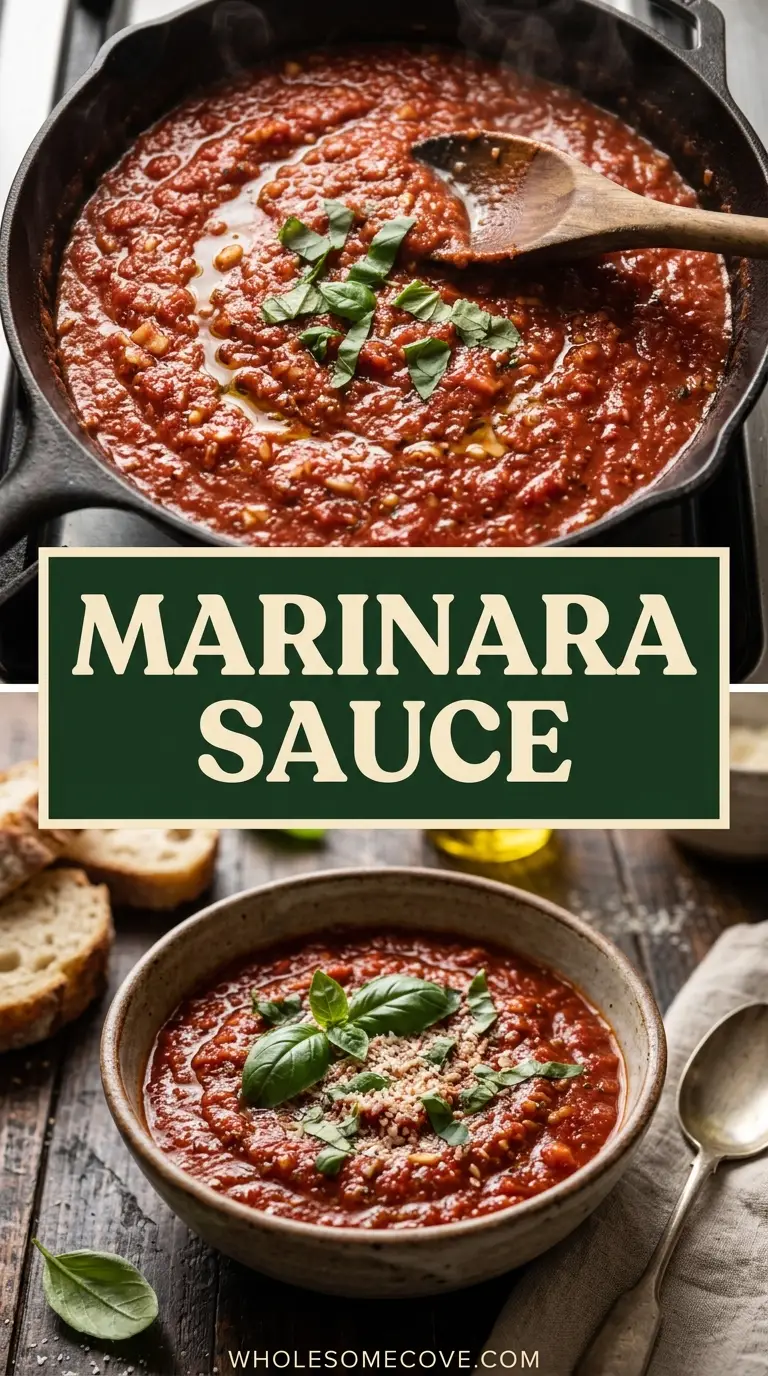
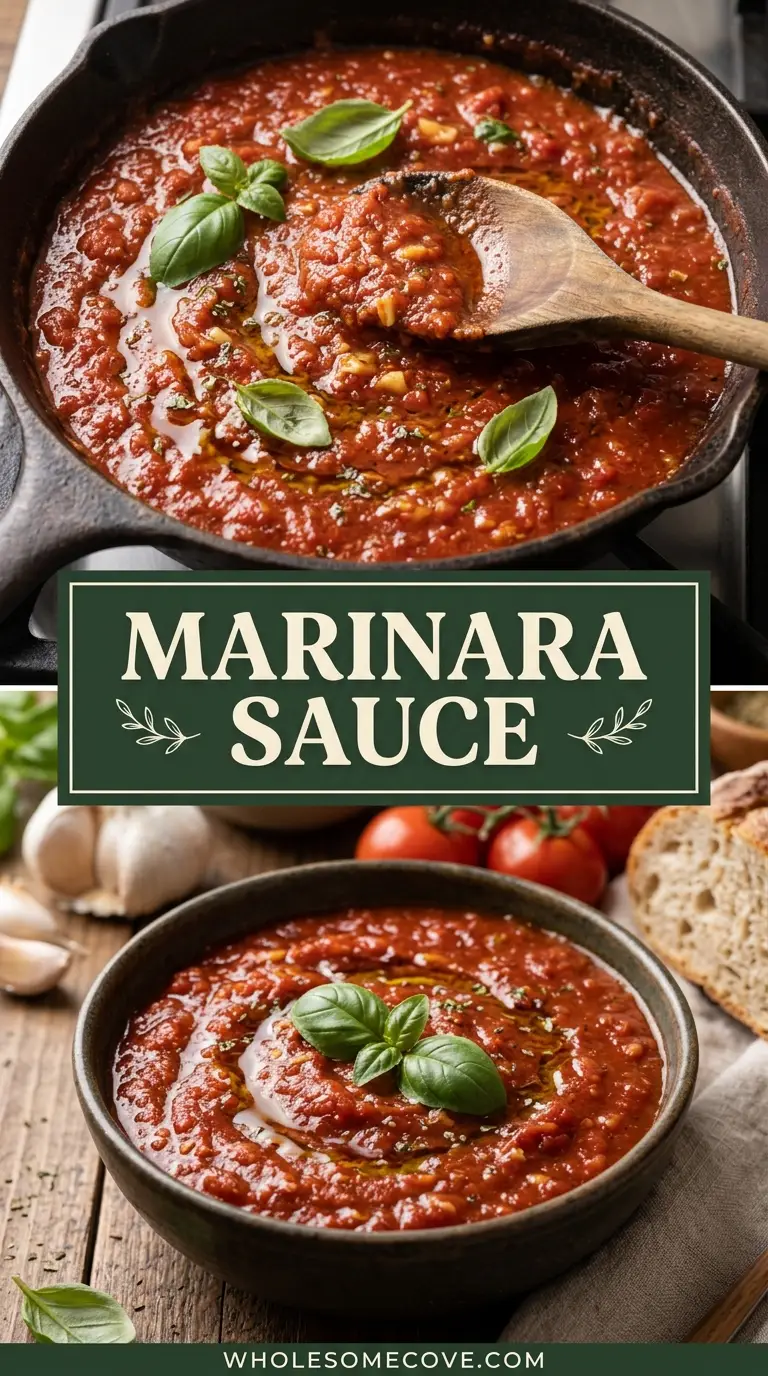
This marinara sauce recipe turns one 28-ounce (794 g) can of whole tomatoes into bright red sauce in 45 minutes. The tomatoes break down into soft, uneven pieces that cling to pasta instead of sliding off.
Most homemade marinara goes wrong in two places. Garlic scorches and turns bitter, or the sauce comes off the heat while it is still thin and sharp.
Here, garlic cooks for just 30 seconds, after a spoonful of tomato paste has browned in the oil. That brief browning gives the sauce a deep, sweet backbone that a short simmer cannot build alone.
| Quick Recipe Summary | |
|---|---|
| Prep Time | 10 minutes |
| Cook Time | 35 minutes |
| Total Time | 45 minutes |
| Servings | 6 servings (about 3 cups / 720 ml) |
| Difficulty Level | Easy |
For a plainer relative of this sauce, see Tomato Sauce Recipe.
Why You’ll Love This Marinara Sauce Recipe
This sauce needs one pot, one can of tomatoes, and about 10 minutes of prep. The finished sauce is thick enough to coat spaghetti and easy to thin for pizza or dipping.
- Ready in 45 minutes: You spend 10 minutes on prep and 35 minutes at the stove, and about 25 of those minutes are an unattended simmer.
- One pot: Everything cooks in a single Dutch oven or saucepan, so cleanup takes a few minutes.
- Pantry friendly: The base is a canned tomato, so you can make it in January as easily as in August.
- Chunky or smooth: Leave the tomatoes in soft pieces, or blend the sauce for 15 seconds for a velvety finish.
- Vegan by default: There is no dairy, meat, or animal product in the pot, so it suits vegan and vegetarian meals as written.
- Freezer friendly: A batch keeps for up to 3 months, which makes weeknight pasta a 10-minute job.
- A flexible base: The same sauce works for pasta, chicken parmesan, baked pasta, shakshuka, and dipping.
You might also enjoy: Spaghetti Sauce Recipe
Ingredients
Marinara has a short ingredient list, so the quality of each item shows up in the finished sauce. This recipe makes about 3 cups (720 ml), or six servings of 1/2 cup (120 ml).
- 3 tablespoons (45 ml) extra virgin olive oil: This is the cooking fat and a big part of the flavor, so use one you would happily taste on bread.
- 1 medium yellow onion (about 1 cup / 150 g), finely diced: Cut the pieces to about 1/4 inch (6 mm) so they melt into the sauce instead of staying chunky.
- 1 tablespoon (16 g) tomato paste: Browning it in the oil adds depth and sweetness. I keep a tube of tomato paste in the fridge specifically for this recipe because an opened can wastes most of its contents.
- 4 garlic cloves, minced (about 4 teaspoons / 12 g): Mince it fine so it cooks in seconds and does not leave sharp raw bites.
- 1 can (28 ounces / 794 g) whole peeled San Marzano tomatoes, with their juices: Whole peeled tomatoes crushed by hand give a better texture than pre-crushed cans, which tend to turn out uniformly fine and slightly pasty.
- 1 bay leaf: It adds a subtle savory note and gets removed before serving.
- 1 teaspoon dried oregano: Rub it between your fingers as you add it to release its oils.
- 1/2 teaspoon fine salt, divided, plus more to taste: Half goes in with the onion and half goes in with the tomatoes.
- 1/4 teaspoon freshly ground black pepper: Adds a mild background heat.
- 1/4 teaspoon red pepper flakes (optional): Added with the garlic. Skip them for a completely mild sauce.
- 1/2 teaspoon granulated sugar (optional): Stirred in at the end only if the sauce tastes sharp.
- 1/2 cup (about 12 g) loosely packed fresh basil leaves, torn: Added off the heat so the flavor stays fresh and green.
Read Also: Pizza Sauce Recipe
Kitchen Equipment Needed
You do not need special gear for this sauce. A heavy pot and a good spoon cover almost everything.
- Dutch oven or heavy-bottomed 3 to 4 quart (3 to 4 L) saucepan: A heavy base spreads heat evenly, which protects the tomato paste and garlic from scorching.
- Wooden spoon: Good for scraping browned bits off the bottom and for crushing stubborn tomato pieces against the pot.
- Chef’s knife: A sharp blade makes a fine onion dice quick and keeps the garlic from bruising.
- Immersion blender (optional): Lets you blend the sauce right in the pot if you want it smooth.
- Glass storage jars: Wide-mouth jars with tight lids hold leftovers and do not stain the way plastic does.
- Cutting board: Choose one large enough to hold the diced onion without it spilling over.
- Can opener: Needed for the tomatoes, unless your can has a pull tab.
- Large mixing bowl: For crushing the tomatoes by hand before they go in the pot.
- Measuring spoons and cups: For the oil, paste, and dried seasonings.
A spicier take on the same base appears in Arrabbiata Sauce Recipe.
Recommended Products for This Recipe
These are my personal recommendations, chosen because each one solves a specific problem that comes up when making marinara at home. None of them are required, but each makes the sauce easier or better.
1. Cento Certified San Marzano Tomatoes
Cheap canned tomatoes often taste metallic or sharp, which forces you to fix the sauce with extra sugar. San Marzano tomatoes are naturally sweeter and lower in acid, so the sauce tastes balanced with little or no sugar.
2. Mutti Double Concentrated Tomato Paste Tube
A can of tomato paste usually leaves you with 3 unused tablespoons that go moldy in the fridge. A tube keeps for weeks after opening, so you can squeeze out exactly one tablespoon each time.
3. Le Creuset Enameled Cast Iron Dutch Oven
Thin pots create hot spots, and hot spots burn garlic and tomato paste before the sauce even begins. An enameled Dutch oven holds steady heat, and the light interior makes it easy to judge how brown the paste has become.
4. Braun MultiQuick Immersion Blender
Transferring hot sauce to a countertop blender is messy and risky. An immersion blender smooths the sauce in the pot in about 15 seconds, with no extra dishes and no splatter risk from a sealed lid.
5. OXO Good Grips Food Mill
Some people dislike tomato skins and seeds in a smooth sauce. A food mill removes both while keeping the texture rounder and less foamy than a blender does.
For a creamier option, try: Vodka Sauce Recipe
Step-by-Step Instructions: How to Make Marinara Sauce
Follow these steps and you will have a pot of marinara sauce ready in 45 minutes.
1. Prep the Tomatoes and Aromatics
- Finely dice 1 medium yellow onion into pieces about 1/4 inch (6 mm) wide. Set it aside.
- Mince 4 garlic cloves and keep them in a separate small pile. They go in much later than the onion.
- Pour the 28-ounce (794 g) can of whole peeled tomatoes, with all of their juices, into a large bowl.
- Crush each tomato with clean hands until no piece is bigger than a walnut. Pull out and discard any hard core or stem end that you feel.
- Tear 1/2 cup (about 12 g) of fresh basil leaves into small pieces and set them aside for the end.
2. Soften the Onion
- Set a 3 to 4 quart (3 to 4 L) saucepan or Dutch oven over medium heat.
- Add 3 tablespoons (45 ml) of extra virgin olive oil and heat for about 1 minute, until it shimmers.
- Add the diced onion and 1/4 teaspoon of the salt. Stir to coat the onion in oil.
- Cook for 6 to 8 minutes, stirring often, until the onion is soft and translucent with no brown edges.
- Keep the heat at medium. If the onion starts to color, lower the heat slightly.
3. Brown the Tomato Paste, Then Add the Garlic
- Push the onion to one side of the pot and add 1 tablespoon (16 g) of tomato paste to the cleared space.
- Cook the paste for about 1 minute, stirring it into the oil, until it darkens from bright red to a deeper brick color.
- Stir the paste into the onion.
- Add the minced garlic, and the 1/4 teaspoon of red pepper flakes if you are using them.
- Cook for just 30 seconds, stirring constantly, until you smell the garlic. I ruined my first batch by adding the garlic with the onion, and it turned bitter before the tomatoes ever went in.
4. Add the Tomatoes and Seasonings
- Pour in the crushed tomatoes and all of the juices from the bowl.
- Scrape the bottom of the pot with a wooden spoon to lift any browned bits into the sauce.
- Add the bay leaf and 1 teaspoon of dried oregano, rubbing the oregano between your fingers as it goes in.
- Add the remaining 1/4 teaspoon of salt and 1/4 teaspoon of freshly ground black pepper.
- Stir well and bring the sauce to a gentle boil over medium-high heat.
5. Simmer Until Thick
- Reduce the heat to low so the sauce bubbles lazily with a few slow pops.
- Simmer uncovered for 25 minutes, stirring every 5 minutes and scraping the bottom each time.
- If the sauce spits onto the stove, set the lid on slightly ajar to catch splatter while still letting steam out.
- A wide Dutch oven thickens the sauce faster than a tall, narrow saucepan because more surface area lets steam escape.
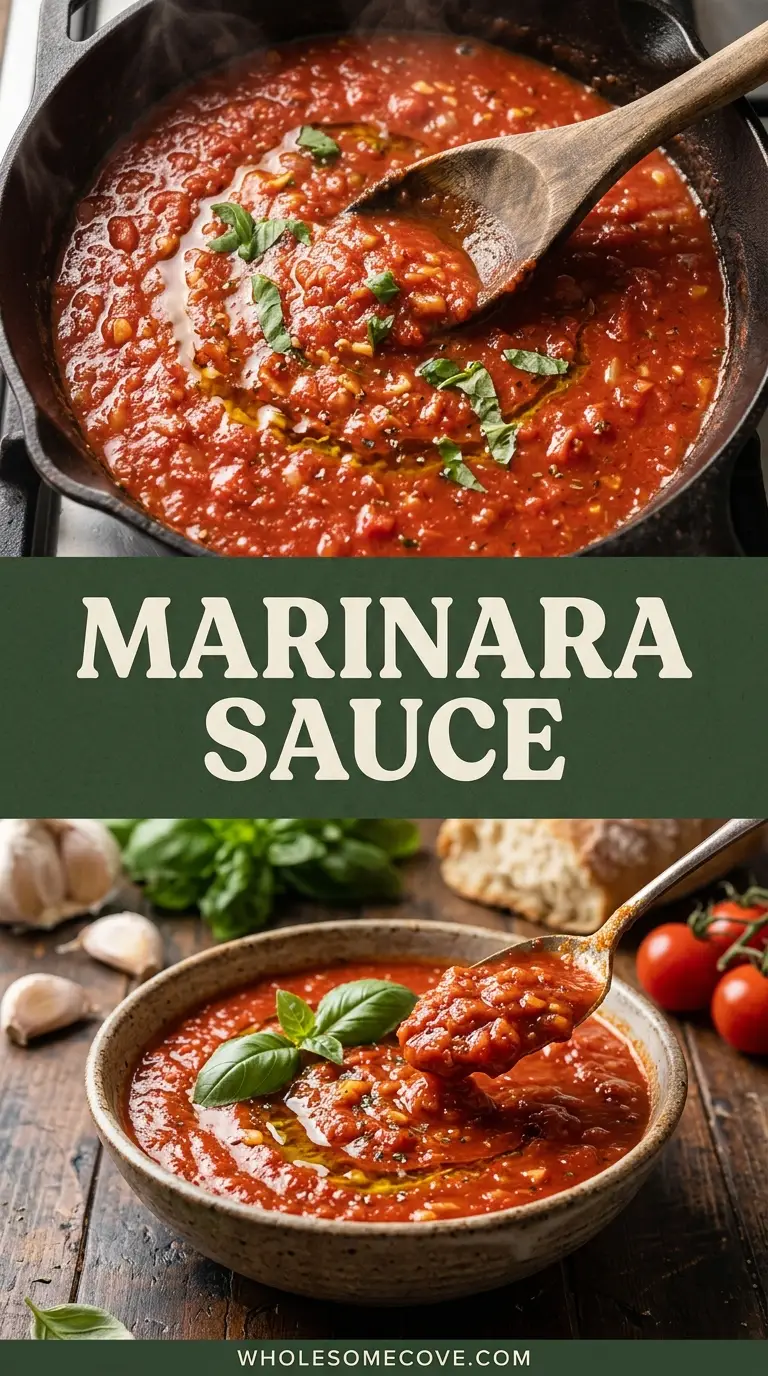
- The sauce is done when it mounds on a spoon, a spoon dragged across the bottom leaves a clear trail, and a thin sheen of oil shows at the edges.
6. Finish with Basil and Adjust the Flavor
- Turn off the heat and remove the bay leaf.
- Stir in the torn basil leaves.
- Taste the sauce. Add more salt a pinch at a time until the tomato flavor tastes bright.
- If the sauce tastes sharp, stir in 1/2 teaspoon of granulated sugar and simmer for 1 more minute. If it tastes balanced, skip the sugar.
- For a smooth sauce, blend with an immersion blender for 10 to 15 seconds. Leave it as is for a chunky sauce.
7. Serve or Store
- Serve the sauce warm over pasta, or use it in any recipe that calls for marinara.
- To store it, let the sauce cool at room temperature for no more than 30 minutes, then transfer it to airtight containers.
- Refrigerate within 2 hours of cooking.
Read Also: Bolognese Recipe
Tips for The Best Marinara Sauce
The difference between a flat sauce and a bright one usually comes down to a few small habits. These are the ones that matter most.
- Buy whole peeled tomatoes: They hold their flavor better than diced or pre-crushed tomatoes, and crushing them by hand gives you control over texture. Diced tomatoes often contain firming agents that keep them from breaking down.
- Look for San Marzano style on the label: A can labeled “DOP” from the San Marzano region is the real thing and tastes sweeter. Many “San Marzano style” cans are grown elsewhere but still taste better than basic canned tomatoes.
- Brown the tomato paste: One minute in hot oil turns it from raw and tinny to deep and sweet. Skipping this step makes a noticeably flatter sauce.
- Add the garlic last: Garlic burns in under a minute over medium heat, and burned garlic cannot be hidden. Thirty seconds is enough to cook off the raw edge.
- Salt in two stages: Salting the onion helps it release moisture and soften. Salting again with the tomatoes lets you season the whole pot properly.
- Simmer uncovered: A lid traps steam and keeps the sauce watery. Leaving the pot open lets it reduce and concentrate.
- Keep the simmer low: A hard boil sprays sauce everywhere and can scorch the bottom. You want bubbles that break slowly.
- Stir in basil at the end: Basil loses its fresh flavor and turns dark when cooked for long. Off the heat, it perfumes the sauce without cooking away.
- Taste before you add sugar: Better tomatoes often need none. Add only 1/2 teaspoon, and only if the sauce still tastes sharp.
- Use a good olive oil: The oil is a major flavor in a sauce with this few ingredients. A bland or stale oil makes the sauce taste dull.
A related recipe with a different flavor profile is Puttanesca Sauce Recipe, which uses olives and capers.
What to Make with Marinara Sauce
Marinara is a base rather than a finished dish, so its real value shows up in what you build with it. These are the best uses for a batch, from weeknight pasta to baked dinners.
- Spaghetti with meatballs: Simmer cooked meatballs in the sauce for 10 minutes, then spoon everything over spaghetti.
- Chicken Parmesan: Spoon warm marinara over breaded chicken cutlets and top with mozzarella before baking.
- Lasagna: Marinara works for the tomato layers between the noodles, cheese, and meat.
- Baked Ziti: Toss cooked pasta with the sauce and ricotta, then bake until the cheese melts and browns.
- Stuffed Shells: Spread a thin layer on the bottom of the dish and pour more over the filled shells.
- Eggplant Parmesan with Zucchini: The sauce layers between roasted vegetables and cheese in this lighter take on the classic.
- Shakshuka: Warm the sauce in a skillet, make small wells, and poach eggs right in it.
- Air Fryer Mozzarella Cheese Sticks: Warm a small bowl of marinara for dipping.
- Lasagna Soup: Marinara gives the broth its tomato richness and cuts down on prep time.
- Tomato Basil Mozzarella Flatbread Pizza: Thin the sauce slightly with water and spread it thinly as the pizza base.
- Baked Chicken Meatballs with Spaghetti Squash: Spoon the sauce over the meatballs and squash for a lower-carb dinner.
- Meatball subs: Pile meatballs and sauce onto toasted rolls and finish with melted provolone.
- Garlic bread or breadsticks: Serve a warm bowl of marinara alongside for dipping.
- Calzones: Use a spoonful of sauce inside and serve extra on the side.
If you want a meatier sauce next: Sunday Gravy Recipe
Variations of Marinara Sauce
This sauce is a solid starting point, and small changes shift it in very different directions. Each variation below changes only the ingredients listed.
- Arrabbiata-style: Increase the red pepper flakes to 1 teaspoon for a sauce with real heat.
- Red wine marinara: After the garlic cooks, add 1/4 cup (60 ml) of dry red wine and simmer for 2 minutes before adding the tomatoes.
- Smooth marinara: Blend the finished sauce with an immersion blender, or pass it through a food mill to remove the skins.
- Fresh tomato marinara: Replace the canned tomatoes with 2.5 pounds (1.1 kg) of ripe plum tomatoes that have been peeled and crushed, then simmer for 35 to 40 minutes.
- Sofrito-style marinara: Add 1 finely diced carrot and 1 finely diced celery stalk with the onion for a sweeter, rounder sauce.
- Meat marinara: Brown 1 pound (450 g) of ground beef or Italian sausage before the onion, then continue with the recipe.
- Creamy pink marinara: Stir 1/4 cup (60 ml) of heavy cream into the finished sauce and simmer for 2 minutes.
- Olive and caper marinara: Stir in 1/4 cup (about 40 g) of chopped olives and 1 tablespoon of capers with the tomatoes.
- Slow-simmered marinara: Cook the sauce on the lowest heat for 1 hour, stirring occasionally, for a thicker and deeper flavor.
- Roasted garlic marinara: Replace the raw garlic with 6 cloves of roasted garlic mashed into a paste and stirred in with the tomatoes.
Read Also: Amatriciana Sauce Recipe
Storage and Reheating
Marinara stores well, and the flavor often improves overnight as it rests. A few simple habits keep it safe and tasting fresh.
- Cool before storing: Let the sauce cool for no more than 30 minutes, then refrigerate it within 2 hours of cooking.
- Refrigerator: Store the sauce in an airtight container for up to 5 days at 40°F (4°C) or below.
- Freezer: Freeze in airtight containers or freezer bags for up to 3 months. Leave 1 inch (2.5 cm) of headspace in jars so the sauce can expand.
- Freeze in portions: I’ve found that freezing sauce in 1-cup (240 ml) zip-top bags laid flat thaws in about 10 minutes in warm water.
- Thawing: For the best texture, thaw in the refrigerator overnight, or use the warm water method for faster results.
- Stovetop reheating: Warm the sauce in a saucepan over medium-low heat for 5 to 8 minutes, stirring often. Add a splash of water if it has thickened.
- Microwave reheating: Cover the sauce and heat in 1-minute bursts, stirring between each, until hot all the way through.
- Signs of spoilage: Discard the sauce if it smells sour or off, looks fuzzy, or shows any mold.
- Canning note: Do not water-bath can this recipe as written. Canning tomato sauce safely requires added acid and a tested method, so follow USDA guidelines if you want shelf-stable jars.
A related way to use up tomato flavor is Tomato Soup Recipe.
Nutritional Facts
These values are estimates for one serving, which is 1/2 cup (120 ml) of sauce from a batch that makes six servings. Exact numbers vary with the brand of tomatoes and the amount of salt.
| Nutrition Per Serving (1/2 cup / 120 ml) | |
|---|---|
| Calories | 100 kcal |
| Total Fat | 7 g |
| Saturated Fat | 1 g |
| Total Carbohydrates | 8 g |
| Dietary Fiber | 2 g |
| Sugars | 5 g |
| Protein | 2 g |
| Sodium | 310 mg |
For a sauce with a different nutrition profile, try: Healthy Alfredo Sauce Recipe
Tips for Using Marinara Sauce Like a Pro
A good batch of marinara works harder when you handle it with a few cook’s habits. These tips cover thickness, seasoning, and fixes for common problems.
- Thin with pasta water: Stir in 1/4 cup (60 ml) of starchy pasta water at a time. The starch helps the sauce cling to the noodles.
- Finish the pasta in the sauce: Drain the pasta 1 minute early, then cook it in the sauce for 1 to 2 minutes so it absorbs flavor.
- Match the amount to the pasta: This batch of about 3 cups (720 ml) coats 1 pound (450 g) of dried pasta generously.
- Thin it for pizza: Stir in 1 to 2 tablespoons of water until it spreads easily, then use about 1/3 cup (80 ml) on a 12-inch (30 cm) pizza.
- Thicken it for lasagna: Simmer the sauce an extra 5 to 10 minutes so the layers do not turn watery in the oven.
- Warm it for dipping: Heat a small bowl until just hot, since cold sauce tastes flat and dull next to hot fried foods.
- Add a cheese rind: Drop a Parmesan rind into the pot during the simmer, then remove it before serving for a savory, nutty note.
- Fix a thin sauce: Simmer it uncovered for another 5 to 10 minutes, stirring often, until it mounds on a spoon.
- Fix a thick sauce: Stir in water 1 tablespoon at a time until it loosens.
- Fix a bland sauce: Add salt first, a pinch at a time. If it still tastes flat, add a little more oregano and simmer for 2 minutes.
- Fix a sharp sauce: Simmer for 5 to 10 more minutes, then add 1/2 teaspoon of sugar only if needed.
- Use it as a soup base: Thin 2 cups (480 ml) of marinara with 2 cups (480 ml) of broth for a quick tomato soup.
- Season at the end: Salt and herbs taste stronger as the sauce reduces, so make final adjustments after the simmer.
Read Also: Best Pasta Sauce Recipes
FAQs About Marinara Sauce
1. What Is the Difference Between Marinara Sauce and Spaghetti Sauce?
Marinara is a quick tomato sauce built on garlic, herbs, and olive oil. It usually simmers for under an hour.
Spaghetti sauce is a broader term. It often includes meat, vegetables, or a longer cook time.
2. Can I Use Marinara Sauce as Pizza Sauce?
Yes, with one small adjustment. Marinara is usually thicker than pizza sauce.
Stir in a splash of water or tomato juice until it spreads easily. Pizza sauce finishes cooking in the oven, so skip extra simmering.
3. How Long Does Homemade Marinara Sauce Last in the Fridge?
It lasts up to 5 days in an airtight container. Cool it first and refrigerate within 2 hours of cooking.
Keep the fridge at 40°F (4°C) or below. Homemade sauce has no preservatives, so discard it if it smells off or shows mold.
4. Can You Freeze Marinara Sauce?
Yes, for up to 3 months. Cool it completely and leave 1 inch (2.5 cm) of space in the container.
Thaw it in the fridge overnight. Reheat it gently on the stove.
5. Why Does My Marinara Taste Bitter or Acidic?
Bitterness usually comes from browned garlic. Acidity usually means the sauce needs more time or the tomatoes were low quality.
Simmer for another 5 to 10 minutes first. If it still tastes sharp, a pinch of sugar, about 1/2 teaspoon, rounds it off.
Once garlic has burned, the sauce cannot be saved. Start again with fresh oil and garlic.
6. Can I Use Fresh Tomatoes Instead of Canned?
Yes, but they take more work. Use about 2.5 pounds (1.1 kg) of ripe plum tomatoes.
Score them, blanch for 30 seconds, peel, and crush. Expect a simmer of 35 to 40 minutes because fresh tomatoes hold more water.
7. Is Marinara the Same as Tomato Sauce?
Not quite. Tomato sauce is a plain cooked tomato base, while marinara adds garlic, herbs, and olive oil.
Marinara is also usually chunkier and more seasoned. Tomato sauce is often used as an ingredient inside other recipes.
More sauces to try: Best Sauce Recipes
Marinara Sauce
Ingredients
- 3 tablespoons extra virgin olive oil - 45 ml; use one you would happily taste on bread
- 1 medium yellow onion - about 1 cup / 150 g, finely diced to about 1/4 inch (6 mm)
- 1 tablespoon tomato paste - 16 g; browning it in the oil adds depth and sweetness
- 4 cloves garlic - about 4 teaspoons / 12 g, minced fine
- 1 can whole peeled San Marzano tomatoes - 28 ounces / 794 g, with their juices
- 1 bay leaf - removed before serving
- 1 teaspoon dried oregano - rub between your fingers as you add it to release its oils
- 1/2 teaspoon fine salt - divided, plus more to taste; half with the onion, half with the tomatoes
- 1/4 teaspoon freshly ground black pepper - adds a mild background heat
- 1/4 teaspoon red pepper flakes - optional; added with the garlic, skip for a completely mild sauce
- 1/2 teaspoon granulated sugar - optional; stirred in at the end only if the sauce tastes sharp
- 1/2 cup fresh basil leaves - about 12 g, loosely packed, torn; added off the heat
Equipment
- Dutch oven or heavy-bottomed 3 to 4 quart saucepan - A heavy base spreads heat evenly and protects the tomato paste and garlic from scorching
- Wooden spoon - For scraping browned bits off the bottom and crushing tomato pieces
- Chef’s knife - For dicing the onion and mincing the garlic
- Immersion blender - (optional) For blending the sauce smooth right in the pot
- Glass storage jars - Wide-mouth jars with tight lids for leftovers
- Cutting board - Large enough to hold the diced onion
- Can opener - Needed for the tomatoes unless the can has a pull tab
- Large mixing bowl - For crushing the tomatoes by hand
- Measuring spoons and cups - For the oil, paste, and dried seasonings
Method
- Finely dice the onion to about 1/4 inch (6 mm) and set aside. Mince the garlic and keep it in a separate pile, since it goes in much later.
- Pour the canned tomatoes with their juices into a large bowl and crush each tomato by hand until no piece is bigger than a walnut, discarding any hard core or stem end. Tear the basil and set aside for the end.
- Set a 3 to 4 quart saucepan or Dutch oven over medium heat, add the olive oil, and heat about 1 minute until it shimmers. Add the onion and 1/4 teaspoon of the salt, stir to coat, and cook 6 to 8 minutes until soft and translucent with no brown edges.
- Push the onion to one side, add the tomato paste to the cleared space, and cook about 1 minute, stirring into the oil, until it darkens to a deeper brick color. Stir the paste into the onion, then add the garlic and red pepper flakes if using, and cook just 30 seconds, stirring constantly, until you smell the garlic.
- Pour in the crushed tomatoes and all their juices, scraping the bottom of the pot with a wooden spoon to lift any browned bits. Add the bay leaf, oregano rubbed between your fingers, the remaining 1/4 teaspoon salt, and the black pepper, then stir well and bring to a gentle boil over medium-high heat.
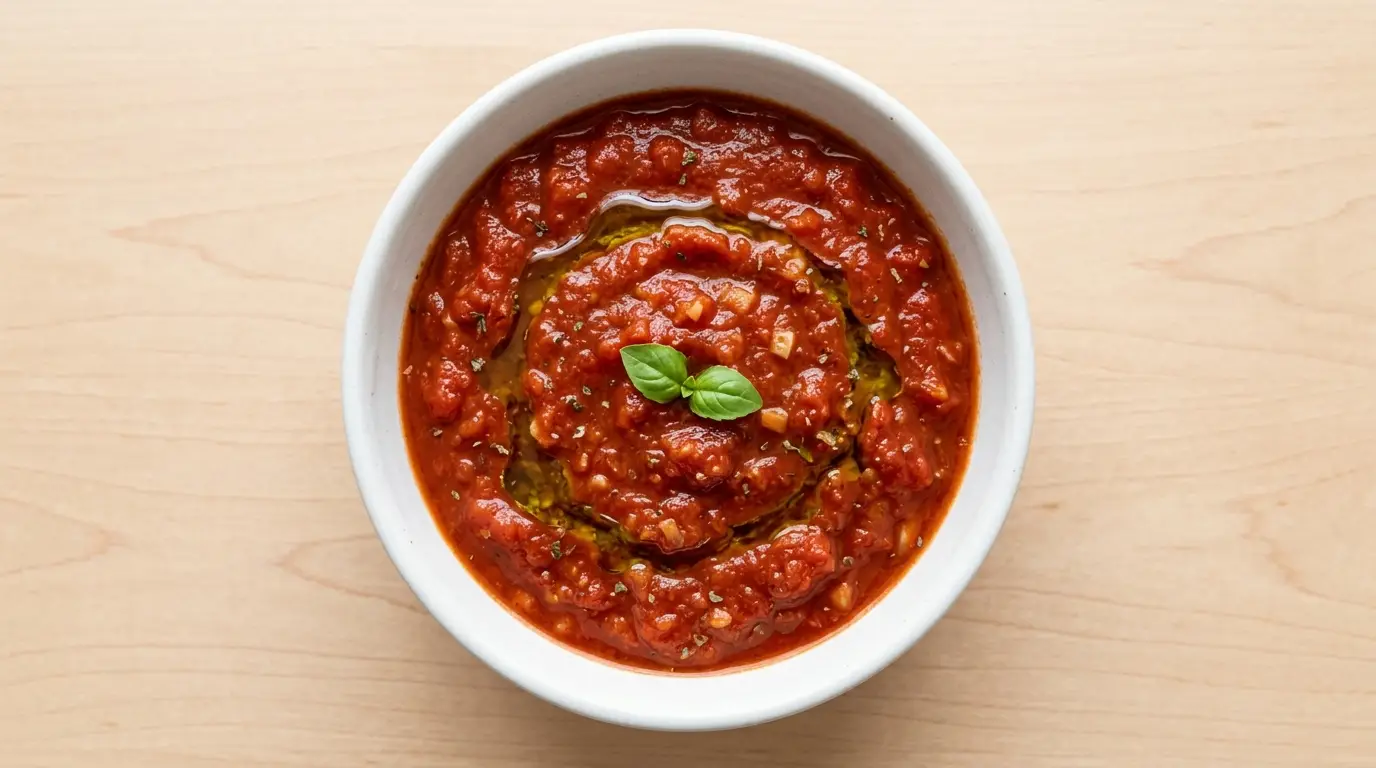
- Reduce the heat to low so the sauce bubbles lazily, and simmer uncovered for 25 minutes, stirring every 5 minutes and scraping the bottom each time. The sauce is done when it mounds on a spoon, a spoon dragged across the bottom leaves a clear trail, and a thin sheen of oil shows at the edges.
- Turn off the heat, remove the bay leaf, and stir in the torn basil. Taste and add salt a pinch at a time until the tomato flavor tastes bright; if it tastes sharp, stir in the sugar and simmer 1 more minute. Blend 10 to 15 seconds for a smooth sauce, or leave chunky.
- Serve warm over pasta or in any recipe that calls for marinara. To store, cool at room temperature for no more than 30 minutes, transfer to airtight containers, and refrigerate within 2 hours of cooking.
Nutrition
Notes
- Buy whole peeled tomatoes: They hold their flavor better than diced or pre-crushed tomatoes, and crushing them by hand gives you control over texture. Diced tomatoes often contain firming agents that keep them from breaking down.
- Look for San Marzano style on the label: A can labeled “DOP” from the San Marzano region is the real thing and tastes sweeter. Many “San Marzano style” cans are grown elsewhere but still taste better than basic canned tomatoes.
- Brown the tomato paste: One minute in hot oil turns it from raw and tinny to deep and sweet. Skipping this step makes a noticeably flatter sauce.
- Add the garlic last: Garlic burns in under a minute over medium heat, and burned garlic cannot be hidden. Thirty seconds is enough to cook off the raw edge.
- Salt in two stages: Salting the onion helps it release moisture and soften; salting again with the tomatoes lets you season the whole pot properly.
- Simmer uncovered and keep the heat low: A lid traps steam and keeps the sauce watery, while a hard boil sprays sauce everywhere and can scorch the bottom.
- Stir in basil at the end: Basil loses its fresh flavor and turns dark when cooked for long; off the heat, it perfumes the sauce without cooking away.
- Taste before you add sugar: Better tomatoes often need none. Add only 1/2 teaspoon, and only if the sauce still tastes sharp.
- Storage: Refrigerate in an airtight container for up to 5 days at 40°F (4°C) or below, or freeze for up to 3 months with 1 inch (2.5 cm) of headspace in jars.
- Canning note: Do not water-bath can this recipe as written. Canning tomato sauce safely requires added acid and a tested method, so follow USDA guidelines if you want shelf-stable jars.
Private Notes
Tried this recipe?
Let us know how it was!Final Thoughts
A pot of marinara sauce asks for very little and gives back a lot. Once you taste how bright it is next to a jarred sauce, it is hard to go back.
Make a batch this week and tell me in the comments how you served it. If you freeze a portion, share your favorite way to use it.
Recommended:
- Creamy Tomato Basil Soup Recipe
- Roasted Tomato Soup Recipe
- Pesto Recipe
- Healthy Pizza Dough Recipe
- Gorgonzola Cream Sauce Recipe
- Bechamel Sauce Recipe
- Pasta Fagioli Recipe
- Chicken Spaghetti Recipe
- Sourdough Focaccia Recipe