I started making this baked salmon with asparagus and lemon recipe on a whim one Tuesday evening when I had two salmon fillets thawing in the fridge and a bunch of asparagus that desperately needed to be used up. I had no grand plan, no special marinade, just garlic, butter, lemon, and a sheet pan.
Thirty minutes later, I had the most flavorful, flaky dinner I’d made all month.
That’s the magic of this dish. It looks impressive, smells incredible while it’s in the oven, and tastes like something you’d order at a nice seafood restaurant. But it’s genuinely one of the simplest weeknight meals you can pull off with minimal prep and almost no cleanup.
What really sold me on making it a regular was how forgiving it is. The first time I made it, I forgot to set a timer and left the salmon in about two minutes too long. It was still juicy, still delicious, still perfectly edible. That’s the kind of recipe I love having in my back pocket.
| Quick Recipe Summary | |
|---|---|
| Prep Time | 10 minutes |
| Cook Time | 15 minutes |
| Total Time | 25 minutes |
| Servings | 4 servings |
| Difficulty Level | Easy |
If you love easy seafood dinners, you’ll also want to bookmark this Grilled Salmon with Dill Sauce for nights when you’d rather fire up the grill.
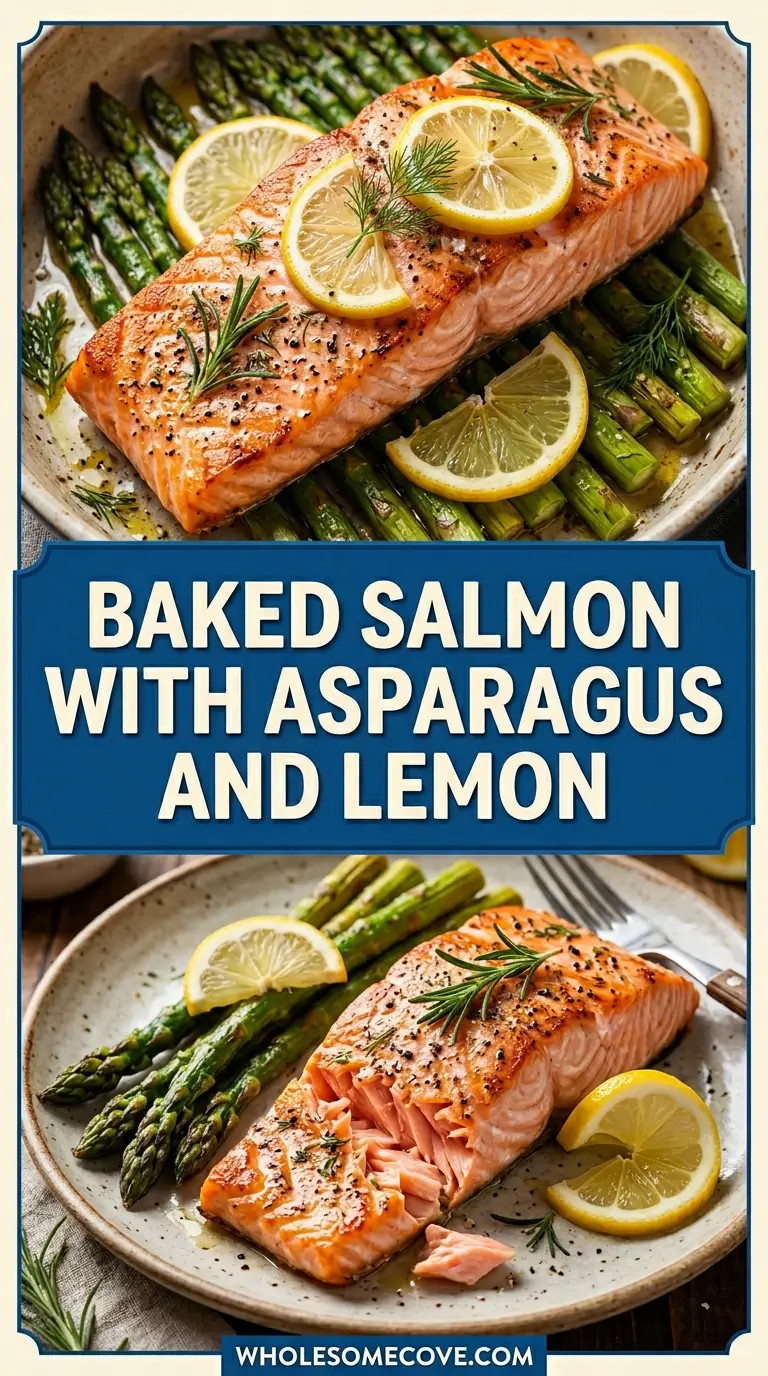
Why You’ll Love This Baked Salmon with Asparagus and Lemon Recipe
This dish has earned a permanent spot in my weekly rotation for so many reasons. It’s one of those rare recipes that checks every box without requiring you to be a seasoned cook.
It comes together in under 30 minutes, start to finish. That includes chopping, seasoning, and getting it in the oven.
Everything cooks on one sheet pan. No boiling, sautéing, or babysitting multiple pots.
The lemon garlic butter sauce does all the heavy lifting. It melts into the salmon as it bakes and coats every asparagus spear with bright, savory flavor.
It’s naturally gluten-free, low-carb, and high in protein. You feel good eating it, not weighed down.
The cleanup takes about three minutes. Line the pan with foil or parchment and the hardest part is tossing it in the trash.
It’s incredibly easy to scale up. Making dinner for two? Four? Six? Just add more fillets and adjust the asparagus accordingly.
The leftovers are fantastic. Cold the next day over a salad, flaked into pasta, or reheated gently for lunch.
You can customize it endlessly. Swap herbs, add spice, use different sauces, and the base recipe still shines through.
Read Also: Air Fryer Salmon Recipe
Ingredients
A few quality ingredients go a long way here. The key is using fresh salmon fillets and real lemon juice, because this recipe is simple enough that those flavor differences really show.
- 4 salmon fillets (about 6 oz / 170 g each), skin-on or skinless
- 1 lb (450 g) fresh asparagus, woody ends trimmed
- 3 tablespoons unsalted butter, softened (or melted)
- 2 tablespoons extra virgin olive oil
- 4 cloves garlic, minced
- 2 tablespoons fresh lemon juice (from about 1 lemon)
- 1 teaspoon lemon zest
- 1 lemon, sliced into thin rounds
- 1 teaspoon dried Italian seasoning (or a mix of dried thyme, parsley, and oregano)
- 1/2 teaspoon smoked paprika
- 1/2 teaspoon garlic powder
- Salt and freshly ground black pepper, to taste
- 2 tablespoons fresh parsley, chopped (for garnish)
This pairs beautifully with my Lemon Garlic Shrimp over Couscous if you’re building out a full seafood spread for guests.
Kitchen Equipment Needed
You don’t need anything fancy to pull this off. Most of these tools are probably already in your kitchen.
- Large rimmed baking sheet (18×13 inch / 46×33 cm)
- Aluminum foil or parchment paper (for lining the pan)
- Small mixing bowl (for the garlic butter sauce)
- Instant-read thermometer (to check doneness)
- Sharp knife and cutting board
- Zester or microplane (for lemon zest)
- Pastry brush or spoon (to coat salmon with sauce)
- Tongs (for handling asparagus)
- Paper towels (to pat salmon dry)
Read Also: Old Fashioned Salmon Patties Recipe
Recommended Products for This Recipe
These are tools and ingredients I personally rely on every time I make this dish, and they genuinely make a difference in the outcome.
1. Wild-Caught Salmon Fillets (Frozen, Individually Wrapped)
Having individually frozen wild-caught salmon fillets in the freezer is a total weeknight lifesaver. Wild salmon has a richer flavor and firmer texture than farmed, and it holds up beautifully to baking without drying out. Just thaw overnight in the fridge and you’re good to go.
2. Heavy-Duty Rimmed Sheet Pan (Half Sheet)
A quality half sheet pan distributes heat more evenly than thin, cheap pans that warp in the oven. Warping causes uneven cooking, and on a dish this simple, that matters. I use mine almost every day.
3. Microplane Fine Zester
Getting lemon zest into the butter sauce adds a whole extra layer of bright, citrusy flavor that juice alone doesn’t give you. A Microplane zester makes this effortless and gets every bit of flavor from the peel without the bitterness of the white pith.
4. Instant-Read Digital Thermometer
Overcooked salmon is dry and unpleasant, while undercooked salmon is unsafe. An instant-read thermometer takes all the guesswork out of it. You’re aiming for an internal temperature of 125–130°F (52–54°C) for medium or 145°F (63°C) for fully cooked.
You might also enjoy: Blackened Fish with Pineapple Salsa
_result.jpg "Baked Salmon with Asparagus and Lemon Recipe – Fresh and Light Dinner")
Step-by-Step Instructions: How to Make Baked Salmon with Asparagus and Lemon
Step 1: Preheat the Oven and Prepare the Pan
- Set your oven to 400°F (200°C) and allow it to fully preheat before you put anything in. A properly heated oven is essential for salmon to cook evenly and quickly.
- Line a large rimmed baking sheet with aluminum foil or parchment paper. Make sure the lining covers the entire surface and comes up the edges slightly to catch any butter or juices.
- Lightly coat the lined pan with a drizzle of olive oil or a quick spray of cooking spray. This prevents sticking, especially if you’re using skinless salmon fillets.
Step 2: Make the Lemon Garlic Butter Sauce
- In a small bowl, combine 3 tablespoons of softened butter with 4 minced garlic cloves, 2 tablespoons of fresh lemon juice, and 1 teaspoon of lemon zest.
- Add 1 teaspoon of dried Italian seasoning and 1/2 teaspoon of smoked paprika. Season with a good pinch of salt and freshly ground black pepper.
- Stir everything together with a fork until well combined. The mixture should form a thick, spreadable paste. If the butter is too firm, microwave it for 5 seconds at a time until it softens but isn’t fully melted.
- Taste it. It should be bright, garlicky, and slightly salty. Adjust with more lemon juice or salt as needed.
Step 3: Prep the Salmon Fillets
- Remove the salmon from the fridge about 10 minutes before cooking so it’s not ice cold when it hits the oven. Cold fish straight from the fridge can cook unevenly.
- Pat each salmon fillet dry with paper towels on both sides. This is one of the most important steps that most people skip. Removing surface moisture helps the fish develop a slightly firmer exterior and allows the butter sauce to stick properly rather than sliding off.
- Season the salmon with a pinch of salt, freshly ground black pepper, and 1/2 teaspoon garlic powder on all sides.
- Place the fillets in the center of the lined baking sheet, spaced about 1 inch (2.5 cm) apart to allow hot air to circulate around each one.
Step 4: Prep the Asparagus
- Hold each asparagus spear near the bottom and gently bend it. It will naturally snap at the point where the tough, woody end begins. Alternatively, line up the bunch and trim about 1 inch (2.5 cm) off the bottom ends with a knife.
- Place the trimmed asparagus on the baking sheet, arranging them around the salmon fillets in a single layer. They should be in one layer with no overlapping so they roast evenly rather than steam.
- Drizzle the asparagus with 2 tablespoons of olive oil and toss gently to coat. Season with salt and freshly ground black pepper.
- Nestle 2-3 lemon slices among the asparagus spears. As the lemon heats, it releases juice that gently flavors the asparagus.
Step 5: Apply the Butter Sauce to the Salmon
- Using a spoon, pastry brush, or your fingers, spread the lemon garlic butter mixture generously over the top of each salmon fillet. Press it gently so it adheres rather than just sitting on top.
- Make sure each fillet gets an even coating. Don’t skip the edges of the fillets.
- Place one or two lemon slices on top of each salmon fillet. These will slightly caramelize in the oven and look beautiful when you serve the dish.
Step 6: Bake the Salmon and Asparagus
- Slide the sheet pan into the preheated 400°F (200°C) oven on the center rack.
- Bake for 12 to 15 minutes, depending on the thickness of your salmon fillets. A good rule of thumb is 10 minutes per 1 inch (2.5 cm) of thickness at the thickest point.
- Check for doneness at 12 minutes. The salmon should be opaque throughout, flake easily when gently pressed with a fork, and register 125–130°F (52–54°C) at the center for medium doneness, or 145°F (63°C) for fully cooked per USDA guidelines.
- The asparagus should be tender with slightly browned, crispy tips at this point. If the tips look like they need more color, you can continue to the next step.
Step 7: Optional Broil for Extra Color
- If you want a golden, slightly caramelized top on the salmon and crispier asparagus tips, switch the oven to broil on high.
- Place the pan on the top rack and broil for 2 to 3 minutes, watching very closely the entire time. Broilers work fast and things can go from golden to burned in under a minute.
- Pull the pan as soon as you see the salmon develop a light golden sheen and the asparagus tips begin to char slightly at the edges.
Step 8: Rest, Garnish, and Serve
- Remove the baking sheet from the oven and allow the salmon to rest for 3 to 5 minutes before serving. This resting period lets the juices redistribute inside the fish, keeping it moist all the way through.
- While it rests, chop fresh parsley finely. Sprinkle it generously over the salmon and asparagus just before serving.
- Squeeze a little extra fresh lemon juice over the top right before plating for a final pop of brightness. Serve immediately while the butter sauce is still warm and glossy.
For another healthy and impressive fish dinner, check out this Baked Cod with Mango Salsa.

Tips for The Best Baked Salmon with Asparagus and Lemon
These are the lessons I’ve picked up from making this recipe countless times. Some of them I learned the hard way, so you don’t have to.
- Always pat the salmon dry. Wet fish creates steam in the oven instead of roasting. Use a paper towel and press firmly on all sides before seasoning.
- Don’t skip the lemon zest. Lemon juice adds acidity, but zest contains the aromatic oils that make the dish smell and taste truly bright and fresh.
- Use room-temperature butter for the sauce. Softened butter blends with garlic and lemon more easily than cold or fully melted butter, creating a creamier, thicker coating.
- Choose salmon fillets of similar thickness. When cooking multiple fillets, try to select pieces that are similar in size so they all finish at the same time.
- Use fresh garlic, not garlic powder. The minced garlic in the butter sauce creates real depth that garlic powder simply can’t replicate. The garlic powder in the dry seasoning adds a base, but fresh garlic is the star.
- Trim asparagus properly. Woody ends are genuinely tough and unpleasant to eat. Snap or cut them off completely every time.
- Don’t overcrowd the pan. Salmon fillets and asparagus need space around them for the oven heat to circulate. If you’re making a larger batch, use two pans.
- Use an instant-read thermometer. Visual cues can be deceiving with salmon. A thermometer gives you certainty.
- Rest before serving. Just 3 to 5 minutes of resting makes a noticeable difference in how moist and juicy the salmon stays.
- Thin asparagus cooks faster. If your asparagus spears are thin, add them to the pan halfway through baking rather than at the start, or they’ll overcook before the salmon is done.
- Don’t open the oven during baking. Every time you open the door, the oven temperature drops by 25 to 50 degrees. Let it do its job undisturbed.
Another favorite weeknight dinner: Summer Vegetable Stir Fry
What to Serve with Baked Salmon with Asparagus and Lemon
This dish is already a complete meal with the asparagus built right in, but it pairs wonderfully with a variety of sides depending on what you’re in the mood for.
A starchy side soaks up that extra lemon garlic butter sauce and rounds out the plate.
- Mashed Potatoes — creamy, buttery, and a perfect base for the pan drippings
- Roasted Potatoes — crispy and golden, they hold up well alongside the flaky salmon
- Healthy Mashed Potatoes — lighter version that still feels comforting
- Roasted Sweet Potato — the sweetness pairs beautifully with the lemon and garlic
- Steamed white or brown rice — simple and absorbs all the butter sauce
- Lemon orzo or couscous — pasta-like and easy to toss with a little olive oil
- Creamed Spinach — rich and savory, a classic steakhouse-style pairing
- Healthy Coleslaw — cool and crunchy, great for a lighter meal
- Broccoli Salad — hearty and fresh with a slightly sweet dressing
- Dinner Rolls — soft and fluffy for soaking up every drop of sauce
- Deviled Eggs — a fun appetizer if you’re serving this for company
Read Also: Grilled Vegetable Skewers Recipe
Variations of Baked Salmon with Asparagus and Lemon
The base recipe is incredibly versatile. These variations are easy swaps that change the flavor profile without changing the simple sheet pan method.
- Honey Dijon version: Whisk together 1 tablespoon Dijon mustard and 1 tablespoon honey with the butter and lemon. The mustard adds tang and the honey creates a beautiful glaze.
- Mediterranean style: Add 1 teaspoon dried oregano, a handful of halved cherry tomatoes, and a few olives to the pan. Top with crumbled feta after baking.
- Garlic herb cream sauce: Replace the butter mixture with a combination of softened cream cheese, garlic, and fresh dill for a richer coating.
- Spicy version: Add 1/4 to 1/2 teaspoon of cayenne pepper or red pepper flakes to the butter mixture for a gentle heat that balances the lemon.
- Teriyaki style: Swap the lemon and herbs for a mixture of soy sauce, honey, sesame oil, and fresh ginger for an Asian-inspired take.
- Pesto salmon: Spread a generous layer of basil pesto over each fillet instead of the butter sauce. The herbaceous flavor is incredible with roasted asparagus.
- Foil packet version: Wrap each salmon fillet and a portion of asparagus in individual foil packets with the butter sauce sealed inside. This traps all the steam and makes the fish extra moist and tender.
- Dairy-free version: Replace the butter with extra olive oil and a tablespoon of tahini whisked into the lemon garlic sauce.
You might also enjoy: Salmon Chowder
Storage and Reheating
Proper storage keeps your leftovers tasting great the next day rather than dry and rubbery.
- Refrigerator: Store leftover salmon and asparagus in an airtight container in the refrigerator for up to 3 days. Keep them together or separate, depending on how you plan to use the leftovers.
- Freezer: Cooked salmon can be frozen for up to 2 months in a freezer-safe container or zip-lock bag. The asparagus doesn’t freeze as well and can become mushy after thawing, so freeze the salmon separately if possible.
- Reheating in the oven: Preheat the oven to 275°F (135°C). Place the salmon on a foil-lined baking sheet and cover loosely with foil. Heat for 10 to 15 minutes until just warmed through. This gentle method preserves moisture better than high heat.
- Reheating in a skillet: Warm a non-stick skillet over medium-low heat with a small amount of butter or olive oil. Add the salmon and cover with a lid. Heat for 3 to 4 minutes, flipping gently once, until warmed through.
- Microwave (quick option): Place salmon in a microwave-safe dish with a splash of water. Cover with a damp paper towel and heat on 50% power in 30-second intervals until warm. This prevents overcooking.
- Serving cold: Cold leftover salmon is genuinely delicious. Flake it over a salad, stuff it into a wrap, or mix it with cream cheese for a quick salmon spread.
- Do not reheat more than once. Reheating multiple times dries out the fish quickly and can cause food safety concerns.
Read Also: Salmon Croquettes Soul Food Recipe
Nutritional Facts
Values are approximate and based on 1 serving (1 salmon fillet with a portion of asparagus and butter sauce). Actual values may vary based on exact ingredients and portion sizes.
| Nutritional Facts (Per Serving) | |
|---|---|
| Calories | 390 kcal |
| Total Fat | 24 g |
| Saturated Fat | 7 g |
| Monounsaturated Fat | 10 g |
| Polyunsaturated Fat | 5 g |
| Cholesterol | 95 mg |
| Sodium | 380 mg |
| Total Carbohydrates | 7 g |
| Dietary Fiber | 3 g |
| Total Sugars | 2 g |
| Protein | 34 g |
| Omega-3 Fatty Acids | 2,100 mg |
| Vitamin D | 18 mcg (90% DV) |
| Vitamin B12 | 3.4 mcg (142% DV) |
| Potassium | 920 mg (20% DV) |
| Selenium | 42 mcg (76% DV) |
| Vitamin C | 12 mg (13% DV) |
| Iron | 3 mg (17% DV) |
| Calcium | 65 mg (5% DV) |
For a complete healthy seafood dinner collection, browse these Easy Healthy Dinner Recipes for Family.
Health Benefits of Key Ingredients
This dish isn’t just delicious — it’s genuinely nutritious, and the ingredients each bring real benefits to the table.
Salmon, asparagus, lemon, garlic, and olive oil are a powerhouse combination for anyone looking to eat well without sacrificing flavor.
- Salmon is one of the richest dietary sources of omega-3 fatty acids, which support heart health, brain function, and inflammation reduction. A single serving provides over 2 grams of omega-3s, along with a full day’s supply of vitamin D and vitamin B12.
- Asparagus is packed with folate, vitamins K, A, and C, and is a natural prebiotic, supporting a healthy gut microbiome. It’s also one of the best plant sources of chromium, which helps regulate blood sugar.
- Garlic contains allicin, a compound shown to support immune function, reduce blood pressure, and have antibacterial properties. Using fresh garlic in this dish maximizes those benefits.
- Lemon provides vitamin C, which boosts iron absorption from the asparagus and other plant-based ingredients in the dish. The citric acid also aids digestion.
- Olive oil is a cornerstone of the Mediterranean diet and is associated with reduced risk of heart disease, improved cholesterol levels, and powerful anti-inflammatory effects thanks to its polyphenol content.
- Butter (in moderation) supplies fat-soluble vitamins A, D, E, and K2, as well as butyrate, a short-chain fatty acid that supports gut health.
- Fresh parsley garnish adds a small but meaningful boost of vitamin K, folate, and antioxidants like lutein and zeaxanthin, which support eye health.
Another wholesome seafood option worth trying is this Seafood Chowder.
FAQs About Baked Salmon with Asparagus and Lemon
1. What temperature should I bake salmon at?
The sweet spot for baking salmon is 400°F (200°C). This temperature cooks the fish through in 12 to 15 minutes while giving the exterior a subtle roasted finish without drying out the center.
Higher temperatures like 425°F (220°C) work well too and reduce cook time slightly, but require more attention. Lower temperatures like 275°F (135°C) are ideal for reheating, not initial cooking.
2. How do I know when the salmon is done?
The most reliable method is to use an instant-read thermometer. The internal temperature should reach 125–130°F (52–54°C) for a medium, slightly translucent center, or 145°F (63°C) for fully cooked per USDA guidelines.
Visually, cooked salmon will be opaque all the way through and will flake easily when gently pressed with a fork. If it resists flaking, it needs a bit more time.
3. Can I use frozen salmon for this recipe?
Yes, but you should thaw it completely first for the best results. The safest way is to thaw it overnight in the refrigerator.
If you’re short on time, you can place the sealed salmon in a bowl of cold water for 30 to 45 minutes. Never thaw seafood at room temperature. After thawing, pat the fillets very dry before seasoning.
4. Do I need to remove the skin before baking?
You don’t have to. Skin-on salmon is easier to handle and the skin acts as a natural barrier that keeps the flesh moist during baking. It peels off easily after cooking.
If you prefer skinless salmon, most fishmongers will remove it for you at the counter. Just note that skinless fillets can be slightly more delicate and may require a gentler touch when removing them from the pan.
5. Can I prep this recipe ahead of time?
You can make the lemon garlic butter sauce up to 2 days ahead and store it in the refrigerator in an airtight container. Trim and store the asparagus in the fridge wrapped in a damp paper towel for up to 3 days.
It’s best not to season the salmon more than 1 to 2 hours in advance, as salt can begin to draw out moisture from the fish if left too long. Assemble and bake fresh for the best texture.
Read Also: Asparagus Soup Recipe
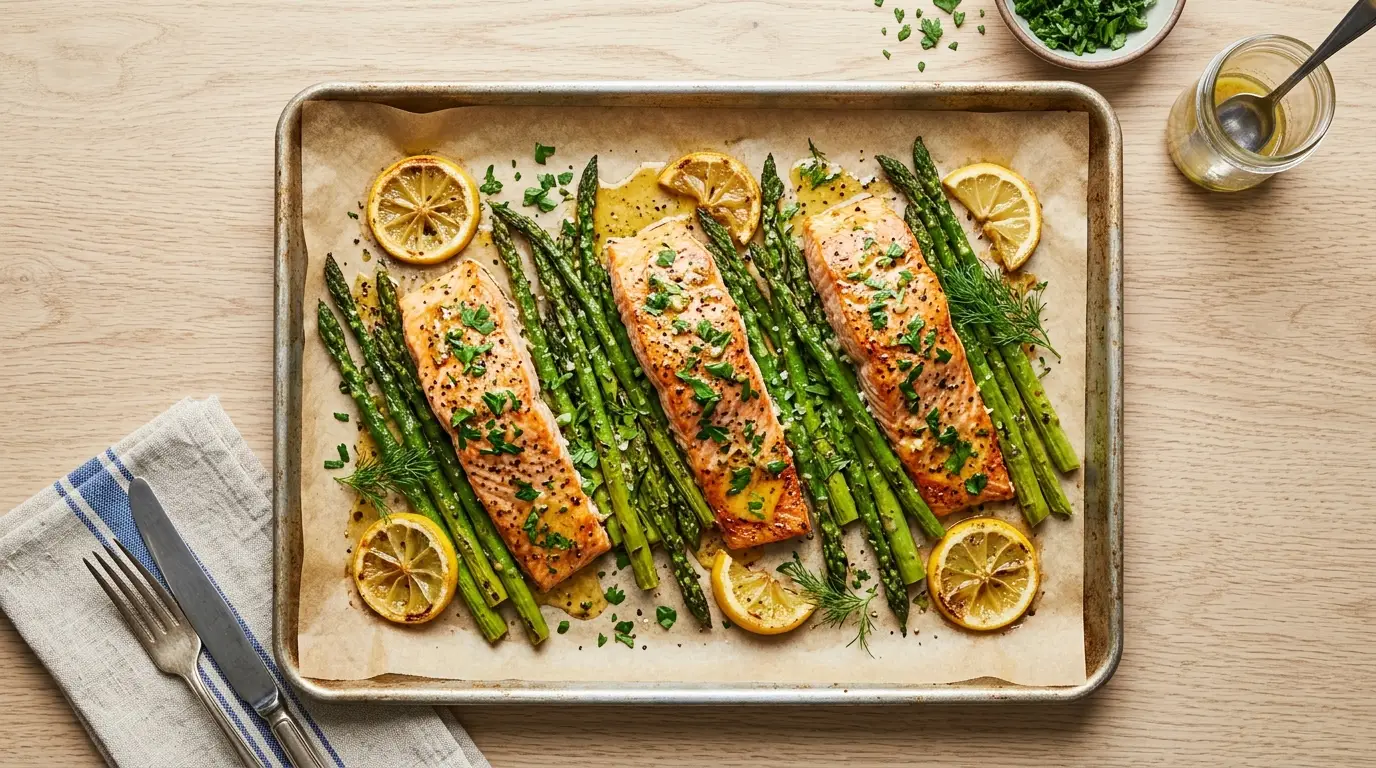
Baked Salmon with Asparagus and Lemon
Ingredients
- 4 salmon fillets - about 6 oz (170g) each, skin-on or skinless
- 1 lb fresh asparagus - 450g, woody ends trimmed
- 2 tbsp extra virgin olive oil - divided — for asparagus and pan
- 1 lemon - sliced into thin rounds, for topping
- 3 tbsp unsalted butter - softened (not melted)
- 4 cloves garlic - minced
- 2 tbsp fresh lemon juice - from about 1 lemon
- 1 tsp lemon zest - from about half a lemon
- 1 tsp dried Italian seasoning - or a mix of dried thyme, parsley, and oregano
- 1/2 tsp smoked paprika
- 1/2 tsp garlic powder - for dry seasoning on salmon
- salt - to taste
- freshly ground black pepper - to taste
- 2 tbsp fresh parsley - finely chopped
Equipment
- Large rimmed baking sheet - 18×13 inch (46×33 cm) half sheet pan
- Aluminum foil or parchment paper - For lining the baking sheet
- Small mixing bowl - For making the lemon garlic butter sauce
- Instant-read thermometer - To check internal temperature of salmon
- Sharp knife and cutting board - For slicing lemon and trimming asparagus
- Zester or microplane - For zesting the lemon
- Pastry brush or spoon - For coating salmon with butter sauce
- Tongs - For handling and arranging asparagus on the pan
- Paper towels - For patting salmon dry before seasoning
Method
- Preheat oven to 400°F (200°C). Line a large rimmed baking sheet with aluminum foil or parchment paper and lightly grease the surface with olive oil or cooking spray.
- In a small bowl, combine softened butter, minced garlic, lemon juice, lemon zest, Italian seasoning, smoked paprika, salt, and pepper. Stir with a fork until a thick, spreadable paste forms.
- Pat salmon fillets dry with paper towels on all sides, then season with salt, black pepper, and garlic powder. Place fillets in the center of the prepared baking sheet, spaced about 1 inch (2.5 cm) apart.
- Trim the woody ends from the asparagus by snapping or cutting off about 1 inch (2.5 cm) from the bottom. Arrange in a single layer around the salmon, drizzle with olive oil, season with salt and pepper, and nestle 2–3 lemon slices among the spears.
- Spread the lemon garlic butter sauce generously over the top and sides of each salmon fillet, then place one or two lemon slices on top of each piece.
- Bake on the center rack for 12–15 minutes, until the salmon flakes easily with a fork and registers 125–130°F (52–54°C) for medium or 145°F (63°C) for fully cooked, and the asparagus is tender.
- For a golden top, switch the oven to high broil and place the pan on the top rack for 2–3 minutes, watching closely until the salmon develops a light golden sheen and the asparagus tips begin to crisp.
- Rest the salmon for 3–5 minutes, then sprinkle with fresh chopped parsley and a final squeeze of lemon juice. Serve immediately while the butter sauce is warm and glossy.
Nutrition
Notes
- Always pat salmon fillets completely dry with paper towels before seasoning — surface moisture creates steam instead of roasting and prevents the butter sauce from adhering properly.
- Use softened (not melted) butter for the sauce so it blends smoothly with the garlic and lemon into a thick paste that coats the fish evenly.
- Choose salmon fillets of similar thickness so they all finish cooking at the same time. A good rule of thumb is 10 minutes per 1 inch (2.5 cm) of thickness at 400°F (200°C).
- If your asparagus spears are very thin, add them to the pan halfway through baking rather than at the start to prevent overcooking before the salmon is done.
- Use a digital instant-read thermometer to check doneness: 125–130°F (52–54°C) for a medium, slightly translucent center; 145°F (63°C) for fully cooked per USDA guidelines.
- For extra richness, substitute the butter sauce with a honey Dijon glaze: whisk 1 tablespoon Dijon mustard and 1 tablespoon honey with the lemon and garlic before spreading on the fillets.
- Store leftovers in an airtight container in the refrigerator for up to 3 days. Reheat gently in a 275°F (135°C) oven covered with foil for 10–15 minutes to preserve moisture.
- Cooked salmon can be frozen for up to 2 months. Freeze without the asparagus, which becomes mushy after thawing. Thaw overnight in the refrigerator before reheating.
- To make ahead, prepare the lemon garlic butter sauce up to 2 days in advance and refrigerate. Trim and store asparagus in the fridge for up to 3 days. Season and bake the salmon fresh for best texture.
- For a dairy-free version, replace the butter with extra olive oil and 1 tablespoon of tahini whisked into the lemon garlic mixture.
Private Notes
Tried this recipe?
Let us know how it was!Final Thoughts
This baked salmon with asparagus and lemon recipe is one of those rare dinner wins that I genuinely look forward to making. It’s fast enough for a rushed weeknight and elegant enough to serve to guests without any embarrassment.
The combination of garlicky lemon butter, tender flaky salmon, and roasted asparagus is just timeless. It never gets old no matter how many times I make it.
If you’ve never made sheet pan salmon before, this is absolutely the place to start. You’ll be amazed at how much flavor comes from such a straightforward method.
Give it a try this week, and let me know in the comments how it turned out for you. Did you stick to the classic version, or did you try one of the variations?
I’d love to see your photos. Tag me or drop a comment below!
Recommended:
- Grilled Salmon with Dill Sauce Recipe
- Air Fryer Salmon Recipe
- Baked Cod with Mango Salsa Recipe
- Blackened Fish with Pineapple Salsa Recipe
- Seafood Stew Recipe
- Shrimp and Avocado Salad Recipe
- Lemon Chicken Soup Recipe
- Summer Dinner Recipes
- Healthy Chicken Parmesan Recipe
- Grilled Lemon Herb Chicken Recipe