A good ratatouille recipe rewards a little patience. This one leans on the step most home cooks skip.
Each vegetable browns on its own before they share a pot. That habit keeps the eggplant and zucchini distinct instead of gray and soft.
Most versions turn watery because everything goes in at once. The pieces steam in a crowded pan rather than caramelize.
Here the eggplant gets salted first, and the peppers and onion soften slowly. The tomatoes cook into a base that coats the vegetables instead of flooding them.
Herbes de Provence and torn basil bring the scent of southern France. A splash of red wine vinegar at the end keeps the sweetness balanced.
It comes together in under an hour and a half and serves six.
Ripe summer produce makes it sing, and good canned San Marzano tomatoes carry it through the rest of the year.
| Quick Recipe Summary | |
|---|---|
| Prep Time | 30 minutes |
| Cook Time | 50 minutes |
| Total Time | 1 hour 20 minutes |
| Servings | 6 servings |
| Difficulty Level | Easy |
Read Also: Eggplant Parmesan With Zucchini
Why You’ll Love This Ratatouille Recipe
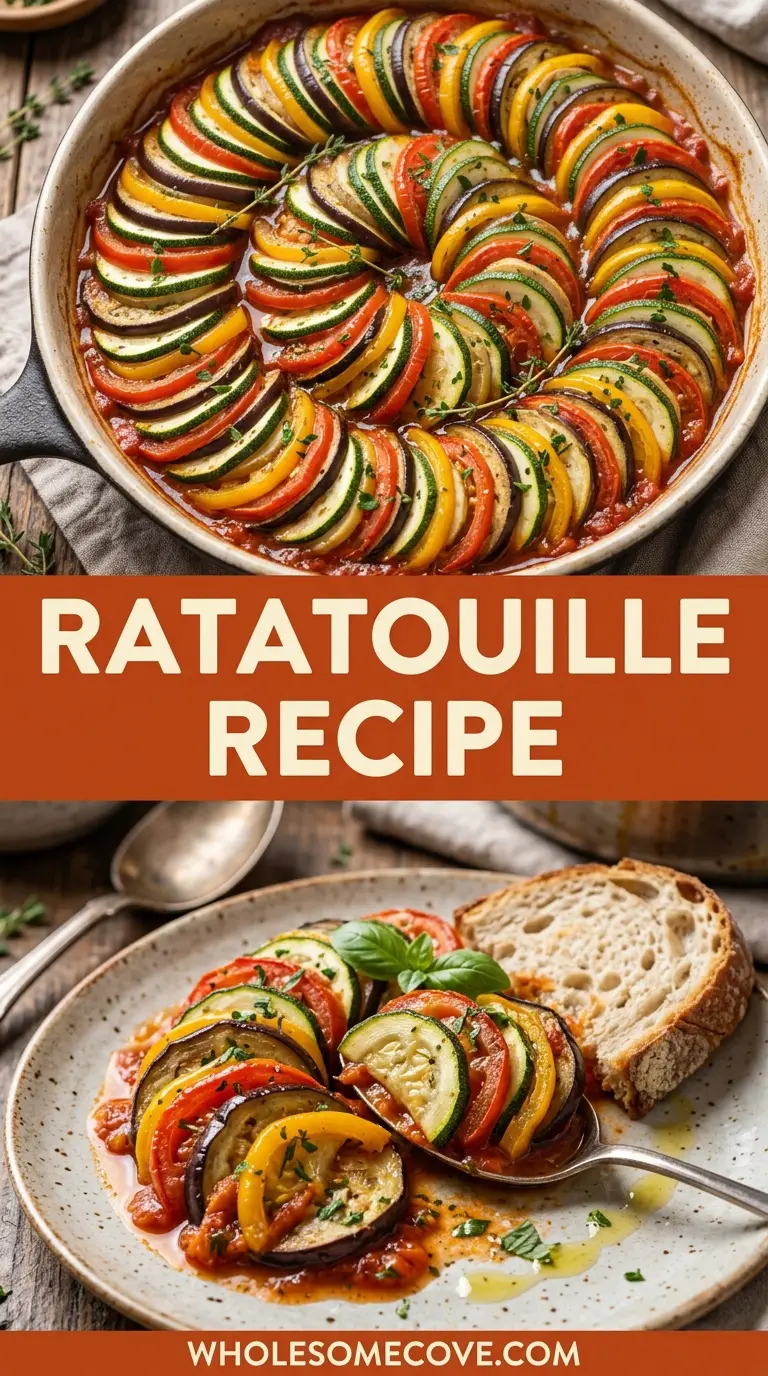
This is the rustic, stewed version French families actually cook, not the fancy fanned-out restaurant plate. It is forgiving, flexible, and better the next day.
Here is what makes it worth the pot and the little bit of knife work:
- It stays glossy, not soupy. Salting the eggplant and browning the vegetables in stages pulls out excess water before it can pool in the dish.
- Every vegetable keeps its identity. The peppers stay sweet, the zucchini keeps a slight bite, and the eggplant turns silky instead of dissolving.
- It works year round. Fresh summer tomatoes are ideal, but a can of San Marzano tomatoes makes it just as good in winter.
- It is naturally vegan and gluten free. No dairy, no flour, no compromise on flavor.
- It stretches across meals. Serve it warm as a side, spoon it over rice as a main, or eat it cold the next day.
- It scales easily. Double the batch in a large Dutch oven and freeze half for later.
- The flavor deepens overnight. A rest in the fridge lets the herbs and tomato settle into every piece.
You’ll Love: French Onion Soup is another French classic built on slow-cooked aromatics if you want to keep the theme going.
Ingredients
The vegetables here are simple, but ripeness matters more than anything else. Choose firm, glossy eggplant and zucchini, and use the best tomatoes you can find. Below are both imperial and metric measures.
- 1 large eggplant (about 1 lb / 450 g), cut into 3/4-inch (2 cm) cubes
- 2 medium zucchini (about 1 lb / 450 g total), cut into 3/4-inch (2 cm) half-moons
- 1 red bell pepper, seeded and cut into 3/4-inch (2 cm) pieces
- 1 yellow bell pepper, seeded and cut into 3/4-inch (2 cm) pieces
- 1 large yellow onion, diced
- 4 garlic cloves, minced
- 1 can (28 oz / 800 g) whole peeled San Marzano tomatoes, hand-crushed (or 1.5 lb / 700 g fresh ripe tomatoes, chopped)
- 2 tablespoons (30 g) tomato paste
- 1/3 cup (80 ml) extra virgin olive oil, divided
- 2 teaspoons dried herbes de Provence
- 1 bay leaf
- 1/4 cup (10 g) fresh basil leaves, torn
- 1 teaspoon kosher salt, plus more for salting the eggplant
- 1/2 teaspoon black pepper
- 1 tablespoon (15 ml) red wine vinegar, optional, to finish
You might also enjoy: Grilled Vegetable Skewers
Kitchen Equipment Needed
Nothing here is specialized, but a wide, heavy pan makes a real difference. Room to spread the vegetables is what lets them brown instead of steam.
- Large Dutch oven or wide, heavy-bottomed pot with a lid
- Large skillet or sauté pan for browning in batches
- Sharp chef’s knife for even, quick chopping
- Sturdy cutting board with room to work
- Wooden spoon or heatproof spatula
- Colander for draining the salted eggplant
- Measuring cups and spoons
- Paper towels or a clean kitchen towel for blotting
Read Also: Roasted Tomato Soup
Recommended Products for This Recipe
These are the tools and specialty items that quietly raise the quality of the finished dish. Each one solved a specific problem I ran into while testing.
1. Staub Enameled Cast Iron Braiser
A thin pan scorches the tomato base before the vegetables finish, which is how ratatouille picks up a bitter edge. Heavy enameled cast iron holds a steady, even heat, so the sauce reduces gently and nothing catches on the bottom. The wide, low shape also gives moisture room to evaporate.
2. Microplane Zester Grater
Chunks of raw garlic can turn sharp and uneven in a slow-cooked stew. Grating the cloves to a paste on a fine rasp spreads the flavor evenly through the whole pot instead of leaving hot pockets. It also melts into the oil in seconds rather than browning too fast.
3. Aged Balsamic Vinegar
A tiny drizzle of syrupy aged balsamic at the end balances the sweetness of the peppers and tomatoes. It adds depth that a squeeze of lemon cannot, without making the dish taste sour. A good bottle lasts for months and works across roasted vegetables too.
4. Premium Herbes de Provence
The dried blend is the backbone of the aroma here, and a fresh, fragrant jar is far more potent than a dusty supermarket one. Look for a blend heavy on thyme, rosemary, and savory. Blooming it in the oil at the start releases the most scent.
For a quicker weeknight option, try: Summer Vegetable Stir Fry
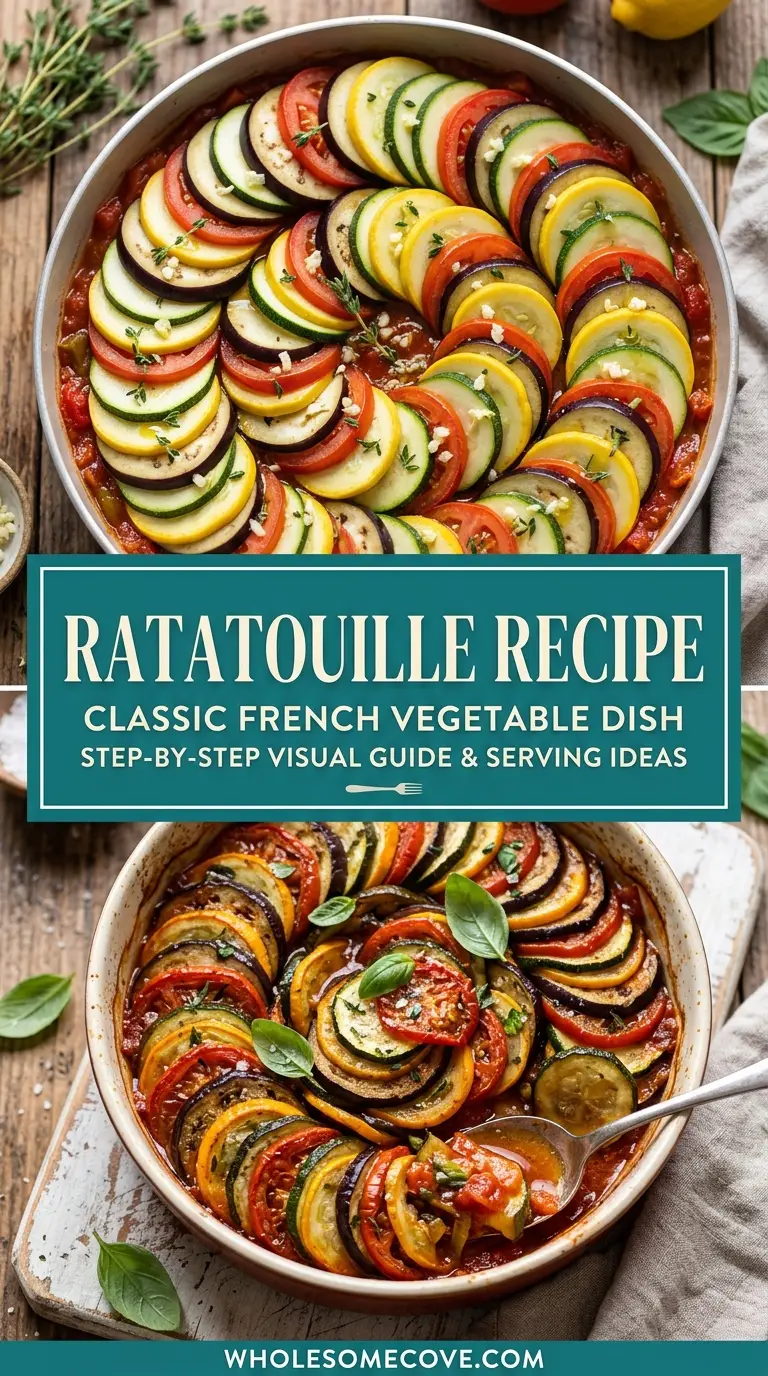
Step-by-Step Instructions: How to Make Ratatouille
Follow these steps in order and you’ll have a glossy, well-textured ratatouille without any of the usual sogginess.
Step 1: Salt and Drain the Eggplant
- Cut the eggplant into 3/4-inch (2 cm) cubes and place them in a colander set over a bowl or in the sink.
- Sprinkle generously with salt and toss to coat. Let them sit for 20 minutes while you prep the other vegetables.
- You’ll see beads of brown liquid form on the surface. This is the water you don’t want ending up in your pan.
- Rinse quickly under cold water if you’re watching sodium, then blot the cubes very dry with paper towels or a clean towel.
The first time I skipped this step, the pan turned soupy within minutes and the eggplant never browned. Twenty minutes of salting fixes it completely.
Step 2: Prep the Remaining Vegetables
- Cut the zucchini into 3/4-inch (2 cm) half-moons, keeping the pieces close in size to the eggplant so everything cooks at a similar rate.
- Seed and dice the red and yellow bell peppers into 3/4-inch (2 cm) pieces.
- Dice the onion and mince or grate the garlic.
- If using canned whole tomatoes, crush them by hand into a bowl, juices and all. If using fresh, chop them roughly.
Step 3: Brown the Eggplant
- Heat 2 tablespoons of the olive oil in a large skillet over medium-high heat until it shimmers.
- Add the eggplant in a single layer, working in batches if needed to avoid crowding.
- Cook for 4 to 5 minutes, turning once or twice, until the cubes are golden and just tender.
- Transfer the eggplant to a wire rack or a plate lined with paper towels.
I keep the browned eggplant on a wire rack rather than a plate, because sitting in its own steam softens the crisp edges I just worked for.
Step 4: Brown the Zucchini
- Add another tablespoon of olive oil to the same skillet.
- Add the zucchini in a single layer and cook for 3 to 4 minutes, until lightly browned but still firm.
- Set the zucchini aside with the eggplant. It should keep a slight bite at this stage, since it will finish cooking later.
Step 5: Soften the Peppers, Onion, and Garlic
- Set your Dutch oven over medium heat and add the remaining olive oil, about 2 tablespoons.
- Stir in the herbes de Provence and let them bloom in the oil for 30 seconds until fragrant.
- Add the diced onion and bell peppers with a pinch of salt. Cook for 8 to 10 minutes, stirring often, until soft and just starting to color.
- Add the minced garlic and cook for 1 minute more, until aromatic but not browned.
Step 6: Build the Tomato Base
- Stir in the tomato paste and cook for 1 to 2 minutes, letting it darken slightly to deepen the flavor.
- Add the crushed tomatoes and their juices, the bay leaf, 1 teaspoon of salt, and the black pepper.
- Bring to a gentle simmer and let the base cook uncovered for 10 minutes, stirring now and then, until it thickens slightly.
Step 7: Combine and Simmer
- Return the browned eggplant and zucchini to the pot and fold them gently into the tomato base.
- Simmer uncovered for 20 to 25 minutes, stirring occasionally, until the vegetables are tender and the sauce coats them without pooling.
- Keep the pot uncovered the whole time. Trapped steam is what makes the finished dish watery.
Step 8: Finish and Rest
- Remove and discard the bay leaf.
- Stir in the torn basil and the optional tablespoon of red wine vinegar. Taste and adjust the salt and pepper.
- Let the ratatouille rest off the heat for at least 10 minutes before serving. It tastes even better after a rest, warm rather than piping hot.
A similar low-and-slow tomato base appears in Creamy Tomato Basil Soup if you like this style of cooking.
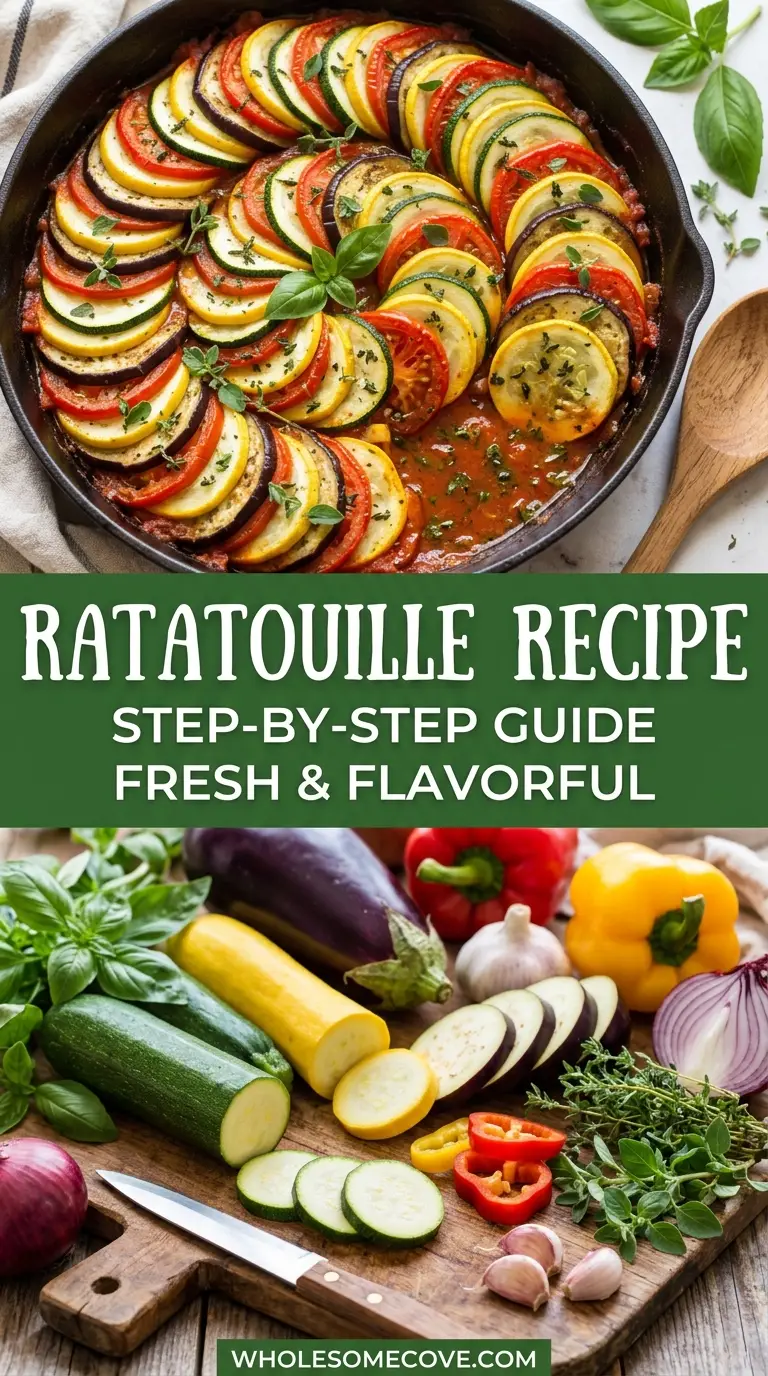
Tips for The Best Ratatouille
Small choices decide whether ratatouille turns out bright and distinct or soft and gray. These are the habits that make the biggest difference.
- Cook in stages, never all at once. Dumping every vegetable into one pot lowers the temperature and traps steam, so the pieces go watery instead of browning.
- Use a wide pan. More surface area means moisture evaporates instead of pooling.
- Don’t skip the eggplant salting. It is the single most reliable fix for a watery dish.
- Keep the pieces a similar size. Even cubes cook at the same rate, so nothing is mushy while something else is still firm.
- Slightly underripe zucchini holds its shape better than very soft, watery ones.
- Taste and season as you go, not just at the end. Each stage benefits from a small pinch of salt.
- Let it rest. Ratatouille is one of those dishes that improves as it cools and sits.
I’ve found that adding the zucchini at the end keeps a slight bite, while zucchini simmered from the very start collapses into the sauce. If you like it soft, add it earlier; if you like texture, add it late.
You might also like: Grilled Portobello Mushrooms
What to Serve with Ratatouille
Ratatouille is happy as a side, a topping, or a light main on its own. It pairs with almost anything off the grill or out of the oven, and it loves something starchy to soak up the sauce. Here are the pairings worth reaching for.
- Crusty bread for scooping up the sauce. A warm loaf of Same Day Sourdough Bread is ideal.
- Steamed rice turns it into a full meal. Spoon it over fluffy Basmati Rice.
- Roasted or grilled chicken. Try it alongside a simple Roast Chicken or Grilled Lemon Herb Chicken.
- Lamb, the classic Provençal match. It is excellent with Lamb Chops.
- Grilled fish. It works beautifully next to Grilled Salmon With Dill Sauce.
- A special-occasion steak like Filet Mignon.
- Eggs. Make a dip in warm ratatouille and poach eggs right in it, the way you would in Shakshuka.
- Polenta or couscous for another soft, starchy base.
- A green salad with a sharp vinaigrette to cut the richness.
- Shaved parmesan and bread for a light summer lunch, served cold.
Read Also: Stuffed Acorn Squash
Variations of Ratatouille
Every household in Provence makes it a little differently, and the recipe takes well to swaps. Once you have the method down, treat the ingredient list as a starting point.
- Confit byaldi (the movie version). Slice the vegetables thin, arrange them in a spiral over a tomato base, and bake covered, then uncovered, until tender.
- Oven-baked ratatouille. Toss everything with olive oil in a baking dish and roast at 400°F (200°C), which is more hands-off than the stovetop method.
- Add protein. Fold in cooked sausage, chickpeas, or white beans to make it heartier.
- Cheesy finish. Scatter crumbled feta or goat cheese over the top in the last 10 minutes for a richer dish.
- Extra herbs. Fresh thyme or a handful of chopped parsley added at the end brightens it further.
- Spicy version. A pinch of red pepper flakes with the garlic gives it gentle heat.
- Chunky or smooth. Simmer longer for a softer, more melded texture, or keep it short for distinct pieces.
I’ve found that roasting the vegetables instead of pan-frying gives a deeper, sweeter flavor with far less hands-on time, though you lose a little of the fresh, separate-vegetable character. It is a fair trade on a busy night.
Cooks looking for another vegetable side often turn to Creamed Spinach.
Storage and Reheating
Ratatouille is a rare dish that genuinely tastes better on day two. It stores and reheats well, which makes it a smart thing to cook ahead.
- Refrigerate: Cool the ratatouille, then transfer it to an airtight container within two hours of cooking. It keeps for up to 4 days.
- Freeze: Store in freezer-safe containers for up to 3 months. The zucchini and eggplant soften after thawing, so frozen ratatouille is best used in soups, pasta, or over rice.
- Thaw: Defrost overnight in the fridge before reheating.
- Reheat on the stove: Warm gently in a wide, uncovered pan over medium-low heat, stirring now and then. Leaving it uncovered lets any extra moisture cook off.
- Reheat in the microwave: Heat individual portions in 30-second bursts, stirring between each, and stop as soon as it is hot.
- Avoid boiling it hard or reheating the whole batch repeatedly, since too much heat breaks the vegetables down into mush.
- Serve leftovers cold or at room temperature as a relish, on toast, or alongside cheese.
For a bright side dish, try: Maple Glazed Carrots
Nutritional Facts
Values below are approximate and based on 6 servings, made as written with the full amount of olive oil and no optional add-ins.
| Nutrient | Amount per Serving |
|---|---|
| Calories | 185 kcal |
| Total Fat | 13 g |
| Saturated Fat | 2 g |
| Carbohydrates | 16 g |
| Fiber | 5 g |
| Sugar | 9 g |
| Protein | 3 g |
| Sodium | 480 mg |
Read Also: Roasted Butternut Squash Soup
Health Benefits of Key Ingredients
Beyond the flavor, ratatouille is built almost entirely from vegetables and olive oil, which makes it genuinely good for you. Here is what the main ingredients bring to the plate.
- Eggplant is low in calories and high in fiber, and its skin contains antioxidants that support heart health.
- Zucchini is mostly water, adding volume and hydration along with vitamin C and potassium.
- Bell peppers are rich in vitamin C and vitamin A, and the red ones carry antioxidants that give them their color.
- Tomatoes provide lycopene, an antioxidant that becomes more available to the body when tomatoes are cooked in oil.
- Onion and garlic contain compounds linked to immune and cardiovascular support.
- Olive oil supplies heart-healthy monounsaturated fats and helps the body absorb the fat-soluble nutrients in the vegetables.
- Fresh basil and herbs add antioxidants and bright flavor with no added sodium or sugar.
For more plant-forward comfort in a bowl, see Lentil and Vegetable Soup.
FAQs About Ratatouille
1. Do I really have to salt the eggplant?
Salting is the most reliable way to keep the dish from turning watery. It draws moisture out of the eggplant through osmosis before it ever hits the pan.
If you’re short on time, you can skip it and brown the eggplant in a very hot, dry skillet instead. It is not quite as effective, but it works in a pinch.
2. Why is my ratatouille watery?
The usual culprit is cooking everything together in a crowded pot, which traps steam and stops the vegetables from browning. Skipping the eggplant salting adds to the problem.
Cook the vegetables in stages, use a wide pan, and simmer uncovered so excess liquid can evaporate. Those three habits fix almost every soggy batch.
3. Should I cook the vegetables separately or all at once?
Browning each vegetable separately gives the best texture and flavor, since each one cooks at a different rate. It is more dishes, but the payoff is a stew with real structure.
If you want less work, the oven-baked method lets you roast everything together. You trade a little of the distinct-vegetable character for convenience.
4. Is ratatouille served hot or cold?
Both work beautifully, which is part of its charm. It is often served warm or at room temperature rather than piping hot, so the flavors come through clearly.
Cold ratatouille the next day makes a lovely lunch with bread and cheese. Many cooks think it tastes best after an overnight rest.
5. Can I make ratatouille ahead of time?
Yes, and it is one of the best make-ahead dishes there is. The flavors deepen as it sits, so cooking it a day early is a real advantage.
Store it covered in the fridge for up to 4 days and reheat gently. It also freezes well for longer storage.
6. Is this the same dish from the Pixar movie?
Not exactly. The thin, fanned-out spiral in the film is a modern presentation called confit byaldi.
This recipe is the traditional rustic stew that Provençal home cooks have always made. Both taste wonderful, but the stewed version is the original.
You might also enjoy: Summer Dinner Recipes
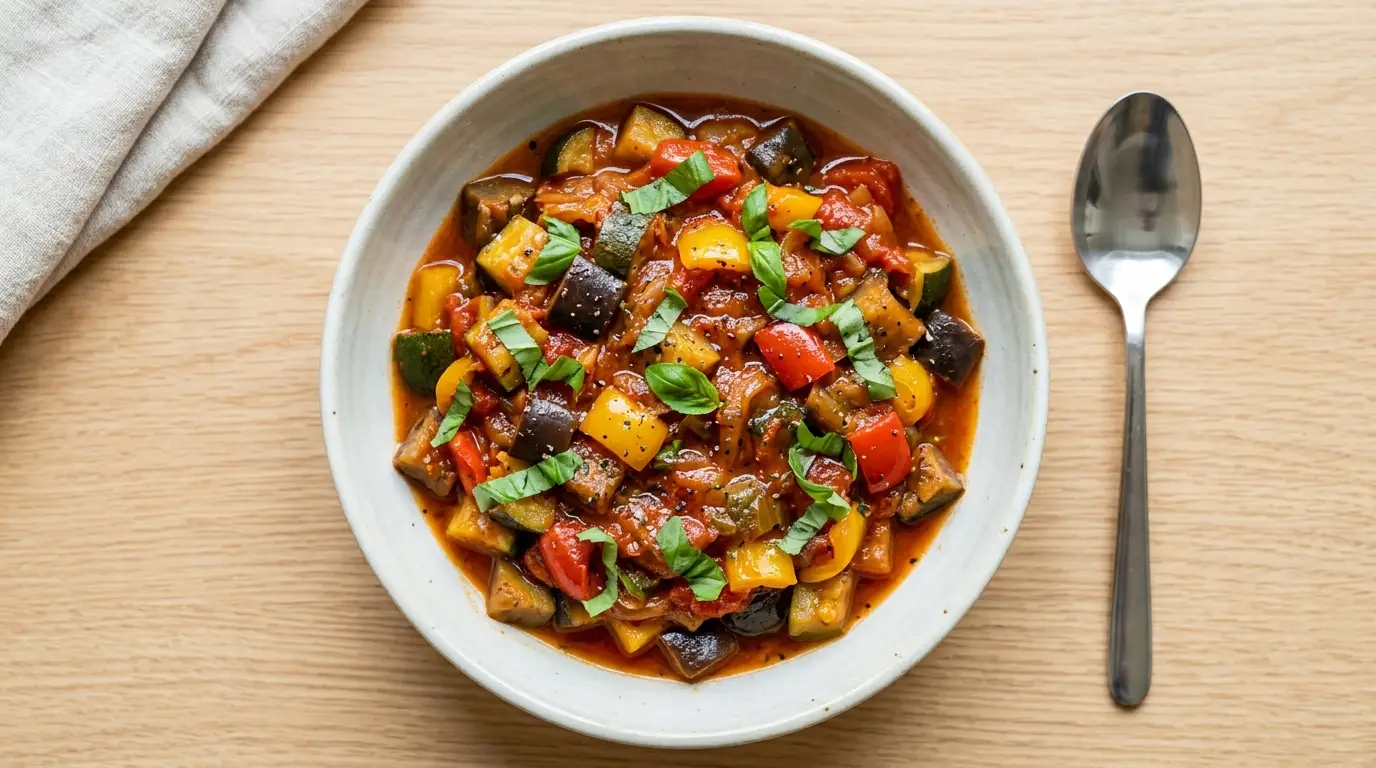
Ratatouille
Ingredients
- 1 large eggplant - about 1 lb / 450 g, cut into 3/4-inch (2 cm) cubes
- 2 medium zucchini - about 1 lb / 450 g total, cut into 3/4-inch (2 cm) half-moons
- 1 red bell pepper - seeded and cut into 3/4-inch (2 cm) pieces
- 1 yellow bell pepper - seeded and cut into 3/4-inch (2 cm) pieces
- 1 large yellow onion - diced
- 4 cloves garlic - minced or grated
- 1 can whole peeled San Marzano tomatoes - 28 oz / 800 g, hand-crushed (or 1.5 lb / 700 g fresh ripe tomatoes, chopped)
- 2 tablespoons tomato paste - 30 g
- 1/3 cup extra virgin olive oil - 80 ml, divided
- 2 teaspoons dried herbes de Provence
- 1 bay leaf
- 1/4 cup fresh basil leaves - 10 g, torn
- 1 teaspoon kosher salt - plus more for salting the eggplant
- 1/2 teaspoon black pepper
- 1 tablespoon red wine vinegar - 15 ml, optional, to finish
Equipment
- Large Dutch oven - or wide, heavy-bottomed pot with a lid
- Large skillet or sauté pan - for browning in batches
- Sharp chef’s knife - for even, quick chopping
- Sturdy cutting board - with room to work
- Wooden spoon - or heatproof spatula
- Colander - for draining the salted eggplant
- Paper towels or a clean kitchen towel - for blotting
- Wire rack - (optional) for resting browned eggplant so it stays crisp
Method
- Cut the eggplant into 3/4-inch (2 cm) cubes and place them in a colander set over a bowl or in the sink.
- Sprinkle generously with salt and toss to coat. Let them sit for 20 minutes while you prep the other vegetables.
- You’ll see beads of brown liquid form on the surface. Rinse quickly under cold water if you’re watching sodium, then blot the cubes very dry with paper towels or a clean towel.
- Cut the zucchini into 3/4-inch (2 cm) half-moons, keeping the pieces close in size to the eggplant so everything cooks at a similar rate.
- Seed and dice the red and yellow bell peppers into 3/4-inch (2 cm) pieces. Dice the onion and mince or grate the garlic.
- If using canned whole tomatoes, crush them by hand into a bowl, juices and all. If using fresh, chop them roughly.
- Heat 2 tablespoons of the olive oil in a large skillet over medium-high heat until it shimmers.
- Add the eggplant in a single layer, working in batches if needed to avoid crowding. Cook for 4 to 5 minutes, turning once or twice, until the cubes are golden and just tender.
- Transfer the eggplant to a wire rack or a plate lined with paper towels.
- Add another tablespoon of olive oil to the same skillet. Add the zucchini in a single layer and cook for 3 to 4 minutes, until lightly browned but still firm.
- Set the zucchini aside with the eggplant. It should keep a slight bite at this stage, since it will finish cooking later.
- Set your Dutch oven over medium heat and add the remaining olive oil, about 2 tablespoons. Stir in the herbes de Provence and let them bloom in the oil for 30 seconds until fragrant.
- Add the diced onion and bell peppers with a pinch of salt. Cook for 8 to 10 minutes, stirring often, until soft and just starting to color.
- Add the minced garlic and cook for 1 minute more, until aromatic but not browned.
- Stir in the tomato paste and cook for 1 to 2 minutes, letting it darken slightly to deepen the flavor.
- Add the crushed tomatoes and their juices, the bay leaf, 1 teaspoon of salt, and the black pepper. Bring to a gentle simmer and let the base cook uncovered for 10 minutes, stirring now and then, until it thickens slightly.
- Return the browned eggplant and zucchini to the pot and fold them gently into the tomato base. Simmer uncovered for 20 to 25 minutes, stirring occasionally, until the vegetables are tender and the sauce coats them without pooling.
- Keep the pot uncovered the whole time. Trapped steam is what makes the finished dish watery.
- Remove and discard the bay leaf. Stir in the torn basil and the optional tablespoon of red wine vinegar. Taste and adjust the salt and pepper.
- Let the ratatouille rest off the heat for at least 10 minutes before serving. It tastes even better after a rest, warm rather than piping hot.
Nutrition
Notes
- Don’t skip salting the eggplant. It’s the single most reliable fix for a watery dish, drawing out excess moisture before cooking.
- Cook in stages, never all at once. Dumping every vegetable into one pot lowers the temperature and traps steam, so the pieces go watery instead of browning.
- Use a wide pan. More surface area means moisture evaporates instead of pooling.
- Keep pieces a similar size. Even cubes cook at the same rate, so nothing is mushy while something else is still firm.
- Slightly underripe zucchini holds its shape better than very soft, watery ones.
- Taste and season as you go, not just at the end. Each stage benefits from a small pinch of salt.
- Let it rest. Ratatouille is one of those dishes that improves as it cools and sits.
- Make ahead: It stores covered in the fridge for up to 4 days and freezes well for up to 3 months. The flavors deepen overnight.
- Reheat gently in a wide, uncovered pan over medium-low heat so extra moisture can cook off. Avoid boiling hard or reheating repeatedly.
- Serve cold or at room temperature as a relish, on toast, or alongside cheese.
- Variations: Try confit byaldi (spiral-sliced, baked), oven-baked at 400°F (200°C), or add chickpeas, white beans, or sausage for a heartier dish.
Private Notes
Tried this recipe?
Let us know how it was!Final Thoughts
Ratatouille is proof that a handful of summer vegetables, treated with a little care, can turn into something memorable. The method takes patience, but none of it is difficult.
Make it once and you’ll understand why it has stayed on French tables for generations. It is humble, flexible, and somehow better every time you reheat it.
Give this one a try the next time your kitchen is overflowing with zucchini and tomatoes. I’d love to hear how yours turns out.
Leave a comment below with your favorite way to serve it, and share this recipe with anyone who still thinks vegetables can’t be the star of dinner.
Recommended:
- Beef Tenderloin
- Prime Rib
- Baked Salmon With Asparagus and Lemon
- Sourdough Focaccia
- Dinner Rolls
- Butternut Squash Risotto
- Roasted Potatoes
- Creme Brulee
- Vegetarian French Onion Soup
- Grilled Chicken and Veggie Skewers