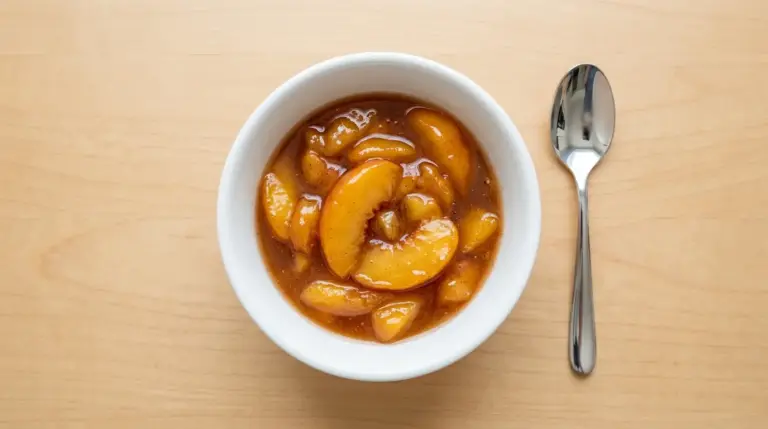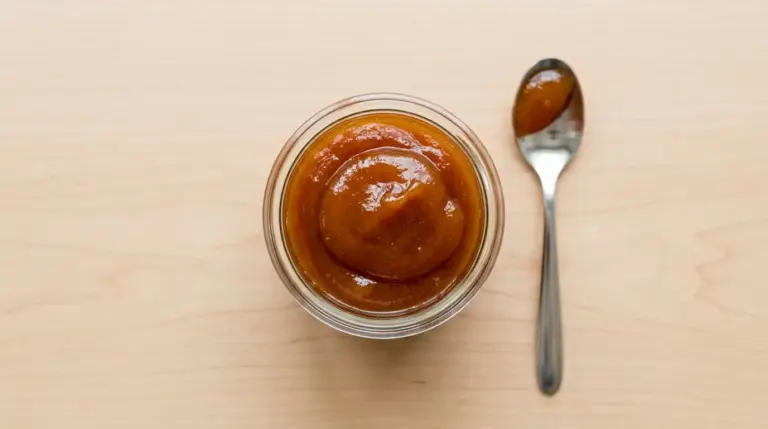
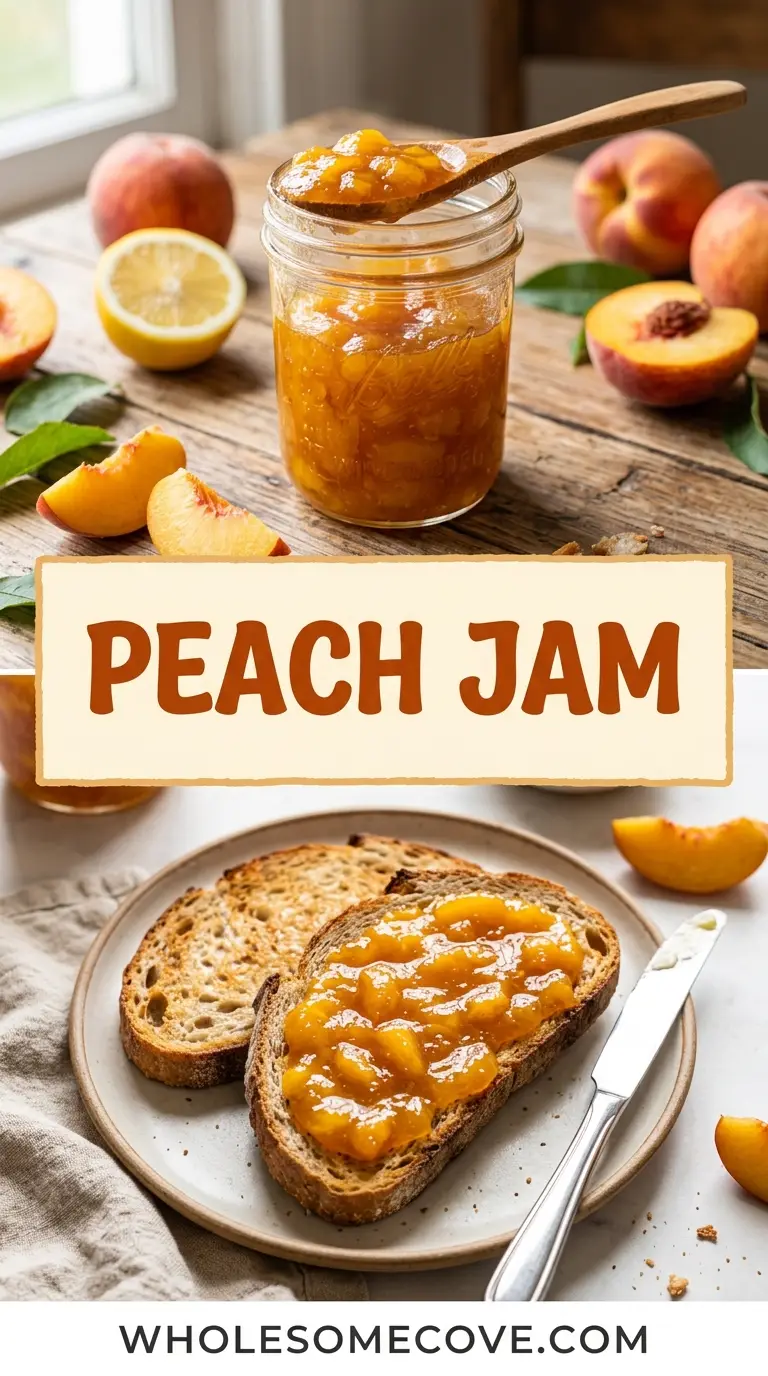
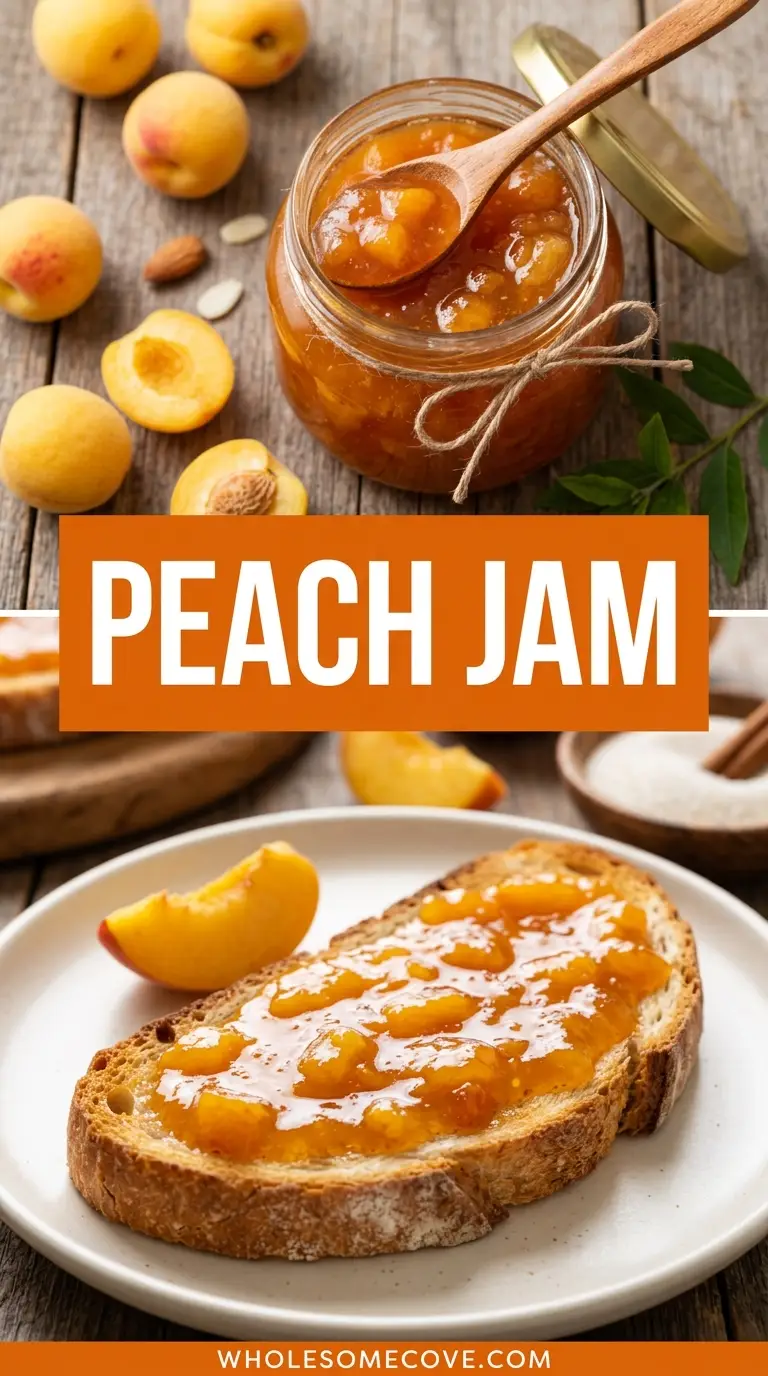
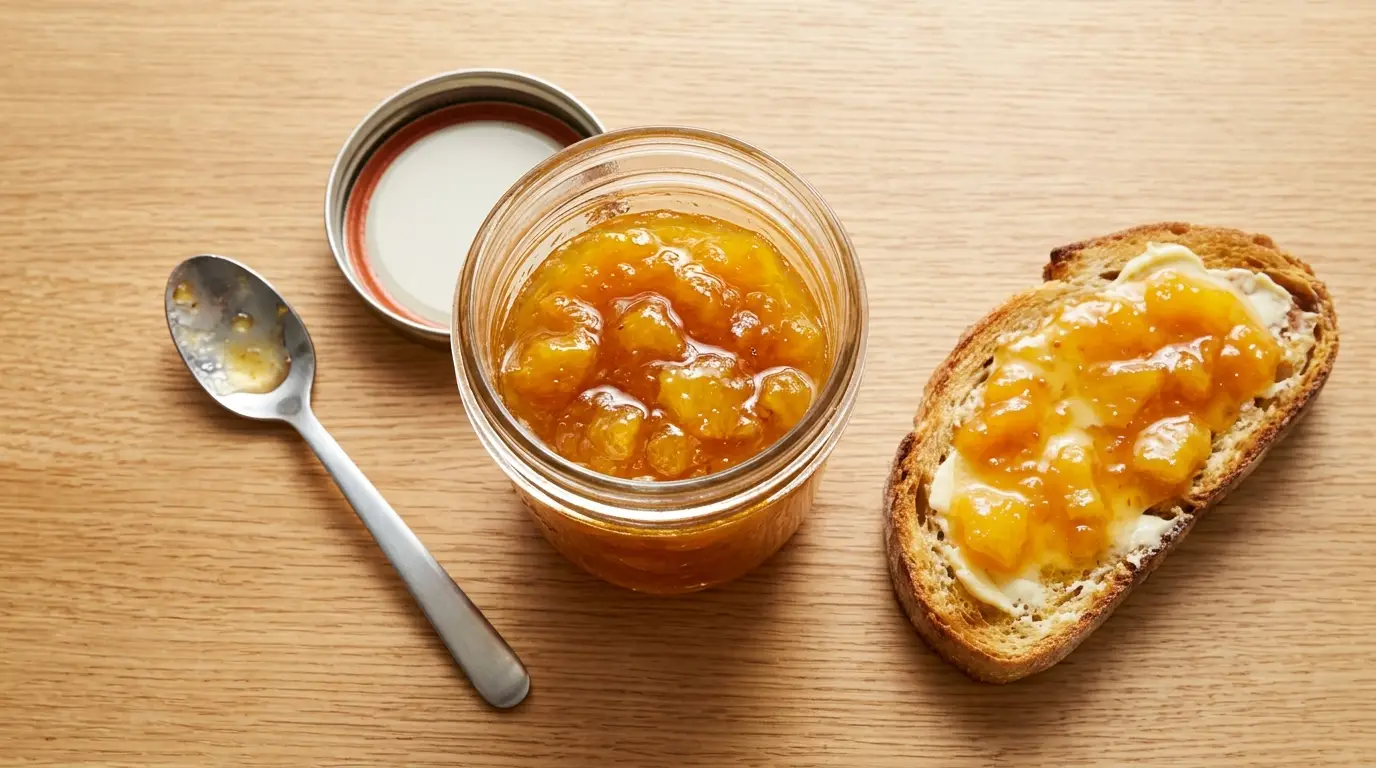
Peach season lasts a few short weeks, and this peach jam recipe turns a couple of pounds of ripe fruit into jars of concentrated summer you can spread on toast in the middle of February. The color lands somewhere between amber and sunset, and a good batch is soft enough to slump off the spoon but thick enough to stay put on bread.
Most homemade peach jam fails for one reason: peaches are naturally low in pectin, so recipes that skip added pectin or cut the sugar end up as pretty peach syrup that never sets.
This version leans on powdered pectin and a proper sugar ratio, so it gels reliably every time. Five main ingredients, about 45 minutes at the stove, and you get five to six half-pint jars.
The lemon juice does double duty here, adding the acidity the pectin needs to form a gel and keeping the fruit bright instead of muddy. Skip it and even the right pectin won’t set properly.
| Quick Recipe Summary | |
|---|---|
| Prep Time | 20 minutes |
| Cook Time | 25 minutes |
| Total Time | 45 minutes |
| Servings | 5 to 6 half-pint jars (about 80 tablespoons) |
| Difficulty Level | Easy |
For a different way to preserve the same fruit, see Peach Butter.
Why You’ll Love This Peach Jam Recipe
This recipe is built for people who want a reliable set without guesswork or years of canning experience. It uses powdered pectin so the jam gels in a predictable window rather than leaving you to boil and hope.
Here’s what makes it worth keeping:
- It sets every time. The powdered pectin and measured sugar take the gamble out of a fruit that’s notoriously hard to set on its own.
- Small batch, better results. A single batch evaporates and gels far more evenly than a doubled pot that sits too deep to concentrate.
- Only five main ingredients. Peaches, sugar, powdered pectin, lemon juice, and a knob of butter to cut the foam.
- Real peach flavor. No artificial thickeners or corn syrup, just fruit cooked down with sugar and acid.
- Shelf stable when canned. Properly processed jars last on the pantry shelf for up to a year.
- Flexible texture. Mash it smooth or leave it chunky depending on how you like it on toast.
- A great gift. A ribboned half-pint jar is one of the easiest homemade presents to give.
You might also enjoy: Peach Compote
Ingredients
Everything here matters for the set, so measure rather than eyeball, especially the sugar and pectin. Use ripe, fragrant yellow peaches; they carry more acid than white peaches, which matters for a safe, reliable jam.
- 3 lbs (about 1.4 kg) ripe yellow peaches, peeled, pitted, and chopped into 1/2-inch pieces (roughly 6 to 8 large peaches, yielding about 6 cups prepped). Buy fresh peaches
- 4 cups (800 g) granulated sugar, measured into a separate bowl and set aside
- 1 box (1.75 oz / 49 g) powdered fruit pectin, such as original Sure-Jell. Get powdered fruit pectin on Amazon
- 1/4 cup (60 ml) bottled lemon juice, for consistent acidity and a reliable set. Buy bottled lemon juice
- 1/2 tsp unsalted butter (optional), to reduce foaming during the boil. Buy unsalted butter
A quick note on the lemon juice: bottled is not a cop-out here. It has a consistent, known acidity, which matters when acidity is part of what makes the jam safe and helps it gel.
Read Also: Peach Pie Filling
Kitchen Equipment Needed
You don’t need a full canning setup to make jam, though a proper canner makes shelf storage easy. At minimum, you need a heavy pot, jars, and a way to test the set.
- Large heavy-bottomed pot or Dutch oven, wide enough that the jam sits shallow and can evaporate. Buy a Dutch oven
- Potato masher, for crushing the fruit to your preferred texture. Buy a potato masher
- Half-pint canning jars with lids and bands (5 to 6). Buy half-pint canning jars
- Ladle and a wide-mouth canning funnel, to fill jars cleanly. Buy a canning funnel
- Jar lifter, if you’re processing jars in a water bath. Buy a jar lifter
- Candy or instant-read thermometer, to confirm the mixture hits the gel point. Buy an instant-read thermometer
- Two small plates, chilled in the freezer for the wrinkle test.
For a related preserving project, see Peach Chutney.
Recommended Products for This Recipe
These are the tools and ingredients I reach for when making jam, chosen because each one solved a specific problem I ran into along the way. They’re worth the upgrade if you plan to make jam more than once a season.
1. Sure-Jell Original Powdered Pectin
Peaches don’t have enough natural pectin to set on their own, which is why old-fashioned no-pectin batches so often turn to syrup. This powdered pectin gels at a specific sugar-to-fruit ratio and a short hard boil, so the set becomes a matter of following the ratio instead of crossing your fingers.
2. Ball Half-Pint Canning Jars
Half-pint jars are the right size for jam because you open one, use it within a couple of weeks, and it doesn’t sit in the fridge going cloudy. These have a standard mouth that fits most funnels and lifters, and the two-piece lids seal reliably in a water bath.
3. Instant-Read Digital Thermometer
The wrinkle test works, but it’s slow and easy to misread. A thermometer that reads 217 to 220°F (103 to 104°C) tells you the gel point has arrived, and I stopped overcooking batches into a stiff, candied texture once I started trusting the number.
4. Enameled Cast Iron Dutch Oven
Thin pots scorch jam at the bottom before the top has a chance to reduce, and burnt sugar taste is impossible to fix. A heavy enameled Dutch oven spreads heat evenly and holds a steady rolling boil, and the wide base gives the jam room to evaporate and thicken.
5. Wide-Mouth Canning Funnel
Ladling hot jam straight into a jar is a good way to smear the rim, which then prevents a clean seal. A wide funnel drops the jam right where it belongs and keeps the rim clean, which is the whole ballgame for getting lids to seal.
For another sweet spread to try, see Crab Apple Jelly.
Step-by-Step Instructions: How to Make Peach Jam
Follow these steps in order and you’ll have jars of properly set peach jam cooling on the counter in under an hour.
Step 1: Prep the Jars and Plates
- Place two small plates in the freezer to chill; you’ll use these to test the set later.
- If you plan to store the jam on the shelf, set a canning rack in a large pot, add your half-pint jars, and cover with water by 1 inch (2.5 cm).
- Bring to a simmer over medium heat, then turn off the heat and cover to keep the jars hot until you need them.
- Keep the lids and bands nearby, clean and ready.
Step 2: Peel and Chop the Peaches
- Peel the peaches with a paring knife for a small batch, or blanch them briefly in boiling water and slip the skins off if you prefer.
- Halve and pit each peach, then chop the flesh into 1/2-inch (1.3 cm) pieces.
- As you chop, toss the pieces with the 1/4 cup (60 ml) bottled lemon juice to keep them from browning.
- You should have about 6 cups of prepped peaches.
Step 3: Combine the Fruit, Pectin, and Butter
- Transfer the chopped peaches and all the lemon juice to your heavy-bottomed pot.
- Use the potato masher to crush the fruit to your preferred texture, smooth or slightly chunky.
- Stir the full box of powdered pectin into the peaches until fully dissolved. Adding powdered pectin at the start, before the sugar, is essential for the set.
- Drop in the 1/2 teaspoon of butter to help keep foaming down.
Step 4: Bring to a Full Rolling Boil
- Set the pot over high heat and bring the mixture to a full rolling boil, one that keeps bubbling even when you stir it.
- Stir frequently so the bottom doesn’t scorch.
- Have your 4 cups (800 g) of measured sugar ready to go beside the stove.
Step 5: Add the Sugar and Boil Hard
- Pour in all 4 cups (800 g) of sugar at once, stirring constantly to dissolve it.
- Return the mixture to a full rolling boil that can’t be stirred down.
- Boil hard for exactly 1 minute, stirring the whole time.
- If using a thermometer, cook until the jam registers 217 to 220°F (103 to 104°C), which is the gel point at sea level.
Step 6: Test the Set
- Remove the pot from the heat.
- Spoon a teaspoon of jam onto one of the chilled plates and return it to the freezer for 1 to 2 minutes.
- Drag your finger through the jam; it’s ready when your finger leaves a distinct trail that doesn’t immediately flood back.
- If it’s still runny, return the pot to a boil for 1 to 3 minutes and test again on the second cold plate.
Step 7: Skim and Jar
- Skim any foam off the surface with a spoon.
- Using the funnel and ladle, fill the hot jars, leaving 1/4 inch (0.6 cm) of headspace at the top.
- Wipe each rim clean with a damp cloth, set the lids on, and screw the bands on fingertip-tight.
Step 8: Process or Store
- For shelf storage, process the filled jars in a boiling water bath for 10 minutes (adjust for altitude if you’re above 1,000 feet / 300 m).
- Remove the jars with a jar lifter and let them sit undisturbed for 12 to 24 hours; you should hear the lids ping as they seal.
- For refrigerator jam, skip processing, let the jars cool, and refrigerate once at room temperature.
- Remember the jam continues to thicken considerably as it cools, so don’t judge the set by how it looks hot in the pot.
For more fruit preserving ideas, see Homemade Cinnamon Applesauce.

Tips for The Best Peach Jam
Small choices make the difference between syrup and a jam that stands up on toast. These are the ones that matter most.
- Wait for ripe, fragrant fruit. Peaches should smell sweet from a few feet away. Underripe fruit lacks flavor, and truly overripe fruit has lost pectin.
- Never double the batch. I doubled my first-ever batch and ended up with jars of loose peach syrup, because a deep pot can’t evaporate evenly. Two single batches back-to-back set far better than one big one.
- Measure the sugar exactly. Cutting the sugar in a standard pectin recipe is the fastest route to jam that won’t gel. If you want low-sugar jam, buy pectin formulated for it.
- Add pectin first, sugar second. Powdered pectin goes in with the cold fruit before boiling; sugar goes in after the first rolling boil. Reversing this order can wreck the set.
- Use a wide pot. More surface area means faster, more even evaporation and a better gel.
- Trust the cold-plate test. The wrinkle on a frozen plate is the most reliable read on set for a home cook without a thermometer.
- Don’t skip the lemon juice. It’s not for flavor as much as for the acid the pectin needs to form a gel.
A related recipe is Peach BBQ Sauce.
What to Make with Peach Jam
Peach jam is a finished spread, but it’s also a genuinely useful building block once you have jars of it on hand. It works anywhere you’d want a bright, fruity hit of sweetness. Here are the ways I put it to use beyond morning toast.
- Swirl a spoonful into Peach Baked Oatmeal for extra fruit flavor.
- Warm it slightly and drizzle over Peach Pancakes instead of syrup.
- Use it as the filling layer in Peach Hand Pies.
- Spoon it between cake layers or over a slice of Peach Coffee Cake.
- Stir a tablespoon into plain yogurt or fold it through Peach Overnight Oats.
- Melt it down as a glaze for pork chops or roast chicken.
- Spread it inside a filled crumb-topped Peach Muffins batter.
- Layer it into a Peach Trifle with cream and sponge.
- Use it as the base sweetener for a batch of Peach Lemonade.
- Warm and spoon over vanilla Peach Ice Cream.
Read Also: Peach French Toast
Variations of Peach Jam
Once you have the base method down, the flavor is easy to tweak. Keep the fruit, sugar, and pectin ratios the same and adjust the additions.
- Vanilla peach jam: Add the scraped seeds of one vanilla bean or 1 teaspoon vanilla extract at the end of cooking.
- Peach bourbon jam: Stir in 2 tablespoons (30 ml) bourbon off the heat for a warm, mellow depth.
- Spiced peach jam: Add 1/2 teaspoon cinnamon and a pinch of nutmeg with the sugar.
- Peach ginger jam: Grate in 1 tablespoon fresh ginger with the fruit for a gentle bite.
- Peach with a kick: Add one seeded, minced jalapeño for a sweet-hot spread that’s great with cheese.
- Honey peach jam: Replace up to 1 cup of the sugar with honey, but keep the total sweetener volume the same for a proper set.
- Brown sugar peach jam: Swap 1 cup of white sugar for packed brown sugar for a deeper, molasses note.
You might also enjoy: Fresh Peach Salsa
Storage and Reheating
Jam is a preserve, so most of “storage” is really about how you sealed it. Follow the timelines below to keep it safe and tasting fresh.
- Sealed and processed jars: Store in a cool, dark pantry for up to 1 year. Check that each lid is concave and doesn’t flex before shelving.
- Refrigerator jam (unprocessed): Keep sealed in the fridge and use within 3 weeks.
- Opened jars: Refrigerate after opening and use within 3 to 4 weeks.
- Freezing: Ladle cooled jam into freezer-safe containers, leaving 1/2 inch (1.3 cm) of headspace, and freeze for up to 1 year. Thaw in the fridge.
- If a seal fails: Any jar that didn’t seal properly should go straight into the fridge and be treated as refrigerator jam.
- Reheating: Jam doesn’t need reheating, but you can warm a few spoonfuls gently in a small pan or the microwave to loosen it for glazing or drizzling.
For a make-ahead breakfast that pairs well, see Peach Chia Pudding.
Nutritional Facts
Values are approximate and based on a 1-tablespoon (20 g) serving, with the recipe yielding roughly 80 tablespoons.
| Nutrient | Per 1 Tbsp Serving |
|---|---|
| Calories | 45 kcal |
| Total Fat | 0 g |
| Sodium | 1 mg |
| Total Carbohydrate | 11 g |
| Sugars | 11 g |
| Fiber | 0.2 g |
| Protein | 0.1 g |
| Vitamin C | 1% DV |
For a lighter fruit option, try: Peach Sorbet
Health Benefits of Key Ingredients
While jam is a treat, the fruit it’s built on carries real nutritional value, and a few of the supporting ingredients pull their weight too. Here’s what the main ingredients bring to the table.
- Peaches: A good source of vitamins A and C, along with potassium and antioxidants that support skin and immune health.
- Lemon juice: Adds vitamin C and the acidity that helps the jam gel, plus it brightens the overall flavor.
- Fiber from whole fruit: Because this jam uses crushed whole peaches rather than juice, it retains a small amount of the fruit’s natural fiber.
- Antioxidants: Peaches contain polyphenols and carotenoids, plant compounds linked to reducing oxidative stress.
- No artificial additives: Making jam at home means no high-fructose corn syrup, artificial colors, or preservatives beyond the sugar and acid doing the preserving.
For more ways to use summer fruit, see Peach Popsicles.
FAQs About Peach Jam
1. Why didn’t my peach jam set?
The most common cause is skipping added pectin, since peaches are naturally low in it and rarely gel on their own. Reducing the sugar or not boiling hard enough after adding it will also leave you with syrup.
Remember that jam thickens as it cools, so give it a full day before deciding it failed. If it’s still runny, you can recook it with a little more pectin.
2. Do I have to peel the peaches?
Peeling gives the smoothest, most classic texture, and it’s quick with a paring knife for a small batch. You can leave the skins on if you don’t mind flecks and plan to blend the jam, but most people prefer them removed.
3. Can I use frozen or canned peaches?
Frozen peaches work, though they release more water, so you may need to boil a little longer to reach the gel point. Canned peaches are softer and sweeter, so drain them well and taste before adding the full sugar amount.
4. Why does the recipe use bottled lemon juice instead of fresh?
Bottled lemon juice has a consistent, known acidity, which matters because acid is part of what makes the jam gel and keeps it safe for canning. Fresh lemon juice varies from lemon to lemon, so bottled is the safer choice for preserving.
5. Can I cut down the sugar?
Not in this recipe, because standard pectin needs a specific sugar ratio to gel and cutting it usually gives you runny jam. If you want less sugar, buy pectin made for low-sugar or no-sugar recipes and follow its instructions instead.
6. How long does homemade peach jam last?
Properly sealed and water-bath processed jars keep in a cool, dark pantry for up to a year. Once opened, or if you made refrigerator jam, use it within about three to four weeks.
You might also enjoy: Peach Iced Tea
Peach Jam
Ingredients
- 3 lbs ripe yellow peaches - about 1.4 kg; peeled, pitted, and chopped into 1/2-inch pieces (roughly 6 to 8 large peaches, yielding about 6 cups prepped)
- 4 cups granulated sugar - 800 g; measured into a separate bowl and set aside
- 1 box powdered fruit pectin - 1.75 oz / 49 g, such as original Sure-Jell
- 1/4 cup bottled lemon juice - 60 ml; for consistent acidity and a reliable set
- 1/2 tsp unsalted butter - (optional) to reduce foaming during the boil
Equipment
- Large heavy-bottomed pot or Dutch oven - Wide enough that the jam sits shallow and can evaporate
- Potato masher - For crushing the fruit to your preferred texture
- Half-pint canning jars with lids and bands - 5 to 6 jars
- Wide-mouth canning funnel - To fill jars cleanly
- Jar lifter - (optional) If you’re processing jars in a water bath
- Candy or instant-read thermometer - (optional) To confirm the mixture hits the gel point
- Two small plates - Chilled in the freezer for the wrinkle test
- Canning rack - (optional) For water bath processing
- Paring knife - For peeling peaches
Method
- Place two small plates in the freezer to chill. If storing on the shelf, set a canning rack in a large pot, add jars, cover with water by 1 inch, and bring to a simmer. Turn off heat and cover to keep jars hot.
- Peel the peaches with a paring knife or blanch briefly in boiling water. Halve, pit, and chop into 1/2-inch pieces, tossing with lemon juice as you go. You should have about 6 cups of prepped peaches.
- Transfer peaches and lemon juice to a heavy-bottomed pot. Crush with a potato masher to desired texture. Stir in the full box of powdered pectin until dissolved, then add the butter.
- Set the pot over high heat and bring to a full rolling boil that keeps bubbling even when stirred. Stir frequently to prevent scorching. Have the measured sugar ready beside the stove.
- Pour in all 4 cups of sugar at once, stirring constantly. Return to a full rolling boil that can’t be stirred down and boil hard for exactly 1 minute, stirring the whole time. If using a thermometer, cook until 217 to 220°F (103 to 104°C).
- Remove from heat. Spoon a teaspoon of jam onto a chilled plate and freeze for 1 to 2 minutes. Drag your finger through; it’s ready when it leaves a distinct trail that doesn’t flood back. If runny, boil 1 to 3 more minutes and test again.
- Skim any foam off the surface. Using a funnel and ladle, fill hot jars leaving 1/4 inch headspace. Wipe rims clean, set lids on, and screw bands on fingertip-tight.
- For shelf storage, process filled jars in a boiling water bath for 10 minutes (adjust for altitude above 1,000 feet). Remove with a jar lifter and let sit undisturbed for 12 to 24 hours. For refrigerator jam, skip processing and refrigerate once cool.
Nutrition
Notes
- Use ripe, fragrant yellow peaches that smell sweet from a few feet away. Underripe fruit lacks flavor and truly overripe fruit has lost pectin.
- Never double the batch. A deep pot can’t evaporate evenly, so two single batches back-to-back set far better than one big one.
- Measure the sugar exactly. Cutting the sugar in a standard pectin recipe is the fastest route to jam that won’t gel. For low-sugar jam, buy pectin formulated for it.
- Add pectin first, sugar second. Powdered pectin goes in with the cold fruit before boiling; sugar goes in after the first rolling boil. Reversing this order can wreck the set.
- Use a wide pot for more surface area, faster evaporation, and a better gel.
- Don’t skip the lemon juice. It provides the acid the pectin needs to form a gel and keeps the fruit bright instead of muddy.
- Trust the cold-plate test. The wrinkle on a frozen plate is the most reliable read on set for a home cook without a thermometer.
- Jam continues to thicken considerably as it cools, so don’t judge the set by how it looks hot in the pot.
- Sealed and processed jars store in a cool, dark pantry for up to 1 year. Refrigerator jam keeps for 3 weeks; opened jars for 3 to 4 weeks.
- To freeze, ladle cooled jam into freezer-safe containers leaving 1/2 inch headspace and freeze for up to 1 year. Thaw in the fridge.
- Any jar that didn’t seal properly should go straight into the fridge and be treated as refrigerator jam.
- Variations: add vanilla bean or extract, bourbon, cinnamon and nutmeg, fresh ginger, minced jalapeño, honey (replace up to 1 cup sugar), or brown sugar (swap 1 cup).
Private Notes
Tried this recipe?
Let us know how it was!Final Thoughts
There’s real satisfaction in lining up jars of golden peach jam on the counter and hearing the lids ping as they seal. It’s one of the simplest ways to hold onto summer long after the fruit stands have packed up.
Give this one a try the next time you find a good crate of ripe peaches. A single afternoon at the stove sets you up for months of good toast.
If you make it, I’d love to hear how it turned out. Leave a comment with your favorite variation, or share a jar with someone who needs a little sunshine.
Recommended:
- Peach Butter
- Peach Cobbler
- Peach Crumble
- Peach Bread
- Peach Muffins
- Peach Scones
- Peach Galette
- Peach Pie
- Peach Turnovers