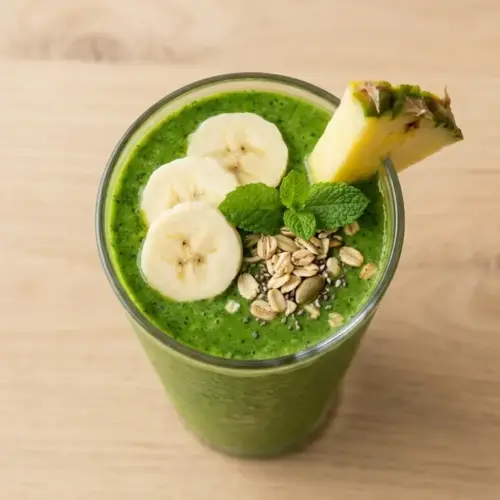
Kale And Fruit Smoothie

This kale and fruit smoothie blends tender kale leaves with frozen mango, banana, and pineapple into a thick, creamy, vibrantly green tropical drink that tastes indulgent while delivering an impressive range of vitamins, minerals, and fibre in just 5 minutes.
Equipment
- High-powered blender - A Vitamix or Ninja is ideal for fully breaking down kale fibres
- Kitchen scale - (optional) for precise portions
- Sharp knife - For stripping kale leaves from stems
- Tall glasses or mason jars - 16 oz / 475ml capacity per serving
- Reusable straws - (optional) helpful for drinking thick smoothies
- Freezer-safe bags or containers - (optional) for pre-portioning smoothie packs
Ingredients
- 2 large handfuls kale leaves - about 60g / 2 oz, fresh or frozen, tough stems removed
- 1 cup frozen mango chunks - 150g / 5.3 oz
- 1 medium banana - fresh or frozen, roughly broken into pieces
- 1/2 cup frozen pineapple chunks - 80g / 2.8 oz
- 1 cup unsweetened almond milk - 240ml / 8 fl oz; coconut milk, oat milk, or water can be substituted
- 1/2 cup cold water - 120ml / 4 fl oz; adjust for desired thickness
Optional Add-Ins
- 1 tablespoon chia seeds - for added fibre and omega-3s
- 1 tablespoon hemp protein powder - or vanilla protein powder, for added protein
- 1 teaspoon raw honey - or maple syrup; only if extra sweetness is desired
- 1/2 lime, juiced - adds brightness and reduces any grassy kale taste
Instructions
- Rinse fresh kale leaves thoroughly under cold running water, then strip the leaves away from the thick central ribs and tear into roughly 5cm / 2-inch pieces. If using frozen kale, skip washing and measure two large handfuls directly from the bag.
- Pour the almond milk and cold water into the blender first, then add the kale, banana, frozen mango, and frozen pineapple on top. Add any optional ingredients (chia seeds, protein powder, honey, lime juice) before blending.
- Secure the lid and blend on low for 5-10 seconds, then increase to the highest speed and blend for 45-60 seconds until completely smooth with no visible kale flecks. If needed, scrape down the sides and blend for another 10-15 seconds.
- Taste the smoothie and add honey or maple syrup if more sweetness is desired, or a small squeeze of lime juice if you detect any bitterness from the kale. Blend briefly to combine any additions.
- Pour into two tall glasses or mason jars (about 400-450ml / 14-16 fl oz each) and serve immediately for the best texture and colour. Top with optional garnishes such as sliced banana or a pineapple wedge on the rim if desired.
Notes
- Always remove the kale stems before blending. The central rib concentrates most of the bitterness and can leave an unpleasant texture.
- Add liquids to the blender first. Placing milk and water at the base creates the suction vortex that keeps all ingredients moving toward the blades without stalling the motor.
- Use frozen fruit instead of ice. Frozen mango, pineapple, and banana chill the smoothie while adding flavour and creaminess; ice only dilutes it.
- No high-powered blender? Pre-blend just the kale and liquid on high for 30-45 seconds before adding the frozen fruit. This breaks down fibres more thoroughly in a standard blender.
- To boost protein, add one scoop of vanilla protein powder, 2-3 tablespoons of hemp seeds, 2 tablespoons of peanut butter, or 1/2 cup (120g) of Greek yogurt.
- For extra creaminess and healthy fats, blend in half a ripe avocado. It makes the smoothie extraordinarily thick and increases its staying power significantly.
- Prep smoothie packs in advance by portioning all solid ingredients into individual freezer bags. Store for up to 3 months and blend straight from frozen with fresh liquid each morning.
- Store leftover smoothie in an airtight glass jar filled to the top (to minimise air exposure) in the refrigerator for up to 24 hours. Add a squeeze of lemon or lime juice before storing to slow oxidation and preserve the green colour.
- If the smoothie turns brown, it is still perfectly safe and nutritious. Browning is simply oxidation and a cosmetic change, not spoilage.
- For a citrus variation, swap the almond milk for fresh orange juice. The vitamin C from the orange also significantly enhances iron absorption from the kale.
Nutrition
Serving: 1SmoothieCalories: 190kcalCarbohydrates: 44gProtein: 4gFat: 2gSaturated Fat: 0.2gPolyunsaturated Fat: 0.8gMonounsaturated Fat: 0.5gSodium: 105mgPotassium: 680mgFiber: 5gSugar: 27gVitamin A: 35IUVitamin C: 94mgCalcium: 12mgIron: 11mg
Tried this recipe?Let us know how it was!