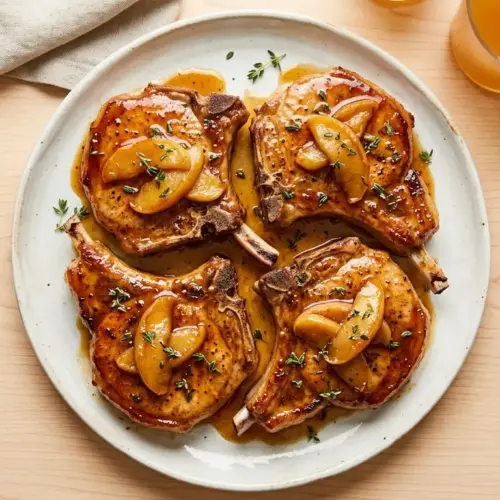
Apple Cider Glazed Pork Chops

Thick center-cut pork chops get a fast sear, then finish in a glossy, flourless reduction of apple cider, cider vinegar, and Dijon that turns syrupy on its own for a bright, savory-sweet dinner ready in about 30 minutes.
Equipment
- Large heavy skillet - 12 inch / 30 cm, cast iron or stainless steel
- Instant-read meat thermometer - for checking doneness
- Tongs - for turning the chops
- Whisk - for combining the glaze
- Cutting board - and a sharp knife
- Plate and foil - for resting the chops
Ingredients
- 4 boneless center-cut pork chops - about 6 oz / 170 g each, 1 inch / 2.5 cm thick
- 1 teaspoon kosher salt - plus more to taste
- ½ teaspoon black pepper - freshly ground
- 1 tablespoon olive oil - extra virgin
- 1 tablespoon unsalted butter
- 1 cup apple cider - 240 ml, not hard cider
- 2 tablespoons apple cider vinegar
- 2 tablespoons pure maple syrup - honey can be substituted
- 1 tablespoon Dijon mustard
- 2 cloves garlic - minced
- 1 large apple - Honeycrisp or Gala, cored and thinly sliced
- 2 sprigs fresh thyme - optional
Instructions
- Pat the pork chops completely dry on both sides with paper towels, then season evenly with the kosher salt and black pepper. Let them sit at room temperature for about 10 minutes while you measure the glaze ingredients.
- In a measuring cup or small bowl, whisk together the apple cider, apple cider vinegar, maple syrup, and Dijon mustard until smooth. Set aside within arm's reach of the stove.
- Heat the skillet over medium-high heat and add the olive oil and butter. Once the butter stops foaming, lay the chops in the pan without crowding and sear undisturbed for 3 to 4 minutes until a deep golden crust forms, then flip and cook another 3 to 4 minutes until the internal temperature reaches 145°F (63°C). Transfer to a plate and tent loosely with foil.
- Lower the heat to medium and add the minced garlic to the same skillet, stirring for about 30 seconds until fragrant. Pour in the cider mixture, whisking and scraping the bottom of the pan to lift all the browned bits, then add the sliced apple and thyme sprigs if using.
- Bring the glaze to a boil and let it bubble rapidly for 6 to 8 minutes, stirring occasionally, until the liquid reduces by more than half and coats the back of a spoon like a loose syrup. The apple slices should be soft and glossy; taste and adjust with a pinch of salt and pepper.
- Remove the thyme sprigs, then return the rested chops to the skillet along with any juices that pooled on the plate. Turn each chop to coat in the glaze, spooning the apples and sauce over the top, and serve right away while warm and glossy.
Notes
- Dry the chops thoroughly. Surface moisture steams the meat instead of searing it, so paper towels are not optional if you want a real crust.
- Do not skip the thermometer. Pull the chops at 145°F (63°C); eyeballing doneness almost always leads to overcooking and chewy meat.
- Let them rest. A three-minute rest lets the juices redistribute and carryover heat finish the cooking safely.
- Choose a firm apple. Honeycrisp or Gala hold their shape in the glaze far better than softer varieties like McIntosh, which turn to mush.
- Reduce with patience. If the glaze looks thin, keep it boiling another minute or two; it thickens more as it cools, so stop just before it looks perfect.
- Deglaze fully. Those browned bits stuck to the pan after searing are pure flavor, so scrape every one of them into the cider.
- Watch the garlic. Thirty seconds is enough; burnt garlic turns the whole glaze bitter.
- Substitutions: Apple juice can stand in for cider (add an extra splash of cider vinegar), and honey can replace maple syrup. Bone-in chops work too, but need a few extra minutes of cook time.
- Storage: Refrigerate leftovers in an airtight container for up to 3 days, or freeze individually for up to 2 months. Reheat gently on the stove or in short 30-second microwave bursts at reduced power.
- Gluten-free: As written this recipe is gluten-free since there is no flour dredge, but always check that your Dijon mustard and cider are certified gluten-free if cooking for someone with celiac disease.
Nutrition
Serving: 1ServingCalories: 360kcalCarbohydrates: 18gProtein: 34gFat: 16gSaturated Fat: 5gSodium: 640mgFiber: 2gSugar: 14g
Tried this recipe?Let us know how it was!