My first real introduction to a proper Papdi Chaat Recipe happened at a tiny street stall tucked into a busy Delhi bazaar, and I genuinely did not know food could taste like that.
It was sweet, spicy, tangy, and creamy all in a single bite, with that addictive crunch from the crispy papdi that somehow held everything together without falling apart. I spent the rest of that trip trying to eat it every single day, and when I got home, I became a little obsessed with recreating it in my own kitchen.
It took me several attempts and one genuinely embarrassing batch where I drowned the papdis in so much yogurt they turned into mush before I figured out the balance.
Now, this is the recipe I make whenever friends come over for a casual get-together or whenever I just want something that feels festive without taking all day. The chutneys can be made ahead, the assembly takes maybe ten minutes, and it never fails to impress.
| Quick Recipe Summary | |
|---|---|
| Prep Time | 20 minutes |
| Cook Time | 15 minutes (boiling potatoes and chickpeas) |
| Total Time | 35 minutes |
| Servings | 4 servings |
| Difficulty Level | Easy |
If you love bold, layered flavors, you might also enjoy my Katori Chaat Recipe — it uses a similar flavor profile in a fun edible bowl presentation.

Why You’ll Love This Papdi Chaat Recipe
This recipe is the definition of a crowd-pleaser, and it comes together faster than almost any other entertaining dish I know.
- No cooking stress: The actual “cooking” here is just boiling potatoes and chickpeas. Once those are done, it’s pure assembly.
- Make-ahead friendly: Both chutneys can be prepared a day or two in advance and stored in the fridge, which makes party day genuinely easy.
- Totally customizable: You can dial up the heat, add extra toppings, skip the onions, or swap canned chickpeas for fresh-cooked ones — the recipe is forgiving and flexible.
- Balanced flavors in every bite: The combination of creamy yogurt, sweet tamarind, fiery green chutney, and salty chaat masala creates something that hits every single flavor note.
- Vegetarian and naturally gluten-flexible: Using store-bought papdis made with all-purpose flour is the traditional choice, but baked versions are widely available for a lighter option.
- Perfect for gatherings: Lay it out on a big platter and let guests scoop their own portions — it works beautifully as a shared starter or party snack.
- Feels special without being complicated: This is genuinely one of those recipes that looks and tastes far more impressive than the effort involved.
Another chaat I love serving alongside this is my Fruit Chaat Recipe — the two together make a brilliant spread for a casual Indian-style snack table.
Ingredients
To make papdi chaat well, quality really does matter more than technique. Fresh yogurt, vibrant chutneys, and crispy (not stale) papdis are the three things you cannot compromise on.
For the Base:
- 24–30 papdi/papri crackers (store-bought or homemade; roughly 80–100g)
- 2 medium russet potatoes (about 300g / 10.5 oz), boiled, peeled, and cut into small ½-inch cubes
- 1 cup (170g / 6 oz) cooked chickpeas (canned is fine — just rinse and drain well)
For the Yogurt:
- 1½ cups (360g / 12.7 oz) full-fat plain yogurt, chilled
- 1 teaspoon powdered sugar
- A pinch of black salt (kala namak)
For the Green Chutney:
- 1 cup (30g / 1 oz) fresh coriander leaves (cilantro), tightly packed
- ¼ cup (10g / 0.35 oz) fresh mint leaves
- 1 small green chili (adjust to your heat preference)
- 1 small clove garlic
- ½-inch piece fresh ginger
- 1 teaspoon roasted cumin seeds
- 1 tablespoon lemon juice
- Salt to taste
- 2–3 tablespoons water (to blend)
For the Tamarind Chutney:
- ¼ cup (60g / 2 oz) tamarind concentrate (or 50g seedless tamarind soaked and pulped)
- 3 tablespoons jaggery or brown sugar (adjust to taste)
- ½ teaspoon roasted cumin powder
- ½ teaspoon red chili powder
- ¼ teaspoon ginger powder
- Salt to taste
- ½ cup (120ml / 4 fl oz) water
For the Spice Topping:
- 1 teaspoon chaat masala
- 1 teaspoon roasted cumin powder
- ½ teaspoon red chili powder (Kashmiri red chili for less heat and great color)
- ¼ teaspoon black salt (kala namak)
For the Garnish:
- ½ cup (30g / 1 oz) fine sev (thin crispy chickpea flour noodles)
- 1 small red onion, finely chopped (optional but adds a nice crunch)
- 2 tablespoons fresh cilantro, finely chopped
- 2 tablespoons pomegranate arils (optional but beautiful and delicious)
You might also enjoy this Chickpea and Spinach Curry Recipe if you find yourself with leftover chickpeas — it’s a great way to use them up.
Kitchen Equipment Needed
You don’t need anything fancy for papdi chaat — it’s one of the most low-equipment recipes I know.
- A medium saucepan or pot for boiling potatoes and chickpeas
- A blender or small food processor for the green chutney
- A small saucepan for making the tamarind chutney
- A mixing bowl and a whisk for the yogurt
- A sharp knife and cutting board for chopping
- A fine mesh strainer for draining chickpeas and rinsing
- Shallow serving plates or a large serving platter for presentation
- Small spoons or ladles for drizzling chutneys and yogurt
Read Also: Healthy Nachos Recipe
Recommended Products for This Recipe
These are the specific products I personally reach for when making papdi chaat at home, and each one genuinely makes a difference.
1. MDH Chaat Masala
Good chaat masala is the seasoning that makes or breaks this recipe. I’ve tried several brands, and MDH is consistently punchy, well-balanced, and authentically flavored without being overpoweringly salty. A single tablespoon transforms the entire dish.
2. Laxmi Brand Tamarind Concentrate
Making tamarind chutney from scratch with tamarind concentrate rather than a block saves a significant amount of time and effort. The Laxmi brand has a clean, deeply sour flavor that doesn’t taste processed, and a small bottle goes a long way.
3. Haldiram’s Nylon Sev
The garnish matters more than people think with papdi chaat. Haldiram’s nylon sev is extra-thin and extra-crispy, which gives that signature light crunch on top without adding bulk. Avoid thicker sev here — the nylon variety is the right call.
4. Deep Indian Ready-Made Papdi
If you don’t want to make papdi from scratch, Deep brand papdis are vacuum-sealed, properly crispy, and hold up well even after you add the wet toppings. They’re available in most Indian grocery stores and online, and honestly, they’re what I use for weeknight versions of this dish.
You might also love my Healthy Hummus Recipe — it’s another easy, crowd-pleasing dip that works beautifully on a snack platter alongside papdi chaat.

Step-by-Step Instructions: How to Make Papdi Chaat
Step 1: Prep the Chickpeas
- If using dried chickpeas, soak them overnight (8 hours minimum) in plenty of cold water. They will roughly double in size.
- Drain and rinse the soaked chickpeas thoroughly under cold running water.
- Transfer them to a pot, cover with fresh water, add a generous pinch of salt, and bring to a boil.
- Reduce the heat to medium-low and simmer for 45–60 minutes until the chickpeas are completely tender but not mushy. They should hold their shape when you press them.
- If using canned chickpeas, simply open the can, drain in a strainer, and rinse well under cold running water. Set aside.
Step 2: Boil the Potatoes
- Place the whole potatoes (skin on) in a pot and cover with cold water by at least 1 inch (2.5cm).
- Bring to a boil over high heat, then reduce to medium and cook for 20–25 minutes until completely fork-tender. A skewer or knife should slide in with no resistance.
- Drain the potatoes and let them cool at room temperature until safe to handle — about 10–15 minutes.
- Peel off the skins, then dice into small ½-inch (about 1.5cm) cubes. Aim for uniform size so every bite has a similar texture.
- Set aside in a bowl at room temperature. You can lightly season with a pinch of salt and chaat masala if you like.
Step 3: Make the Green Chutney
- Add the fresh cilantro leaves, mint leaves, green chili, garlic clove, ginger piece, roasted cumin seeds, lemon juice, and salt to your blender or small food processor.
- Add 2–3 tablespoons of water — just enough to get things moving, not so much that it becomes watery.
- Blend on high until completely smooth. Scrape down the sides once or twice to make sure everything is incorporated.
- Taste and adjust — if it needs more heat, add more chili; if it needs more brightness, add a little more lemon juice.
- Transfer to a small bowl and refrigerate until needed. This chutney keeps well for up to 2 days in the fridge.
Step 4: Make the Tamarind Chutney
- Combine the tamarind concentrate (or pulped tamarind), jaggery, and water in a small saucepan over medium heat.
- Stir until the jaggery fully dissolves into the liquid — this usually takes 2–3 minutes.
- Add the roasted cumin powder, red chili powder, ginger powder, and salt.
- Continue cooking on medium-low heat for 6–8 minutes, stirring occasionally, until the chutney thickens enough to coat the back of a spoon.
- Remove from heat, let cool completely, and taste. Adjust sweetness with more jaggery or tanginess with a small squeeze of lemon juice if needed.
- Store in the fridge until ready to use. This chutney can be made up to a week in advance.
Step 5: Prepare the Yogurt
- Pour the chilled yogurt into a mixing bowl.
- Add the powdered sugar and pinch of black salt (kala namak).
- Whisk vigorously for about 1–2 minutes until the yogurt is completely smooth, glossy, and has a thick but pourable consistency.
- If your yogurt is very thick (like Greek yogurt), add 1–2 tablespoons of cold water and whisk again. You want it to flow, not sit in a stiff lump.
- Taste it — it should be slightly sweet with that subtle sulphurous note from the black salt. Cover the bowl and keep it in the fridge until you’re ready to assemble.
Step 6: Assemble the Papdi Chaat
- Arrange 6–8 papdi crackers on each serving plate in a single layer. Don’t pile them — you want them spread out so every cracker gets toppings.
- Scatter a generous spoonful of cubed potatoes over the papdis, making sure each cracker gets a bit.
- Add a spoonful of cooked chickpeas over the top, spreading them evenly across the plate.
- Spoon the whisked yogurt over everything, drizzling it generously so it covers most of the surface. Don’t be shy here — this is the creamy base that ties everything together.
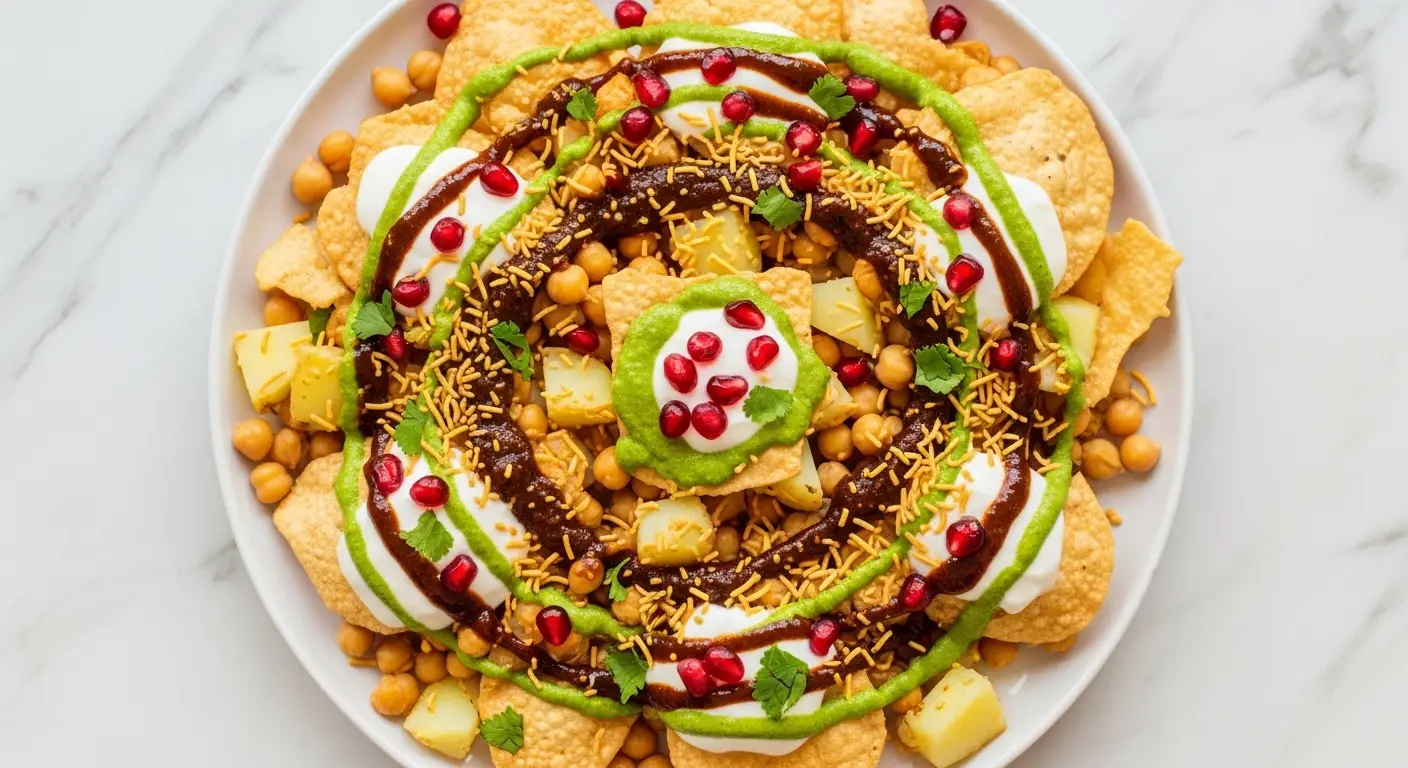
- Drizzle the green chutney in a zigzag pattern across the plate. Use about 1–2 teaspoons per serving, more if you love heat.
- Follow with the tamarind chutney in a similar zigzag or swirl pattern, using about 1–2 teaspoons. The contrast of the bright green and dark brown chutneys looks beautiful.
- Add the finely chopped red onion now if you’re using it — scatter it over the top for crunch and bite.
Step 7: Season and Garnish
- Sprinkle chaat masala evenly over the entire plate — about ¼ teaspoon per serving is a good starting point.
- Follow with a pinch of roasted cumin powder, a light dusting of red chili powder or Kashmiri red chili powder for color and warmth, and a tiny pinch of black salt.
- Scatter a generous handful of nylon sev over the top — this is the final crunch layer, so don’t skimp.
- Add finely chopped cilantro for freshness and a scattering of pomegranate arils for a jewel-like finish and sweet pop.
- Serve immediately. Papdi chaat waits for no one — the longer it sits, the soggier the papdis become.
Read Also: Chickpea Salad Recipe

Tips for The Best Papdi Chaat
A few small choices make the difference between good papdi chaat and the kind that people talk about for days.
- Keep the yogurt cold. Warm or room-temperature yogurt makes the dish feel heavy. Pull it from the fridge and whisk it right before you plate everything.
- Never use sour yogurt. Papdi chaat already has plenty of tang from the chutneys. If your yogurt is sour, balance it with a bit of extra sugar before using.
- Thick chutneys are better than thin ones. If your chutneys are too watery, they’ll pool at the bottom of the plate instead of sitting on top. Cook the tamarind chutney down more, and use less water in the green chutney.
- Assemble just before serving. The papdis soften quickly once wet toppings hit them. If you’re making this for a party, lay out all the components and assemble individual plates right as guests sit down, or set up a DIY chaat station.
- Toast the cumin before grinding. Dry-roast whole cumin seeds in a small pan for 1–2 minutes until fragrant, then grind them. Pre-ground cumin powder works, but freshly roasted and ground cumin has a far more aromatic flavor.
- Use quality papdi. Stale or old papdis will taste rancid. If you’re using store-bought, check the freshness date and taste one before assembling your whole plate. They should be very crisp and completely neutral in flavor.
- Cut the potato cubes small and even. Large chunks are hard to eat with papdi, and they throw off the balance. Aim for ½-inch cubes or smaller so they nestle between the crackers naturally.
- Don’t skip the black salt (kala namak). This is the sulfurous, slightly egg-like salt that gives authentic chaat its distinctive savory depth. Regular salt is not a substitute here — it changes the character of the dish entirely.
My Tzatziki Sauce Recipe is another yogurt-based sauce that follows a similar logic — thick, cold, and well-seasoned makes all the difference.
What to Serve with Papdi Chaat
Papdi chaat works beautifully as a starter or a snack on its own, but it also fits naturally into a broader spread.
Papdi chaat is most at home on an Indian-style snack table, surrounded by other street food favorites and finger foods that can all be eaten without much fuss.
- Katori Chaat — the two chaat dishes together make a fantastic party spread, and the crispy edible bowls of katori chaat are a wonderful visual contrast
- Fruit Chaat — the sweet, spiced fruit version balances the savory richness of papdi chaat perfectly
- Healthy Nachos — if you’re making a mixed snack table with guests who aren’t familiar with Indian food, these are great alongside
- Chickpea and Spinach Curry — if you want to extend the meal into a fuller dinner, this makes a satisfying main course after the chaat starter
- Healthy Hummus — a great addition to a mezze-style spread where the papdi chaat anchors the Indian section
- Mexican Street Corn — the bold, charred flavor of street corn works surprisingly well alongside the tangy brightness of chaat when you’re doing a global street food theme
- Curry Chicken Salad — for a meal where chaat is the starter and you want to stay in a similar flavor world, this salad carries those warm spiced notes forward beautifully
Another favorite: Healthy Coleslaw Recipe
Variations of Papdi Chaat
The standard recipe is beloved for a reason, but there’s plenty of room to play once you’ve made it a few times.
Classic papdi chaat is endlessly adaptable, and different regions of India have their own takes on it that are all worth trying.
- Dahi Bhalla Papdi Chaat: Add soaked and squeezed urad dal fritters (dahi bhalla or dahi vada) to the plate before the yogurt layer. The pillowy fritters soak up the chutneys beautifully and add a completely different texture.
- Aloo Tikki Chaat: Replace the plain boiled potato cubes with small pan-fried spiced potato patties (aloo tikki). The crispy exterior of the tikki adds another dimension of crunch.
- Sprouted Moong Papdi Chaat: Add a handful of sprouted moong beans (green mung sprouts) as an extra topping. They add a fresh, slightly nutty flavor and a nutritional boost.
- Boondi Papdi Chaat: Scatter a handful of soaked boondi (tiny chickpea flour balls) over the plate just before serving. Soaking them briefly in water softens them slightly so they aren’t too crunchy.
- Vegan Papdi Chaat: Swap the dairy yogurt for a thick, unsweetened plant-based yogurt (almond or coconut yogurt work well). The flavor profile stays intact as long as the yogurt isn’t sour.
- Baked Papdi Version: Use baked papdis instead of fried ones for a noticeably lighter result. The texture is a touch less flaky but still very satisfying, and they hold up slightly longer before softening.
- Mumbai-Style Papdi Chaat: Add finely chopped onions, chopped tomatoes, and a squeeze of lime over the top. Mumbai street vendors often include these for extra freshness and texture.
Read Also: Healthy Cabbage Skillet with Quinoa and Chickpeas Recipe
Storage and Reheating
Papdi chaat is one of those dishes that simply does not store well once assembled — and that’s just the nature of the beast.
The components, however, store beautifully and make the recipe very easy to plan ahead.
- Green Chutney: Transfer to an airtight jar and refrigerate for up to 2 days. For longer storage, freeze in an ice cube tray and pop the cubes into a bag — they last up to 3 months frozen.
- Tamarind Chutney: Store in a sealed jar in the fridge for up to 2 weeks. It actually improves after a day or two as the flavors deepen.
- Whisked Yogurt: Prepared yogurt (with sugar and black salt) keeps covered in the fridge for 1 day.
- Boiled Potatoes: Store cut, boiled potatoes in an airtight container in the fridge for up to 2 days. Keep them plain (unseasoned) until assembly.
- Cooked Chickpeas: Refrigerate in their cooking liquid or a sealed container for up to 4 days. Drain before using.
- Papdi Crackers: Keep in their original sealed packaging at room temperature. Once opened, transfer to an airtight container to preserve the crunch. They’ll stay crispy for 1–2 weeks.
- Do not assemble ahead: Assembled papdi chaat becomes soggy within 10–15 minutes. Always assemble just before eating. There is no way to revive a soggy assembled plate.
You might also enjoy: Lentil Soup Recipe
Nutritional Facts
The following is an approximate nutritional breakdown per serving (1 plate, roughly 6–8 papdis with toppings as described), based on using store-bought fried papdi and full-fat yogurt. Actual values vary depending on brands and portion sizes.
| Nutrient | Per Serving (Approx.) | ||| | Calories | 280–320 kcal | | Carbohydrates | 38–42g | | Protein | 9–11g | | Fat | 10–13g | | Saturated Fat | 3–4g | | Fiber | 5–7g | | Sugar | 10–12g | | Sodium | 600–800mg | | Calcium | 180–200mg | | Iron | 2–3mg |
Note: Using baked papdi significantly reduces the fat and calorie count. Swapping full-fat yogurt for low-fat reduces saturated fat further. The chickpeas and yogurt together make this a reasonably protein-rich snack for a non-meat dish.
Read Also: Healthy Fried Rice Recipe
Health Benefits of Key Ingredients
Papdi chaat isn’t just delicious — several of its key ingredients carry meaningful nutritional value.
While fried papdi is definitely the indulgent element, the rest of the dish is actually packed with ingredients that do good things for you.
- Chickpeas: High in plant-based protein and soluble fiber, which supports digestive health and helps regulate blood sugar. They’re also a good source of iron, folate, and manganese.
- Plain yogurt: Rich in probiotics that support gut microbiome health, plus a solid source of calcium, phosphorus, and B vitamins. Full-fat yogurt also provides sustained satiety.
- Fresh cilantro and mint: Both herbs are loaded with antioxidants and have anti-inflammatory properties. Cilantro in particular has been studied for its potential to support healthy blood sugar levels.
- Tamarind: A good source of tartaric acid (which acts as an antioxidant), along with B vitamins, magnesium, and potassium. Traditional Ayurvedic medicine has long used it to aid digestion.
- Ginger (in green chutney): Contains gingerols, which are well-documented for their anti-nausea and anti-inflammatory effects. Even the small amount in chutney contributes.
- Lemon juice: A concentrated source of vitamin C, which supports immune function and helps with iron absorption from plant sources like chickpeas.
- Pomegranate arils (garnish): Exceptionally high in polyphenol antioxidants, especially punicalagins, which have been linked to reduced inflammation and heart health benefits.
- Boiled potatoes: A good source of potassium, vitamin B6, and vitamin C. Boiling rather than frying keeps the caloric load low while preserving most of the nutritional value.
My Chickpea Salad Recipe is another great way to enjoy the nutritional benefits of chickpeas in a fresh, no-cook format.
FAQs About Papdi Chaat
1. What is the difference between papdi chaat and other chaats like sev puri or bhel puri?
Papdi chaat is specifically built around crispy flat papdi wafers as the base, topped with yogurt, boiled vegetables, and chutneys. Sev puri uses a similar base but typically skips the yogurt and focuses more on raw vegetables and sev as the star topping. Bhel puri is made with puffed rice (murmura) rather than papdi, and has a drier, more salad-like texture without the heavy yogurt component.
2. Can I use store-bought papdis instead of making them from scratch?
Absolutely — and this is what I recommend for most home cooks. Store-bought papdis are widely available in Indian grocery stores and online, and the quality is very good in vacuum-sealed packets. The only thing to watch is freshness: open the packet only when you’re ready to assemble, and taste one first to make sure they’re crispy and don’t have a rancid or stale flavor.
3. What can I use if I can’t find kala namak (black salt)?
Black salt is worth seeking out — even a small jar lasts months and genuinely changes the flavor of chaat in a way that regular salt cannot replicate. That said, if you truly can’t find it, you can substitute with a small amount of regular salt plus a tiny pinch of celery salt, which gives a mildly savory, sulfurous note. The flavor won’t be identical, but the dish will still be delicious.
4. How do I keep papdi chaat from getting soggy at a party?
The best approach for parties is a DIY chaat station. Set out all the components in separate bowls — papdi, potatoes, chickpeas, yogurt, both chutneys, spices, and garnishes — along with small plates and spoons. Guests assemble their own portions, which means nothing gets soggy. If you must pre-assemble, do it no more than 5 minutes before serving, and keep the yogurt and chutneys slightly thicker than usual so they don’t spread and saturate the papdi as quickly.
5. Is papdi chaat gluten-free?
Traditional papdi is made with all-purpose flour or whole wheat flour, so it is not gluten-free. However, you can make a gluten-free version using rice flour papdi, which is available in some specialty stores, or by using thin rice crackers as a substitute. The chutneys, yogurt, chickpeas, and potatoes are all naturally gluten-free, so the only substitution needed is in the crackers themselves.
Read Also: Guacamole Recipe
Papdi Chaat
Ingredients
- 24-30 papdi crackers - store-bought or homemade; roughly 80-100g
- 2 medium russet potatoes - about 300g / 10.5 oz, boiled, peeled, and cut into small 1/2-inch cubes
- 1 cup cooked chickpeas - 170g / 6 oz; canned is fine, rinsed and drained well
- 1 1/2 cups full-fat plain yogurt - 360g / 12.7 oz, chilled
- 1 tsp powdered sugar
- 1 pinch black salt - kala namak
- 1 cup fresh cilantro leaves - 30g / 1 oz, tightly packed
- 1/4 cup fresh mint leaves - 10g / 0.35 oz
- 1 small green chili - adjust to heat preference
- 1 small clove garlic
- 1/2 inch fresh ginger - about 1.5cm piece
- 1 tsp roasted cumin seeds
- 1 tbsp lemon juice - freshly squeezed
- salt - to taste
- 2-3 tbsp water - to help blend the chutney
- 1/4 cup tamarind concentrate - 60g / 2 oz; or 50g seedless tamarind soaked and pulped
- 3 tbsp jaggery or brown sugar - adjust to taste
- 1/2 tsp roasted cumin powder
- 1/2 tsp red chili powder
- 1/4 tsp ginger powder
- salt - to taste
- 1/2 cup water - 120ml / 4 fl oz
- 1 tsp chaat masala
- 1 tsp roasted cumin powder
- 1/2 tsp red chili powder - Kashmiri red chili recommended for less heat and better color
- 1/4 tsp black salt - kala namak
- 1/2 cup nylon sev - 30g / 1 oz; thin crispy chickpea flour noodles
- 1 small red onion - finely chopped; optional but adds crunch
- 2 tbsp fresh cilantro - finely chopped
- 2 tbsp pomegranate arils - optional; adds color and a sweet pop
Equipment
- Medium saucepan or pot - For boiling potatoes and chickpeas
- Blender or small food processor - For making the green chutney
- Small saucepan - For cooking the tamarind chutney
- Mixing bowl - For whisking the yogurt
- Whisk - For whisking the yogurt smooth
- Sharp knife and cutting board - For dicing potatoes and chopping garnishes
- Fine-mesh strainer - For draining and rinsing chickpeas
- Serving platter or shallow plates - For assembling and presenting the chaat
- Small spoons or ladles - For drizzling chutneys and yogurt
Method
- If using canned chickpeas, drain and rinse them thoroughly under cold running water and set aside. If using dried chickpeas, soak overnight, drain, then simmer in salted water for 45-60 minutes until tender but holding their shape.
- Place whole potatoes in a pot, cover with cold water, and boil for 20-25 minutes until completely fork-tender. Drain, cool, peel, and dice into small 1/2-inch (1.5cm) cubes.
- Blend cilantro, mint, green chili, garlic, ginger, roasted cumin seeds, lemon juice, salt, and 2-3 tablespoons of water until completely smooth. Refrigerate until needed.
- Combine tamarind concentrate, jaggery, water, cumin powder, chili powder, ginger powder, and salt in a small saucepan over medium heat, stirring until the jaggery dissolves. Simmer 6-8 minutes until thick enough to coat the back of a spoon, then cool completely.
- Whisk together the chilled yogurt, powdered sugar, and a pinch of black salt until completely smooth and pourable. If using thick Greek-style yogurt, add 1-2 tablespoons of cold water and whisk again. Refrigerate until assembly.
- Arrange 6-8 papdi crackers in a single layer on each serving plate, then scatter cubed potatoes and chickpeas evenly over the top. Spoon the whisked yogurt generously over everything, then drizzle both chutneys in a zigzag pattern across the plate.
- Sprinkle chaat masala, roasted cumin powder, red chili powder, and black salt evenly over each plate. Finish with a generous handful of nylon sev, chopped red onion, fresh cilantro, and pomegranate arils, then serve immediately.
Nutrition
Notes
- Assemble papdi chaat just before serving — the papdis soften within 10-15 minutes of adding wet toppings and cannot be revived once soggy.
- Both chutneys can be made 1-2 days in advance and refrigerated. The tamarind chutney keeps for up to 2 weeks in the fridge.
- Always use chilled yogurt and whisk it smooth right before plating. Warm yogurt makes the dish feel heavy and flat.
- Black salt (kala namak) is essential for authentic chaat flavor — its sulphurous, savory note cannot be replicated with regular salt. Find it at Indian grocery stores or online.
- For a party, set up a DIY chaat station with all components in separate bowls so guests can assemble their own plates, keeping the papdis crispy throughout the event.
- Dry-roast whole cumin seeds for 1-2 minutes before grinding for a far more aromatic flavor than pre-ground cumin powder.
- If your tamarind chutney is too thin, continue simmering for a few more minutes — it should coat the back of a spoon before you take it off the heat.
- For a vegan version, substitute a thick unsweetened plant-based yogurt (almond or coconut yogurt) in equal quantity — the flavor profile stays intact.
- Freeze leftover green chutney in an ice cube tray and store the cubes in a freezer bag for up to 3 months.
- Use nylon (fine) sev rather than thick sev for the garnish — the thin variety gives a light, airy crunch without adding unwanted bulk to each bite.
Private Notes
Tried this recipe?
Let us know how it was!Final Thoughts
If you’ve been curious about Indian street food but weren’t sure where to start, this is genuinely one of the most approachable and rewarding dishes to try first. The flavors are bold and layered, but the process is relaxed and forgiving.
Make the chutneys the day before and you’ll find that the whole thing comes together in minutes on the day. That’s the kind of recipe I keep coming back to.
I really hope you give this papdi chaat a go — it has a way of winning people over on the very first bite. Drop a comment below and let me know how it turned out, or share a photo if you make it for a gathering.
Recommended:
- Katori Chaat Recipe
- Fruit Chaat Recipe
- Chickpea and Spinach Curry Recipe
- Healthy Nachos Recipe
- Healthy Hummus Recipe
- Mexican Street Corn Recipe
- Chickpea Salad Recipe
- Lentil Soup Recipe
- Curry Chicken Salad Recipe
- Healthy Cabbage Skillet with Quinoa and Chickpeas Recipe