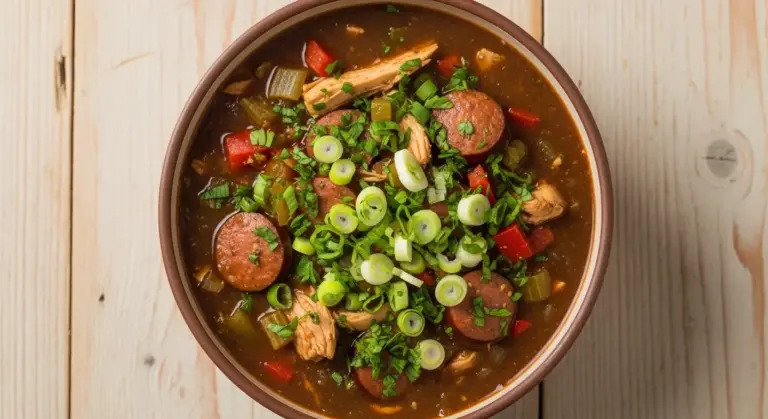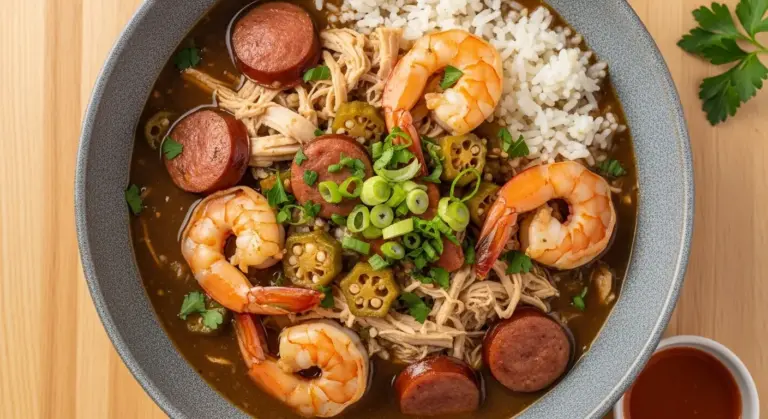
This Chicken and Sausage Gumbo Recipe is the one I keep coming back to every single winter. I first made it after spending a long weekend in New Orleans years ago, completely obsessed with every bowl I ate, and determined to recreate that deep, smoky flavor the moment I got home.
It took me a few tries to get the roux right. My first attempt turned it into something closer to library paste than the rich mahogany base you need, but once I figured out that patience is basically the whole secret, everything clicked.
This recipe is the classic Louisiana-style version: a dark, nutty roux, the holy trinity of vegetables, bone-in chicken thighs, andouille sausage, and just enough heat to make you reach for your glass. It’s a project worth every minute.
| Quick Recipe Summary | |
|---|---|
| Prep Time | 30 minutes |
| Cook Time | 2 hours 15 minutes |
| Total Time | 2 hours 45 minutes |
| Servings | 8 servings |
| Difficulty Level | Intermediate |
If you love hearty Southern comfort food, you’ll also enjoy this Chicken Stew, which shares a lot of the same soul-warming energy.
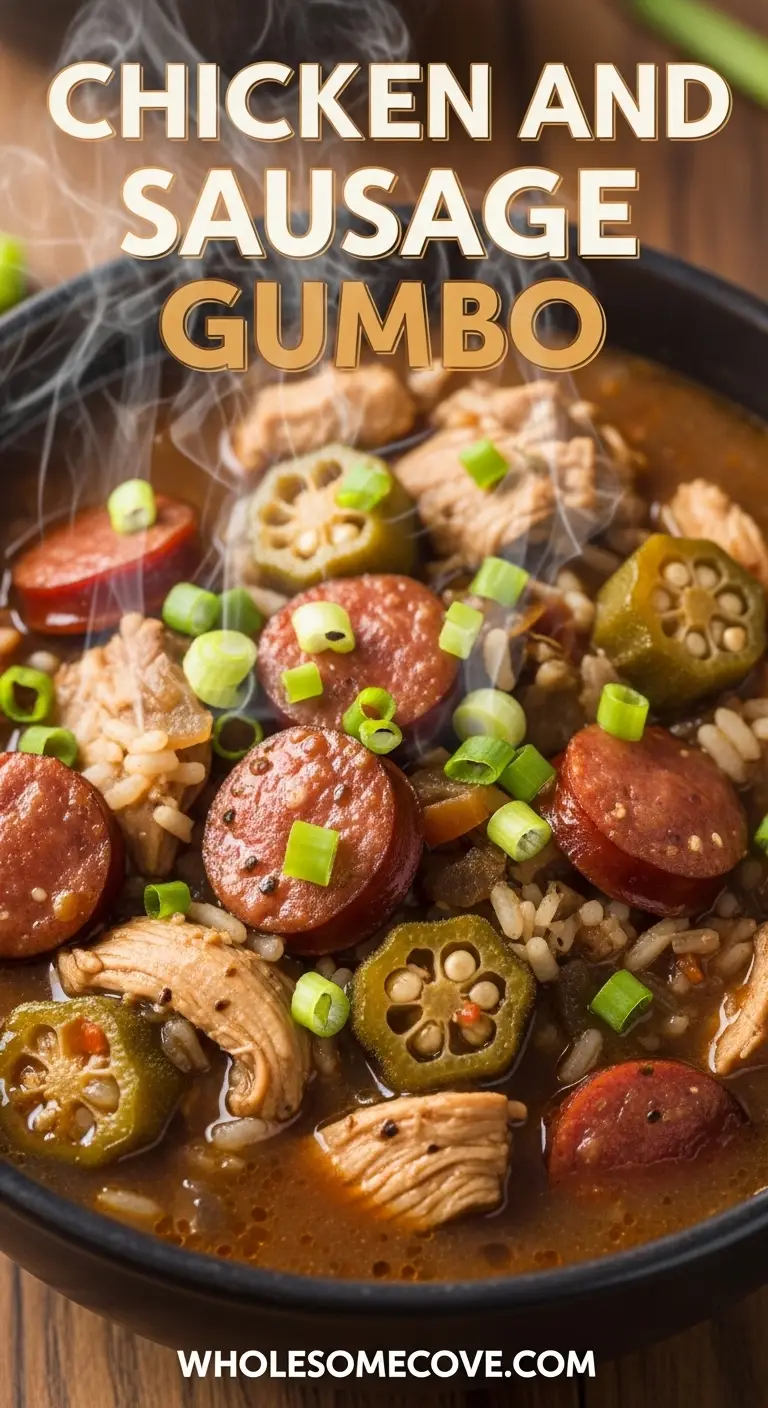
Why You’ll Love This Chicken and Sausage Gumbo Recipe
This gumbo is the kind of meal that fills a house with the most incredible smell as it simmers. It’s deeply comforting and packed with layers of flavor you simply can’t rush.
- It’s a true one-pot dinner. You build everything in a single Dutch oven, which means incredible layered flavor and minimal cleanup at the end of the night.
- The dark roux is the star. Cooking the flour and fat low and slow until it turns a deep chocolate brown creates a nutty, complex base you can’t get from shortcuts, and it’s absolutely worth it.
- It feeds a crowd beautifully. This recipe makes eight generous servings, which makes it perfect for family dinners, potlucks, or any weekend gathering where you want to seriously impress people.
- The flavor only gets better with time. Like most slow-cooked dishes, gumbo tastes even more incredible on day two or three, making it one of the best meals you can prep ahead for the week.
- It’s deeply customizable. Once you’ve nailed the base, you can swap proteins, adjust the heat level, and make it entirely your own without losing any of the magic.
- It’s a recipe with real history and tradition. Making gumbo connects you to generations of Southern cooking, and sharing a bowl of it with someone is genuinely one of the best things you can do.
You might also enjoy this Brunswick Stew, another classic Southern slow-cooked dish with a wonderful depth of flavor.
Ingredients
Every single ingredient here has a job to do. I’ve written in both cups/ounces and grams where it matters, so no matter where you’re cooking from, you’re covered.
- Chicken thighs, bone-in and skin-on: 3 lbs (1.36 kg), about 6 pieces. Bone-in thighs give the broth an incredible richness that boneless chicken just can’t match. I’ve tried both and there’s no contest.
- Andouille sausage: 1 lb (454 g), sliced into 1/4-inch (6mm) rounds. This smoked, spiced sausage is the backbone of authentic gumbo flavor. Don’t substitute with regular smoked sausage if you can help it.
- All-purpose flour: 1 cup (125 g). This forms the roux along with the oil, and the ratio here is intentionally equal parts, by weight ideally.
- Vegetable oil or rendered lard: 1 cup (240 ml). A neutral oil works, but I’ve made this with lard and the flavor is noticeably richer.
- Yellow onion: 1 large (about 2 cups / 300 g), diced.
- Green bell pepper: 1 large (about 1 cup / 150 g), diced. This is part of the “holy trinity” of Cajun and Creole cooking alongside the onion and celery.
- Celery: 3 stalks (about 1 cup / 100 g), diced.
- Garlic: 6 cloves, minced. I always use more garlic than most recipes call for. You can pull back to 4 cloves if you prefer.
- Chicken broth or stock: 6 cups (1.4 liters). A good homemade or store-bought low-sodium stock makes a real difference here.
- Okra: 1 1/2 cups (170 g), fresh or frozen, sliced into 1/2-inch (12mm) rounds. Okra acts as a natural thickener and adds an authentic texture. I personally love it in here.
- Diced tomatoes: 1 can (14.5 oz / 411 g), drained. This adds a subtle acidity that balances the rich roux.
- Bay leaves: 2 whole.
- Cajun seasoning: 2 teaspoons. Store-bought is fine, but if you want to make your own, check out the homemade sausage seasoning on the site for seasoning inspiration.
- Dried thyme: 1 teaspoon.
- Dried oregano: 1/2 teaspoon.
- Black pepper: 1/2 teaspoon, freshly ground.
- Cayenne pepper: 1/4 teaspoon, or more to taste.
- Salt: to taste (about 1 to 1.5 teaspoons, depending on your broth’s sodium).
- Worcestershire sauce: 2 teaspoons. Just a small splash adds a lovely savory depth.
- File powder: 1 teaspoon (optional, but traditional). File powder is ground sassafras leaves and acts as both a seasoning and a mild thickener. Add it off the heat.
- Cooked white rice: for serving. Long-grain white rice is the traditional companion.
- Green onions and fresh parsley: for garnish, finely chopped.
Read Also: Sausage Gnocchi Soup Recipe
Kitchen Equipment Needed
You don’t need a specialty kitchen to make this, but having the right pots and tools will make the whole process smoother, especially for the roux where heat control is everything.
- Heavy-bottomed Dutch oven or enameled cast iron pot (6-quart / 5.7-liter minimum): This is the single most important piece of equipment. A heavy bottom prevents the roux from scorching, which is the number one way a gumbo can go wrong.
- Wooden spoon or heat-resistant silicone spatula: You’ll be stirring the roux constantly, so something long and sturdy that can handle sustained heat is essential.
- Sharp chef’s knife and cutting board: For dicing the holy trinity and slicing the sausage.
- Instant-read kitchen thermometer: Optional, but incredibly helpful for checking that your chicken is cooked through (165°F / 74°C internal).
- Tongs: For safely handling the hot chicken pieces when searing and later when pulling the meat off the bone.
- Large mixing bowl: For resting and shredding the cooked chicken.
- Ladle: For serving. Gumbo is meant to be ladled generously over rice.
- Measuring cups and spoons: Precise measurements matter most for the roux, so don’t eyeball the flour and oil.
- Rice cooker or medium saucepan: For preparing the white rice to serve alongside.
You might also love this comforting Chicken Soup, another classic that relies on some of the same foundational techniques.
Recommended Products for This Recipe
After making this gumbo more times than I can count, these are the products that have genuinely made a difference in how the dish turns out. I only recommend things I actually use and trust.
1. Lodge Enameled Cast Iron Dutch Oven
A heavy, enameled Dutch oven is the single most important piece of equipment for making gumbo. The thick bottom distributes heat evenly, which is what keeps your roux from burning before it can develop that deep chocolate color. I have been using mine for years and it has never let me down.
2. Authentic Andouille Sausage
The quality of your andouille matters enormously in this recipe. A good andouille has a smoky, spicy punch that cheap smoked sausage simply can’t replicate, and it infuses the whole pot with incredible flavor as it cooks. Look for a brand made in Louisiana for the most authentic result.
3. Zatarain’s File Powder
File powder is the traditional finishing touch in Louisiana gumbo and it adds a faint, earthy flavor and a little extra thickening that no other ingredient can replicate. It’s stirred in at the very end, off the heat, and a little goes a long way. If you’ve never cooked with it before, you’ll wonder how you made gumbo without it.
4. Premium Cajun Seasoning Blend
A high-quality Cajun seasoning blend makes a noticeable difference in the depth of flavor you get here, especially one that is not mostly salt. I like using a blend with a good balance of paprika, garlic, and heat so I can control the salt levels myself throughout cooking.
For another hearty Southern-style dish, check out this Cowboy Stew, which is equally filling and packed with bold flavors.

Step-by-Step Instructions: How to Make Chicken and Sausage Gumbo
1. Season and Sear the Chicken
- Pat the chicken thighs completely dry with paper towels. This step is critical for getting a good sear; any moisture on the surface will steam the chicken instead of browning it.
- Season all sides generously with about 1 teaspoon of salt, 1/4 teaspoon of black pepper, and 1 teaspoon of the Cajun seasoning.
- Heat 2 tablespoons of vegetable oil in your Dutch oven over medium-high heat until the oil shimmers but does not smoke.
- Place the chicken thighs skin-side down in the pot. Do not overcrowd the pan; sear in batches if needed.
- Sear for 4 to 5 minutes without moving them until the skin is deeply golden brown and releases easily from the pan. Flip and sear the other side for 3 minutes.
- Transfer the seared chicken to a plate and set aside. The chicken will finish cooking in the gumbo liquid later; it does not need to be cooked through at this stage.
2. Brown the Andouille Sausage
- In the same pot with the remaining drippings, add the sliced andouille sausage in a single layer over medium-high heat.
- Cook for 2 to 3 minutes, stirring once or twice, until the sausage slices are nicely browned and have released some of their flavorful fat into the pot.
- Remove the sausage with a slotted spoon and set aside with the chicken. Leave any fat and browned bits in the bottom of the pot; that’s pure flavor for your roux.
3. Make the Dark Roux (This Is the Most Important Step)
- Reduce the heat to medium. Add the remaining oil (or lard) to the pot so you have approximately 1 cup (240 ml) of fat total in the pot, combined with the drippings already there. If you have more than 1 cup of drippings, pour off the excess first.
- Add the flour all at once and immediately begin stirring with a wooden spoon or heat-resistant spatula, making sure to scrape all the way to the edges and bottom of the pot.
- Stir constantly and continuously. Do not walk away. A dark roux requires your full, undivided attention for 25 to 40 minutes.
- As the roux cooks, it will turn from a pale paste to blonde, then tan, then peanut butter colored, then a reddish-brown, and finally a deep milk-chocolate brown. You want it the color of dark chocolate or a very dark brick red. The darker it gets (without burning), the more complex your gumbo’s flavor will be.
- If at any point you see or smell scorching or detect black specks in the roux, reduce your heat immediately. A burnt roux cannot be saved and you will need to start over.
- Once the roux has reached a deep chocolate-brown color, you are ready for the next step. The whole kitchen should smell wonderfully nutty at this point.
4. Cook the Holy Trinity
- Carefully add the diced onion, green bell pepper, and celery to the hot roux all at once. Be cautious: the moisture from the vegetables will cause the roux to sizzle aggressively.
- Stir immediately and continuously to coat all the vegetables in the roux.
- Cook over medium heat, stirring frequently, for 8 to 10 minutes until the vegetables have softened significantly and the onions are translucent and beginning to turn golden at the edges.
- Add the minced garlic and stir to combine. Cook for another 1 to 2 minutes until the garlic is fragrant. Don’t let it brown.
5. Build the Gumbo Base
- Slowly pour in about 1 cup (240 ml) of the chicken broth while stirring constantly. This tempers the roux and prevents lumps from forming. Stir until fully incorporated before adding more.
- Continue adding the remaining broth one cup at a time, stirring well after each addition, until all 6 cups are fully incorporated and the mixture is smooth.
- Add the drained diced tomatoes, bay leaves, dried thyme, dried oregano, remaining Cajun seasoning (1 teaspoon), cayenne pepper, remaining black pepper, and Worcestershire sauce. Stir to combine everything thoroughly.
- Return the seared chicken thighs to the pot along with any accumulated juices on the plate. Nestle them into the liquid; they should be mostly submerged.
- Bring the gumbo to a boil over medium-high heat, then reduce the heat to low and cover the pot partially with the lid (leaving a small gap to allow steam to escape).
- Simmer gently for 45 minutes to 1 hour, stirring occasionally, until the chicken is very tender and falling off the bone.
6. Shred the Chicken and Add the Sausage
- Using tongs, carefully remove the cooked chicken thighs from the pot and place them in a large bowl. Allow them to cool for 5 to 10 minutes until you can handle them comfortably.
- Remove and discard the skin and bones. Use two forks or your fingers to shred the chicken meat into large, rustic pieces.
- Return the shredded chicken to the pot along with the reserved andouille sausage slices. Stir to combine.
7. Add the Okra and Simmer
- Add the sliced okra to the pot and stir gently to incorporate it into the gumbo.
- Continue to simmer uncovered over low heat for an additional 20 to 30 minutes. The okra will release a natural mucilaginous compound as it cooks that helps thicken the gumbo further.
- Taste the gumbo and adjust seasoning at this stage: add more salt, cayenne, or Cajun seasoning to your preference.
- Remove and discard the bay leaves.
8. Finish and Serve
- Remove the pot from the heat. If using file powder, stir it in now, off the heat. Never add file powder while the gumbo is still actively boiling, as it can become stringy and unpleasant.
- Prepare your white rice according to package directions if you haven’t already.
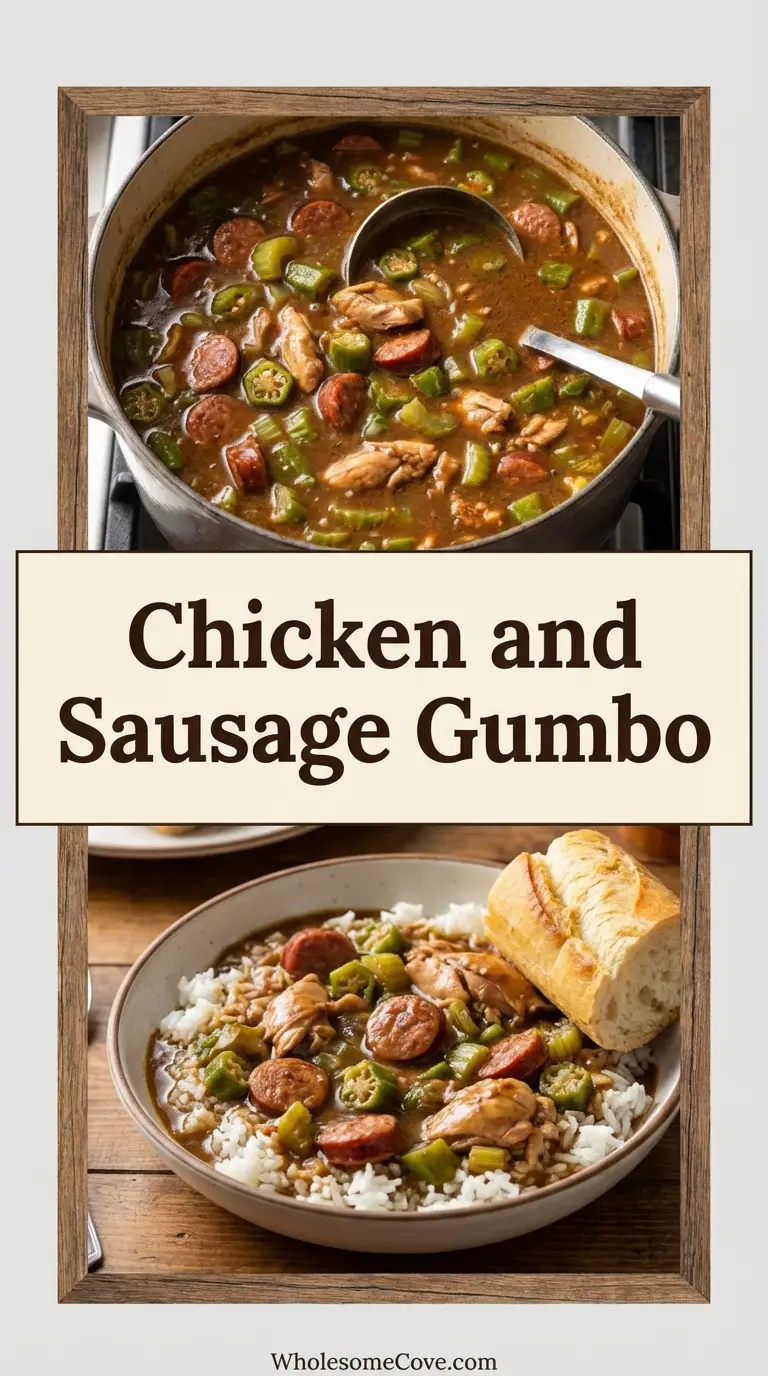
- To serve, place a generous scoop of cooked rice in the center of a deep bowl, then ladle the hot gumbo around and over the rice.
- Garnish with freshly sliced green onions and chopped fresh parsley. Serve immediately and enjoy every single bite.
For another deeply satisfying one-pot Southern meal, have a look at this Cowboy Stew, which feeds a crowd with equally bold flavors.
Tips for The Best Chicken and Sausage Gumbo
Making gumbo well is about understanding the technique, not just following the steps. These are the things I wish someone had told me before my first attempt.
- Never rush the roux. The single most common mistake is cooking the roux too fast over high heat. Medium to medium-low heat gives you the control you need to reach a dark brown without burning it. If you have any doubt, drop the heat.
- Use equal parts flour and fat by volume, not weight. Many beginners get tripped up on this. For a dark roux, you need a 1:1 ratio by volume, so 1 cup of fat to 1 cup of flour.
- Bone-in chicken makes infinitely better gumbo. The collagen from the bones and the gelatin from the skin enriches the broth in a way that boneless chicken simply cannot. Please don’t skip this.
- Add the vegetables to a very hot roux cautiously. Have your diced vegetables ready right next to the stove before the roux reaches the right color so you can add them immediately. The cold vegetables will stop the roux from continuing to darken.
- Don’t cover the pot completely while simmering. You want some evaporation to happen, which concentrates the flavors. A partially covered pot strikes the right balance.
- Season in layers, not all at once. Season the chicken before searing, add seasoning to the base, and then adjust again at the end. This builds a much more complex flavor than adding everything at the end.
- Make it a day ahead if you can. The flavor of gumbo improves dramatically after a night in the refrigerator. It is one of the rare dishes that truly is better the next day.
- Serve rice in the bowl, not mixed in. Serve the rice separately in each bowl and ladle the gumbo around it. If you mix the rice into the pot, it will absorb all the liquid and turn mushy.
This gumbo is incredible served alongside a slice of warm Healthy Cornbread, which is the most classic Southern pairing you can make.
What to Serve with Chicken and Sausage Gumbo
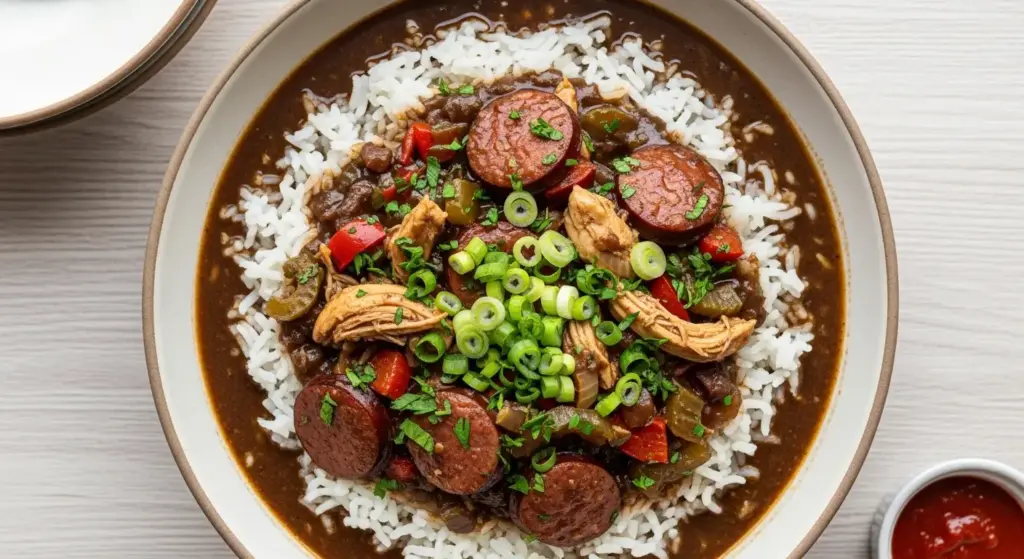
Gumbo is a complete meal on its own, but the right sides make the whole experience feel like a proper Southern feast.
- White rice: This is non-negotiable in my kitchen. Long-grain white rice is the traditional base, and every bowl of gumbo needs it. Cook a big batch because people always want seconds.
- Cornbread: A thick wedge of skillet cornbread on the side is perfect for mopping up every last drop of that incredible broth. Sweet or savory, both are excellent.
- Coleslaw: A cool, creamy coleslaw alongside a hot bowl of gumbo is one of those pairings that just works perfectly. The crunch and creaminess balance all that deep, rich flavor.
- Potato Salad: In many parts of Louisiana, potato salad is actually served right inside the bowl of gumbo. Try it: it sounds unusual but it is delicious.
- Deviled Eggs: A classic Southern appetizer that pairs wonderfully with gumbo when you’re feeding a crowd. They can be made ahead and set out while the gumbo simmers.
- Broccoli Salad: A bright, crunchy broccoli salad cuts right through the richness of the gumbo and gives the meal a little freshness.
- French bread or crusty baguette: Tear off chunks of a good crusty loaf to dip straight into the gumbo. This is deeply satisfying in a way that is hard to describe until you try it.
Read Also: Coleslaw Recipe
Variations of Chicken and Sausage Gumbo
Once you’ve mastered this base recipe, the variations are essentially endless. Here are the most popular and most delicious ways to change it up.
- Seafood Gumbo: Replace the chicken entirely with a combination of shrimp, crab, and oysters. Add the seafood in the last 10 to 15 minutes of cooking since it cooks much faster than chicken. This is probably the most well-known variation and it is absolutely spectacular.
- Chicken, Sausage, and Shrimp Gumbo: Keep the chicken and andouille and add 1 lb (454 g) of peeled, deveined shrimp in the last 5 to 7 minutes of cooking for a surf-and-turf version that covers all the bases.
- Slow Cooker Gumbo: Make the roux on the stovetop as directed, then transfer everything to a slow cooker and cook on low for 6 to 8 hours. The chicken will shred itself at that point, and the whole house will smell incredible all day.
- Turkey and Sausage Gumbo: A great way to use up Thanksgiving leftovers. Substitute shredded leftover turkey for the chicken, reduce the cooking time accordingly, and add it near the end since it is already cooked.
- Vegetarian Gumbo: Omit the chicken and sausage entirely and use vegetable broth as the base. Add extra okra, diced sweet potato, kidney beans, and a can of diced green chiles to build a hearty, meatless version that still has real depth.
- Spicier Cajun-Style Gumbo: Double the cayenne, add a whole jalapeño diced into the holy trinity, and use extra Cajun seasoning to build more heat. Serve with hot sauce on the side for those who like to dial it up even further.
If you love hearty Southern stews like this one, you’ll definitely enjoy this Seafood Stew as another bold, brothy option for weeknight dinners.
Storage and Reheating
Gumbo stores exceptionally well, which makes it one of my favorite meals to batch cook on a Sunday for the week ahead.
- Refrigerator: Store the gumbo (without the rice, which should be stored separately) in an airtight container in the refrigerator for up to 4 days. The flavors will deepen and improve with time, so day 3 is often the best bowl you’ll have.
- Freezer: Transfer cooled gumbo to freezer-safe airtight containers or zip-lock bags and freeze for up to 3 months. Leave about an inch of headspace in the containers to allow for expansion. Do not freeze with rice.
- Thawing: Thaw frozen gumbo in the refrigerator overnight before reheating. Do not try to rush the thaw on the counter, as this can compromise texture and safety.
- Reheating on the stovetop: Pour the gumbo into a pot over medium heat and bring it gently up to temperature, stirring occasionally. Add a splash of chicken broth if it has thickened too much during storage. This is the best method.
- Reheating in the microwave: Transfer a single portion to a microwave-safe bowl. Cover loosely with a microwave-safe lid or damp paper towel to prevent splattering. Heat in 90-second intervals, stirring between each, until hot throughout.
- Do not add file powder before storing. If you plan to store leftovers, add the file powder only to each serving at the time of reheating, not to the whole pot. File powder can become unpleasant in texture after refrigeration.
Another great make-ahead meal the whole family will love is this Easy Crockpot Marry Me Chicken, which is just as hands-off and equally rewarding.
Nutritional Facts
The following is an approximate nutritional breakdown per serving (1/8 of the recipe, not including rice), calculated based on the ingredients listed above. Actual values will vary based on the specific brands and any ingredient substitutions you make.
- Calories: approximately 420 kcal
- Total Fat: 28 g
- Saturated Fat: 8 g
- Cholesterol: 110 mg
- Sodium: 780 mg (varies significantly based on broth and sausage brand)
- Total Carbohydrates: 14 g
- Dietary Fiber: 2 g
- Sugars: 4 g
- Protein: 32 g
- Vitamin C: 25% DV (from bell pepper and tomatoes)
- Iron: 15% DV
- Calcium: 6% DV
For more hearty, nourishing chicken dishes, the Best Chicken Soup Recipes roundup has a wonderful collection to explore when you’re in the mood for something similarly warming.
Health Benefits of Key Ingredients
Gumbo isn’t just comfort food; it’s also full of ingredients that offer real nutritional value when you look at what goes into the pot.
- Chicken thighs are an excellent source of high-quality protein, B vitamins (especially niacin and B6), and minerals like zinc and phosphorus. The darker meat also contains more iron than chicken breast.
- Okra is one of the most nutritious vegetables you can add to a dish. It’s rich in vitamins C and K, folate, magnesium, and potassium, and its soluble fiber may help support healthy blood sugar and cholesterol levels.
- Green bell pepper and onion together bring a powerful punch of vitamin C and antioxidants, particularly quercetin from the onion, which has well-documented anti-inflammatory properties.
- Celery is low in calories but high in vitamin K, vitamin C, and potassium, and it contains natural compounds called phthalides that some research suggests may support healthy blood pressure.
- Garlic has been extensively studied for its antimicrobial and anti-inflammatory properties, primarily attributed to the compound allicin. Using six whole cloves here means you’re getting a meaningful amount per serving.
- Tomatoes provide lycopene, a powerful antioxidant that gives tomatoes their red color and has been associated with heart health and reduced inflammation in multiple studies.
- Andouille sausage is high in protein and B vitamins, though it is also higher in sodium and saturated fat, so it’s worth enjoying in moderation as part of an otherwise balanced diet.
Another soup that makes the most of nutritious, hearty ingredients is this Sausage Lentil Soup, which is packed with plant-based protein and deeply satisfying.
FAQs About Chicken and Sausage Gumbo
1. Can I make the roux ahead of time?
Yes, and it’s actually a great time-saving strategy. You can make the roux up to a week in advance and store it in an airtight jar in the refrigerator.
When you’re ready to make the gumbo, simply warm the roux gently in your Dutch oven before adding the vegetables. Stir it back to a smooth consistency and proceed with the recipe as written.
2. What is the difference between Cajun and Creole gumbo?
Cajun gumbo typically does not include tomatoes and has a darker roux, reflecting its rural French Acadian roots. Creole gumbo, associated with New Orleans, often includes tomatoes and may use both okra and file powder as thickeners.
This recipe leans Creole in that it includes tomatoes, but it uses a very dark roux and andouille sausage that are more traditionally Cajun. It’s honestly the best of both worlds.
3. Do I have to use okra?
No, you can leave it out if you really don’t enjoy it. However, keep in mind that okra is one of the traditional thickeners in gumbo and contributes to the characteristic texture.
If you skip it, increase your file powder slightly (to 1 1/2 teaspoons) to compensate for some of the thickening it would have provided.
4. Can I use chicken breast instead of thighs?
You technically can, but I’d encourage you not to. Chicken thighs stay moist and tender after the long simmer in the gumbo and they add far more collagen and richness to the broth.
Chicken breast will become dry and stringy after that much cooking time and the broth won’t have the same body. If you really prefer white meat, add the diced chicken breast in the last 20 minutes of cooking only.
5. My roux burned. Can I save it?
Unfortunately, no. A burnt roux has a distinctly bitter, acrid flavor that will permeate the entire pot of gumbo. There is no way to mask or fix that bitterness once it’s cooked in.
The good news is that it happens to almost everyone at least once. Discard the burnt roux, wipe out the pot completely, and start the roux again from scratch. Reduce your heat and give it more time; it will be worth it.
Another hearty, crowd-pleasing Southern dish worth keeping in your rotation is this Chicken Chesapeake, which brings a totally different but equally satisfying set of flavors.
Chicken and Sausage Gumbo
Ingredients
- 3 lbs chicken thighs 1.36 kg, bone-in and skin-on, about 6 pieces
- 1 lb andouille sausage 454 g, sliced into 1/4-inch (6mm) rounds
- 1 cup all-purpose flour 125 g
- 1 cup vegetable oil or rendered lard 240 ml
- 1 large yellow onion about 2 cups or 300 g, diced
- 1 large green bell pepper about 1 cup or 150 g, diced
- 3 stalks celery about 1 cup or 100 g, diced
- 6 cloves garlic minced
- 6 cups chicken broth or stock 1.4 liters, low-sodium preferred
- 1 1/2 cups okra 170 g, fresh or frozen, sliced into 1/2-inch (12mm) rounds
- 14.5 oz diced tomatoes 411 g, 1 can, drained
- 2 bay leaves whole
- 2 tsp Cajun seasoning divided; 1 tsp for chicken, 1 tsp for gumbo base
- 1 tsp dried thyme
- 1/2 tsp dried oregano
- 1/2 tsp black pepper freshly ground, divided
- 1/4 tsp cayenne pepper or more to taste
- 1 tsp salt about 1 to 1.5 tsp total, to taste
- 2 tsp Worcestershire sauce
- 1 tsp file powder optional but traditional; add off heat at the end
- cooked white rice long-grain preferred; prepare separately
- green onions finely sliced, for garnish
- fresh parsley finely chopped, for garnish
Equipment
- Heavy-bottomed Dutch oven or enameled cast iron pot (6-quart) Essential for even heat distribution during roux cooking
- Wooden spoon or heat-resistant silicone spatula Long and sturdy for constant roux stirring
- Chef’s knife and cutting board For dicing vegetables and slicing sausage
- Instant-read kitchen thermometer (optional) For checking chicken doneness at 165°F / 74°C
- Tongs For handling hot chicken during searing and removal
- Large mixing bowl For resting and shredding cooked chicken
- Ladle For serving gumbo over rice
- Measuring cups and spoons Precise measurement is critical for the roux
- Rice cooker or medium saucepan For preparing white rice to serve alongside
Method
- Pat the chicken thighs dry, then season all sides with 1 tsp salt, 1/4 tsp black pepper, and 1 tsp Cajun seasoning. Heat 2 tbsp oil in the Dutch oven over medium-high heat and sear the chicken skin-side down for 4-5 minutes until deeply golden, then flip and sear 3 more minutes; transfer to a plate.
- In the same pot over medium-high heat, cook the sliced andouille for 2-3 minutes until browned and some fat has rendered into the pot. Remove with a slotted spoon and set aside, leaving all the drippings in the pot.
- Reduce heat to medium, add oil to the pot to total approximately 1 cup of fat combined with drippings, then add all the flour at once and stir constantly for 25-40 minutes until the roux reaches a deep milk-chocolate brown color. Never stop stirring and reduce heat immediately if you smell scorching.
- Carefully add the diced onion, bell pepper, and celery to the hot roux and stir immediately to coat; cook over medium heat for 8-10 minutes until softened and translucent. Add the minced garlic and cook for 1-2 minutes more until fragrant.
- Slowly pour in the chicken broth one cup at a time, stirring constantly after each addition until smooth and fully incorporated. Stir in the drained tomatoes, bay leaves, thyme, oregano, remaining Cajun seasoning, cayenne, remaining black pepper, and Worcestershire sauce.
- Return the seared chicken thighs and any plate juices to the pot, nestling them into the liquid. Bring to a boil over medium-high heat, then reduce to low, partially cover, and simmer for 45 minutes to 1 hour until the chicken is very tender and falling off the bone.
- Remove the cooked chicken thighs, let cool for 5-10 minutes, then discard the skin and bones and shred the meat into large pieces using two forks. Return the shredded chicken and the reserved andouille sausage to the pot and stir to combine.
- Stir in the sliced okra and simmer uncovered over low heat for 20-30 minutes until the okra is tender and the gumbo has thickened. Taste and adjust seasoning with salt, cayenne, or extra Cajun seasoning, then remove and discard the bay leaves.
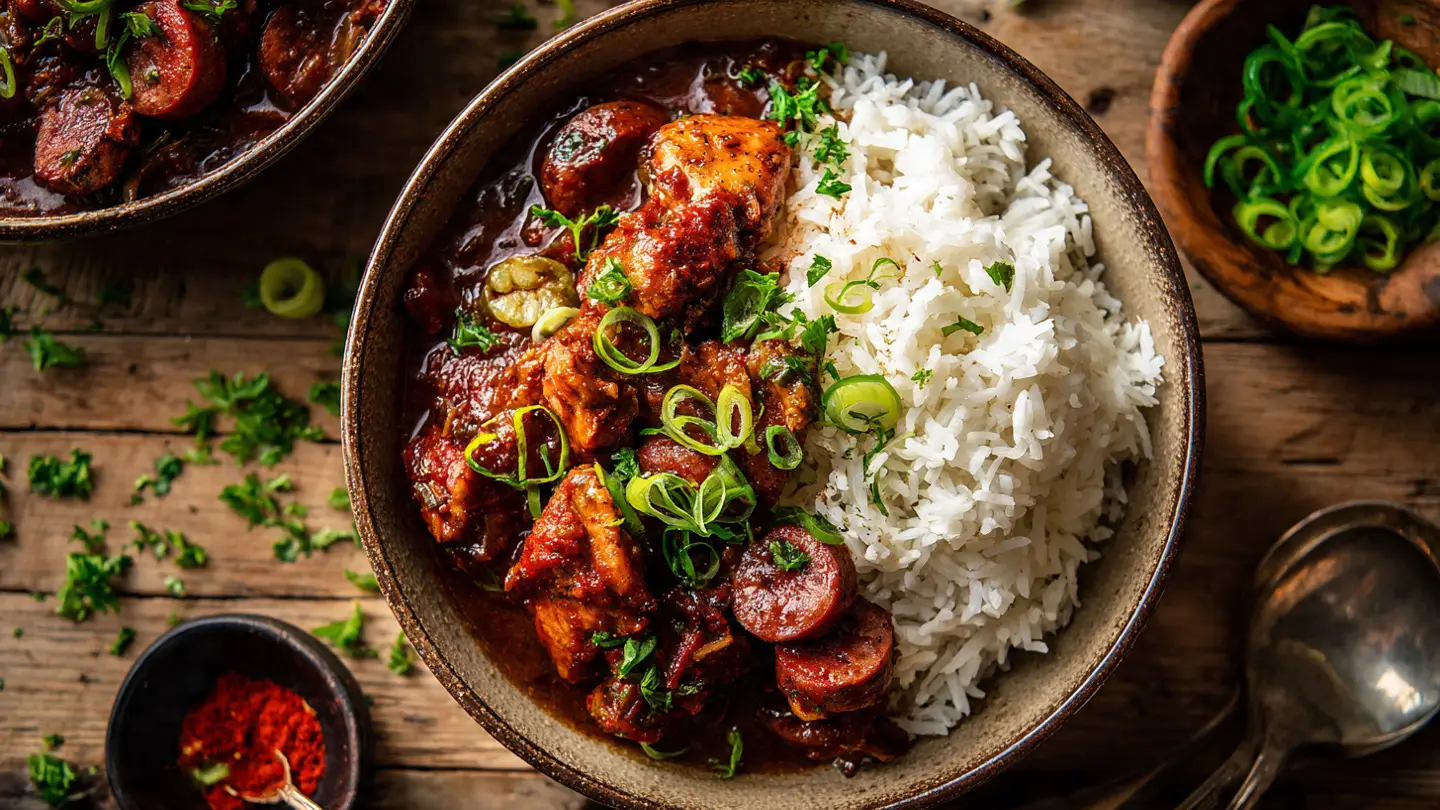
- Remove the pot from heat and stir in the file powder if using — never add it while the gumbo is boiling. Ladle the hot gumbo over cooked white rice in deep bowls and garnish with sliced green onions and fresh parsley.
Nutrition
Notes
- Never rush the roux — cook it over medium to medium-low heat and stir constantly for 25-40 minutes until it reaches a deep chocolate-brown color. A burnt roux cannot be saved and the gumbo must be restarted.
- Use equal parts flour and fat by volume (1 cup each) for the correct roux consistency.
- Bone-in, skin-on chicken thighs are strongly recommended over boneless or chicken breast — they add collagen and richness to the broth that white meat cannot replicate.
- Have your diced vegetables ready beside the stove before the roux reaches the right color so you can add them immediately to stop the roux from darkening further.
- Add file powder only off the heat after the gumbo has finished cooking. Adding it while boiling can make it stringy and unpleasant.
- Gumbo tastes significantly better the next day — make it ahead when you can and refrigerate overnight for deepened flavor.
- Store the gumbo and rice separately in the refrigerator for up to 4 days, or freeze the gumbo (without rice) for up to 3 months in airtight containers.
- The roux can be made up to 1 week ahead and stored in a sealed jar in the refrigerator. Warm gently before using.
- For a seafood variation, replace the chicken with shrimp, crab, and oysters added in the last 10-15 minutes of cooking.
- Serve rice in individual bowls and ladle the gumbo around it — do not mix rice into the pot or it will absorb all the liquid and become mushy.
Private Notes
Tried this recipe?
Let us know how it was!Final Thoughts
Making a great Chicken and Sausage Gumbo is one of those cooking experiences that teaches you patience, and rewards you enormously for it. Every step, from the long slow roux to the gentle simmer, is doing something important.
If your first roux isn’t perfect, try again. Once you nail it, this will become one of your most requested recipes.
I’d love to know how your gumbo turns out! Leave a comment below and tell me what you thought, what tweaks you made, or how your family reacted when you set a bowl down in front of them. And if you share it on social media, tag me so I can see your beautiful pot of gumbo.
Recommended:
- Chicken Taco Soup Recipe
- Slow Cooker Chili Recipe
- Beef Stew Recipe
- Sausage Balls Recipe
- Cracklin Bread Recipe
- Creamy Tomato Basil Soup Recipe
- Crockpot Beef Stew Recipe
- Mashed Potatoes Recipe
- Green Bean Casserole Recipe
- Fall Dinner Recipes