Most homemade tzatziki turns watery within a few hours because the cucumber was never squeezed hard enough. This tzatziki sauce recipe fixes that with a 15-minute salt-and-drain step.
Cucumber is about 95 percent water, so salting and squeezing it keeps the sauce spoonable instead of soupy.
Two cups of full-fat Greek yogurt give the sauce a body thick enough to cling to a pita wedge, while three raw garlic cloves and a tablespoon of fresh dill supply the sharp, herbal bite.
The whole thing uses eight ingredients, needs no cooking, and makes about 3 cups. That is enough for twelve 1/4-cup servings.
| Quick Recipe Summary | |
|---|---|
| Prep Time | 25 minutes |
| Cook Time | 0 minutes |
| Total Time | 1 hour 25 minutes |
| Servings | 12 servings (1/4 cup each) |
| Difficulty Level | Easy |
You might also enjoy: Best Sauce Recipes

Why You’ll Love This Tzatziki Sauce Recipe
This version sticks to the classic Greek formula and adds one extra step that makes the difference. The sauce stays thick in the fridge instead of weeping in the bowl.
- Thick and creamy: Strained Greek yogurt and a well-squeezed cucumber produce a sauce that holds its shape on a spoon, a sandwich, or a plate of grilled meat.
- No cooking at all: Everything is raw, so the work is grating, squeezing, and stirring.
- Eight ingredients: Greek yogurt, cucumber, garlic, olive oil, lemon juice, dill, salt, and pepper cover the whole list.
- Mostly hands-off: The 25-minute prep time includes a 15-minute rest while the salted cucumber drains, and the actual hands-on work is about 10 minutes.
- Makes about 3 cups: That covers a mezze platter, a batch of gyros, and a week of lunch sandwiches without making a second bowl.
- Works four ways: It is a dip, a sauce, a sandwich spread, and, with a splash of water, a salad dressing.
- Better after resting: One hour in the fridge softens the raw garlic and lets the dill flavor spread through the yogurt.
- Protein in every spoonful: Each 1/4-cup serving has about 4 grams of protein from the yogurt.
A creamy sauce with a different flavor profile is Garlic Parmesan Sauce Recipe.
Ingredients
This list uses the classic combination found in most established tzatziki recipes. Metric weights are included next to the cup and spoon measures.
- 2 cups (about 490 g) plain full-fat Greek yogurt, unsweetened and unflavored
- 1 large English cucumber (about 12 ounces or 340 g), peeled, halved lengthwise, and seeded
- 3 garlic cloves (about 9 g), finely minced or grated into a paste
- 2 tablespoons (30 ml) extra virgin olive oil
- 1 tablespoon (15 ml) fresh lemon juice, from about 1/2 medium lemon
- 1 tablespoon (about 3 g) fresh dill, finely chopped
- 3/4 teaspoon fine sea salt, divided (1/2 teaspoon, or 3 g, for salting the cucumber and 1/4 teaspoon, or 1.5 g, for the sauce)
- 1/4 teaspoon freshly ground black pepper (about 0.5 g)
Read Also: Cucumber Chickpea Feta Salad Recipe
Kitchen Equipment Needed
Nothing here is specialized, and most of it is already in a standard kitchen. The two items that matter most are a box grater and a clean towel for squeezing.
- Box grater with large holes for the cucumber
- Fine-mesh strainer to hold the salted cucumber while it drains
- Medium bowl to catch the cucumber liquid under the strainer
- Clean flour sack towel or a double layer of cheesecloth for squeezing the cucumber dry
- Glass mixing bowls for combining the sauce
- Citrus juicer to get the lemon juice without seeds
- Garlic press or a sharp knife for the garlic
- Chef’s knife and cutting board for the dill
- Measuring cups and spoons for the yogurt, oil, lemon juice, and salt
- Silicone spatula for folding without breaking up the cucumber
- Regular spoon for scooping out the cucumber seeds
- Airtight glass storage container for the finished sauce
Another cool, creamy dip: Healthy Guacamole Recipe
Recommended Products for This Recipe
These are my personal recommendations, based on what has made the sauce thicker, cleaner-tasting, and easier to make. Each one solves a specific problem that shows up when making tzatziki at home.
1. Fage Total 5% Plain Greek Yogurt
Fage is strained until it is dense, so the finished sauce clings to a spoon instead of running off it. Nonfat versions make a looser, tarter sauce because there is less fat to carry the garlic and olive oil.
2. California Olive Ranch Extra Virgin Olive Oil
The oil goes into the sauce raw, so its flavor is not cooked away. A mild, fruity oil blends smoothly into the yogurt, while a very bitter or grassy one can take over the dill and lemon.
3. Microplane Classic Zester Grater
Grating garlic on a Microplane turns it into a fine paste that spreads evenly through the yogurt. That prevents the occasional harsh bite of a raw garlic chunk, and it also zests the lemon for the zest variation below.
4. Flour Sack Kitchen Towels
I keep a stack of flour sack towels just for squeezing cucumber, because paper towels shred under pressure and leave lint in the sauce. The tight cotton weave lets water through while holding every shred of cucumber inside.
5. Pyrex Simply Store Glass Food Storage Containers
Plastic containers hold onto garlic odor and can leave the sauce tasting stale by day three. Glass stays neutral, goes straight from the fridge to the table, and the lids seal tightly enough to keep the surface from drying out.
Another Mediterranean option worth trying is Mediterranean Chickpea Salad Recipe.

Step-by-Step Instructions: How to Make Tzatziki Sauce
Follow these steps and you will have thick, creamy tzatziki ready to chill in about 25 minutes.
1. Prep the Cucumber
- Wash the cucumber and peel it completely with a vegetable peeler. Peeling gives the sauce an even, pale color.
- Cut the cucumber in half lengthwise.
- Run a regular spoon down the center of each half to scoop out the seeds, then discard the seeds. English cucumbers have few seeds, but the ones they do have hold a lot of water.
2. Grate and Salt the Cucumber
- Grate both cucumber halves on the large holes of a box grater. You should end up with about 1 1/2 cups of grated cucumber.
- Set a fine-mesh strainer over a medium bowl and add the grated cucumber.
- Sprinkle 1/2 teaspoon of the salt over the cucumber and toss with your fingers until evenly coated.
- Let it rest for 15 minutes. Liquid will collect in the bowl underneath as the salt pulls water out of the cucumber.
3. Squeeze the Cucumber Dry
- Pour the grated cucumber into the center of a clean flour sack towel or a double layer of cheesecloth.
- Gather the corners into a bundle and twist the top tightly.
- Squeeze over the sink with both hands for about a minute, until only a few drops fall.
- Open the towel. You should have about 3/4 cup of pale, damp cucumber that holds together in a dense clump.
- Fluff the cucumber apart with a fork. Do not rinse it, because the sauce only needs 1/4 teaspoon more salt.
4. Prep the Garlic, Lemon, and Dill
- Mince the 3 garlic cloves as finely as possible, or grate them into a paste with a Microplane or garlic press.
- Squeeze the lemon half into a small bowl and remove any seeds. Measure out 1 tablespoon of juice.
- Pull the dill fronds off the thick stems and chop them finely. Measure 1 tablespoon.
5. Mix the Yogurt Base
- Spoon the 2 cups of Greek yogurt into a medium mixing bowl.
- Add the garlic, 2 tablespoons of olive oil, 1 tablespoon of lemon juice, the remaining 1/4 teaspoon of salt, and the 1/4 teaspoon of black pepper.
- Stir with a silicone spatula for about 30 seconds, until the mixture is smooth and glossy with no streaks of oil.
6. Fold in the Cucumber and Dill
- Add the squeezed cucumber and the chopped dill to the yogurt base.
- Fold gently until the cucumber and dill are evenly spread through the sauce. Stop as soon as everything is combined.
- Taste a small spoonful. Add a pinch more salt or a few drops of extra lemon juice if the sauce needs it, though the flavors will deepen in the fridge.
7. Chill and Serve
- Cover the bowl, or transfer the sauce to an airtight container, and refrigerate for at least 1 hour.
- Stir the sauce before serving. If a little liquid has pooled on top, pour it off or stir it back in.
- Spoon into a shallow bowl and serve cold.
Read Also: Greek Pasta Salad Recipe

Tips for The Best Tzatziki Sauce
Small details decide whether tzatziki turns out thick and bright or thin and bland. These are the ones that matter most.
- Squeeze harder than seems reasonable. I ruined my first batch by squeezing the cucumber for only a few seconds, and a puddle of liquid had formed on top by the next morning.
- Choose full-fat strained Greek yogurt. Full-fat yogurt holds up better than nonfat because the fat carries the garlic and olive oil and keeps the texture creamy instead of chalky.
- Grate on the large holes. Large holes keep the cucumber in distinct shreds, while the fine side turns it into a wet pulp that releases water into the sauce.
- Seed the cucumber every time. The seed core is the wettest part of the vegetable, and removing it is a cheap way to avoid a runny sauce.
- Use English or Persian cucumbers when possible. Their thin skin and small seeds mean less peeling and less water. If you only have a standard cucumber, peel it and scoop out all of the seeds.
- Grate or mince the garlic very fine. Large pieces of raw garlic stay sharp even after chilling, while a fine paste mellows into the yogurt.
- Remember that garlic gets stronger over time. The sauce tastes sharpest on day two or three, so lean toward the lower end if you plan to serve it later in the week.
- Chop the dill right before mixing. Fresh dill loses color and aroma quickly once cut. If you cannot find fresh dill, use 1 teaspoon dried dill, though the flavor will be flatter.
- Use fresh lemon juice. Bottled juice tastes harsh and flat next to the yogurt.
- Keep the sauce chunky, not blended. A food processor makes a thinner, smoother sauce closer to a dressing, so grating by hand is better for the classic texture.
- Check the yogurt label. Plain Greek yogurt should list milk and live cultures only, because any added sugar or flavor will clash with the garlic.
- Taste after chilling. Cold dulls salt and tang, so adjust the seasoning only after the sauce has rested for the full hour.
For another tangy sauce, try: Tartar Sauce Recipe
What to Make with Tzatziki Sauce
Tzatziki is rarely eaten alone. It works as a cooling topping for spiced meat, a dip for crisp vegetables and fried foods, and a sandwich spread, and the ideas below show where it fits best.
- Greek Chicken Gyros: Tzatziki is the classic sauce for gyros, where it cools the seasoned chicken and soaks into the warm pita.
- Lamb Chops: Spoon a cold dollop next to seared lamb so the garlic and lemon cut through the richness.
- Grilled Chicken and Veggie Skewers: Use it as a dipping sauce for charred chicken and vegetables.
- Souvlaki: Pork or chicken skewers wrapped in pita with tomato, onion, and a generous spoonful of tzatziki.
- Turkey Burger: Spread it on the bun in place of mayonnaise for a lighter, tangier burger.
- Grilled Salmon with Dill Sauce: The dill and lemon in tzatziki echo the flavors that already work with salmon.
- Falafel: Crisp chickpea patties and cold tzatziki make a classic contrast of hot and cool.
- Roasted Potatoes: Dip crisp wedges into the sauce instead of ketchup.
- Air Fryer French Fries: The garlic and tang cut through salty fries.
- Air Fryer Classic Zucchini Fries: A creamy dip balances the crunch of the coating.
- Healthy Hummus: Serve both on a mezze platter with warm pita bread, olives, and tomatoes.
- Raw vegetable platter: Cucumber rounds, carrot sticks, cherry tomatoes, and radishes all work as dippers.
- Greek salad: Thin a few spoonfuls with a little water and drizzle it over tomatoes, cucumber, and feta.
A more elaborate lamb dinner worth considering is Rack of Lamb Recipe.
Variations of Tzatziki Sauce
The base recipe is the most widely published version, but small swaps change the character of the sauce without changing the method.
- Mint tzatziki: Replace the dill with 1 tablespoon of finely chopped fresh mint, or use 2 teaspoons of each herb for a mixed flavor.
- Red wine vinegar tzatziki: Replace the lemon juice with 1 teaspoon of red wine vinegar for a sharper, more savory tang.
- Lemon zest tzatziki: Zest the lemon before juicing it and stir in 1/2 teaspoon of zest for brighter aroma.
- Lighter tzatziki: Use 2% Greek yogurt instead of full-fat. The sauce will be slightly tangier and less rich.
- Labneh tzatziki: Replace half of the yogurt with labneh for an extra thick sauce that spreads like cream cheese.
- Roasted garlic tzatziki: Replace the raw garlic with 6 mashed roasted garlic cloves for a sweeter, softer flavor.
- Spicy tzatziki: Add a pinch of Aleppo pepper or red pepper flakes, or 1 finely minced seeded jalapeno.
- Herb tzatziki: Add 1 tablespoon of chopped flat-leaf parsley along with the dill for a greener, grassier sauce.
- Dairy-free tzatziki: Use plain, unsweetened, thick coconut or cashew yogurt in place of the Greek yogurt. The flavor is different, but the method is the same.
- Cacik: Stir 1/3 to 1/2 cup of cold water into the finished sauce, add the mint, and serve it as a chilled Turkish-style yogurt and cucumber soup.
Read Also: Watermelon Feta Salad With Mint Recipe
Storage and Reheating
Tzatziki is a fresh sauce, so storage matters more than it does for most condiments. The main enemy is cucumber water, which keeps seeping out even after salting and squeezing.
- Refrigerator: Store the sauce in an airtight container for up to 3 days. Some sources allow up to 4 days, but the texture is best early.
- Container choice: Glass works best because it does not hold onto garlic odor the way plastic can.
- Stir before serving: A thin layer of liquid on top is normal. Stir it back in for a looser sauce or pour it off for a thicker one.
- Freezing: Freezing is not recommended. Thawed tzatziki turns grainy and separates because both the yogurt and the cucumber release water.
- Reheating: Tzatziki is served cold and should never be heated. Spoon it onto hot food right before eating.
- Out on the table: Keep it chilled and do not leave it out for more than 2 hours, or 1 hour if the room is above 90°F (32°C).
- Make ahead: Squeeze the cucumber up to 1 day in advance and refrigerate it in a covered container, then mix the sauce the day you plan to serve it.
- Refreshing day-old sauce: If the sauce looks loose, stir in 1 to 2 tablespoons of fresh Greek yogurt to bring back the body.
- Packing lunches: Pack the sauce in a small sealed container beside an ice pack so it stays cold until lunch.
For another fridge-friendly sauce, try: Yum Yum Sauce Recipe
Nutritional Facts
The values below are estimates for one 1/4-cup serving, based on 12 servings made with full-fat Greek yogurt.
| Nutrition per Serving (1/4 cup) | |
|---|---|
| Calories | 70 kcal |
| Total Fat | 5 g |
| Saturated Fat | 2 g |
| Carbohydrates | 2 g |
| Fiber | 0 g |
| Sugar | 2 g |
| Protein | 4 g |
| Sodium | 85 mg |
A balanced Mediterranean meal that pairs well with this sauce is Mediterranean Quinoa Salad With Grilled Chicken Recipe.
Tips for Using Tzatziki Sauce Like a Pro
Making the sauce is half the job. These tips cover how to adjust it, serve it, and rescue it when something goes sideways.
- Turn it into a dressing: Stir 1 to 2 tablespoons of cold water or extra lemon juice into 1/2 cup of sauce until it pours in a ribbon.
- Make it thicker for spreading: Strain the finished sauce through a cheesecloth-lined strainer for 20 to 30 minutes in the fridge.
- Swap it for mayonnaise: Spread it on sandwiches, wraps, and burgers for a tangier, lighter alternative.
- Dollop it on hot food at the last second: The sauce stays cold and creamy on top instead of melting into the dish.
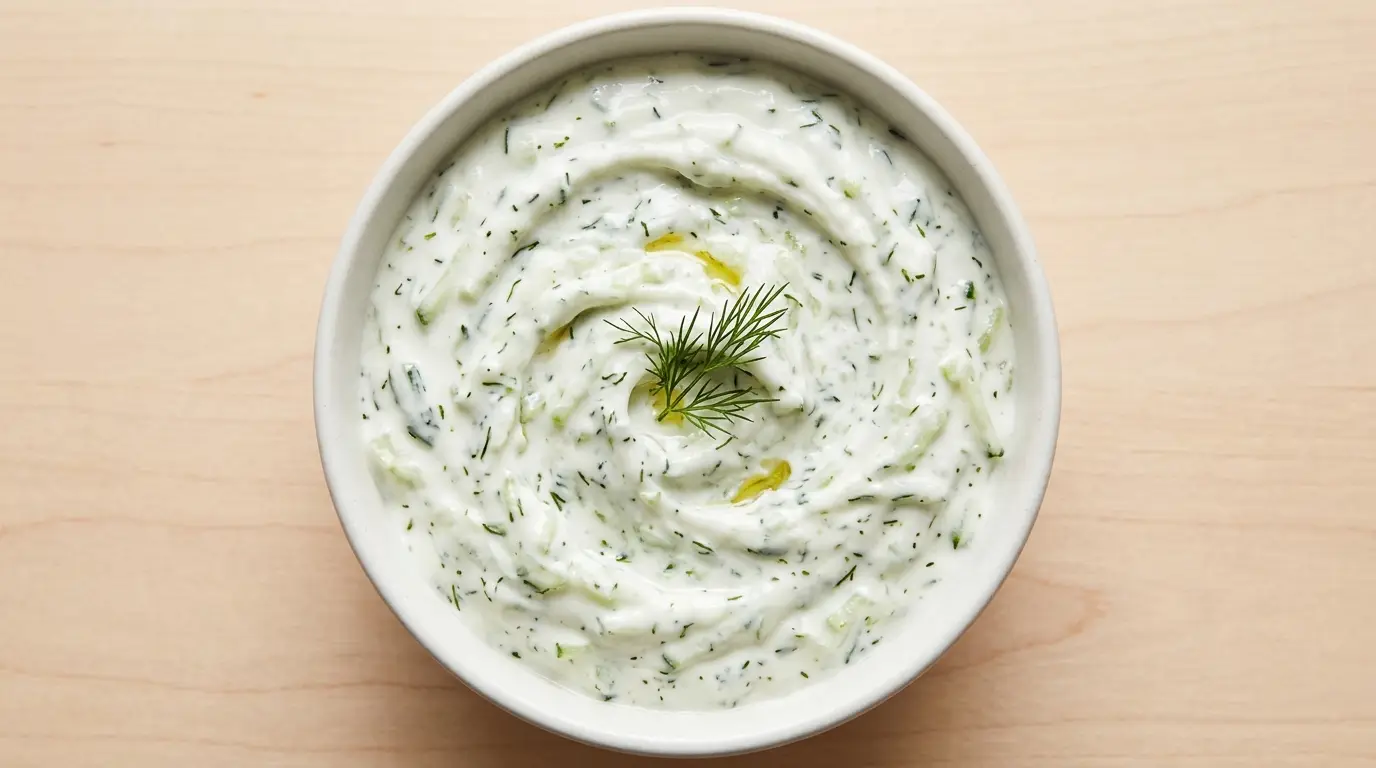
- Serve it in a shallow bowl: Swirl the surface with the back of a spoon, then finish with a small drizzle of extra virgin olive oil and a sprig of dill.
- Add color with a pinch of paprika or sumac: A light dusting on top looks good and adds a faint smoky or lemony note.
- Fix a sauce that is too garlicky: Stir in 2 to 3 tablespoons of extra yogurt and let it rest another 30 minutes.
- Fix a sauce that is watery: Pour it into a cheesecloth-lined strainer and drain in the fridge for 20 minutes, or stir in a spoonful of thick yogurt.
- Fix a sauce that tastes flat: Add a small pinch of salt first, then a few drops of lemon juice, tasting between each addition.
- Fix a sauce that tastes too sharp: Balance it with a spoonful of yogurt or a few drops of olive oil rather than more salt.
- Keep it cold at gatherings: Nest the serving bowl inside a larger bowl of ice so it stays fresh and thick.
- Use a clean spoon each time: Double-dipping adds bacteria that shorten the sauce’s fridge life.
- Double the batch with care: Grate and squeeze the cucumber in two rounds so each handful gets squeezed completely.
- Do not waste the cucumber liquid: Pour it over ice with a squeeze of lime, or blend it into a green smoothie.
Read Also: Grilled Lemon Herb Chicken Recipe
FAQs About Tzatziki Sauce
1. What Is Tzatziki Sauce Made Of?
Traditional tzatziki is made from strained yogurt, grated cucumber, garlic, olive oil, lemon juice or vinegar, and fresh dill or mint.
This recipe uses lemon juice and dill with a little black pepper.
2. Why Is My Tzatziki Watery?
Excess cucumber liquid is the most common cause.
Salt the grated cucumber, rest it 15 minutes, then squeeze it in a towel until only a few drops fall.
Thin yogurt can also cause it, so choose strained Greek yogurt rather than regular.
3. Can I Use Regular Yogurt Instead of Greek Yogurt?
Yes, but you need to strain it first.
Line a strainer with cheesecloth, add the yogurt, and let it drain in the fridge for at least 2 hours, or overnight for the thickest result.
Start with roughly 3 cups of regular yogurt to end up with about 2 cups of thick yogurt.
4. How Long Does Tzatziki Last in the Fridge?
Homemade tzatziki keeps for about 3 days in an airtight container in the refrigerator.
Some sources allow up to 4 days, but the cucumber keeps releasing water, so the texture is best early.
5. Can You Freeze Tzatziki?
Freezing is not recommended.
Thawed tzatziki turns grainy and separates because the yogurt and cucumber both release water.
6. Do You Peel the Cucumber for Tzatziki?
Peeling is traditional and gives the sauce a pale, even color.
English cucumber skin is thin and edible, so you can leave a few stripes of peel on for extra color if you prefer.
The seeds should still come out in either case.
7. What Is the Difference Between Tzatziki and Raita?
Tzatziki is Greek and leans on garlic, dill, and olive oil.
Raita is an Indian yogurt side that usually gets cumin and mint and is often thinner.
Both are built on yogurt and cucumber, which is why they look similar.
8. How Do You Pronounce Tzatziki?
Most English speakers say tsah-ZEE-kee.
The “tz” at the start is a quick “ts” sound, like the end of “cats.”
For a different kind of dip, try: Guacamole Recipe
Tzatziki Sauce
Ingredients
- 2 cups plain full-fat Greek yogurt - about 490 g, unsweetened and unflavored
- 1 large English cucumber - about 12 ounces or 340 g, peeled, halved lengthwise, and seeded
- 3 garlic cloves - about 9 g, finely minced or grated into a paste
- 2 tablespoons extra virgin olive oil - 30 ml
- 1 tablespoon fresh lemon juice - 15 ml, from about 1/2 medium lemon
- 1 tablespoon fresh dill - about 3 g, finely chopped
- 3/4 teaspoon fine sea salt - divided: 1/2 teaspoon (3 g) for salting the cucumber and 1/4 teaspoon (1.5 g) for the sauce
- 1/4 teaspoon freshly ground black pepper - about 0.5 g
Equipment
- Box grater - large holes for the cucumber
- Fine-mesh strainer - to hold the salted cucumber while it drains
- Medium bowl - to catch the cucumber liquid under the strainer
- Clean flour sack towel or double layer of cheesecloth - for squeezing the cucumber dry
- Glass mixing bowls - for combining the sauce
- Citrus juicer - to get the lemon juice without seeds
- Garlic press - or a sharp knife for the garlic
- Cutting board - for the dill
- Measuring cups and spoons - for the yogurt, oil, lemon juice, and salt
- Silicone spatula - for folding without breaking up the cucumber
- Regular spoon - for scooping out the cucumber seeds
- Airtight glass storage container - for the finished sauce
- Vegetable peeler - for peeling the cucumber
Method
- Wash and peel the cucumber completely, cut it in half lengthwise, and scoop out the seeds with a spoon.
- Grate the cucumber halves on the large holes of a box grater (about 1 1/2 cups), set in a fine-mesh strainer over a bowl, sprinkle with 1/2 teaspoon salt, and rest 15 minutes.
- Transfer the cucumber to a flour sack towel or double cheesecloth, twist into a bundle, and squeeze over the sink for about a minute until only a few drops fall (you should have about 3/4 cup), then fluff apart with a fork without rinsing.
- Mince or grate the garlic into a paste, squeeze and measure 1 tablespoon lemon juice, and finely chop 1 tablespoon fresh dill.
- Stir the Greek yogurt, garlic, olive oil, lemon juice, remaining 1/4 teaspoon salt, and black pepper with a silicone spatula for about 30 seconds until smooth and glossy.
- Gently fold in the squeezed cucumber and chopped dill until evenly combined, then taste and adjust with a pinch of salt or a few drops of lemon juice if needed.
- Cover and refrigerate at least 1 hour, stir before serving, and spoon into a shallow bowl to serve cold.
Nutrition
Notes
- Squeeze the cucumber harder than seems reasonable; a quick squeeze leaves a puddle of liquid on top by the next morning.
- Use full-fat strained Greek yogurt for the creamiest texture; nonfat versions make a looser, tarter sauce.
- Grate on the large holes and seed the cucumber every time; the seed core is the wettest part.
- English or Persian cucumbers have thin skin and few seeds, so they need less peeling and release less water.
- Grate or mince the garlic very fine; large raw garlic pieces stay sharp even after chilling.
- Garlic gets stronger over time, so lean toward less garlic if serving on day two or three.
- Chop the dill right before mixing; if unavailable, use 1 teaspoon dried dill, though the flavor will be flatter.
- Store in an airtight glass container in the refrigerator for up to 3 days; glass does not hold garlic odor like plastic.
- Do not freeze; thawed tzatziki turns grainy and separates. Serve cold and never reheat.
- Make ahead: squeeze the cucumber up to 1 day in advance, then mix the sauce the day you serve it.
- If the sauce looks loose, stir in 1 to 2 tablespoons of fresh Greek yogurt to bring back the body.
- Do not leave out more than 2 hours, or 1 hour if the room is above 90°F (32°C).
Private Notes
Tried this recipe?
Let us know how it was!Final Thoughts
This tzatziki sauce stays thick, tangy, and garlicky because the cucumber gets salted, drained, and squeezed before it ever meets the yogurt. Once you have done that step a single time, it becomes automatic.
Make a batch for your next gyro night, grilled dinner, or mezze spread and let it chill for the full hour. Let me know in the comments how it turned out, and share it with anyone who needs a better dip.
Recommended:
- Air Fryer Mediterranean Bruschetta Recipe
- Greek Lentil Soup Recipe
- Avgolemono Soup Recipe
- Lemon Garlic Shrimp Over Couscous Recipe
- Tandoori Chicken Recipe
- Grilled Vegetable Skewers Recipe
- Mediterranean Pasta Salad Recipe
- Honey Mustard Sauce Recipe
- Bang Bang Sauce Recipe
- Grilled Portobello Mushrooms Recipe