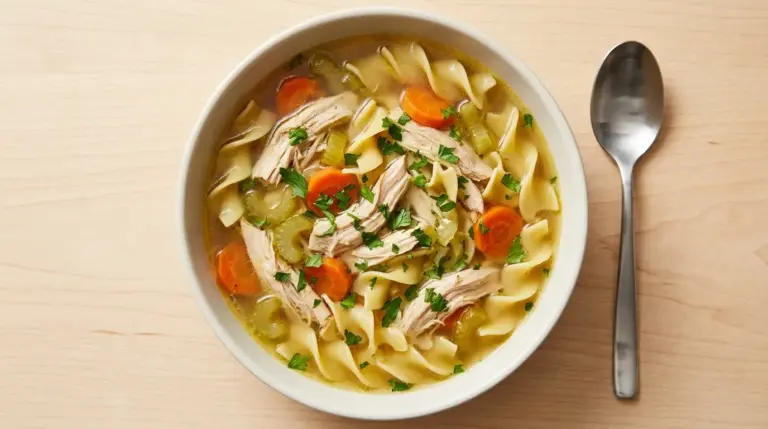
This easy chicken noodle soup recipe comes together in one pot in about 40 minutes, using shredded chicken, egg noodles, and a simple mirepoix of onion, carrot, and celery. The broth turns golden and savory without any all-day simmering.
Most homemade versions end up with bloated, mushy noodles by the second bowl. This one fixes that by cooking the egg noodles until just tender and pulling the pot off the heat the moment they are done.
A spoonful of dried thyme and a bay leaf do most of the flavor work here. The chicken stays tender because it goes in already cooked and only needs a minute or two to warm through.
Nine ingredients plus pantry salt and pepper is all it takes. Fresh parsley stirred in at the end keeps the whole bowl tasting bright instead of flat.
| Quick Recipe Summary | |
|---|---|
| Prep Time | 10 minutes |
| Cook Time | 30 minutes |
| Total Time | 40 minutes |
| Servings | 6 bowls |
| Difficulty Level | Easy |
For another cozy bowl in the same spirit, see Creamy Chicken Soup.

Why You’ll Love This Easy Chicken Noodle Soup Recipe
This is the kind of recipe you memorize after making it twice. It uses one pot, a handful of affordable ingredients, and about 40 minutes from start to finish.
Here is what makes it worth keeping in your regular rotation:
- One pot, minimal cleanup. Everything cooks in a single Dutch oven or stockpot, so you are not scrubbing a sink full of dishes afterward.
- Ready in about 40 minutes. There is no all-day broth simmer here, yet the flavor still tastes slow-cooked thanks to the thyme, bay leaf, and gentle sauté.
- Uses cooked chicken. Rotisserie chicken or leftover roast chicken drops right in, which cuts the work and adds extra depth.
- Noodles stay firm. Cooking the egg noodles to just-tender and serving right away keeps them from turning to mush.
- Easy to adapt. Swap the noodles for rice, add extra vegetables, or make it gluten-free without changing the method.
- Freezer-friendly base. The broth and chicken freeze beautifully when you leave the noodles out, so a future dinner is always ready.
- Budget-conscious. Carrots, celery, onion, and broth are inexpensive staples most kitchens already have.
You might also enjoy: Chicken Soup
Ingredients
Everything here is a grocery-store staple, and most of it keeps well in the pantry or fridge. Measurements are given in both imperial and metric so the recipe works wherever you cook.
- 2 tablespoons (30 ml) olive oil or extra-virgin olive oil, for sautéing the vegetables
- 1 medium yellow onion, diced (about 1 cup / 150 g)
- 3 medium carrots, peeled and sliced into coins (about 1 1/2 cups / 180 g)
- 3 celery stalks, sliced (about 1 cup / 120 g)
- 3 cloves garlic, minced
- 8 cups (1.9 liters) chicken broth or low-sodium chicken broth
- 1 1/2 teaspoons dried thyme, or 2 teaspoons fresh thyme leaves
- 2 dried bay leaves
- 8 ounces (225 g) wide egg noodles, such as a quality brand of wide egg noodles
- 3 cups (420 g) cooked chicken, shredded (rotisserie or leftover roast works well)
- 1/4 cup (15 g) fresh parsley, chopped
- Salt and freshly ground black pepper, to taste
A few notes on the key players. Wide egg noodles are traditional because they hold their shape and soak up broth without falling apart. Rotisserie chicken is the easiest route, though any cooked chicken breast or thigh meat works.
For a deeper, richer bowl, swap 2 cups of the broth for bone broth. I keep a couple of cartons in the pantry specifically for soup nights because the extra body it adds is noticeable against regular broth.
Read Also: Cream Of Chicken Soup
Kitchen Equipment Needed
You only need a few basic tools for this soup, and chances are you already own most of them. The right pot and a sturdy cutting setup make the whole process smoother.
- Large Dutch oven or stockpot, at least 6 quarts, such as a Dutch oven
- Sharp chef’s knife for dicing the vegetables, like a quality chef’s knife
- Cutting board, ideally a large wooden cutting board
- Wooden spoon or silicone spatula for stirring, like a sturdy wooden spoon set
- Ladle for serving, such as a soup ladle
- Measuring cups and spoons, such as a measuring cups and spoons set
- Two forks for shredding the chicken, or a pair of meat shredding claws
- Vegetable peeler for the carrots
A heavy-bottomed pot matters more than you might think. Thin pots scorch the onions and garlic before they soften, which leaves a slightly burnt edge in the finished broth.
For a brothy bowl with a different flavor base, see Cuban Chicken Soup.
Recommended Products for This Recipe
These are the products I reach for when making this soup, chosen because each one solves a specific problem I ran into while testing. They are optional, but they make the process easier and the result more consistent.
1. Enameled Cast Iron Dutch Oven
Thin stockpots develop hot spots that scorch the onion and garlic before the rest of the vegetables soften. A heavy enameled Dutch oven spreads heat evenly across the base, so the aromatics cook down gently and the broth never picks up a scorched taste.
2. Fine Mesh Skimmer
When you simmer broth, a layer of foam and stray bits rise to the surface and can make the soup cloudy. A fine mesh skimmer lifts that off in seconds and leaves you with the clear golden broth this soup is known for.
3. Glass Storage Containers with Lids
Leftover soup keeps better when the noodles and broth can be portioned cleanly, and glass does not stain or hold onions odors the way plastic does. I store the broth and noodles in separate containers so the pasta does not bloat overnight.
4. Microplane Grater
A microplane turns garlic into a fine paste that melts into the broth instead of leaving sharp raw chunks. It also handles a quick grating of fresh nutmeg or lemon zest if you want to brighten the bowl.
You might also enjoy: Carrabbas Chicken Noodle Soup

Step-by-Step Instructions: How to Make Easy Chicken Noodle Soup
Follow these simple steps and you’ll have a comforting pot of chicken noodle soup ready in about 40 minutes.
1. Sauté the Aromatics
- Set your Dutch oven or stockpot over medium heat and add the 2 tablespoons (30 ml) of olive oil.
- Once the oil shimmers, add the diced onion, sliced carrots, and sliced celery.
- Cook, stirring occasionally, for 5 to 7 minutes until the onion turns translucent and the vegetables begin to soften.
- Season with a pinch of salt at this stage to help the vegetables release their moisture.
2. Add the Garlic
- Add the 3 cloves of minced garlic to the pot.
- Stir constantly for about 30 to 60 seconds, just until the garlic smells fragrant.
- Do not let the garlic brown, since burnt garlic turns bitter and will carry through the whole broth.
3. Pour in the Broth and Seasonings
- Pour in all 8 cups (1.9 liters) of chicken broth.
- Add the 1 1/2 teaspoons of dried thyme and the 2 bay leaves.
- Raise the heat to high and bring the liquid up to a gentle boil.
- Once boiling, reduce the heat to maintain a steady simmer and let it cook for 10 minutes so the flavors meld and the carrots turn tender.
4. Cook the Noodles
- Add the 8 ounces (225 g) of wide egg noodles directly to the simmering broth.
- Cook for 6 to 8 minutes, or until the noodles are just tender. Check a minute early, since egg noodles cook fast.
- Stir occasionally so the noodles do not stick to the bottom of the pot.
5. Add the Chicken
- Stir in the 3 cups (420 g) of shredded cooked chicken.
- Let the soup cook for another 2 to 3 minutes, just until the chicken is heated through.
- Remove and discard the 2 bay leaves at this point.
6. Finish and Season
- Stir in the 1/4 cup (15 g) of chopped fresh parsley.
- Taste the broth and add salt and freshly ground black pepper as needed.
- Serve immediately while the noodles are at their best texture.
I learned the hard way that walking away during step 4 is how you end up with mush. The noodles went from perfect to bloated in the few minutes it took me to set the table, so now I stay at the stove and serve the moment they hit tender.
Read Also: Instant Pot Chicken Noodle Soup

Tips for The Best Easy Chicken Noodle Soup
Small choices make the difference between a flat, canned-tasting soup and one that tastes like it simmered all afternoon. These are the adjustments worth paying attention to.
- Serve it right away. Egg noodles keep absorbing liquid, so the soup is at its peak the moment the noodles turn tender. Letting it sit is what causes bloating.
- Undercook noodles if you plan to wait. If dinner is still a while off, pull the noodles a minute or two early so they finish in the residual heat without going soft.
- Use low-sodium broth. This lets you control the salt yourself, especially important if your rotisserie chicken is already seasoned.
- Do not skip the bay leaf. It adds a subtle background depth that is hard to name but very noticeable when missing.
- Cut vegetables evenly. Uniform carrot coins and celery slices cook at the same rate, so nothing ends up crunchy or mushy.
- Add a squeeze of lemon. A small splash of fresh lemon juice at the end lifts the whole bowl and cuts through the richness.
- Shred, don’t cube, the chicken. Shredded meat catches more broth and spreads through every spoonful better than neat cubes.
When I want a richer broth without extra work, I stir in a splash of bone broth near the end. It adds body that plain broth alone cannot match, and it is my go-to fix when a batch tastes thin.
For a hands-off method using the same ingredients, see Slow Cooker Chicken Noodle Soup.
What to Serve with Easy Chicken Noodle Soup
Chicken noodle soup is a comforting meal on its own, but the right side turns it into a full spread. Bread for dipping is almost mandatory, and a light salad rounds things out.
Here are pairings that work well:
- Crusty bread or dinner rolls for soaking up the broth. Warm Dinner Rolls are a soft, pull-apart option.
- Homemade biscuits, flaky and buttery, for a Southern-style meal. Try these Homemade Biscuits.
- Cornbread, slightly sweet, to balance the savory broth. This Healthy Cornbread is a lighter take.
- A simple green salad with a sharp vinaigrette to cut the richness.
- Coleslaw for a cool, crunchy contrast. A Coleslaw with a tangy dressing works nicely.
- Grilled cheese or a toasted sandwich for a classic soup-and-sandwich combo.
- Roasted vegetables on the side for extra color and nutrition.
- Avocado toast when you want something quick and fresh alongside. This Avocado Toast comes together in minutes.
For a cozy drink to finish a cold-weather meal, you might also enjoy: Hot Chocolate
You might also enjoy: Italian Wedding Soup
Variations of Easy Chicken Noodle Soup
One of the best things about this soup is how easily it bends to what you have on hand or what you are in the mood for. These variations keep the base method intact while changing the character of the bowl.
- Creamy chicken noodle soup. Stir in 1 cup (240 ml) of heavy cream or a splash of half-and-half at the end for a richer, velvety broth.
- Lemon chicken noodle soup. Add the juice of one lemon and a handful of fresh dill for a brighter, Greek-inspired version.
- Chicken and rice soup. Swap the egg noodles for 1 cup (185 g) of uncooked white rice and simmer until tender.
- Spicy version. Add a pinch of red pepper flakes or a dash of hot sauce for gentle heat.
- Extra-vegetable soup. Toss in frozen peas, corn, or chopped spinach during the last few minutes of cooking.
- Gluten-free. Use gluten-free noodles or rice, and check that your broth is certified gluten-free.
- Herb-forward. Finish with fresh dill, tarragon, or extra parsley to shift the flavor profile.
- Egg noodle swap. Broken spaghetti, ditalini, or small shells all work if you are out of egg noodles.
For a cozy spin-off worth bookmarking, see Marry Me Chicken Soup.
Storage and Reheating
This soup stores well, with one important caveat about the noodles. Handling the pasta separately is the key to leftovers that taste as good as the first bowl.
- Refrigerate: Store the soup in an airtight container in the fridge for up to 4 days.
- Store noodles separately: For the best texture, keep cooked noodles in their own container and add them to individual bowls when reheating. This stops them from soaking up broth and turning soft.
- Freeze the base: Freeze the broth and chicken (without noodles) for up to 3 months in a freezer-safe container.
- Thaw: Move frozen soup to the fridge overnight before reheating.
- Reheat on the stove: Warm the soup gently over medium heat until it reaches a simmer, then add fresh or stored noodles.
- Reheat in the microwave: Heat single portions in 1-minute intervals, stirring between each, until hot throughout.
- Add broth as needed: The noodles absorb liquid over time, so stir in a splash of extra broth when reheating to loosen it up.
A trick that saves me every week: I cook a small batch of noodles separately and store them apart from the broth. That way the Thursday bowl is just as good as the Monday one, with no bloated pasta in sight.
You might also enjoy: Best Chicken Soup Recipes
Nutritional Facts
The values below are estimates per serving, based on six servings. Actual numbers vary depending on the broth, chicken, and noodles you use.
| Nutrient | Amount per Serving |
|---|---|
| Calories | 285 kcal |
| Protein | 24 g |
| Carbohydrates | 28 g |
| Fat | 8 g |
| Saturated Fat | 2 g |
| Fiber | 3 g |
| Sugar | 4 g |
| Sodium | 890 mg |
| Cholesterol | 75 mg |
Read Also: Best Lentil Soup Recipes
Health Benefits of Key Ingredients
Beyond being comforting, this soup is built on ingredients that bring real nutritional value. Each one contributes something useful to a balanced bowl.
- Chicken: A lean source of high-quality protein that supports muscle maintenance and keeps you full. It also provides B vitamins important for energy.
- Carrots: Rich in beta-carotene, which the body converts to vitamin A for eye health and immune support. They also add natural sweetness and fiber.
- Celery: Low in calories and high in water content, with vitamin K and antioxidants that support bone health.
- Onion: Contains compounds with anti-inflammatory properties and prebiotic fiber that supports gut bacteria.
- Garlic: Long valued for its immune-supporting compounds, garlic adds flavor while contributing allicin, which has antimicrobial properties.
- Chicken broth: Provides hydration and electrolytes, which is part of why this soup feels so restorative when you are under the weather.
- Parsley: A small but mighty herb packed with vitamin C and vitamin K, plus a fresh flavor that brightens the bowl.
- Thyme: Contains antioxidants and has traditionally been used to soothe coughs and congestion.
For a lighter, meatless option, try: Creamy Tomato Basil Soup
FAQs About Easy Chicken Noodle Soup
1. Why do my noodles always get mushy in chicken noodle soup?
Egg noodles keep absorbing liquid even after they finish cooking, so leaving them in hot broth slowly turns them soft. The fix is to cook them just until tender and serve the soup right away.
If you are making the soup ahead, cook the noodles separately and add them to each bowl when serving. This keeps them firm and also keeps the broth clearer.
2. Can I use rotisserie chicken in this recipe?
Yes, and it is one of the easiest shortcuts for this soup. Rotisserie chicken is already cooked and seasoned, so it adds flavor and saves you the step of poaching raw meat.
Just shred about 3 cups of the meat and stir it in near the end to warm through. Keep in mind the seasoning on the chicken may mean you need less added salt.
3. How do I keep my broth from turning cloudy?
Cloudy broth usually comes from starch released by noodles cooking directly in the pot, or from boiling too hard. Cooking noodles separately and keeping the soup at a gentle simmer both help.
Skimming off any foam that rises to the surface also keeps the broth looking clear and golden. A fine mesh skimmer makes this quick and easy.
4. Can I make chicken noodle soup ahead of time?
Absolutely, and the broth actually tastes better after a day as the flavors deepen. The best approach is to make the broth and chicken base ahead and store it without noodles.
Add freshly cooked noodles when you reheat and serve. The base keeps in the fridge for up to 4 days or in the freezer for up to 3 months.
5. What are the best noodles for chicken noodle soup?
Wide egg noodles are the classic choice because they hold their shape and soak up broth without disintegrating. Curly egg noodles work just as well for the same reasons.
If you want something different, ditalini or small shells cook evenly and give you noodles in every spoonful. Avoid very thin or delicate pasta, which breaks down fast.
6. Can I use chicken breast instead of thighs, or raw chicken instead of cooked?
Both breast and thigh meat work, so use whichever you prefer or have on hand. Thighs stay a little more tender, while breast is leaner.
If starting with raw chicken, poach it in the broth first until cooked through, then remove, shred, and return it to the pot. This adds about 15 to 20 minutes to the total time.
Read Also: Lemon Chicken Soup
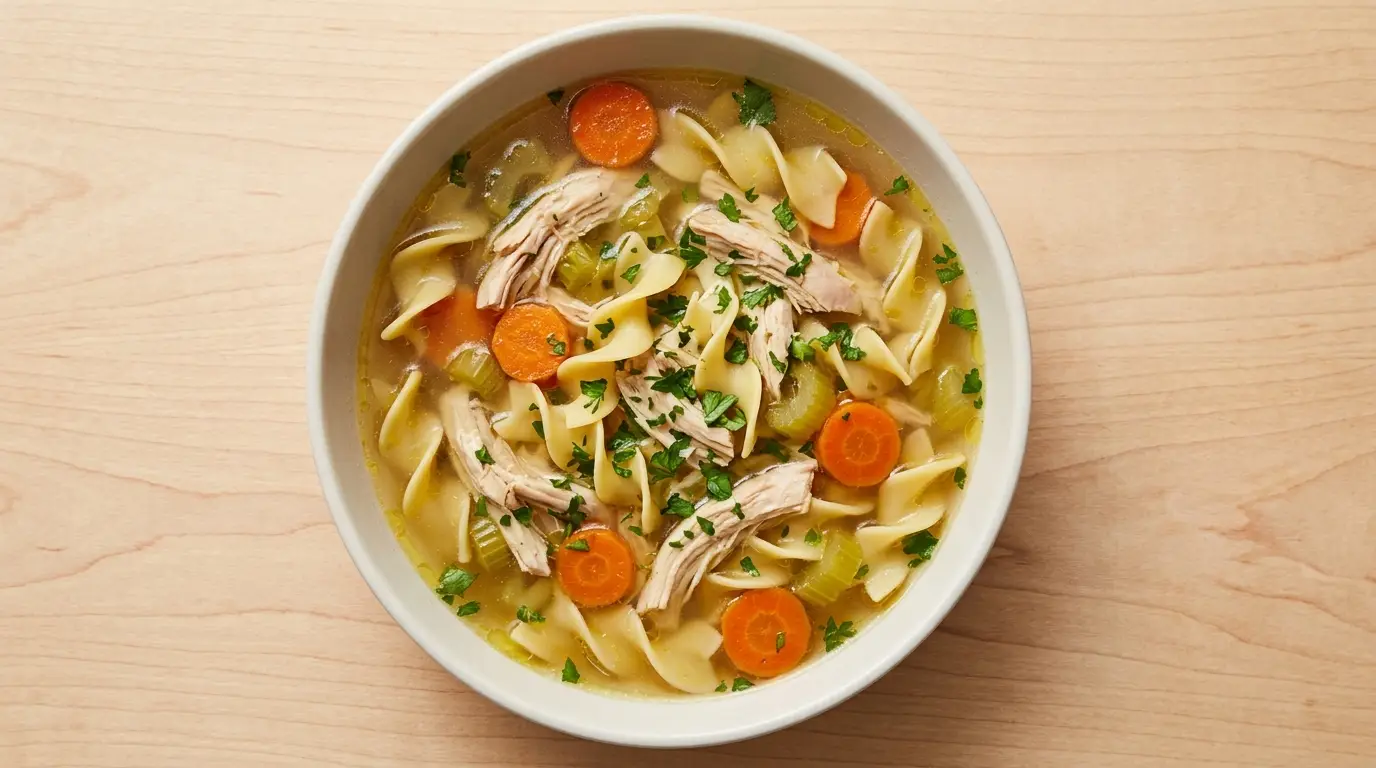
Easy Chicken Noodle Soup
Ingredients
- 2 tablespoons olive oil - 30 ml, or extra-virgin olive oil, for sautéing the vegetables
- 1 medium yellow onion - about 1 cup or 150g, diced
- 3 medium carrots - about 1 1/2 cups or 180g, peeled and sliced into coins
- 3 stalks celery - about 1 cup or 120g, sliced
- 3 cloves garlic - minced
- 8 cups chicken broth - 1.9 liters, or low-sodium chicken broth
- 1 1/2 teaspoons dried thyme - or 2 teaspoons fresh thyme leaves
- 2 dried bay leaves
- 8 ounces wide egg noodles - 225g, such as a quality brand of wide egg noodles
- 3 cups cooked chicken - 420g, shredded; rotisserie or leftover roast works well
- 1/4 cup fresh parsley - 15g, chopped
- salt and freshly ground black pepper - to taste
Equipment
- Large Dutch oven or stockpot - at least 6 quarts
- Sharp chef’s knife - for dicing the vegetables
- Cutting board - ideally a large wooden cutting board
- Wooden spoon or silicone spatula - for stirring
- Ladle - for serving
- Two forks - for shredding the chicken, or use meat shredding claws
- Vegetable peeler - for the carrots
- Fine mesh skimmer - (optional) for skimming foam to keep broth clear
- Glass Storage Containers with Lids - (optional) for storing leftovers
- Microplane grater - (optional) for finely grating garlic
Method
- Set a Dutch oven or stockpot over medium heat and add the olive oil. Once shimmering, add the diced onion, sliced carrots, and sliced celery, and cook, stirring occasionally, for 5 to 7 minutes until the onion turns translucent and the vegetables begin to soften. Season with a pinch of salt.
- Add the minced garlic and stir constantly for about 30 to 60 seconds, just until fragrant. Do not let the garlic brown, since burnt garlic turns bitter and will carry through the whole broth.
- Pour in all 8 cups of chicken broth, then add the dried thyme and bay leaves. Raise the heat to high and bring to a gentle boil, then reduce the heat to maintain a steady simmer and cook for 10 minutes so the flavors meld and the carrots turn tender.
- Add the wide egg noodles directly to the simmering broth and cook for 6 to 8 minutes, or until just tender. Check a minute early since egg noodles cook fast, and stir occasionally so they do not stick to the bottom of the pot.
- Stir in the shredded cooked chicken and let the soup cook for another 2 to 3 minutes, just until the chicken is heated through. Remove and discard the bay leaves.
- Stir in the chopped fresh parsley, then taste the broth and add salt and freshly ground black pepper as needed. Serve immediately while the noodles are at their best texture.
Nutrition
Notes
- Serve it right away. Egg noodles keep absorbing liquid, so the soup is at its peak the moment the noodles turn tender. Letting it sit is what causes bloating.
- Undercook noodles if you plan to wait. If dinner is still a while off, pull the noodles a minute or two early so they finish in the residual heat without going soft.
- Use low-sodium broth. This lets you control the salt yourself, especially important if your rotisserie chicken is already seasoned.
- Do not skip the bay leaf. It adds a subtle background depth that is hard to name but very noticeable when missing.
- Cut vegetables evenly. Uniform carrot coins and celery slices cook at the same rate, so nothing ends up crunchy or mushy.
- Add a squeeze of lemon. A small splash of fresh lemon juice at the end lifts the whole bowl and cuts through the richness.
- Shred, don’t cube, the chicken. Shredded meat catches more broth and spreads through every spoonful better than neat cubes.
- Store noodles separately. For the best leftovers, keep cooked noodles in their own container and add them to individual bowls when reheating to prevent them from soaking up broth and turning soft.
- Freeze the base. Freeze the broth and chicken (without noodles) for up to 3 months in a freezer-safe container. The soup base keeps in the fridge for up to 4 days.
- For a richer broth. Swap 2 cups of the broth for bone broth, or stir in a splash near the end to add body that plain broth alone cannot match.
Private Notes
Tried this recipe?
Let us know how it was!Final Thoughts
There is a reason chicken noodle soup never goes out of style. It is simple, soothing, and endlessly adaptable, and this version gives you all of that in about 40 minutes.
Keep this recipe handy for cold evenings, lazy weekends, and any day someone in the house needs a little comfort. Once you make it from scratch, the canned version loses its appeal fast.
Give it a try and make it your own with your favorite noodles or extra vegetables. I would love to hear how yours turns out, so leave a comment below and share this recipe with anyone who could use a warm bowl.
Recommended:
- Chicken Stew
- Chicken Gnocchi Soup
- Mexican Chicken Soup
- Crack Chicken Soup
- Buffalo Chicken Soup
- Lasagna Soup
- Zuppa Toscana
- Chicken Corn Chowder
- Panera Broccoli Cheddar Soup
- Marry Me Chicken Casserole