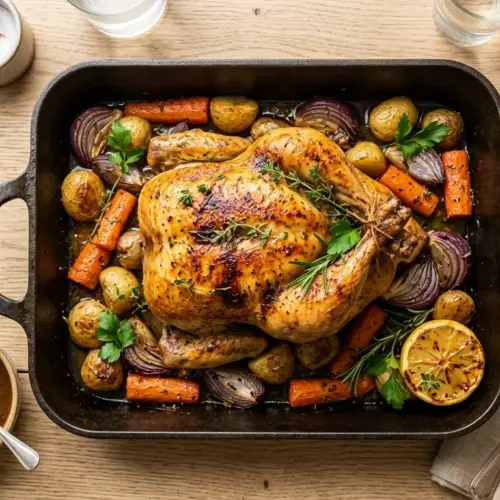
Roast Chicken

This classic roast chicken delivers everything you want from the dish: shatteringly crispy golden skin, juicy and tender meat, and deep herb-forward flavor in every bite. A generous herb butter made with fresh thyme, rosemary, parsley, and garlic is pressed directly under the skin to baste the breast meat from the inside as it roasts, while the cavity is packed with lemon and garlic for fragrant, aromatic steam. Roasted hot and fast at 425°F on a bed of vegetables, this is a foolproof, one-pan dinner that feels impressive but comes together with just 15 minutes of hands-on prep.
Equipment
- Roasting pan with rack - A rack keeps the bird elevated for even heat circulation and crispier skin
- Instant-read meat thermometer - Essential for confirming doneness at 165°F (74°C)
- Cast iron skillet (12-inch) - (optional) Alternative to a roasting pan; retains and distributes heat exceptionally well
- Small mixing bowl - For mixing the herb butter
- Paper towels - For thoroughly drying the chicken before roasting
- Kitchen twine - For trussing the legs together for even cooking
- Carving knife and fork - Sharp carving set for slicing and serving the finished bird
- Aluminum foil - For tenting the chicken during its 15-minute rest
- Cutting board - Large enough to rest and carve a whole chicken
Ingredients
For the Chicken
- 1 whole chicken - 4.5–5 lbs (2–2.3 kg), giblets removed, patted completely dry with paper towels
- 1 tbsp extra virgin olive oil - 15ml
- 1½ tsp kosher salt - for the outside of the bird, plus extra for the cavity
- ½ tsp black pepper - freshly ground
For the Herb Butter
- 4 tbsp unsalted butter - 57g, softened to room temperature
- 2 cloves garlic - minced, for the herb butter
- 1 tbsp fresh thyme leaves - or 1 tsp dried thyme
- 1 tbsp fresh rosemary - finely chopped; or 1 tsp dried rosemary
- 1 tbsp fresh flat-leaf parsley - finely chopped
- ½ lemon - juiced into the herb butter; reserve the other half for the cavity
For the Cavity
- 2 cloves garlic - left whole
- ½ lemon - the squeezed half from the herb butter plus the remaining unused half, stuffed cut-side in
For the Roasting Pan
- 1 medium yellow onion - cut into thick rounds
- 2 medium carrots - roughly chopped into 2-inch (5cm) pieces
- 2 stalks celery - roughly chopped into 2-inch (5cm) pieces
- ½ cup low-sodium chicken broth - 120ml; or water
Instructions
- Remove the chicken from the refrigerator at least 30 minutes before cooking. Preheat your oven to 425°F (220°C) and position the rack in the center.
- In a small bowl, mash together the softened butter, 2 minced garlic cloves, thyme, rosemary, parsley, and the juice of half the lemon until fully combined and smooth.
- Remove the giblets, then pat the entire chicken completely dry inside and out with paper towels. Season the cavity generously with salt and pepper, then stuff it with the 2 whole garlic cloves and both lemon halves.
- Gently loosen the skin from the breast meat with your fingers and push two-thirds of the herb butter directly underneath the skin, spreading it evenly. Rub the remaining butter all over the outside of the bird, then drizzle with olive oil and season generously with salt and pepper.
- Tie the legs together snugly with kitchen twine and tuck the wing tips under the body to prevent burning.
- Scatter the onion, carrots, and celery across the bottom of the roasting pan and pour in the chicken broth. Place the rack over the vegetables and set the chicken breast-side up on top.
- Roast uncovered at 425°F (220°C) for 1 hour to 1 hour 20 minutes, basting once at the 45-minute mark with the pan drippings. The chicken is done when an instant-read thermometer inserted in the thickest part of the thigh reads 165°F (74°C).
- Transfer the chicken to a cutting board, tent loosely with aluminum foil, and rest for a minimum of 15 minutes before carving to allow the juices to redistribute.
- Remove the twine and discard the cavity aromatics. Carve by removing the legs, separating drumsticks from thighs, removing the wings, and slicing the breasts. Spoon pan juices over the top before serving.
Notes
- Dry the chicken thoroughly — patting it completely dry with paper towels is the single most important step for achieving crispy, golden skin. For best results, let it air-dry uncovered in the fridge for a few hours or overnight after patting dry.
- Always bring the chicken to room temperature before roasting. Thirty minutes out of the fridge ensures even cooking and reduces the risk of dry breast meat.
- Use an instant-read thermometer, not a timer. Oven temperatures vary and chicken sizes differ — 165°F (74°C) in the thickest part of the thigh (without touching bone) is the only reliable indicator of doneness.
- Do not cover the chicken during roasting. Covering traps steam and prevents the skin from crisping. If the breast skin darkens too quickly, loosely tent just the breast with a small piece of foil for the final 15–20 minutes.
- Baste once at the 45-minute mark. More frequent basting lowers the oven temperature and extends cook time — one baste is enough to develop great color and flavor.
- The 15-minute rest is non-negotiable. Slicing too early causes the juices to run onto the cutting board instead of staying in the meat. Tent with foil and be patient.
- Save the pan drippings. Strain them through a fine-mesh sieve and use as the base for a quick pan gravy, or refrigerate and skim the fat for use in soups and sauces.
- Save the carcass for stock. After dinner, simmer the bones with water, onion, carrot, and celery for 2–3 hours to make rich homemade chicken stock.
- Leftovers keep well refrigerated in an airtight container for up to 4 days, or frozen for up to 3 months. Reheat in a covered baking dish at 325°F (165°C) with a splash of broth to retain moisture.
- Herb butter variations: Try swapping the fresh herbs for smoked paprika and garlic powder for a Spanish-inspired bird, or use Dijon mustard and tarragon for a French-style roast chicken.
Nutrition
Serving: 1ServingCalories: 420kcalCarbohydrates: 3gProtein: 38gFat: 28gSaturated Fat: 9gPolyunsaturated Fat: 5gMonounsaturated Fat: 12gCholesterol: 155mgSodium: 580mgPotassium: 380mgFiber: 1gSugar: 1gVitamin A: 12IUVitamin C: 8mgCalcium: 4mgIron: 10mg
Tried this recipe?Let us know how it was!