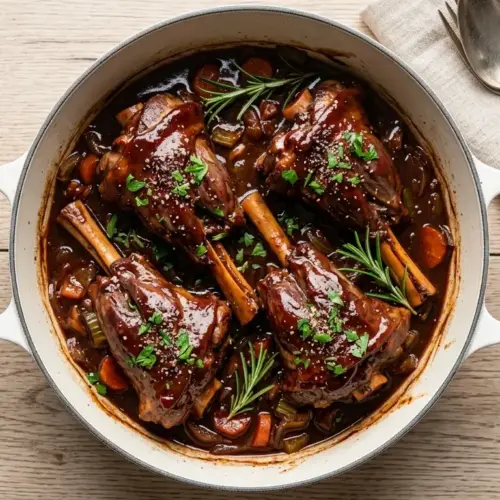
Lamb Shank Recipe

This braised lamb shank recipe delivers fall-off-the-bone tender meat slow-cooked in a rich, glossy red wine sauce with aromatic vegetables, fresh herbs, and tomatoes. Seared to a deep golden crust and then oven-braised for nearly three hours, the collagen-rich shanks transform into something truly extraordinary — the sauce becomes silky and intensely flavored while the meat practically melts away from the bone on its own. It's the kind of showstopper dinner that looks and tastes like it took all day, but the oven does most of the work for you.
Equipment
- Large Dutch oven or heavy-bottomed pot - At least 6-quart / 5.7L capacity with a tight-fitting lid
- Kitchen tongs - For turning and handling the shanks
- Wooden spoon or heat-safe spatula
- Ladle - For serving
- Fine-mesh strainer - (optional) For straining the sauce
- Aluminum foil - As a backup if your pot does not have a lid
Ingredients
- 4 lamb shanks - about 1 lb / 450g each
- 2 tsp kosher salt - plus more to taste
- 1 tsp freshly ground black pepper
- 3 tbsp extra virgin olive oil - divided
- 1 large yellow onion - diced
- 2 large carrots - peeled and cut into 1-inch / 2.5cm chunks
- 3 stalks celery - sliced into 1-inch / 2.5cm pieces
- 8 cloves garlic - minced
- 3 tbsp tomato paste
- 2 cups dry red wine - 480ml; such as Cabernet Sauvignon, Merlot, or Shiraz
- 2 cups beef stock - 480ml
- 14 oz whole peeled tomatoes - 400g / 1 can, crushed by hand with their juices
- 3 sprigs fresh rosemary
- 4 sprigs fresh thyme
- 2 dried bay leaves
For Garnish
- fresh flat-leaf parsley - chopped, for garnish
Instructions
- Preheat your oven to 325°F (165°C). Pat each lamb shank completely dry with paper towels, then season all sides generously with kosher salt and black pepper, pressing the seasoning into the meat with your hands.
- Heat 2 tablespoons of olive oil in a Dutch oven over medium-high heat until shimmering. Sear the lamb shanks in batches for 10–12 minutes per batch, turning every 3–4 minutes, until a deep golden-brown crust forms on all sides, then transfer to a plate.
- Reduce heat to medium, add the remaining 1 tablespoon of olive oil, and cook the onion, carrot, and celery for 8–10 minutes until softened. Stir in the minced garlic for 1–2 minutes, then add the tomato paste to the center of the pot and cook, stirring constantly, for 2 minutes until darkened and fragrant.
- Pour in the red wine and scrape up all the browned bits from the bottom of the pot, then bring to a vigorous simmer and cook for 5–6 minutes until reduced by half. Add the beef stock and crushed tomatoes with their juices, then nestle in the rosemary, thyme, and bay leaves.
- Return the seared lamb shanks and any collected juices to the pot, nestling them into the braising liquid. Cover with the lid, transfer to the preheated oven, and braise for 2 to 2.5 hours, turning the shanks once at the halfway point, until the meat is completely fork-tender and pulling away from the bone.
- Remove the shanks and set aside tented with foil; discard the herb sprigs and bay leaves, then simmer the braising liquid over medium-high heat for 10–15 minutes until reduced to a glossy, thick sauce. Return the shanks to the pot, spoon the sauce over them generously, and serve garnished with chopped fresh parsley.
Notes
- Always pat the lamb shanks completely dry with paper towels before searing — moisture on the surface prevents browning and will cause the meat to steam instead of sear.
- Don't rush the sear. Let each side sit undisturbed in the hot oil until it releases naturally for the deepest, most flavorful crust.
- Use a wine you'd actually drink. The flavor concentrates during braising, so a decent quality wine makes a noticeably better sauce. Avoid anything labeled "cooking wine."
- Cooking the tomato paste for 2 minutes before adding liquid caramelizes it and adds a deep, savory richness to the braising sauce that you can't achieve otherwise.
- Braised lamb shanks taste even better the next day. Cool completely in the sauce, refrigerate overnight, skim the solidified fat from the surface, and reheat gently before serving.
- No red wine? Replace it with an equal amount of beef stock plus 1 tablespoon of Worcestershire sauce and 1 teaspoon of balsamic vinegar for similar depth.
- To make in a slow cooker, complete the sear and aromatic steps on the stovetop, then transfer everything to a slow cooker and cook on low for 8–10 hours or on high for 5–6 hours.
- If the sauce is too thin after removing the shanks, simmer it uncovered for an additional 10–20 minutes, or whisk in 1 tablespoon of cornstarch mixed with 2 tablespoons of cold water.
- Store leftovers in an airtight container with the sauce in the refrigerator for up to 3–4 days, or freeze for up to 3 months. Thaw overnight in the fridge before reheating.
- Serve over mashed potatoes, creamy polenta, buttery couscous, or with crusty bread to soak up the braising sauce.
Nutrition
Serving: 1ServingCalories: 520kcalCarbohydrates: 14gProtein: 55gFat: 22gSaturated Fat: 8gPolyunsaturated Fat: 2gMonounsaturated Fat: 10gCholesterol: 165mgSodium: 820mgPotassium: 780mgFiber: 3gSugar: 7gVitamin A: 45IUVitamin C: 18mgCalcium: 8mgIron: 25mg
Tried this recipe?Let us know how it was!