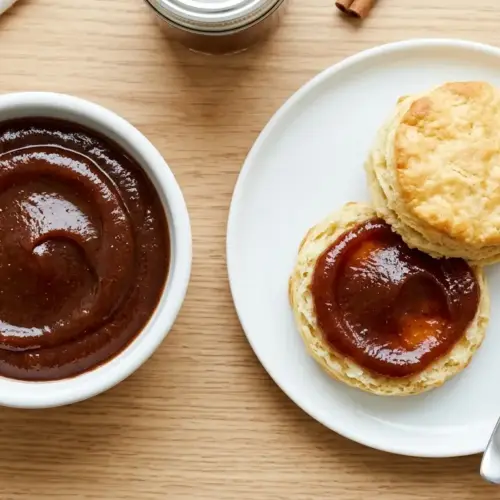
Homemade Apple Butter

This homemade apple butter transforms 4 pounds of apples into a thick, glossy, deeply caramelized spread with warm spices and no dairy—perfect for toast, biscuits, oatmeal, and more.
Equipment
- Heavy-bottomed saucepan or Dutch oven - 4-quart or larger
- Immersion blender - or regular blender used in batches
- Wooden spoon or silicone spatula - for stirring
- Glass storage jars - with lids for the finished butter
- Splatter screen - (optional)
Ingredients
- 4 pounds apples - 1.8 kg, peeled, cored, and chopped into 1-inch pieces (about 8 to 10 medium apples; use a mix of Granny Smith and Honeycrisp or Fuji)
- 1 cup water or apple cider - 240 ml; cider gives a more concentrated apple flavor
- 1/2 cup dark brown sugar - 110 g, packed; light brown sugar works too
- 1/4 cup granulated sugar - 50 g
- 1 tablespoon fresh lemon juice - 15 ml
- 2 teaspoons ground cinnamon
- 1/4 teaspoon ground cloves
- 1/4 teaspoon ground nutmeg
- 1/8 teaspoon fine salt
- 1 teaspoon pure vanilla extract - optional, stirred in at the end
Instructions
- Peel each apple, cut it into quarters, and remove the core. Chop the quarters into roughly 1-inch (2.5 cm) pieces so they cook down quickly and evenly.
- Add the chopped apples and 1 cup (240 ml) of water or apple cider to your heavy saucepan. Bring to a gentle boil over medium heat, then reduce to a low simmer. Cover and cook for about 20 minutes, stirring once or twice, until the apples are fork-tender and falling apart.
- Stir in the dark brown sugar, granulated sugar, cinnamon, cloves, nutmeg, and salt. Add the lemon juice, which brightens the flavor and keeps the color from turning dull. Stir well so the sugar dissolves and the spices distribute evenly.
- Turn off the heat for a moment so the puree doesn't splatter. Use an immersion blender to blend the mixture directly in the pot until completely smooth. If using a regular blender, work in small batches and leave the lid vented to let steam escape, then return the puree to the pot.
- Set the heat to low and leave the pot uncovered so moisture can escape. Cook for 45 to 60 minutes, stirring every 5 to 10 minutes, especially toward the end when it thickens and can catch on the bottom. The butter is ready when it has darkened to a deep mahogany brown and mounds on a spoon without a ring of liquid separating out.
- Stir in the vanilla extract if using, then remove the pot from the heat. To test the set, drop a spoonful on a chilled plate; it should hold a soft mound rather than spreading into a puddle. Let it cool slightly, then transfer to clean jars. It will thicken a little more as it cools.
Notes
- Use a mix of apple varieties. Tart apples like Granny Smith balance the sweetness, while softer apples like McIntosh or Fuji break down faster and add body.
- Don't rush the reduction. The uncovered stage is where the color deepens and the texture sets. Pulling it off the heat early is the top reason batches turn out thin.
- Watch for the spoon test. A spoonful placed on a cold plate should hold its shape without weeping liquid around the edges.
- Stir more often near the end. As the butter thickens, the bottom scorches fast. Stay close and stir constantly during the final 10 minutes.
- Taste before jarring. Adjust cinnamon or add a pinch more salt if the flavor feels flat.
- Cook low, not high. High heat splatters and scorches before the water has a chance to cook off gently.
- Chop apples to an even size. Uniform 1-inch pieces soften at the same rate, so you don't end up with mushy edges and firm centers going into the blender.
- Let it cool before judging thickness. Apple butter firms up noticeably as it drops to room temperature, so pull it a touch looser than your target.
- Storage: Refrigerate in airtight jars for up to 3 weeks; freeze in 1-cup portions for up to 1 year; or can in a boiling water bath for 10 minutes for shelf-stable storage.
- Rescue a runny batch: If it never thickened, return it to a low simmer uncovered and reduce further until it mounds on a spoon.
Nutrition
Serving: 2tablespoonsCalories: 62kcalCarbohydrates: 16gProtein: 0.2gFat: 0.1gSodium: 13mgFiber: 1.2gSugar: 14gVitamin C: 2mg
Tried this recipe?Let us know how it was!