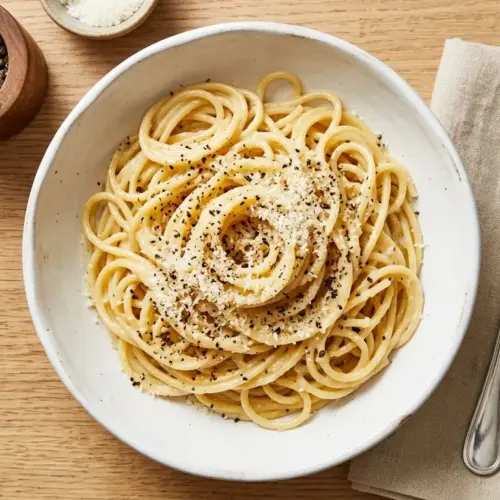
Cacio e Pepe

Cacio e Pepe is a classic Roman pasta dish made with just three ingredients: spaghetti, Pecorino Romano, and freshly cracked black pepper. What makes it extraordinary is the technique — finely grated sheep's milk cheese is emulsified with starchy pasta water into a silky, glossy sauce that coats every strand without a drop of cream or butter. Toasting the peppercorns twice builds deep, aromatic heat, while tempering the cheese off the heat guarantees a smooth, clump-free result every time. This is weeknight Roman cooking at its most elegant and satisfying.
Equipment
- Large pot - For boiling pasta
- Wide stainless steel or carbon steel skillet - 10–12 inch (25–30 cm); do not use non-stick
- Mortar and pestle - For cracking peppercorns coarsely; a heavy skillet can substitute
- Microplane grater or fine box grater - For grating cheese as finely as possible
- Tongs - For tossing pasta in the pan
- Ladle - For transferring pasta water
- Small bowl - For mixing the cheese paste
- Heat-safe mixing bowl - (optional) Useful for tempering cheese off the heat
Ingredients
- 7 oz spaghetti - 200g; or tonnarelli, bucatini, or rigatoni
- 3 oz Pecorino Romano cheese - 85g, freshly grated very finely (about 1 cup tightly packed); use authentic DOP Pecorino Romano for best results
- 1 oz Parmigiano Reggiano - 30g, freshly grated (about 1/3 cup); optional but helps prevent clumping
- 1.5 tsp whole black peppercorns - 4g; Tellicherry peppercorns preferred; will be toasted and cracked
- 0.5 tbsp coarse sea salt - For pasta water; use less than usual as pecorino is very salty
- water - Slightly less than usual — about 4 cups (1 liter) per 100g pasta — to concentrate the starch
Instructions
- Grate both Pecorino Romano and Parmigiano Reggiano (if using) on the finest setting of your Microplane or box grater until the texture resembles fluffy powder. Place in a small bowl and leave at room temperature for at least 10 minutes before using.
- Add the whole black peppercorns to a dry skillet over medium heat and toast for 1–2 minutes, shaking occasionally, until fragrant. Transfer to a mortar and pestle and crush to a coarse, varied texture — not a fine powder.
- Fill a large pot with slightly less water than usual, bring to a boil, and add the coarse sea salt. Cook the spaghetti 2–3 minutes less than the package's al dente time, then reserve 1.5–2 cups (350–480ml) of the starchy pasta water before draining.
- Add the cracked pepper to the dry wide skillet over medium heat and toast for 30 seconds, stirring constantly. Pour in 1/3 cup (80ml) of the reserved hot pasta water, stir, and simmer for 1 minute, then reduce heat to low.
- Add 2–3 tablespoons of warm (not boiling) pasta water to the bowl of grated cheese and stir vigorously until a smooth, creamy paste forms with a consistency like heavy cream. Adjust with more pasta water or cheese as needed.
- Transfer the undercooked pasta directly into the skillet using tongs and toss vigorously over medium-low heat for 1–2 minutes, adding small splashes of reserved pasta water as needed to keep the pasta glossy and fluid.
- Remove the skillet from the heat completely, pour the cheese paste over the pasta, and toss quickly with tongs until the sauce is smooth and coats every strand. Add small splashes of pasta water if the sauce tightens, and return to the lowest heat for 30 seconds only if needed.
- Twist the pasta into nests using tongs and place into warm bowls. Finish with an extra pinch of cracked black pepper and a small cloud of finely grated Pecorino Romano, then serve immediately.
Notes
- Use authentic DOP Pecorino Romano imported from Italy — domestic Romano is usually cow's milk and is far more prone to clumping.
- Grate the cheese as finely as possible using a Microplane. The finer the grind, the smoother and creamier the sauce will be.
- Always remove the pan from the heat completely before adding the cheese paste — this is the single most important step to prevent a grainy or clumpy sauce.
- Tempering the cheese in a separate bowl with warm pasta water before adding it to the pasta gives you full control over consistency and prevents seizing.
- Use slightly less water than usual when boiling pasta to create a more starch-concentrated liquid, which acts as a natural emulsifier in the sauce.
- Toast the peppercorns twice — first whole in a dry pan, then again after cracking — to build deeper, more complex pepper flavor.
- A blend of 75% Pecorino Romano and 25% Parmigiano Reggiano is ideal for beginners; the Parmigiano softens the sauce and makes it more stable.
- Cacio e Pepe does not reheat well — make only what you plan to eat in one sitting for the best texture and flavor.
- If reheating is necessary, warm leftovers in a pan over low heat with 2–3 tablespoons of water or broth, tossing gently. Do not microwave on high.
- Do not freeze — the cheese sauce turns grainy and watery upon thawing.
Nutrition
Serving: 1ServingCalories: 520kcalCarbohydrates: 68gProtein: 22gFat: 16gSaturated Fat: 9gPolyunsaturated Fat: 1gMonounsaturated Fat: 4gCholesterol: 45mgSodium: 680mgPotassium: 180mgFiber: 3gSugar: 2gVitamin A: 6IUCalcium: 42mgIron: 15mg
Tried this recipe?Let us know how it was!