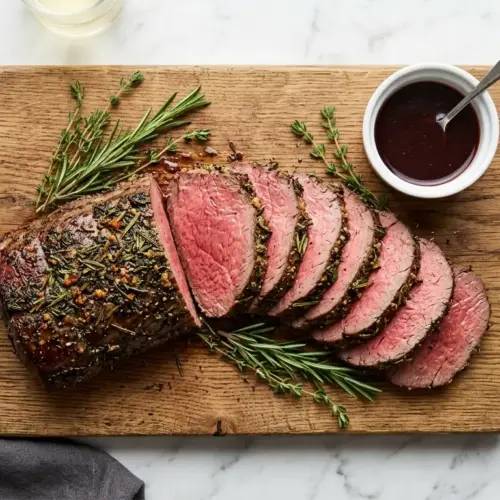
Beef Tenderloin

This classic roasted beef tenderloin features a center-cut roast coated in a fragrant garlic-herb butter, seared to a golden-brown crust on the stovetop, and finished in a hot oven to a perfectly blushing medium-rare. It's an elegant, impressive centerpiece that's more approachable than it looks, requiring just a handful of quality ingredients and a reliable meat thermometer to pull off a restaurant-worthy result at home.
Equipment
- Instant-read meat thermometer - Essential for accurate doneness — do not skip
- 12-inch oven-safe cast iron skillet - Or heavy oven-safe stainless steel skillet
- Roasting rack and roasting pan - (optional) Helps promote even browning
- Butcher's twine - For trussing the roast at 1-inch intervals
- Sharp chef's knife - For slicing the finished roast
- Small mixing bowl - For making the herb butter rub
- Aluminum foil - For tenting the roast during resting
- Tongs - For turning the roast while searing
- Basting brush - For applying the herb butter to the seared roast
- Paper towels - For drying the meat before searing
- Fine-mesh strainer - (optional) For straining the pan sauce
Ingredients
- 3-4 lbs center-cut beef tenderloin roast - 1.3–1.8 kg; trimmed of silver skin and excess fat, tied with butcher's twine at 1-inch intervals
- 2 tbsp extra-virgin olive oil - 30 ml, divided
- 1 tsp kosher salt - 5 g, plus more for seasoning all surfaces
- 1 tsp freshly cracked black pepper - 2 g
- 4 tbsp unsalted butter - 56 g, softened to room temperature
- 4 cloves garlic - about 1½ tsp when minced
- 1 tbsp fresh rosemary leaves - finely chopped
- 1 tbsp fresh thyme leaves - finely chopped
- 1 tbsp fresh flat-leaf parsley - finely chopped
- 1 tsp Dijon mustard - optional; adds depth and helps butter adhere to the roast
- flaky sea salt - such as Maldon; for finishing just before serving
For the Optional Pan Sauce
- 1 cup beef broth - 240 ml
- ½ cup dry red wine - 120 ml; Cabernet Sauvignon or Merlot recommended
- 1 tbsp cold unsalted butter - 14 g, cut into small pieces; for finishing the sauce
- 1 tsp fresh thyme leaves - for the pan sauce
- salt and pepper - to taste, for seasoning the pan sauce
Instructions
- Remove the beef tenderloin from the refrigerator at least 1 hour before cooking and let it rest at room temperature. Pat it completely dry with paper towels on all sides, then season generously all over with kosher salt and cracked black pepper.
- Use a sharp knife to remove any remaining silver skin from the surface of the roast. Fold the thinner tail end underneath the roast and tie the entire length with butcher's twine at 1-inch (2.5 cm) intervals to create an even thickness.
- In a small bowl, combine the softened butter, minced garlic, chopped rosemary, thyme, parsley, and Dijon mustard (if using). Mix with a fork until fully combined and set aside at room temperature.
- Preheat your oven to 425°F (220°C). Place a 12-inch cast iron or heavy oven-safe skillet over medium-high heat for 2–3 minutes until very hot, then add 1 tablespoon of olive oil and swirl to coat.
- Place the seasoned tenderloin into the hot skillet and sear on all sides — including both ends — turning every 2–3 minutes until a deep golden-brown crust forms on every surface, about 10–12 minutes total.
- Remove the skillet from heat and coat the entire surface of the seared tenderloin with the herb butter rub. Transfer to the preheated oven and roast until the internal temperature reaches 120–125°F (49–52°C) for medium-rare, about 20–30 minutes depending on roast size.
- Transfer the roast to a cutting board and loosely tent with aluminum foil. Let it rest for 10–15 minutes — the internal temperature will rise 5–10°F (3–6°C) during this time through carryover cooking.
- Place the skillet over medium heat, pour in the red wine, and scrape up all the browned bits from the bottom. Add the beef broth and simmer 5–7 minutes until reduced, then stir in the thyme, season with salt and pepper, and swirl in the cold butter pieces off heat until glossy.
- Remove the twine, slice the rested tenderloin into 1–1½ inch (2.5–3.8 cm) rounds using long, smooth strokes. Finish with a sprinkle of flaky sea salt and serve immediately with pan sauce on the side.
Notes
- Always use a meat thermometer — pull the roast at 120–125°F (49–52°C) for medium-rare; it will rise to 130–135°F (54–57°C) as it rests.
- Pat the meat completely dry before searing — surface moisture causes steaming instead of browning and prevents a good crust from forming.
- Let the tenderloin sit at room temperature for at least 1 hour before cooking for even cooking from edge to center.
- Choose a center-cut roast for the most uniform thickness; if the tail end is thin, fold it under and tie it to avoid overcooking.
- Get the pan screaming hot before adding the oil — at least 2–3 minutes of preheating ensures a fast, effective sear.
- Tent the resting roast loosely with foil; a tight tent traps steam and softens the crust you worked hard to build.
- The tenderloin can be seasoned and trussed up to 24 hours ahead; salting overnight and leaving it uncovered in the refrigerator actually improves the crust.
- Store leftover slices in an airtight container in the refrigerator for up to 3–4 days. Reheat gently in a 250°F (120°C) oven with a splash of broth, covered with foil, until warmed to 110–120°F (43–49°C).
- For a peppercorn crust variation, coat the roast in coarsely crushed mixed peppercorns before searing in place of the herb butter.
- Leftover tenderloin is outstanding served cold with Dijon mustard on a crusty roll, or sliced thin and added to pasta with garlic butter and wilted spinach.
Nutrition
Serving: 1ServingCalories: 300kcalCarbohydrates: 1gProtein: 33gFat: 17gSaturated Fat: 7gPolyunsaturated Fat: 1gMonounsaturated Fat: 7gCholesterol: 100mgSodium: 315mgPotassium: 480mgVitamin A: 4IUVitamin C: 2mgCalcium: 2mgIron: 18mg
Tried this recipe?Let us know how it was!