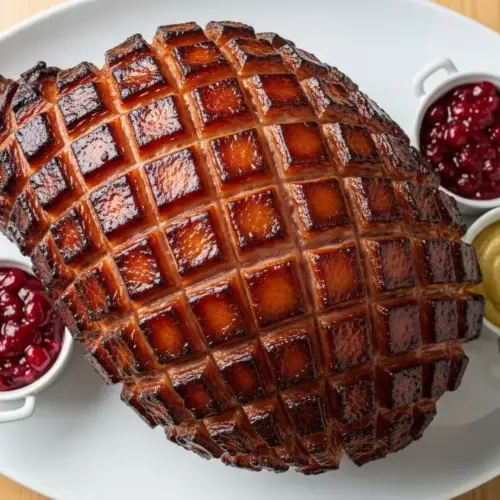
Baked Ham with Brown Sugar Glaze

This classic baked ham recipe features a bone-in, fully cooked ham roasted low and slow until perfectly juicy, then finished with a rich brown sugar glaze made with honey, Dijon mustard, apple cider vinegar, and warm spices. The result is a stunning, lacquered centerpiece with a caramelized amber crust that's equally at home on an Easter table or a Christmas spread — and it's far easier to make than it looks.
Equipment
- Large roasting pan - At least 13x9 inches (33x23 cm)
- Roasting rack - Fits inside the roasting pan
- Heavy-duty aluminum foil
- Sharp chef's knife or carving knife - For scoring and carving
- Small saucepan - For making the glaze
- Instant-read meat thermometer - Essential for checking doneness
- Pastry brush or basting brush - Silicone preferred
- Wooden spoon or silicone spatula - For stirring the glaze
Ingredients
For the Ham
- 1 bone-in fully cooked ham, shank or butt end - 8 to 10 lbs (3.6 to 4.5 kg); pre-cooked/ready-to-eat
- 1 cup water or pineapple juice - 240 ml; for the roasting pan
- whole cloves - optional, for scoring decoration
For the Brown Sugar Glaze
- 1 cup packed dark brown sugar - 200g
- 1/4 cup honey - 85g
- 2 tablespoons Dijon mustard
- 2 tablespoons apple cider vinegar
- 1 tablespoon unsalted butter
- 1 teaspoon ground cinnamon
- 1/2 teaspoon ground ginger
- 1/2 teaspoon garlic powder
- 1/4 teaspoon ground cloves
- 1/4 teaspoon smoked paprika
- black pepper - pinch
Instructions
- Remove the ham from the refrigerator about 1 hour before cooking and discard all packaging. Allowing it to come closer to room temperature ensures even cooking throughout.
- Preheat oven to 325°F (165°C). Place a roasting rack inside a large roasting pan and pour 1 cup (240 ml) of water or pineapple juice into the bottom of the pan.
- Using a sharp knife, cut shallow parallel lines about ½ inch (1.2 cm) deep and 1 inch (2.5 cm) apart across the surface of the ham, then repeat in the opposite direction to create a diamond crosshatch pattern. If desired, press a whole clove into the center of each diamond.
- Place the ham flat-side down on the roasting rack, then wrap it tightly in heavy-duty aluminum foil, crimping the edges firmly to create a sealed tent that will trap steam.
- Roast the foil-wrapped ham at 325°F (165°C) for 12 to 15 minutes per pound (26 to 33 minutes per kg), until the internal temperature reaches approximately 120°F (49°C).
- Combine all glaze ingredients in a small saucepan over medium heat, stirring to combine. Bring to a gentle boil, then reduce heat and simmer for 2 to 3 minutes until slightly thickened; remove from heat and cool for 10 minutes.
- Remove the pan from the oven and increase oven temperature to 425°F (220°C). Carefully remove the foil, then generously brush the glaze all over the ham, working it into the scored lines.
- Return the uncovered ham to the oven and bake for 15 minutes, then brush on another layer of glaze and bake for another 10 to 15 minutes until deep amber and caramelized. For extra caramelization, broil for 2 to 3 minutes, watching closely.
- Remove the ham from the oven and let it rest for 15 to 20 minutes before carving. Slice parallel to the bone to remove large sections of meat, then slice against the grain, and spoon pan juices over the top before serving.
Notes
- Always use a bone-in ham for the juiciest results — the bone conducts heat and adds richness that boneless hams simply cannot match.
- Do not skip the foil wrap during the first phase of roasting. Without it, the exterior dries out and the glaze will scorch before the interior is warmed through.
- Use dark brown sugar rather than light brown sugar for a deeper, more molasses-forward glaze with better caramelization.
- Let the glaze cool for about 10 minutes before applying — a thicker, cooler glaze adheres to the surface much better than a thin, hot one.
- Score the ham at least ½ inch (1.2 cm) deep so the glaze can penetrate into the meat, not just sit on the surface.
- Always use an instant-read thermometer rather than relying solely on timing. You're aiming for an internal temperature of 140°F (60°C) in the thickest part of the ham, avoiding the bone.
- Plan for approximately ¾ pound (340g) of bone-in ham per adult when estimating servings.
- Save the ham bone after carving — freeze it in a zip-top bag for up to 3 months and use it to make bean soup, split pea soup, or a rich stock.
- Store leftover ham wrapped tightly in the refrigerator for up to 5 days, or freeze sliced portions for up to 3 months. Reheat covered with foil at 325°F (165°C) with a splash of broth to prevent drying.
- The glaze can be made up to 5 days ahead and stored in an airtight container in the refrigerator. Reheat gently before using.
Nutrition
Serving: 1ServingCalories: 320kcalCarbohydrates: 22gProtein: 32gFat: 11gSaturated Fat: 4gPolyunsaturated Fat: 1gMonounsaturated Fat: 5gCholesterol: 95mgSodium: 1450mgPotassium: 490mgSugar: 21gVitamin A: 2IUCalcium: 2mgIron: 10mg
Tried this recipe?Let us know how it was!