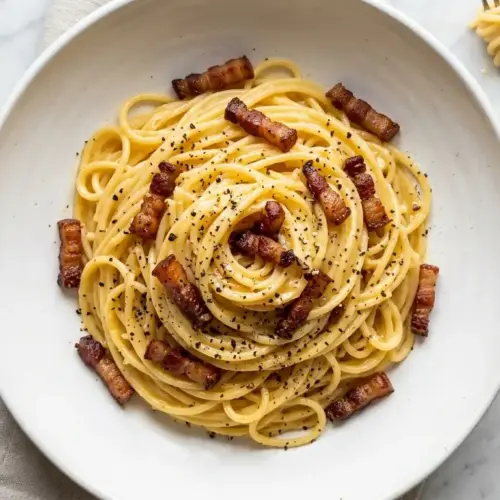
Authentic Carbonara Sauce

This classic Roman carbonara sauce is the authentic, cream-free version that delivers an impossibly silky, glossy coating on every strand of spaghetti using just egg yolks, finely grated Pecorino Romano, crispy guanciale, and a generous crack of black pepper. The magic lies entirely in the emulsion of eggs, aged cheese, rendered pork fat, and starchy pasta water — a technique that produces something richer and more luxurious than any cream-based imitation, all in under 30 minutes.
Equipment
- Large pasta pot (at least 6 quarts / 5.7 liters) - For boiling the spaghetti with enough water to generate starchy cooking liquid
- Large skillet or sauté pan (12-inch / 30cm) - For rendering the guanciale and tossing the finished pasta
- Medium mixing bowl - For whisking together the egg yolk and cheese mixture
- Microplane fine grater - For finely grating Pecorino Romano; chunky grated cheese will not melt smoothly into the sauce
- Tongs or pasta fork - For tossing the pasta efficiently when combining with the sauce
- Ladle or heatproof measuring cup - For scooping and reserving pasta cooking water
- Colander - For draining the pasta; optional if using tongs to transfer directly
Ingredients
For the Pasta
- 14 oz spaghetti - 400g; dried, not fresh — the starchy cooking water from dried pasta is essential
- salt - For pasta water only; about 1 tablespoon once water is boiling
For the Sauce
- 7 oz guanciale - 200g; sliced into small strips or cubes; substitute with pancetta if unavailable
- 4 large egg yolks - Room temperature
- 1 whole egg - Large, room temperature
- 3.5 oz Pecorino Romano cheese - 100g; finely grated; plus extra for serving
- 1 tsp freshly cracked black pepper - Freshly ground is non-negotiable; increase to taste
Optional
- 1 small garlic clove - Not traditional; adds a subtle background note if desired — remove and discard before serving
Instructions
- Whisk 4 egg yolks and 1 whole egg together with 100g (3.5 oz) finely grated Pecorino Romano and 1 teaspoon freshly cracked black pepper until you have a thick, pale yellow paste. Set aside at room temperature — do not refrigerate.
- Bring a large pot of water to a full rolling boil, salt generously, then add 400g (14 oz) spaghetti and cook until just short of al dente (1-2 minutes less than package instructions). Before draining, reserve at least 240ml (1 cup) of starchy pasta cooking water.
- Add 200g (7 oz) guanciale pieces to a cold large skillet, then place over medium heat and cook 5–7 minutes until golden and crispy on the edges. Remove the pan from heat, leaving all rendered fat in the pan.
- Whisk 60ml (¼ cup) of the hot pasta cooking water into the egg and cheese mixture gradually, whisking constantly until the mixture is smooth, glossy, and pourable.
- Return the skillet with guanciale to medium-low heat, then add the drained spaghetti using tongs and toss for about 1 minute until the pasta absorbs the rendered fat. Remove the pan completely from heat.
- With the pan off the heat, pour the tempered egg and cheese mixture over the pasta and toss immediately and continuously until every strand is coated in a glossy, creamy sauce, adding pasta water a tablespoon at a time if the sauce is too thick.
- Plate the carbonara right away into warm bowls and finish each serving with extra finely grated Pecorino Romano and a generous crack of fresh black pepper.
Notes
- Never add the egg mixture to the pan while it is still over direct heat — remove the skillet from the burner completely before adding the sauce to prevent scrambled eggs.
- Use room temperature eggs. Cold eggs straight from the fridge will begin to set too quickly when they hit the warm pasta.
- Reserve at least 240ml (1 cup) of pasta cooking water before draining — this starchy liquid is essential for adjusting the sauce consistency and is the single most important insurance policy against a dry or seized carbonara.
- Grate the Pecorino Romano as finely as possible using a Microplane. Coarsely grated cheese will not melt smoothly into the sauce and will leave lumps.
- Guanciale substitutes: pancetta is the closest substitute and widely available. Thick-cut unsmoked bacon also works but adds a smoky note that shifts the flavor profile away from the traditional Roman original.
- For a milder sauce, use half Pecorino Romano and half finely grated Parmigiano Reggiano. The result is slightly less sharp but still wonderfully creamy.
- Do not rinse the pasta after draining — rinsing removes surface starch that helps the sauce cling to every strand.
- Storage: Carbonara is best eaten immediately. If you have leftovers, refrigerate in an airtight container for up to 2 days. Do not freeze.
- Reheating: Reheat gently in a skillet over the lowest possible heat with a splash of water or broth, tossing constantly. Microwave on 50% power in 30-second intervals as a backup option.
- Pasta shape variations: Rigatoni and bucatini are excellent alternatives to spaghetti. Rigatoni in particular is widely used in Rome and its ridges trap the sauce beautifully.
Nutrition
Serving: 1ServingCalories: 620kcalCarbohydrates: 70gProtein: 25gFat: 26gSaturated Fat: 10gPolyunsaturated Fat: 3gMonounsaturated Fat: 11gCholesterol: 230mgSodium: 680mgPotassium: 290mgFiber: 3gSugar: 2gVitamin A: 8IUCalcium: 22mgIron: 15mg
Tried this recipe?Let us know how it was!