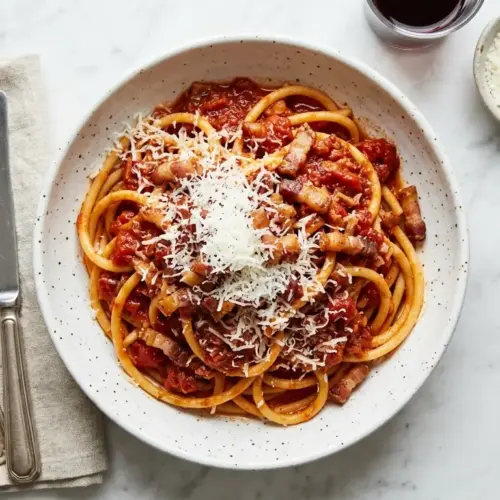
Amatriciana Sauce

Amatriciana sauce is a bold, deeply savory Roman pasta sauce made with just a handful of quality ingredients: guanciale (cured pork cheek), hand-crushed San Marzano tomatoes, Pecorino Romano, red chili flakes, and a splash of dry white wine. The guanciale renders down into silky, rich lardons that infuse every drop of the tomato sauce with incredible pork fat flavor, while the Pecorino adds a sharp, salty finish. Ready in just 35 minutes, this is one of the four great Roman pasta sauces — and once you make it the traditional way, it will become a permanent fixture in your weeknight dinner rotation.
Equipment
- Large deep skillet or braiser (12-inch) - Wide pan ensures even rendering and efficient sauce reduction
- Large stockpot - At least 4–5 quart capacity for boiling pasta
- Sharp chef's knife - For slicing guanciale into lardons
- Cutting board - Keep guanciale cold for easier slicing
- Wooden spoon or silicone spatula - For stirring and deglazing the pan
- Fine grater or microplane - For finely grating Pecorino Romano
- Measuring cup or ladle - For scooping pasta water before draining
- Tongs or pasta fork - For tossing pasta into the sauce
- Colander - For draining cooked pasta
Ingredients
- 4.4 oz guanciale - 125g; cured pork cheek — trim rind and slice into ¼-inch planks, then cut into lardons
- ¼ cup dry white wine - 60ml; Pinot Grigio or Sauvignon Blanc recommended
- 14 oz San Marzano whole peeled tomatoes - 400g (1 standard can); hand-crush before adding to pan
- ½ tsp red chili flakes - peperoncino; adjust to taste for desired heat level
- 14 oz bucatini or spaghetti - 400g; bucatini is the traditional Roman choice; spaghetti also works
- ½ cup Pecorino Romano cheese - 60g, finely grated; reserve extra for serving — buy a block and grate fresh
- ¼–½ cup pasta cooking water - 60–120ml; reserved from the pasta pot; starch helps bind sauce to noodles
- salt - to taste; use sparingly — guanciale and Pecorino are already very salty
- black pepper - to taste; freshly cracked preferred
- 1 tbsp extra virgin olive oil - optional — only needed if substituting leaner pancetta for guanciale
Instructions
- Trim the rind from the guanciale and slice into ¼-inch (6mm) planks, then cut into small lardons (bite-sized strips). Set aside on the cutting board.
- Pour the canned San Marzano tomatoes into a bowl and crush them by hand into a rough, chunky puree — leave some pieces intact for texture. Set aside.
- Bring a large pot of water to a rolling boil over high heat, then season generously with salt until it tastes pleasantly salty. Do not add pasta yet.
- Add the guanciale to a cold 12-inch skillet and place over medium-low heat. Cook, stirring occasionally, for 8–10 minutes until golden and crispy, then transfer with a slotted spoon to a paper-towel-lined plate — leaving all rendered fat in the pan.
- Add red chili flakes to the hot guanciale fat and sizzle for 30–45 seconds, then pour in the white wine and scrape up any browned bits. Simmer for 1–2 minutes until the alcohol smell dissipates.
- Pour the hand-crushed tomatoes into the pan, season with black pepper, and bring to a gentle simmer over medium heat. Cook uncovered for 15–18 minutes, stirring occasionally, until the sauce thickens and darkens slightly.
- Cook the bucatini or spaghetti in the salted boiling water until 1–2 minutes shy of al dente, then scoop out at least 1 cup (240ml) of pasta water before draining.
- Return the crispy guanciale to the sauce, add the drained pasta, and pour in ¼ cup (60ml) of pasta water. Toss vigorously over medium-low heat for 1–2 minutes until the pasta finishes cooking and is fully coated, adding more pasta water as needed.
- Remove the pan from heat and toss in half the grated Pecorino Romano until melted into the sauce. Divide among four warmed bowls and top with the remaining Pecorino before serving immediately.
Notes
- Render guanciale slowly: Cook over medium-low heat from a cold pan — rushing on high heat will leave you with tough, dry pieces instead of silky lardons.
- Best guanciale substitute: Use cubed pancetta (unsmoked) as the closest alternative. Add 1 tbsp olive oil since pancetta is leaner. Avoid smoked bacon — the smokiness is not traditional.
- Crush tomatoes by hand: Always buy whole canned tomatoes and crush them yourself. Pre-crushed tomatoes contain stabilizers and produce a less vibrant sauce.
- Add cheese off the heat: Remove the skillet from heat before stirring in Pecorino. Adding cheese to a boiling pan causes it to clump and turn grainy.
- Grate cheese fresh: Pre-grated cheese contains anti-caking agents that prevent smooth melting. Buy a block of Pecorino Romano and grate it on a microplane.
- Salt carefully: Guanciale and Pecorino Romano are both very salty. Taste before adding any extra salt — in many cases none is needed at all.
- No garlic or onion in the authentic version: The traditional Amatriciana from Amatrice uses no alliums. Onion is sometimes added in Roman-style versions, but is not required.
- Storage: Store sauce (without pasta) in an airtight container in the refrigerator for up to 5 days, or freeze for up to 3 months. Always cook fresh pasta when reheating.
- Reheat gently: Warm leftover sauce in a skillet over medium-low heat with a splash of water or broth to restore consistency before tossing with fresh pasta.
- Best pasta shapes: Bucatini (traditional Roman) and spaghetti (traditional Amatrice) are classic choices. Rigatoni also works beautifully — its ridges and hollow center trap the chunky sauce.
Nutrition
Serving: 1ServingCalories: 580kcalCarbohydrates: 72gProtein: 22gFat: 22gSaturated Fat: 8gPolyunsaturated Fat: 2gMonounsaturated Fat: 10gCholesterol: 40mgSodium: 890mgPotassium: 480mgFiber: 4gSugar: 6gVitamin A: 12IUVitamin C: 18mgCalcium: 20mgIron: 15mg
Tried this recipe?Let us know how it was!