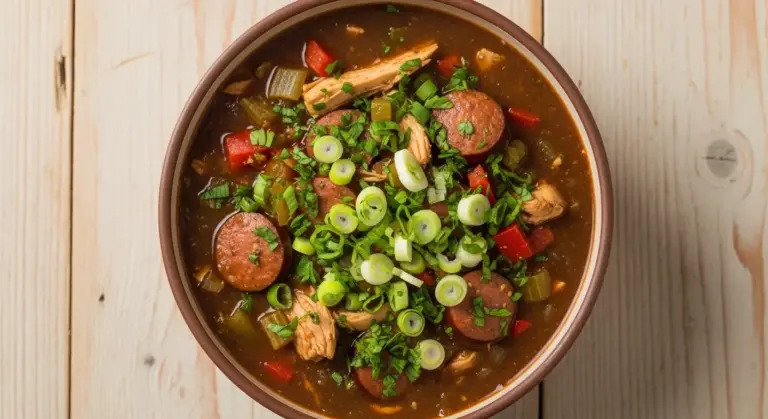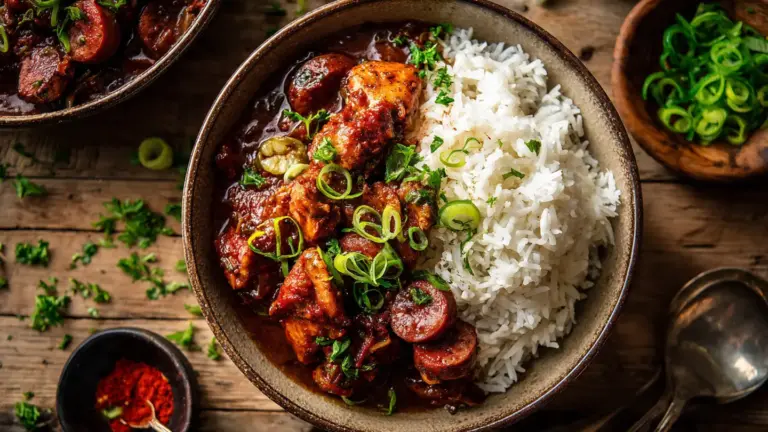
I made my first shrimp and chicken gumbo recipe on a rainy October Saturday, and I genuinely had no idea what I was getting myself into. I thought gumbo was just a fancy soup. Spoiler: it is not just a fancy soup.
That was two years ago, and now this dish shows up on my table at least once a month from fall through spring. My family has started requesting it by name, which is how I know it truly earned its place in the rotation.
The deep, dark roux is everything. I burned my first two batches trying to rush it. Once I learned to trust the process, the flavor payoff was unlike anything I’d made before.
It has that unmistakable Louisiana soul: smoky andouille, tender chicken, plump shrimp, and the Holy Trinity of vegetables all swimming in a rich, thick broth. If you’ve never made it from scratch, this is your sign to start.
| Quick Recipe Summary | |
|---|---|
| Prep Time | 30 minutes |
| Cook Time | 1 hour 30 minutes |
| Total Time | 2 hours |
| Servings | 6 servings |
| Difficulty Level | Intermediate |
If you love hearty Southern stews, you’ll want to bookmark my Chicken and Sausage Gumbo Recipe too — it’s the classic version that started my whole gumbo obsession.
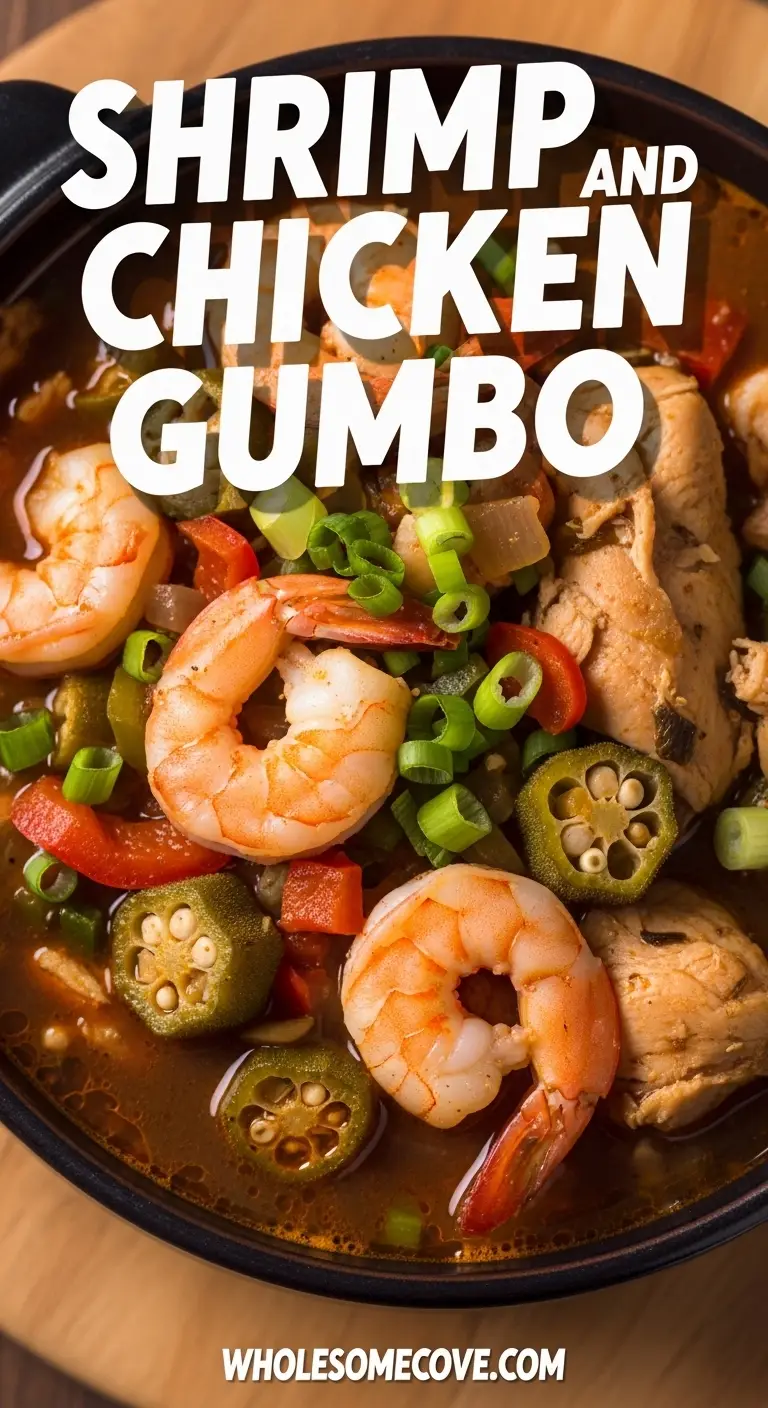
Why You’ll Love This Shrimp and Chicken Gumbo Recipe
This is a bowl of pure Southern comfort that delivers on every single level. It’s the kind of dinner that makes people go quiet at the table because they’re too busy eating to talk.
The combination of proteins is what makes it special. You get smoky depth from the andouille, savory richness from the chicken, and that sweet, briny pop from the shrimp all in one spoonful.
The roux is your flavor foundation, and once you nail it, you’ll feel like a Louisiana chef. That deep, chocolate-brown roux is what separates a great gumbo from a mediocre one.
This recipe feeds a crowd without breaking the bank. Shrimp and chicken are both affordable, and a big pot of gumbo stretches beautifully.
It’s even better the next day. The flavors meld overnight and the broth gets even richer — leftovers are genuinely something to look forward to.
You can customize it to your heat preference. Dial back the cayenne for a milder bowl or go heavy for a dish with serious fire.
- Deep, complex flavor from a properly made dark roux
- Perfect balance of three proteins: chicken, shrimp, and andouille sausage
- A one-pot meal that feeds the whole family with minimal cleanup
- Authentic Louisiana-style cooking made accessible for home cooks
- Freezes beautifully for easy future meals
- Naturally gluten-free adaptable with a few simple swaps
- Incredibly satisfying and filling without feeling overly heavy
For another deeply flavorful Southern stew, check out my Brunswick Stew Recipe — it uses a similar slow-cooked approach and the results are just as rewarding.
Ingredients
The ingredients list looks long, but most of it is pantry staples you likely already have. The fresh proteins and the okra are really all you need to pick up.
For the Roux:
- 1/2 cup (120 ml) vegetable oil or lard
- 1/2 cup (65 g) all-purpose flour
For the Gumbo:
- 1.5 lbs (680 g) bone-in, skin-on chicken thighs (about 4 thighs)
- 1 lb (450 g) large raw shrimp, peeled and deveined (21-25 count)
- 12 oz (340 g) andouille sausage, sliced into 1/4-inch rounds
- 1 cup (150 g) yellow onion, diced
- 1 cup (100 g) celery, diced
- 1 cup (150 g) green bell pepper, diced
- 4 cloves garlic, minced
- 1 cup (120 g) fresh or frozen okra, sliced into 1/2-inch rounds
- 1 can (14.5 oz / 411 g) diced tomatoes, drained
- 6 cups (1.4 L) chicken broth or stock, low sodium preferred
- 2 bay leaves
- 1 tsp dried thyme
- 1 tsp smoked paprika
- 1/2 tsp dried oregano
- 1/2 tsp cayenne pepper (adjust to taste)
- 1 tsp Worcestershire sauce
- 1/2 tsp black pepper
- 1 tsp salt (plus more to taste)
- 2 tbsp Creole seasoning (such as Tony Chachere’s), divided
- 2 green onions, sliced (for garnish)
- Fresh parsley, chopped (for garnish)
- Cooked long-grain white rice, for serving
- Hot sauce, for serving
You might also enjoy: Seafood Stew Recipe
Kitchen Equipment Needed
Having the right tools makes this recipe so much smoother, especially when you’re tending to that roux. These are the ones I use every time.
- Large Dutch oven or heavy-bottomed pot (at least 6-quart capacity) — essential for an even roux
- Wooden spoon or silicone spatula — for stirring the roux continuously
- Large mixing bowl
- Sharp chef’s knife and cutting board
- Measuring cups and measuring spoons
- Ladle for serving
- Instant-read meat thermometer — for checking chicken doneness
- Medium saucepan (for cooking rice separately)
- Slotted spoon or spider strainer
Read Also: Shrimp Chowder Recipe
Recommended Products for This Recipe
These are items I personally use and genuinely recommend — they’ve made a real difference in my gumbo-making process.
1. Lodge Enameled Cast Iron Dutch Oven
A heavy Dutch oven distributes heat incredibly evenly, which is critical for cooking a roux without hot spots that cause burning. I’ve tried making roux in thin-bottomed pots and scorched it twice — switching to cast iron changed everything. The enamel coating also makes cleanup a breeze after a long cook.
2. Tony Chachere’s Original Creole Seasoning
This is the gold standard Creole seasoning and it’s used in kitchens across Louisiana. It’s the perfect blend of salt, spices, and heat, and using it in this recipe adds an authentic depth you really can’t replicate by mixing spices from scratch. A big container lasts a long time and is incredibly versatile.
3. Andouille Sausage (Cajun Style)
Not all andouille is created equal. A good-quality, traditionally smoked Cajun andouille brings a completely different level of smokiness compared to generic smoked sausage. When you slice it and brown it in the pot, it releases fat and flavor that form the base of your gumbo.
4. OXO Good Grips Instant-Read Thermometer
Knowing exactly when your chicken is at 165°F (74°C) means you never overcook or undercook it, and the shred comes out perfectly tender every time. I burned myself pulling apart undercooked chicken before I started using a thermometer consistently.
5. Lodge 12-Inch Cast Iron Skillet
I use this to brown the chicken thighs and sausage before they go into the gumbo. A proper sear builds a fond on the bottom of the pan that’s packed with flavor. The skillet also works beautifully for sautéing if you’re finishing vegetables separately.
For another comfort food classic worth trying, check out my Chicken Stew Recipe.
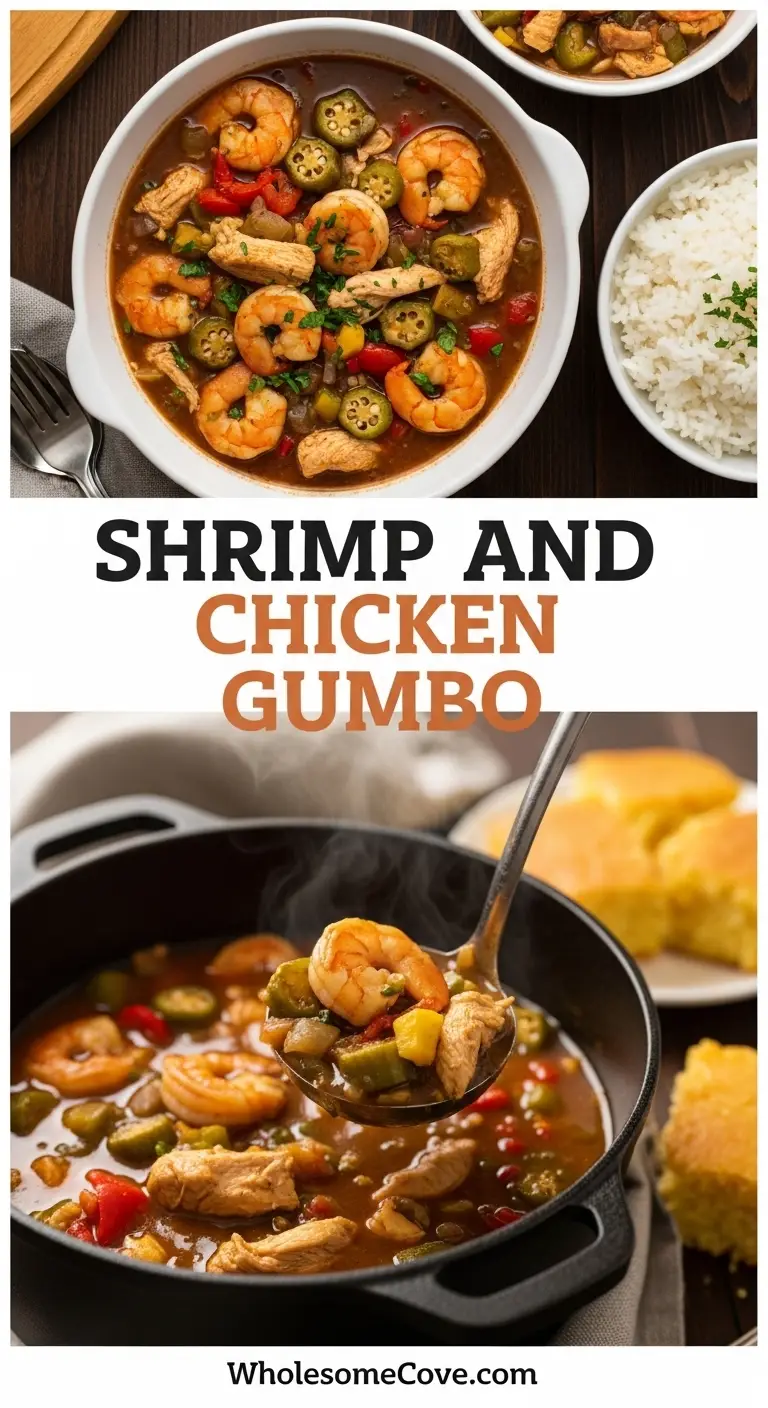
Step-by-Step Instructions: How to Make Shrimp and Chicken Gumbo
Step 1: Season and Brown the Chicken
- Pat the chicken thighs dry with paper towels. Moisture on the surface prevents proper browning.
- Season both sides of the chicken thighs generously with 1 tablespoon of the Creole seasoning and a pinch of salt and black pepper.
- Heat 1 tablespoon of oil in your Dutch oven over medium-high heat until shimmering.
- Place the chicken thighs skin-side down and cook for 5-6 minutes without moving them, until the skin is golden brown and releases easily from the pot.
- Flip and cook the other side for 3-4 minutes.
- Remove the chicken to a plate. It does not need to be fully cooked at this stage — it will finish cooking in the gumbo. Set aside.
Step 2: Brown the Andouille Sausage
- In the same pot with the leftover chicken fat, add the sliced andouille sausage rounds.
- Cook over medium-high heat for 3-4 minutes, stirring occasionally, until the sausage is nicely browned on both sides.
- Use a slotted spoon to transfer the sausage to the plate with the chicken. Leave any rendered fat and browned bits in the pot — that is pure flavor.
Step 3: Make the Roux
- Reduce heat to medium. If the pot looks dry, add additional oil to bring the fat level up to 1/2 cup (120 ml) total. You can measure roughly by eye.
- Add the 1/2 cup (65 g) of flour to the hot fat all at once. Stir immediately and continuously with a wooden spoon or heat-resistant silicone spatula.
- Cook the roux, stirring constantly without stopping, for 20-30 minutes. Do not walk away from the pot.
- The roux will go through stages: first it will smell like raw flour, then it will lighten and become blonde, then gradually deepen through peanut butter color, then milk chocolate, and finally to a rich dark chocolate color.
- You are aiming for a dark chocolate or brick-red color. This is what gives Louisiana gumbo its signature deep, nutty flavor.
- If you see dark flecks or it smells burned, lower the heat immediately. A burned roux means starting over — there is no recovering it.
- Once the roux reaches the right color, remove from heat for 30 seconds before adding vegetables.
Step 4: Cook the Holy Trinity
- Return the pot to medium heat with the roux.
- Add the diced onion, celery, and green bell pepper (the “Holy Trinity” of Cajun cooking) all at once. The vegetables will sizzle and steam dramatically — this is normal.
- Stir constantly for 5-6 minutes until the vegetables have softened and the onion is translucent. The vegetables help cool the roux and stop it from darkening further.
- Add the minced garlic and stir for 1 more minute until fragrant.
Step 5: Build the Gumbo Base
- Add the drained diced tomatoes and stir to combine with the roux and vegetable mixture.
- Gradually add the chicken broth, one cup at a time, stirring well after each addition to prevent lumps.
- Once all the broth is incorporated, add the bay leaves, dried thyme, smoked paprika, dried oregano, cayenne pepper, Worcestershire sauce, and the remaining 1 tablespoon of Creole seasoning.
- Stir well to combine all the seasonings evenly into the broth.
Step 6: Add the Chicken and Simmer
- Return the browned chicken thighs to the pot, nestling them into the broth.
- Bring the gumbo to a boil, then reduce heat to low. Cover and simmer for 35-40 minutes, until the chicken is fully cooked through and tender enough to shred.
- Use tongs to remove the chicken thighs to a cutting board. Let them cool for 5 minutes, then remove and discard the skin and bones.
- Use two forks to shred the chicken into bite-sized pieces.
Step 7: Add the Sausage, Okra, and Chicken Back In
- Return the browned andouille sausage to the pot.
- Add the sliced okra to the pot. Okra is a natural thickener and will help give the gumbo its characteristic body.
- Stir in the shredded chicken.
- Continue to simmer uncovered for 15-20 minutes, stirring occasionally. The gumbo will thicken further as the okra cooks down.
- Taste and adjust salt, black pepper, and cayenne to your liking.
Step 8: Add the Shrimp
- In the last 5-7 minutes of cooking, add the peeled and deveined shrimp directly to the pot.
- Stir gently and cook until the shrimp are pink and curled, about 4-5 minutes. Do not overcook the shrimp — they go tough and rubbery very quickly.
- Remove the bay leaves and discard them.
Step 9: Serve
- Ladle the gumbo into wide, deep bowls over a scoop of cooked long-grain white rice.
- Garnish with sliced green onions and fresh chopped parsley.
- Serve with hot sauce on the side for anyone who wants more heat.
Another great seafood comfort food worth trying: Seafood Chowder Recipe
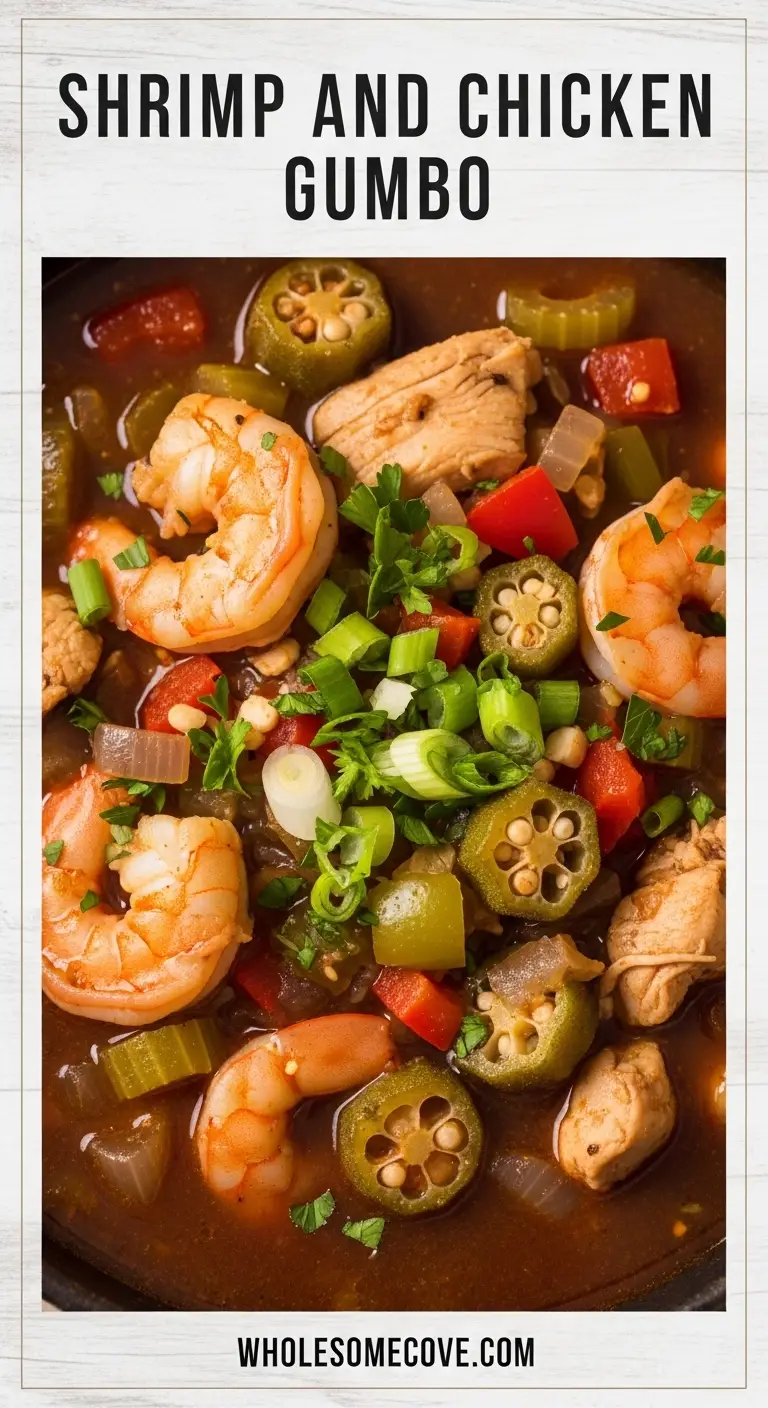
Tips for The Best Shrimp and Chicken Gumbo
The biggest factor in great gumbo is patience. These tips will help you get every step right the first time around.
- Don’t rush the roux. A dark roux takes 20-30 minutes of constant stirring. Set a timer and clear your schedule. This is not negotiable.
- Use a heavy-bottomed pot. Thin pots create hot spots that burn the roux unevenly. A Dutch oven is ideal.
- Brown your proteins first. Taking the time to sear the chicken and sausage before building the gumbo adds layers of flavor from the Maillard reaction that you simply can’t achieve any other way.
- Add shrimp last. Shrimp cook in just 4-5 minutes. Adding them too early makes them rubbery and tough. Watch them carefully — pink and curled means done.
- Season in layers. Season the chicken before searing, season the gumbo base during cooking, and taste and adjust at the end. Gumbo built on layered seasoning tastes far more complex.
- Go low and slow for the simmer. Once the chicken is in, keep the heat low. A violent boil can tighten the chicken and cloud the broth.
- Fresh okra is best, but frozen works fine. If using frozen, thaw and pat it dry first to reduce the slime factor during cooking.
- Taste constantly in the final 20 minutes. The flavors intensify as the gumbo reduces, so what tasted balanced early may need adjusting later.
- Let it rest before serving. Even just 10 minutes off the heat lets the flavors settle and come together beautifully.
- Make it a day ahead. Gumbo genuinely improves overnight as the spices continue to bloom. Reheat low and slow, adding a splash of broth if it thickened too much.
Read Also: Shrimp and Avocado Salad Recipe
What to Serve with Shrimp and Chicken Gumbo
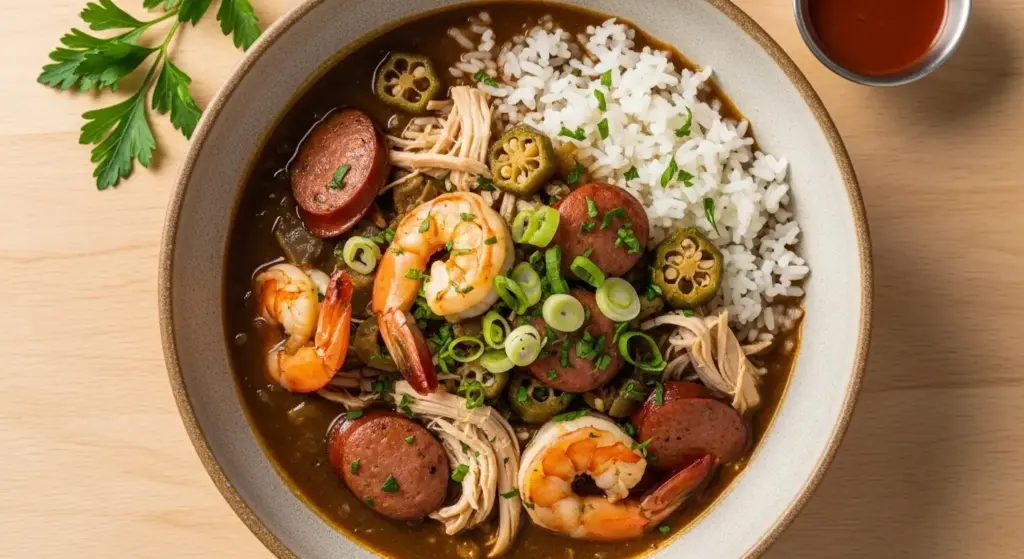
Gumbo is a full meal on its own, but a few simple sides can round it out into a real Southern spread. These are the pairings that show up most often on my table.
- Long-grain white rice: The classic and essential companion. Rice soaks up the gumbo broth beautifully and balances the rich, spiced stew.
- Cornbread: A wedge of slightly sweet cornbread is perfect for soaking up the last bit of broth in the bowl. Try my Healthy Cornbread for a lighter take.
- Coleslaw: The cool crunch of coleslaw is a wonderful contrast to the warm, hearty gumbo. It cuts through the richness perfectly.
- Potato salad: A Louisiana tradition — some people actually stir it directly into their gumbo bowl. Give it a try before you judge!
- Biscuits: Fluffy, buttery biscuits are another great vehicle for sopping up all that rich broth. My Homemade Biscuit Recipe takes under 30 minutes to make.
- Hot sauce: Always on the table. Louisiana-style hot sauce is the go-to, but any vinegar-based hot sauce works well.
- Deviled Eggs: A classic Southern appetizer that pairs naturally with a gumbo dinner spread.
- Broccoli salad: The slightly sweet, crunchy contrast works surprisingly well alongside the deep flavors of gumbo.
For another classic side that pairs well with Southern mains, try my Coleslaw Recipe.
Variations of Shrimp and Chicken Gumbo
Once you’ve nailed the base recipe, there’s a lot of room to riff on it. These are the variations I’ve personally tried and loved.
The base technique stays the same across all of them — the roux, the Holy Trinity, the slow simmer. Just swap or add proteins and adjust seasonings accordingly.
- Seafood gumbo: Omit the chicken entirely and go all-in on seafood. Crab claws, oysters, scallops, and shrimp make a stunning seafood gumbo. Add blue crab claws during the simmer and oysters in the last 3-4 minutes.
- Chicken and sausage gumbo (no shrimp): The most traditional version. Skip the shrimp and use a combination of andouille and smoked sausage for maximum smokiness.
- Turkey gumbo: A fantastic post-Thanksgiving use for leftover roasted turkey. Replace the chicken with shredded turkey and use turkey broth for an even deeper flavor.
- Gumbo z’herbes (greens gumbo): A meatless Cajun tradition made with multiple types of leafy greens. It’s traditionally served during Lent and is incredibly flavorful despite having no meat.
- File gumbo: Instead of (or in addition to) okra, thicken the gumbo with file powder, which is made from ground sassafras leaves. Stir it in off the heat at the very end. It gives a slightly different, earthy flavor.
- Spicy gumbo: Double the cayenne and add a whole sliced jalapeño with the Holy Trinity for serious heat lovers.
- Slow cooker gumbo: Make the roux on the stovetop, then transfer everything to a slow cooker and cook on low for 6-8 hours. Add shrimp in the last 30 minutes.
Another great hearty Southern option worth making: Cowboy Stew Recipe
Storage and Reheating
Gumbo stores incredibly well, which makes it perfect for batch cooking. Here’s how to keep it tasting great all week.
Store the gumbo and the rice separately in the refrigerator. Storing them together causes the rice to absorb too much broth, making the gumbo thick and the rice mushy.
- Refrigerator: Store cooled gumbo in an airtight container for up to 4 days. The flavor genuinely improves by day two.
- Freezer: Gumbo freezes beautifully for up to 3 months. Freeze without the shrimp if possible — shrimp can become slightly rubbery after freezing and reheating. Add fresh shrimp when reheating instead.
- Reheating on the stovetop: Pour into a saucepan over medium-low heat. Add a splash of chicken broth or water to loosen the consistency if it thickened in the fridge. Stir occasionally and heat until steaming, about 8-10 minutes.
- Reheating in the microwave: Transfer a portion to a microwave-safe bowl, cover loosely, and heat in 90-second intervals, stirring in between, until hot throughout.
- Do not boil when reheating. A hard boil during reheating can toughen the shrimp and change the texture of the gumbo.
- Portioning for freezing: Freeze in individual or two-portion containers so you can pull out exactly what you need without thawing the whole batch.
Read Also: Oyster Stew Recipe
Nutritional Facts
The following estimates are per serving (1/6 of the full recipe), served over 1/2 cup of cooked white rice. Actual values will vary depending on the exact ingredients and brands used.
| Nutrient | Amount Per Serving |
|---|---|
| Calories | ~480 kcal |
| Protein | 38 g |
| Total Fat | 22 g |
| Saturated Fat | 6 g |
| Carbohydrates | 32 g |
| Fiber | 3 g |
| Sugars | 4 g |
| Sodium | 820 mg |
| Cholesterol | 195 mg |
These values are approximate and will differ based on the size of shrimp, the brand of sausage, and how much rice you serve alongside.
You might also enjoy: Shrimp Macaroni Salad Recipe
Health Benefits of Key Ingredients
Beyond the incredible flavor, this gumbo packs in a solid nutritional punch from some genuinely functional ingredients. Here’s what makes each key component worth highlighting.
Gumbo is one of those dishes where great flavor and real nourishment go hand in hand, which makes it easier to justify making a big pot on a regular basis.
- Shrimp: A lean, high-protein seafood that is low in calories and rich in iodine, selenium, and vitamin B12. A 3-oz serving of shrimp provides about 20 grams of protein with very little fat.
- Chicken thighs: Darker meat provides more iron and zinc than breast meat, along with collagen-rich connective tissue that breaks down during slow cooking to add body to the broth.
- Okra: A nutritional powerhouse packed with vitamin C, vitamin K, folate, and soluble fiber. The mucilage in okra (the sliminess) is what thickens gumbo naturally and is also beneficial for gut health.
- Andouille sausage: While higher in fat and sodium, it provides significant protein and the antioxidant lycopene from the smoked paprika used in its seasoning.
- Onion, celery, and bell pepper (Holy Trinity): These aromatic vegetables are rich in vitamins C and B6, folate, and antioxidants including quercetin and luteolin.
- Garlic: Contains allicin, a compound with well-documented antimicrobial and anti-inflammatory properties. It also supports immune function and heart health.
- Tomatoes: A source of lycopene, vitamin C, and potassium. Cooking tomatoes actually increases the bioavailability of lycopene compared to eating them raw.
- Chicken broth: Provides gelatin and minerals from the bones, which support joint health and add richness to the gumbo without added fat.
For another protein-packed, nourishing bowl, try my Chicken Soup Recipe.
FAQs About Shrimp and Chicken Gumbo
1. What is the difference between Creole and Cajun gumbo?
Creole gumbo (New Orleans-style) typically includes tomatoes and is associated with the more urban, French-influenced cooking of New Orleans. Cajun gumbo comes from the rural bayou regions and usually skips the tomatoes, relying more heavily on a darker roux and file powder for thickening and flavor.
This recipe leans Creole with the addition of diced tomatoes, but the technique is rooted in both traditions.
2. Can I use frozen shrimp?
Absolutely, and most of the time that’s exactly what I use. Frozen shrimp are usually flash-frozen at peak freshness right on the boat, so they’re often fresher than “fresh” shrimp at the seafood counter. Just make sure to thaw them completely under cold running water and pat them dry before adding them to the gumbo.
3. What can I substitute for okra?
File powder is the most traditional substitute and it’s what many Louisiana cooks use when okra isn’t available. Stir in 1-2 teaspoons at the very end, off the heat. You can also skip the thickener entirely — the roux will still give you a nicely bodied gumbo, just slightly thinner than the okra version.
4. How dark should the roux be?
For this gumbo, you want a dark chocolate or brick-red roux. Lighter roux (blonde, peanut butter) is used in cream-based dishes and won’t give you that deep, nutty gumbo flavor. The darker you go, the more flavor you develop — but also the more attention it requires. Don’t go beyond dark chocolate or it will taste bitter.
5. Can I make this gumbo ahead of time?
Yes, and I actually recommend it. Make the gumbo a full day ahead, refrigerate it overnight without the shrimp, and reheat it the next day. Add the shrimp during reheating when the gumbo is hot and bubbly, cooking them for just 4-5 minutes. The overnight rest makes the flavors significantly more developed and complex.
For a similarly make-ahead-friendly dish, try my Slow Cooker Chili Recipe.
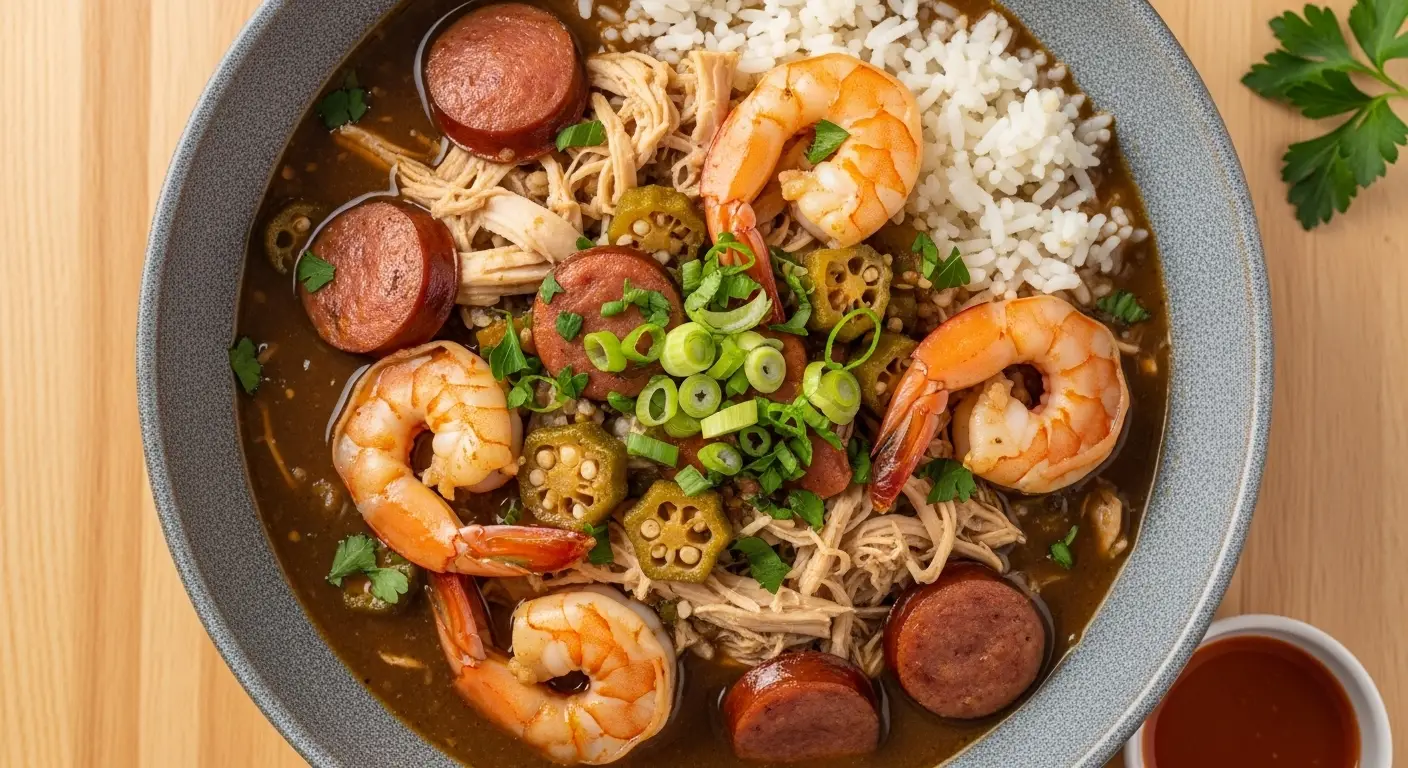
Shrimp and Chicken Gumbo
Ingredients
- 1/2 cup vegetable oil or lard 120 ml
- 1/2 cup all-purpose flour 65 g
- 1.5 lbs bone-in, skin-on chicken thighs 680 g, about 4 thighs
- 1 lb large raw shrimp, peeled and deveined 450 g, 21-25 count
- 12 oz andouille sausage 340 g, sliced into 1/4-inch rounds
- 1 cup yellow onion 150 g, diced
- 1 cup celery 100 g, diced
- 1 cup green bell pepper 150 g, diced
- 4 garlic cloves minced
- 1 cup fresh or frozen okra 120 g, sliced into 1/2-inch rounds
- 14.5 oz canned diced tomatoes 411 g, drained
- 6 cups low-sodium chicken broth 1.4 L
- 2 bay leaves
- 1 tsp dried thyme
- 1 tsp smoked paprika
- 1/2 tsp dried oregano
- 1/2 tsp cayenne pepper adjust to taste
- 1 tsp Worcestershire sauce
- 1/2 tsp black pepper
- 1 tsp salt plus more to taste
- 2 tbsp Creole seasoning divided; such as Tony Chachere’s
- cooked long-grain white rice
- 2 green onions sliced, for garnish
- fresh parsley chopped, for garnish
- hot sauce for serving
Equipment
- Large Dutch oven or heavy-bottomed pot At least 6-quart capacity; essential for an even roux
- Wooden spoon or silicone spatula For stirring the roux continuously
- Large mixing bowl
- Chef’s knife and cutting board
- Measuring cups and measuring spoons
- Ladle For serving
- Instant-read meat thermometer For checking chicken doneness at 165°F / 74°C
- Medium saucepan For cooking rice separately
- Slotted spoon or spider strainer
Method
- Pat chicken thighs dry, season both sides with 1 tablespoon Creole seasoning, salt, and black pepper. Heat 1 tablespoon oil in the Dutch oven over medium-high heat and sear the chicken skin-side down for 5-6 minutes, then flip for 3-4 minutes; remove to a plate (chicken does not need to be fully cooked).
- In the same pot, add the sliced andouille and cook over medium-high heat for 3-4 minutes until browned on both sides. Remove with a slotted spoon to the plate with the chicken, leaving all rendered fat in the pot.
- Reduce heat to medium, bring the fat in the pot to 1/2 cup (120 ml), add the flour all at once, and stir continuously for 20-30 minutes until the roux reaches a dark chocolate or brick-red color. Do not stop stirring and do not let it burn.
- Add the diced onion, celery, and bell pepper to the roux and stir constantly over medium heat for 5-6 minutes until softened. Add the minced garlic and cook for 1 more minute until fragrant.
- Stir in the drained diced tomatoes, then gradually add the chicken broth one cup at a time, stirring well after each addition. Add the bay leaves, thyme, smoked paprika, oregano, cayenne, Worcestershire sauce, and remaining 1 tablespoon Creole seasoning; stir to combine.
- Return the browned chicken thighs to the pot, bring to a boil, then reduce to low, cover, and simmer for 35-40 minutes until fully cooked through. Remove chicken, discard skin and bones, shred the meat with two forks, and set aside.
- Return the andouille sausage and shredded chicken to the pot and stir in the sliced okra. Simmer uncovered for 15-20 minutes, stirring occasionally, until the gumbo thickens; taste and adjust salt, pepper, and cayenne.
- Add the peeled and deveined shrimp to the pot and cook for 4-5 minutes until pink and curled. Remove and discard the bay leaves.
- Ladle the gumbo over cooked long-grain white rice in deep bowls and garnish with sliced green onions, fresh parsley, and hot sauce on the side.
Nutrition
Notes
- Do not rush the roux — stirring for a full 20-30 minutes over medium heat is non-negotiable for authentic gumbo flavor. A burned roux cannot be saved; start over if you see dark flecks or smell bitterness.
- Use a heavy Dutch oven or cast iron pot for the roux; thin-bottomed pans create uneven hot spots that cause scorching.
- Always brown your chicken and sausage first — the fond left in the pot adds a critical layer of depth to the final dish.
- Add shrimp in the last 4-5 minutes only; overcooking makes them rubbery and tough.
- No okra? Substitute 1-2 teaspoons of file powder stirred in off the heat at the very end for a traditional thickener.
- Make-ahead tip: Prepare the gumbo a full day ahead without the shrimp, refrigerate overnight, and add the shrimp during reheating. The flavor improves significantly after resting.
- Storage: Refrigerate in an airtight container for up to 4 days. Store rice and gumbo separately to prevent the rice from absorbing all the broth.
- Freezer: Freeze gumbo (without shrimp) for up to 3 months. Thaw overnight in the refrigerator and add fresh shrimp when reheating.
- For Cajun-style gumbo, omit the diced tomatoes — tomatoes are a Creole (New Orleans) addition that is not traditional in rural Cajun cooking.
- Reheat gently over medium-low heat with a splash of broth to loosen; do not boil or the shrimp will toughen.
Private Notes
Tried this recipe?
Let us know how it was!Final Thoughts
If you’ve been on the fence about making gumbo from scratch, I hope this recipe finally gets you in the kitchen. It’s one of those dishes that seems intimidating until you actually make it, and then you can’t believe you waited so long.
The roux is the heart of this recipe. Once you’ve stood over a pot stirring for 25 minutes and watched that flour and oil transform into something that smells like magic, you’ll understand exactly why real Louisiana gumbo is in a category of its own.
Make a big pot, gather some people you love, and serve it over rice with hot sauce on the side. That’s all this dish needs.
I’d love to hear how it turns out for you! Drop a comment below with any questions or let me know what variation you tried. And if you loved this recipe, share it with a fellow Southern food lover who needs a good gumbo in their life.
Recommended:
- Chicken and Sausage Gumbo Recipe
- Seafood Stew Recipe
- Brunswick Stew Recipe
- Shrimp Chowder Recipe
- Lemon Chicken Soup Recipe
- Lamb Stew Recipe
- Creamy Chicken Soup Recipe
- Shrimp Tacos with Mango Salsa
- Zucchini Noodles with Pesto and Shrimp Bowls
- Beef Stew Recipe