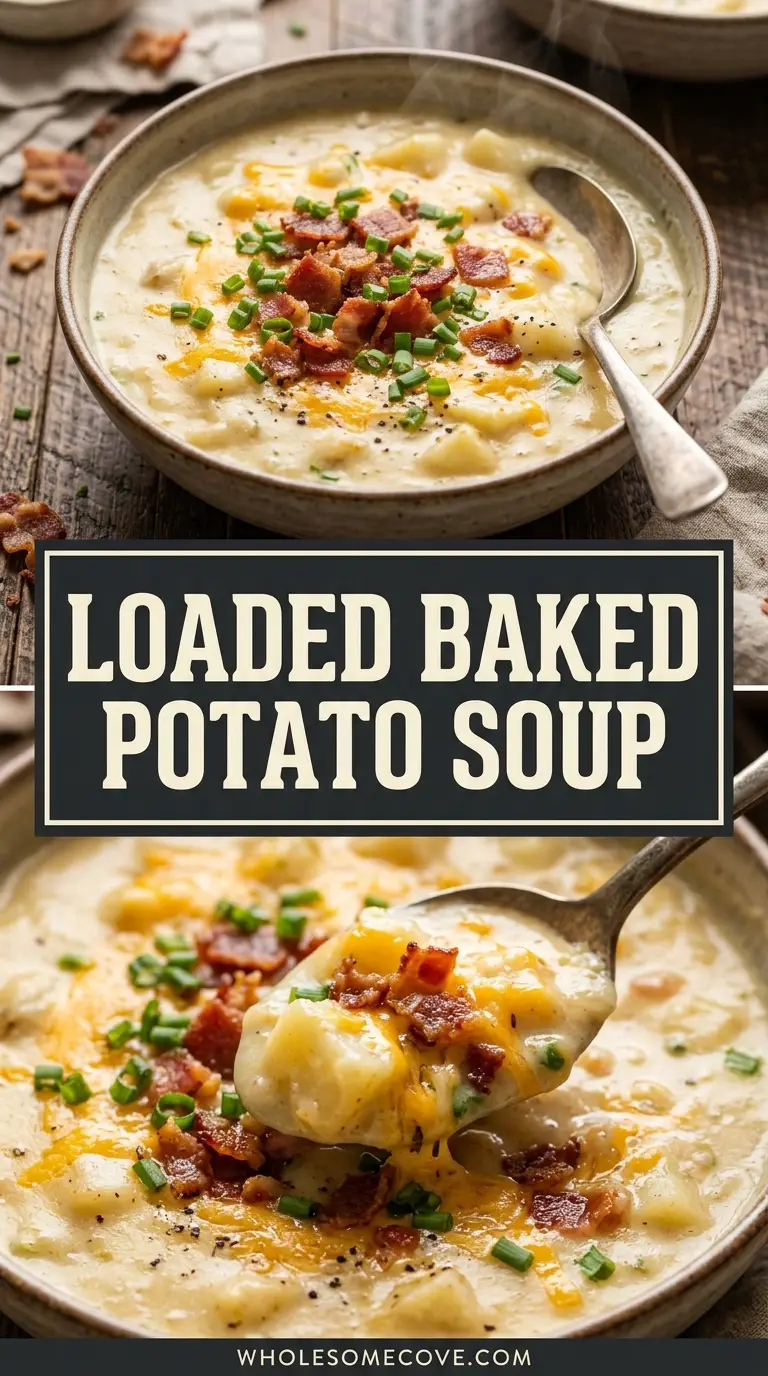
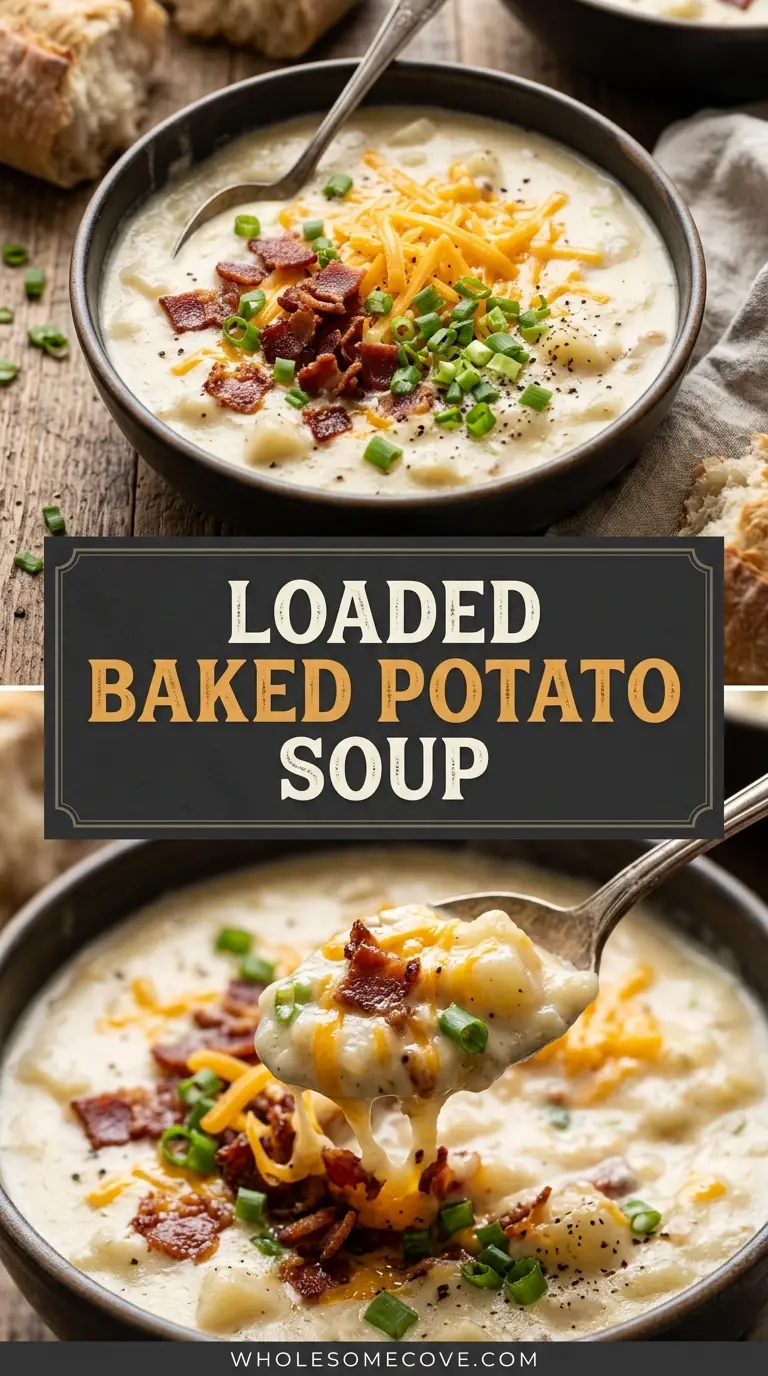
This loaded baked potato soup recipe turns four russet potatoes into a thick, spoon-coating bowl that tastes like a fully dressed baked potato.
Crisp bacon, sharp cheddar, sour cream, and sliced green onion all go into the pot, not just on top. The texture is the whole point.
Mashing part of the cooked potato right in the pot thickens the broth naturally. You get real body without a gluey, paste-like finish.
That gummy texture is the most common complaint with potato soup. It usually comes from over-blending starchy russets until they break down into glue.
Keeping most of the potato in soft chunks solves it.
Everything comes together in about 50 minutes in one pot. You end up with roughly six generous bowls, each finished like a baked potato.
| Quick Recipe Summary | |
|---|---|
| Prep Time | 15 minutes |
| Cook Time | 35 minutes |
| Total Time | 50 minutes |
| Servings | 6 bowls |
| Difficulty Level | Easy |
Read Also: Potato Soup Recipe
Why You’ll Love This Loaded Baked Potato Soup Recipe
This is the kind of soup that feels like a full meal in a bowl, and it leans on ingredients most people already keep on hand. Here is why it earns a spot in the regular rotation.
- It is a true one-pot meal. The bacon, aromatics, roux, potatoes, and dairy all build in the same pot, so cleanup stays minimal.
- The texture is thick and creamy. Mashing a portion of the potatoes thickens the base without relying on a heavy amount of cream.
- It tastes exactly like a loaded baked potato. Bacon, cheddar, sour cream, and green onion are built into the soup and stacked on top again.
- It is ready in about 50 minutes. That makes it realistic for a weeknight, not just a weekend project.
- It is easy to scale. The recipe doubles cleanly for a crowd or halves for two without any guesswork.
- It reheats well. Leftovers hold their flavor for days, which makes this a strong meal-prep option.
- Beginners can pull it off. There is no tricky technique beyond making a simple roux, and even that is forgiving.
For another take on this flavor combination, see Slow Cooker Potato Soup Recipe.
Ingredients
Every ingredient here pulls its weight, and most are pantry or fridge staples. The amounts below make about six bowls, with both imperial and metric listed.
- 6 slices thick-cut bacon (about 6 oz / 170 g), chopped
- 2 lb / 900 g russet potatoes (about 4 medium), peeled and diced into ½-inch pieces
- 1 medium yellow onion (about 1 cup / 150 g), finely diced
- 3 cloves garlic, minced
- ¼ cup / 55 g unsalted butter
- ¼ cup / 30 g all-purpose flour
- 4 cups / 950 ml chicken broth
- 2 cups / 475 ml whole milk
- 1 cup / 240 ml heavy cream
- 1½ cups / 170 g sharp cheddar cheese, freshly shredded
- ½ cup / 120 g sour cream, at room temperature
- 3 green onions, thinly sliced (white and green parts separated)
- 1 teaspoon salt, plus more to taste
- ½ teaspoon black pepper
For the toppings, set aside extra shredded cheddar, the reserved crisp bacon, a little more sour cream, and the green parts of the green onions.
For a cheese-forward spin, see Potato Cheese Soup Recipe.
Kitchen Equipment Needed
You do not need anything specialized for this soup, though a few tools make it smoother. Here is what to have ready before you start.
- A large Dutch oven or heavy soup pot (at least 5 quarts)
- A large stockpot as a backup option if you do not own a Dutch oven
- A vegetable peeler for the potatoes
- A box grater for shredding cheese from a block
- A potato masher to thicken the base
- An immersion blender if you prefer a smoother finish
- A balloon whisk for a lump-free roux
- A wooden spoon for stirring and scraping the bottom
- A soup ladle for serving
You might also enjoy: Instant Pot Potato Soup Recipe
Recommended Products for This Recipe
These are the tools and ingredients I reach for when I want this soup to come out right the first time. Each one earned its place by fixing a specific problem rather than just taking up drawer space.
1. Lodge Enameled Cast Iron Dutch Oven
Thin pots scorch the roux and the dairy before you notice, which is how potato soup picks up a burnt undertone. The heavy enameled base holds steady, even heat, so the bottom simmers gently instead of catching, and the wide mouth gives you room to mash the potatoes right in the pot.
2. OXO Box Grater
Pre-shredded cheese is coated in anti-caking starch, which keeps it from melting cleanly and leaves the soup slightly grainy. Shredding a block of sharp cheddar on a sturdy box grater melts into the broth far more smoothly, and the enclosed base keeps the pile contained instead of scattering across the counter.
3. KitchenAid Immersion Blender
A handheld blender solved my biggest frustration with this recipe. Mashing by hand left stubborn lumps, while tipping everything into a full blender turned the whole batch to paste, so a few quick pulses with an immersion blender along one side of the pot gives a creamy base while leaving plenty of tender chunks.
4. Better Than Bouillon Roasted Chicken Base
Watery broth makes for a flat-tasting soup, and that is where a lot of homemade versions fall short. A spoonful of concentrated roasted chicken base dissolves into the liquid and deepens the savory backbone without adding more salt than you can control.
5. Cabot Sharp Cheddar
Mild cheese gets lost once it is stirred into a rich, bacon-heavy base. A genuinely sharp, aged cheddar cuts through all that fat and reads clearly in every spoonful, which is exactly what a loaded baked potato flavor needs.
A related recipe is Ham and Potato Soup Recipe.

Step-by-Step Instructions: How to Make Loaded Baked Potato Soup
Follow these steps in order and you will have a thick, loaded bowl of soup ready in about 50 minutes.
Step 1: Cook the Bacon
- Place your Dutch oven over medium heat and add the chopped bacon.
- Cook, stirring occasionally, for 7 to 9 minutes until the bacon is crisp and the fat has rendered out.
- Use a slotted spoon to transfer the bacon to a paper-towel-lined plate, leaving the drippings in the pot.
- Spoon off all but about 2 tablespoons of the bacon fat, and set the extra aside in case you need it later. I keep a small jar of bacon fat in the fridge specifically for the onions here, since it carries more smoke than butter alone.
Step 2: Soften the Aromatics
- Add the butter to the reserved bacon fat and let it melt over medium heat.
- Stir in the diced onion and the white parts of the green onions.
- Cook for 4 to 5 minutes until the onion turns soft and translucent, stirring so it does not brown.
- Add the minced garlic and cook for about 30 seconds, just until fragrant.
Step 3: Build the Roux
- Sprinkle the flour evenly over the onions and butter.
- Whisk constantly for 1 to 2 minutes to cook out the raw flour taste.
- The mixture should look like a thick, pale paste coating the bottom of the pot.
- Keep it moving so the flour does not scorch.
Step 4: Add the Broth and Potatoes
- Pour in the chicken broth slowly, whisking the whole time to keep the roux smooth.
- Add the diced russet potatoes and stir to combine.
- Season with the salt and black pepper.
- Bring the pot to a gentle boil, then reduce to a steady simmer.
Step 5: Simmer Until Tender
- Let the soup simmer, uncovered, for 15 to 18 minutes.
- Stir now and then and scrape the bottom so nothing sticks.
- The potatoes are ready when a fork slides through a piece with no resistance.
- Lower the heat to medium-low before moving on to the dairy.
Step 6: Thicken the Base
- Use a potato masher to mash roughly half of the potatoes directly in the pot.
- For a smoother soup, run an immersion blender along one side for a few short pulses instead.
- Leave plenty of soft potato chunks so the soup still has texture.
- The base should visibly thicken as the starch releases.
Step 7: Add the Milk, Cream, and Cheese
- With the heat on medium-low, pour in the whole milk and heavy cream.
- Warm the soup through for 3 to 4 minutes without letting it boil.
- Add the shredded cheddar a handful at a time, stirring until each addition melts.
- Stir in the sour cream last, mixing until the soup looks glossy and smooth.
Step 8: Finish and Serve
- Stir in most of the crisp bacon, reserving some for the top.
- Taste and adjust with more salt and pepper as needed.
- Ladle the soup into bowls while hot.
- Top each bowl with extra cheddar, the reserved bacon, a dollop of sour cream, and the sliced green parts of the green onions.
For a vegetable-packed variation, see Broccoli Cheese Potato Soup Recipe.
Tips for The Best Loaded Baked Potato Soup
A few small habits make the difference between a thin, broken soup and a thick, velvety one. Keep these in mind as you cook.
- Temper the dairy. I ruined my first pot by pouring cold cream straight into boiling soup, which split it into grainy curds, so now I lower the heat before the milk and cream go in.
- Shred your own cheese. Block cheddar grated at home melts cleaner than bagged shreds, which are coated to resist clumping.
- Cut potatoes evenly. Uniform ½-inch pieces cook at the same rate, so you avoid raw centers next to mush.
- Do not fully blend the soup. Over-processing russets releases too much starch and turns the whole pot gluey.
- Keep the heat gentle after adding dairy. A hard boil at this stage is the fastest way to curdle the milk and cream.
- Salt in stages. Bacon, broth, and cheese all add sodium, so season lightly at first and adjust at the end.
- Reserve some toppings. Stirring everything in is fine, but a fresh layer of bacon and cheese on top keeps each bowl looking and tasting loaded.
A similar approach works in Chicken Potato Soup Recipe.
What to Serve with Loaded Baked Potato Soup
This soup is rich and filling, so the best pairings are simple sides that add crunch, freshness, or something to dip. Here are the pairings I keep coming back to.
- Warm Homemade Biscuits for tearing and dunking into the thick broth
- Soft Dinner Rolls brushed with butter
- A slice of Healthy Cornbread for a slightly sweet contrast
- Crisp, tangy Coleslaw to cut through the richness
- A cold, crunchy Broccoli Salad on the side
- Roasted Brussels Sprouts with Bacon to lean into the smoky flavor
- A simple Roast Chicken if you want the soup as a starter
- A chilled Classic Pasta Salad for a potluck spread
- A plain green salad with a sharp vinaigrette
- Oyster crackers or toasted sourdough for extra crunch on top
For a beefy comfort-food alternative, see Cheeseburger Soup Recipe.
Variations of Loaded Baked Potato Soup
Once you have the base down, this soup takes well to swaps and add-ins. Use these ideas to match it to what you have or who you are feeding.
- Truly baked potato version. For the deeper, roasted flavor the name suggests, bake the russets at 400°F (200°C) for about an hour until tender, scoop out the flesh, and stir it in during Step 4 in place of the raw diced potato. Plan for roughly an extra hour of total time.
- Yukon Gold version. I have found Yukon Gold potatoes hold their shape better than russets if you want distinct chunks, while russets melt into a creamier base.
- Loaded with ham. Stir in diced cooked ham along with or in place of the bacon for a smoky, meatier bowl.
- Chicken and potato. Add shredded rotisserie chicken in the final few minutes for extra protein.
- Broccoli cheddar twist. Fold in a cup or two of small broccoli florets during the simmer.
- Extra cheesy. Mix in a handful of shredded Monterey Jack or Gruyere along with the cheddar.
- Spicy kick. Add a diced jalapeno with the onion or a pinch of cayenne with the seasoning.
- Lighter version. Swap the heavy cream for additional whole milk and use turkey bacon.
- Slow cooker method. Build the base, then transfer to a slow cooker and add the dairy at the end.
You’ll find more inspiration in Potato Soup Recipes.
Storage and Reheating
Loaded baked potato soup keeps well, though the dairy base needs a gentle hand when you warm it back up. Follow these guidelines to keep leftovers smooth.
- Refrigerate cooled soup in an airtight container for up to 4 days.
- Store toppings separately so the bacon stays crisp and the green onions stay fresh.
- Reheat on the stovetop over low heat, stirring often, rather than blasting it in the microwave.
- Add a splash of milk or broth while reheating, since the soup thickens considerably once chilled.
- Avoid boiling reheated soup, as high heat can cause the dairy to separate.
- Freezing is possible but imperfect, because cream-based soups can turn grainy once thawed.
- For best freezer results, freeze the soup base before adding the dairy, then stir in milk, cream, and cheese when you reheat.
- Thaw frozen soup overnight in the refrigerator before warming it slowly.
You might also enjoy: Zuppa Toscana Recipe
Nutritional Facts
The values below are estimates for one of six servings, made with the ingredients as listed and before extra toppings. Actual numbers will vary with brands and portion sizes.
| Nutrient | Amount per Serving |
|---|---|
| Calories | 485 |
| Total Fat | 33 g |
| Saturated Fat | 18 g |
| Cholesterol | 90 mg |
| Sodium | 820 mg |
| Total Carbohydrates | 33 g |
| Dietary Fiber | 3 g |
| Sugars | 6 g |
| Protein | 15 g |
Read Also: Twice Baked Potatoes Recipe
Health Benefits of Key Ingredients
Rich as it is, this soup is built on real, whole ingredients that bring more than just flavor. Here is what the main components contribute nutritionally.
- Russet potatoes supply potassium, vitamin C, and vitamin B6, along with resistant starch that supports digestion.
- Cheddar cheese adds calcium and protein, plus a good dose of vitamin A.
- Milk and heavy cream provide calcium and fat-soluble vitamins that help the body absorb nutrients.
- Onion contains antioxidants and natural compounds linked to heart health.
- Garlic offers allicin, a compound studied for its immune and anti-inflammatory properties.
- Green onions bring vitamin K and vitamin C with very few calories.
- Bacon, used in moderation, contributes protein and savory depth that makes the dish satisfying.
- Sour cream adds calcium and probiotics when it is a cultured variety.
A similar comforting bowl is Corn Chowder Recipe.
FAQs About Loaded Baked Potato Soup
1. Why is my potato soup gummy or gluey?
Gumminess almost always comes from overworking the potatoes. Blending starchy russets too aggressively releases excess starch, which turns the soup into a paste.
To avoid it, mash only part of the potatoes and leave the rest in chunks. A few short pulses with an immersion blender are plenty if you want it smoother.
2. What are the best potatoes for loaded baked potato soup?
Russet potatoes are the classic choice because they are starchy and break down easily. That starch is what gives the soup its naturally thick body.
Yukon Golds also work well if you prefer a creamier texture with more defined chunks. Avoid waxy red potatoes, which stay firm and do not thicken the base.
3. Can I make loaded baked potato soup ahead of time?
Yes, and the flavor often deepens overnight. Store it in the refrigerator for up to four days in a sealed container.
Keep the crisp bacon and fresh toppings separate until serving. Reheat gently on the stove with a splash of milk to loosen it.
4. Can you freeze loaded baked potato soup?
You can, though cream-based soups sometimes turn grainy after thawing. The potatoes and dairy can change texture once frozen and reheated.
For the best result, freeze the soup base before you add the milk, cream, and cheese. Stir those in fresh when you reheat it.
5. How do I thicken potato soup without flour?
Mashing more of the cooked potatoes is the simplest way to thicken the base naturally. The released starch does the work on its own.
You can also stir in a slurry of cornstarch and cold water near the end. A handful of instant potato flakes will tighten a thin soup quickly as well.
6. Can I make this in a slow cooker?
Yes, with a small adjustment to the order. Cook the bacon and build the base on the stove, then transfer everything to the slow cooker to simmer the potatoes.
Add the milk, cream, cheese, and sour cream during the last 30 minutes on low. Adding dairy too early risks curdling over long cook times.
For a classic restaurant-style pairing, try: Creamy Tomato Basil Soup Recipe

Loaded Baked Potato Soup
Ingredients
- 6 slices thick-cut bacon - about 6 oz / 170 g, chopped
- 2 lb russet potatoes - 900 g, about 4 medium, peeled and diced into ½-inch pieces
- 1 medium yellow onion - about 1 cup / 150 g, finely diced
- 3 cloves garlic - minced
- ¼ cup unsalted butter - 55 g
- ¼ cup all-purpose flour - 30 g
- 4 cups chicken broth - 950 ml
- 2 cups whole milk - 475 ml
- 1 cup heavy cream - 240 ml
- 1½ cups sharp cheddar cheese - 170 g, freshly shredded
- ½ cup sour cream - 120 g, at room temperature
- 3 green onions - thinly sliced, white and green parts separated
- 1 teaspoon salt - plus more to taste
- ½ teaspoon black pepper
- extra shredded cheddar cheese - for topping
- reserved crisp bacon - for topping
- sour cream - a little more, for topping
- green parts of the green onions - sliced, for topping
Equipment
- Dutch oven - or heavy soup pot, at least 5 quarts
- Large stockpot - (optional) backup option if you do not own a Dutch oven
- Vegetable peeler - for the potatoes
- Box grater - for shredding cheese from a block
- Potato masher - to thicken the base
- Immersion blender - (optional) if you prefer a smoother finish
- Balloon whisk - for a lump-free roux
- Wooden spoon - for stirring and scraping the bottom
- Soup Ladle - for serving
Method
- Place your Dutch oven over medium heat and add the chopped bacon. Cook, stirring occasionally, for 7 to 9 minutes until crisp and the fat has rendered out.
- Use a slotted spoon to transfer the bacon to a paper-towel-lined plate, leaving the drippings in the pot. Spoon off all but about 2 tablespoons of the bacon fat.
- Add the butter to the reserved bacon fat and let it melt over medium heat. Stir in the diced onion and the white parts of the green onions and cook for 4 to 5 minutes until soft and translucent.
- Add the minced garlic and cook for about 30 seconds, just until fragrant.
- Sprinkle the flour evenly over the onions and butter. Whisk constantly for 1 to 2 minutes to cook out the raw flour taste until it forms a thick, pale paste.
- Pour in the chicken broth slowly, whisking the whole time to keep the roux smooth. Add the diced russet potatoes and stir to combine.
- Season with the salt and black pepper. Bring the pot to a gentle boil, then reduce to a steady simmer.
- Let the soup simmer, uncovered, for 15 to 18 minutes, stirring now and then and scraping the bottom so nothing sticks, until a fork slides through a potato piece with no resistance.
- Lower the heat to medium-low. Use a potato masher to mash roughly half of the potatoes directly in the pot, or run an immersion blender along one side for a few short pulses, leaving plenty of soft chunks.
- With the heat on medium-low, pour in the whole milk and heavy cream. Warm the soup through for 3 to 4 minutes without letting it boil.
- Add the shredded cheddar a handful at a time, stirring until each addition melts. Stir in the sour cream last, mixing until the soup looks glossy and smooth.
- Stir in most of the crisp bacon, reserving some for the top. Taste and adjust with more salt and pepper as needed.
- Ladle the soup into bowls while hot. Top each bowl with extra cheddar, the reserved bacon, a dollop of sour cream, and the sliced green parts of the green onions.
Nutrition
Notes
- Temper the dairy. Lower the heat before the milk and cream go in to prevent the soup from splitting into grainy curds.
- Shred your own cheese. Block cheddar grated at home melts cleaner than bagged shreds, which are coated to resist clumping.
- Cut potatoes evenly. Uniform ½-inch pieces cook at the same rate, so you avoid raw centers next to mush.
- Do not fully blend the soup. Over-processing russets releases too much starch and turns the whole pot gluey.
- Salt in stages. Bacon, broth, and cheese all add sodium, so season lightly at first and adjust at the end.
- Storage: Refrigerate cooled soup in an airtight container for up to 4 days. Store toppings separately so the bacon stays crisp.
- Reheating: Reheat on the stovetop over low heat, stirring often, and add a splash of milk or broth since the soup thickens once chilled. Avoid boiling.
- Freezing: Freezing is possible but imperfect because cream-based soups can turn grainy. For best results, freeze the soup base before adding the dairy, then stir in milk, cream, and cheese when you reheat.
- Truly baked potato version: Bake the russets at 400°F (200°C) for about an hour, scoop out the flesh, and stir it in during Step 4 in place of the raw diced potato, adding roughly an extra hour of total time.
- Slow cooker method: Cook the bacon and build the base on the stove, then transfer to a slow cooker to simmer the potatoes. Add the dairy during the last 30 minutes on low.
Private Notes
Tried this recipe?
Let us know how it was!Final Thoughts
This soup hits that sweet spot between comfort food and a genuinely easy weeknight dinner. One pot, about 50 minutes, and you have a bowl that tastes like a loaded baked potato in spoonable form.
Once you make it a time or two, you will start tweaking it to your own taste. That is exactly how a recipe becomes a keeper.
If you give this loaded baked potato soup a try, I would love to hear how it turned out. Leave a comment with your favorite toppings or share it with a friend who needs a cozy dinner idea.
Recommended:
- New England Clam Chowder Recipe
- Potato Leek Soup Recipe
- Au Gratin Potatoes Recipe
- Scalloped Potatoes Recipe
- Chicken Gnocchi Soup Recipe
- Panera Broccoli Cheddar Soup Recipe
- French Onion Soup Recipe
- Best Potato Recipes
- Cream of Chicken Soup Recipe