Fresh-cooked rice is the main reason homemade fried rice turns out gummy.
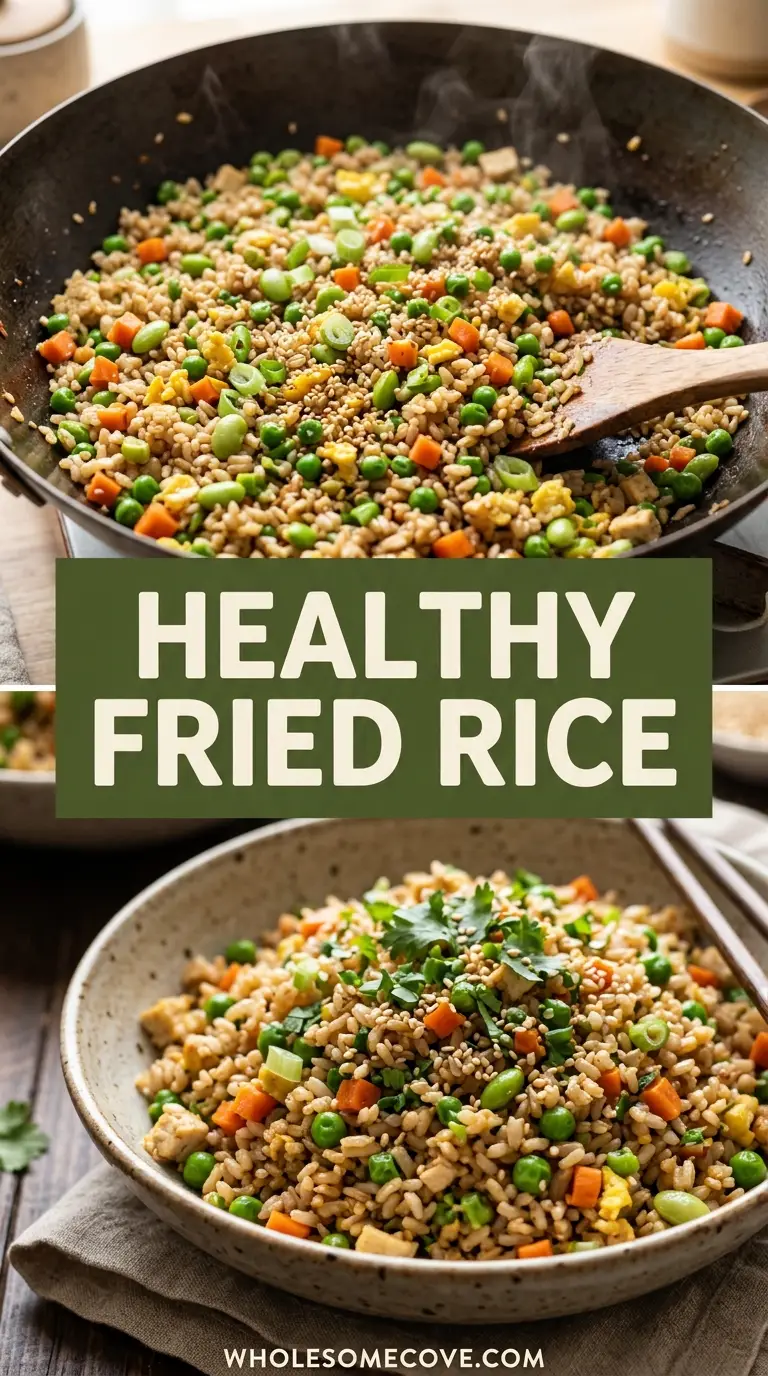
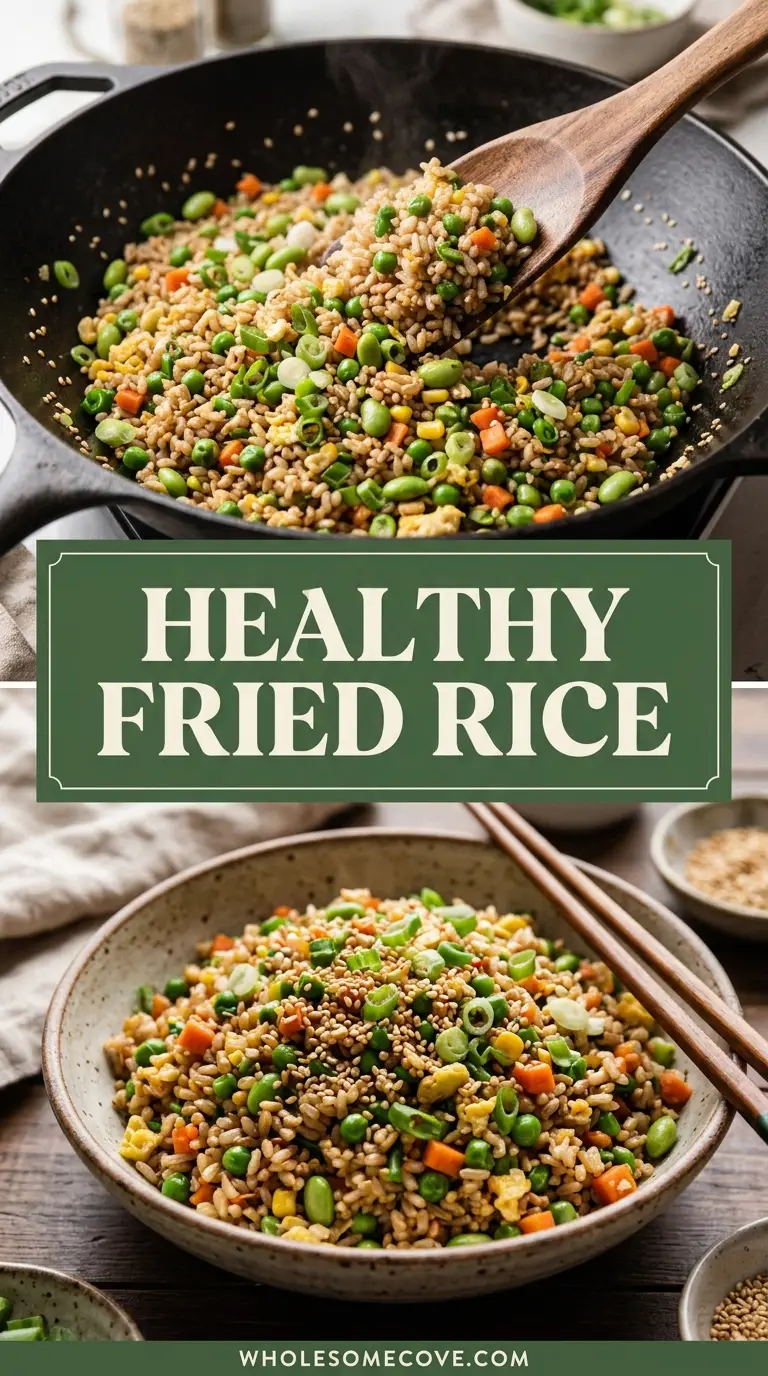
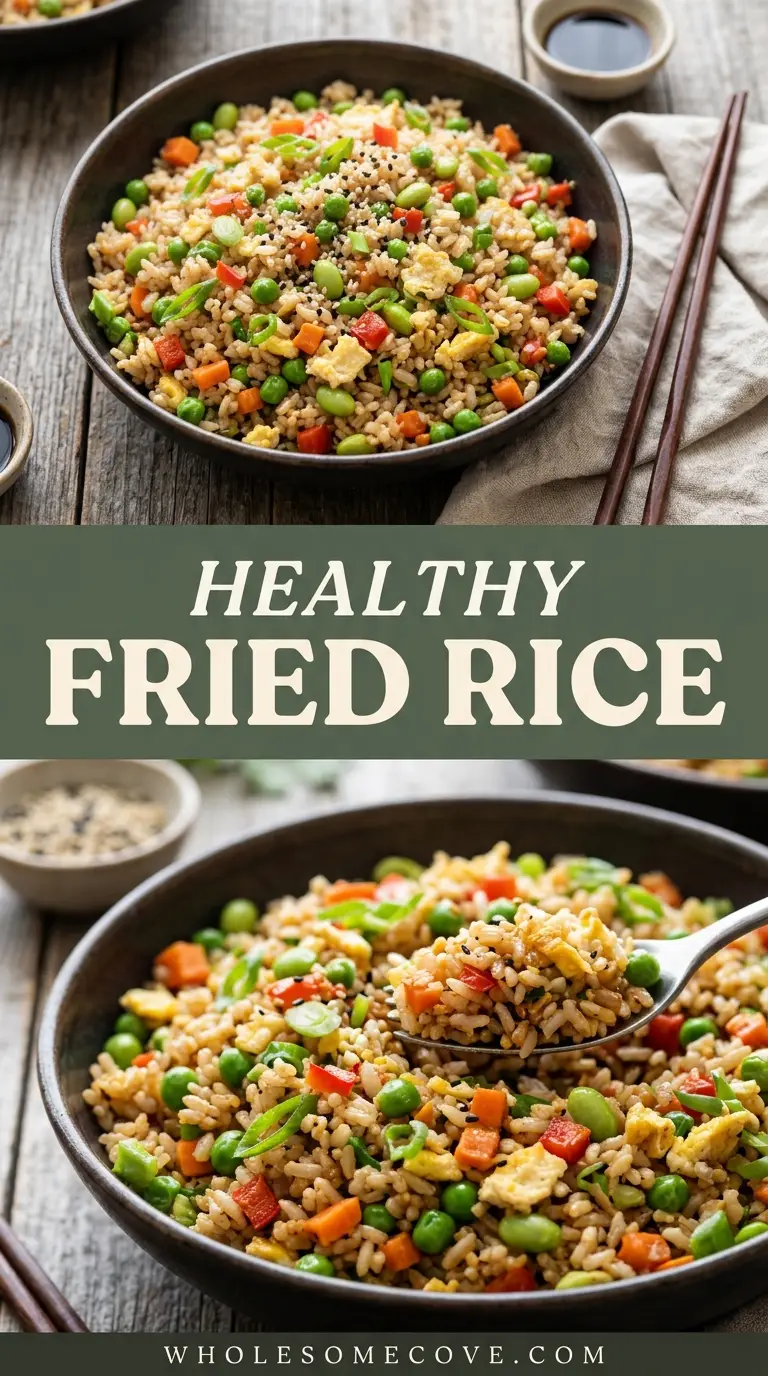
This healthy fried rice recipe starts with cold brown rice, so every grain stays separate. Two tablespoons of oil cover the whole pan, which keeps each serving near 345 calories.
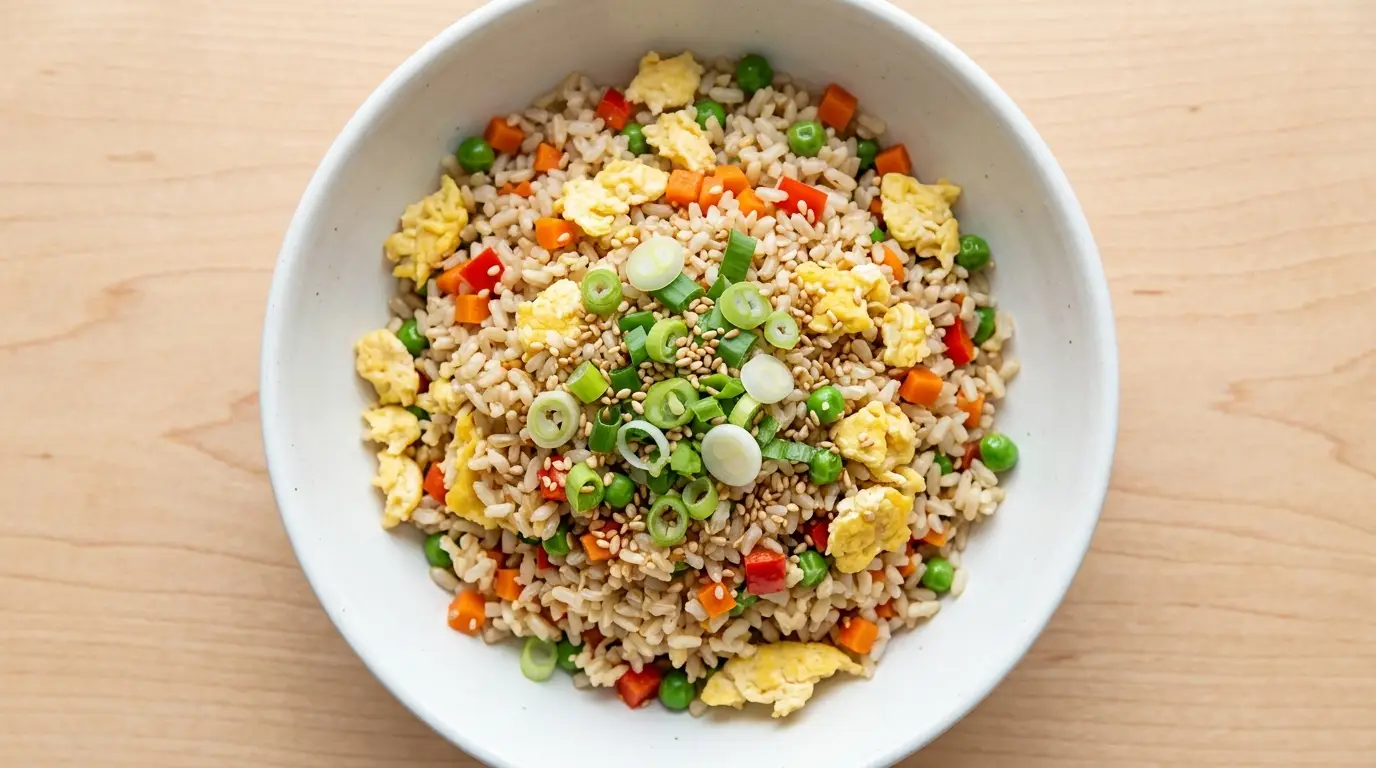
Scrambled eggs, diced carrot, red bell pepper, and peas add color and bite without extra grease. The sesame oil goes in off the heat, so its toasted aroma stays in the bowl instead of burning off.
Once the rice is chilled, everything cooks in one skillet in 25 minutes.
| Quick Recipe Summary | |
|---|---|
| Prep Time | 10 minutes |
| Cook Time | 15 minutes |
| Total Time | 25 minutes (rice cooked and chilled ahead) |
| Servings | 4 servings (about 1½ cups each) |
| Difficulty Level | Easy |
Read Also: Cauliflower Fried Rice With Tofu Recipe
Why You’ll Love This Healthy Fried Rice Recipe
This healthy fried rice recipe trades takeout-style grease for whole grain rice and plenty of vegetables. It works as a weeknight dinner or as a side dish.
- Fast: It takes 25 minutes from the first chop to the first bite, as long as the rice is already chilled.
- One pan: A single skillet or wok handles the eggs, vegetables, and rice, so cleanup stays short.
- Light on oil: Just 2 tablespoons (30 ml) of avocado oil cover all four servings.
- Balanced: Each serving has about 345 calories, 11 g of protein, and 6 g of fiber.
- Great texture: Soft egg curds, crisp-tender vegetables, and chewy brown rice with lightly toasted edges.
- Flexible: Broccoli, corn, cabbage, or mushrooms can replace the vegetables listed below.
- Meal prep friendly: The leftovers reheat well and keep in the refrigerator for 3 to 4 days.
For another way to build a vegetable-heavy dinner around brown rice, see Tofu and Veggie Stir Fry with Brown Rice.
Ingredients
Everything below is measured for four servings. The rice needs to be cooked and chilled ahead of time, so plan for that before you start.
- 3 cups (585 g) cooked organic brown rice, chilled at least 4 hours or overnight (about 1 cup / 190 g uncooked)
- 3 large eggs, lightly beaten
- 2 tablespoons (30 ml) avocado oil, divided into three portions of 2 teaspoons (10 ml) each
- 1 medium carrot, finely diced into ¼-inch (6 mm) pieces (about ½ cup / 65 g)
- 1 medium red bell pepper, diced into ¼-inch (6 mm) pieces (about 1 cup / 135 g)
- 1 cup (145 g) frozen peas, straight from the freezer
- 4 scallions, thinly sliced, with the white parts and green parts kept separate
- 3 garlic cloves, minced (about 1 tablespoon)
- 1 tablespoon (6 g) fresh ginger, finely grated
- 3 tablespoons (45 ml) low-sodium soy sauce
- 1 teaspoon (5 ml) toasted sesame oil
- ¼ teaspoon ground white pepper
- 2 teaspoons toasted sesame seeds, for garnish
You might also enjoy: Stir Fry Sauce
Kitchen Equipment Needed
You do not need specialty gear for this recipe. A wide, heavy pan with plenty of surface area is the one thing that matters.
- A 14-inch (35 cm) carbon steel wok or a 12-inch (30 cm) nonstick skillet with a flat bottom
- A stainless steel wok spatula for pressing and tossing the rice
- A rimmed baking sheet for cooling freshly cooked rice quickly
- A sharp chef’s knife and a large cutting board for dicing the vegetables
- A fine grater or microplane for the ginger and garlic
- A small bowl for beating the eggs
- A plate for holding the scrambled eggs while the vegetables cook
- Measuring cups and measuring spoons
- Glass meal prep containers with tight lids for storing leftovers
A related recipe is Summer Vegetable Stir Fry.
Recommended Products for This Recipe
These are my personal recommendations, based on the small problems that come up most often when making fried rice at home. None of them are required, but each one fixes a specific frustration.
1. Zojirushi Rice Cooker
Brown rice cooked on the stovetop often ends up crunchy in the center or blown out and mushy, and mushy grains are the worst starting point for fried rice. A rice cooker with a brown rice setting holds the water ratio and timing steady, so the grains stay intact and slightly firm. Cook a double batch on Sunday and the next two fried rice dinners are already half done.
2. Microplane Ginger Grater
Ginger cut into coins leaves woody bites, and mincing it by knife is slow and sticky. A fine grater turns a thumb-sized knob into a wet pulp that disappears into the rice and flavors every forkful. It handles garlic just as well, so one tool replaces two chopping jobs.
3. San-J Reduced Sodium Tamari
Standard soy sauce contains wheat, which rules out this recipe for anyone avoiding gluten. Tamari tastes slightly rounder and less sharp, and the reduced sodium version keeps the salt in check at 3 tablespoons. It swaps in one for one with no other changes.
4. Victorinox Fibrox Pro 8-Inch Chef’s Knife
Fried rice cooks fast, so the carrot and pepper need to be cut to the same small size or they finish at different times. A sharp 8-inch knife makes that dicing quick and even, while a dull one slips on slick pepper skin. This one holds its edge well and stays light in the hand.
5. Kadoya Pure Sesame Oil
Light sesame oil has almost no scent, which is a common mix-up in the grocery aisle. Kadoya’s dark, toasted oil has the nutty aroma this recipe relies on, and one teaspoon is enough for four servings. Keep the bottle in a cool, dark cupboard so the flavor stays fresh.
For another whole grain option, try: Brown Basmati Rice
Step-by-Step Instructions: How to Make Healthy Fried Rice
Follow these simple steps and you’ll have a delicious healthy fried rice ready in no time.
1. Prep the Rice and Vegetables
- Take the chilled rice out of the refrigerator and break up any clumps with a fork or slightly damp fingertips until the grains are loose.
- Dice the carrot and the red bell pepper into ¼-inch (6 mm) pieces so they cook at the same speed.
- Slice the scallions thinly and keep the white parts and green parts in two separate piles.
- Mince the garlic and finely grate the ginger.
- Beat the 3 eggs in a small bowl until the yolks and whites are fully combined.
- Measure the soy sauce into a small cup and set the sesame oil, white pepper, and sesame seeds beside the stove.
- Measure the avocado oil into three portions of 2 teaspoons (10 ml) each.
- Line everything up next to the pan, because the cooking moves quickly once it starts.
2. Scramble the Eggs
- Heat a 12-inch (30 cm) nonstick skillet or a wok over medium-high heat for 1 minute.
- Add the first 2 teaspoons (10 ml) of avocado oil and swirl it to coat the bottom of the pan.
- Pour in the beaten eggs and let them sit undisturbed for about 10 seconds.
- Push the eggs gently with a spatula for 45 to 60 seconds, until they form large, soft curds that are still slightly glossy.
- Slide the eggs onto a plate and leave the pan on the heat. There is no need to wipe it out.
3. Cook the Vegetables
- Add the second 2 teaspoons (10 ml) of avocado oil to the same pan over medium-high heat.
- Add the diced carrot and red bell pepper and stir for about 3 minutes, until the colors brighten and the pieces are crisp-tender.
- Add the scallion whites, garlic, and ginger and stir for 30 seconds, until fragrant. Lower the heat briefly if the garlic starts to brown too quickly.
- Add the frozen peas straight from the freezer and cook for 1 minute, until they are hot and bright green.
- Push the vegetables to one side of the pan to clear space for the rice.
4. Fry the Rice
- Add the final 2 teaspoons (10 ml) of avocado oil to the empty side of the pan.
- Add the loosened rice and spread it into an even layer across the whole pan.
- Press the rice flat with the spatula and let it sit undisturbed for 1 minute, so the bottom layer toasts lightly.
- Stir, spread the rice out again, and press it flat once more.
- Repeat this press-and-stir cycle for 4 to 5 minutes total, until the rice is steaming hot, the grains feel bouncy, and a few edges look golden.
- Expect a chewy texture. Brown rice never turns fluffy the way jasmine rice does, and that chew is part of the appeal.
5. Season and Finish
- Drizzle the 3 tablespoons (45 ml) of soy sauce around the outer edge of the pan, not directly onto the rice, so it sizzles against the hot metal. I ruined my first batch by pouring it straight onto the center of the rice, which left dark, soggy patches next to pale, bland ones.
- Toss everything together for about 1 minute, until the rice turns an even light tan.
- Return the scrambled eggs to the pan, break them into bite-size pieces with the spatula, and fold them in.
- Turn off the heat. Drizzle in the 1 teaspoon (5 ml) of toasted sesame oil and sprinkle on the ¼ teaspoon of white pepper.
- Add the scallion greens and toss for 15 seconds.
- Taste the rice and add a little more soy sauce, 1 teaspoon at a time, only if it needs it.
6. Serve the Fried Rice
- Divide the fried rice among 4 bowls, about 1½ cups (about 220 g) each.
- Sprinkle ½ teaspoon of toasted sesame seeds over each bowl, using the 2 teaspoons in total.
- Serve right away while the rice is hot and the edges are still slightly crisp.
Read Also: Teriyaki Sauce Recipe
Tips for The Best Healthy Fried Rice
Most problems with fried rice come from moisture, heat, or crowding the pan. These tips fix all three.
- Start with cold rice. Cooked rice that has chilled for at least 4 hours dries out and firms up, so the grains separate in the pan instead of clumping.
- Cool the rice safely. Refrigerate cooked rice within 1 hour of cooking, since rice left at room temperature for long stretches can grow bacteria that cause food poisoning.
- Spread it thin to cool. I’ve found that rice cooled in a thin layer on a rimmed baking sheet dries more evenly than rice left in a deep container, which stays damp in the middle.
- Cook the brown rice with the right ratio. Rinse 1 cup (190 g) of brown rice, simmer it with 2 cups (475 ml) of water, covered, for 40 to 45 minutes, then rest it off the heat for 10 minutes. Package directions vary, so follow yours if it differs.
- Dry the vegetables. Pat any washed fresh vegetables dry before they hit the pan, because extra water turns into steam and makes the rice soggy.
- Keep the heat at medium-high. The rice should sizzle when it lands in the pan, and it should never simmer in liquid.
- Do not crowd the pan. A 12-inch (30 cm) skillet is the largest batch this recipe should take, and doubling it works better in two rounds.
- Add the soy sauce in stages. Low-sodium soy sauce gives you room to taste and adjust, and regular soy sauce can push the dish too salty at the same amount.
- Finish with sesame oil off the heat. Toasted sesame oil burns easily and loses its aroma, so add it after the burner is off.
- Choose white pepper. It adds a sharper, more restaurant-style heat than black pepper and blends in without leaving specks.
- Prep before you cook. Once the pan is hot, the whole recipe moves in minutes, so every ingredient should be cut and measured first.
Another option for egg-forward meals is Healthy Egg Salad.
What to Serve with Healthy Fried Rice
This fried rice works as a light main dish on its own, and it also anchors a bigger spread. The best pairings add protein or a fresh, crunchy contrast.
- Beef and Broccoli Stir Fry for a classic takeout-style pairing with tender beef and a glossy sauce.
- Healthy Orange Chicken for a sweet and tangy protein that sits well beside savory rice.
- Teriyaki Grilled Chicken for smoky, caramelized edges that echo the toasted rice.
- Air Fryer Sesame Pork Skewers for an easy handheld option that cooks while the rice chills.
- Egg Drop Soup for a light, warm starter that rounds out an Asian-style dinner.
- Air Fryer Salmon for a rich, flaky fish that adds omega-3 fats to the plate.
- Steamed edamame with flaky salt for a quick, protein-rich side.
- A cold cucumber salad with rice vinegar and sesame seeds for crunch and acidity.
- Quick-pickled radishes or carrots to cut through the richness of the sesame oil.
- Hot jasmine green tea or iced barley tea to drink alongside.
For a lighter option, try: Asian Chicken Lettuce Cups
Variations of Healthy Fried Rice
The base recipe is vegetable and egg only, which makes it easy to build on. Add protein at the same time as the peas, and add extra vegetables at the same time as the carrot and pepper.
- Chicken fried rice: Add 8 ounces (225 g) of diced cooked chicken breast with the peas and heat it through for 1 to 2 minutes.
- Shrimp fried rice: Sauté 8 ounces (225 g) of peeled shrimp in 1 teaspoon of oil for 2 minutes, until pink, then remove them and fold them back in with the eggs.
- Tofu fried rice: Press 8 ounces (225 g) of extra-firm tofu, cube it, and brown it in the pan before the vegetables.
- Pineapple fried rice: Stir in ¾ cup (125 g) of fresh pineapple chunks with the rice for a sweet and savory finish.
- Mushroom fried rice: Mushrooms hold up better than zucchini in this dish because they release less water, so sauté 1 cup (70 g) of sliced mushrooms until golden before adding the carrot.
- Kimchi fried rice: Add ½ cup (75 g) of chopped kimchi with the garlic and ginger for a tangy, spicy kick.
- Cauliflower rice version: Replace the brown rice with 3 cups (340 g) of riced cauliflower and cook it for 4 to 5 minutes, which lowers the carbs significantly.
- Gluten-free version: Use tamari labeled gluten-free in place of the soy sauce.
- White rice version: Use 3 cups (555 g) of cold jasmine rice, which dries into especially separate grains.
Read Also: Air Fryer Chicken Breast Recipe
Storage and Reheating
Fried rice stores well when you cool it quickly and keep it cold. The same food safety rules for cooked rice apply to the leftovers.
- Cool quickly: Let the finished fried rice cool for no more than 1 hour at room temperature before refrigerating it.
- Refrigerator: Store the rice in airtight containers for 3 to 4 days.
- Portioning: I keep single servings in small glass containers because the rice reheats more evenly in a shallow layer than from one large tub.
- Freezer: Freeze cooled fried rice flat in zip-top freezer bags, pressed to remove the air, for up to 2 months.
- Thawing: Move frozen rice to the refrigerator the night before, or reheat it directly from frozen with a splash of water.
- Microwave reheating: Sprinkle 1 tablespoon of water over each serving, cover loosely, and heat for 1½ to 2 minutes, stirring halfway, until steaming hot.
- Skillet reheating: Warm ½ teaspoon of oil in a nonstick skillet over medium heat and stir-fry the rice for 3 to 4 minutes to bring back the toasted edges.
- Safe temperature: Reheat leftovers until they reach 165°F (74°C) in the center.
- Reheat once: Only reheat what you plan to eat, and discard any leftovers that have been reheated already.
More weeknight ideas that reheat well are collected in Easy Healthy Dinner Recipes for Family.
Nutritional Facts
Each serving is about 1½ cups, or one quarter of the recipe. The values below are estimates and will vary slightly by brand.
| Nutrition per Serving | |
|---|---|
| Calories | 345 |
| Total Fat | 14 g |
| Saturated Fat | 2.5 g |
| Cholesterol | 140 mg |
| Sodium | 490 mg |
| Total Carbohydrates | 43 g |
| Dietary Fiber | 6 g |
| Sugars | 4 g |
| Protein | 11 g |
You might also like: Sweet Potato and Black Bean Bowls
Health Benefits of Key Ingredients
Each ingredient in this fried rice adds something useful beyond flavor. The mix of whole grain, protein, and vegetables is what makes this version more balanced than a typical takeout box.
- Brown rice: It keeps its bran and germ, so it provides more fiber, magnesium, and manganese than white rice.
- Eggs: They supply complete protein and choline, a nutrient involved in brain and liver function.
- Peas: One cup of cooked peas offers roughly 8 g of plant protein and 8 g of fiber, which helps the dish keep you full.
- Carrots: They contain beta-carotene, which the body converts into vitamin A for eye and skin health.
- Red bell pepper: A cup of diced red pepper supplies well over a full day’s vitamin C.
- Garlic and ginger: Both add strong flavor, so you can use less salt and still end up with a savory dish.
- Scallions: They contribute vitamin K and a fresh, mild onion flavor with almost no calories.
- Sesame oil and seeds: They add unsaturated fats and a toasted aroma in very small amounts. Sesame is a common allergen, so leave it out for anyone with an allergy.
- Avocado oil: It is rich in monounsaturated fat and handles medium-high heat without smoking.
Read Also: Chickpea And Spinach Curry Recipe
FAQs About Healthy Fried Rice
1. Can I use freshly cooked rice for fried rice?
Fresh rice holds too much steam and moisture, so it clumps and turns mushy in the pan. Chilled rice fries into separate grains.
If you are short on time, spread the rice thin on a rimmed baking sheet. Refrigerate it uncovered for at least 1 hour before frying.
2. Is fried rice actually healthy?
It can be, depending on the oil, the rice, and the vegetables. Many takeout versions use a lot of oil and very little produce.
This version uses 2 tablespoons of oil, whole grain rice, and four vegetables. That brings each serving to about 345 calories.
3. Is brown rice or white rice better for fried rice?
Both work, but they behave differently. Medium-grain jasmine rice dries out easily and tastes mild.
Brown rice adds fiber and a nuttier chew. It needs a little longer in the pan to heat through.
4. Do I need a wok to make fried rice?
No, a large nonstick or carbon steel skillet works well. The goal is surface area.
Wide pans let the rice touch hot metal instead of steaming in a pile. Use a 12-inch (30 cm) pan for this amount.
5. How do I get it to taste like takeout?
High heat, a pressed layer of rice, and white pepper do most of the work. Toasted sesame oil added at the end supplies the restaurant-style aroma.
Pressing the rice against the pan for a full minute gives it those lightly toasted edges.
6. Can I make healthy fried rice vegan or egg-free?
Yes, tofu works as the egg replacement. Crumble 1 cup (225 g) of firm tofu and scramble it in step 2 for 3 to 4 minutes.
The rest of the recipe is already plant-based. Check that your soy sauce contains no added fish products.
7. Can I make this fried rice gluten-free?
Yes, swap the soy sauce for a tamari labeled gluten-free. Standard soy sauce contains wheat, so always check the label.
Everything else in the recipe is naturally gluten-free. Use the same amount of tamari as the recipe lists for soy sauce.
For a heartier stir-fry, try: Chinese Pepper Steak
Healthy Fried Rice
Ingredients
- 3 cups organic brown rice - 585 g, cooked and chilled at least 4 hours or overnight (about 1 cup / 190 g uncooked)
- 3 large eggs - lightly beaten
- 2 tablespoons avocado oil - 30 ml, divided into three portions of 2 teaspoons (10 ml) each
- 1 medium carrot - finely diced into ¼-inch (6 mm) pieces, about ½ cup / 65 g
- 1 medium red bell pepper - diced into ¼-inch (6 mm) pieces, about 1 cup / 135 g
- 1 cup frozen peas - 145 g, straight from the freezer
- 4 scallions - thinly sliced, white parts and green parts kept separate
- 3 cloves garlic - minced, about 1 tablespoon
- 1 tablespoon fresh ginger - 6 g, finely grated
- 3 tablespoons low-sodium soy sauce - 45 ml
- 1 teaspoon toasted sesame oil - 5 ml
- ¼ teaspoon ground white pepper
- 2 teaspoons toasted sesame seeds - for garnish
Equipment
- 14-inch (35 cm) carbon steel wok or 12-inch (30 cm) nonstick skillet - Flat bottom, wide surface area
- Stainless steel wok spatula - For pressing and tossing the rice
- Rimmed baking sheet - For cooling freshly cooked rice quickly
- Sharp chef’s knife and large cutting board - For dicing the vegetables
- Fine grater or microplane - For the ginger and garlic
- Small bowl - For beating the eggs
- Plate - For holding the scrambled eggs while the vegetables cook
- Measuring cups and measuring spoons
- Glass meal prep containers with tight lids - For storing leftovers
Method
- Break up the chilled rice with a fork until the grains are loose. Dice the carrot and red bell pepper into ¼-inch pieces, slice the scallions (keeping whites and greens separate), mince the garlic, grate the ginger, and beat the eggs.
- Heat a 12-inch nonstick skillet or wok over medium-high heat for 1 minute. Add 2 teaspoons of avocado oil, pour in the beaten eggs, and gently push them with a spatula for 45 to 60 seconds until soft curds form. Slide the eggs onto a plate.
- Add 2 teaspoons of avocado oil to the same pan. Stir the carrot and red bell pepper for about 3 minutes, then add the scallion whites, garlic, and ginger for 30 seconds. Add the frozen peas and cook 1 minute, then push the vegetables to one side.
- Add the final 2 teaspoons of avocado oil to the empty side of the pan, add the rice, and spread it into an even layer. Press it flat and let it sit 1 minute, then repeat the press-and-stir cycle for 4 to 5 minutes until steaming hot with lightly golden edges.
- Drizzle the soy sauce around the outer edge of the pan so it sizzles, then toss for about 1 minute until the rice is evenly light tan. Return the eggs, fold them in, turn off the heat, and finish with sesame oil, white pepper, and scallion greens.
- Divide among 4 bowls (about 1½ cups each), sprinkle ½ teaspoon of toasted sesame seeds over each bowl, and serve right away while hot.
Nutrition
Notes
- Start with cold rice: cooked rice chilled for at least 4 hours dries out and firms up so the grains separate instead of clumping.
- Cool rice safely: refrigerate cooked rice within 1 hour of cooking, and spread it thin on a rimmed baking sheet for even drying.
- Cook the brown rice with the right ratio: rinse 1 cup (190 g) brown rice, simmer with 2 cups (475 ml) water covered for 40 to 45 minutes, then rest off heat 10 minutes.
- Pat washed fresh vegetables dry before cooking, since extra water turns to steam and makes the rice soggy.
- Keep the heat at medium-high and do not crowd the pan; a 12-inch skillet is the largest batch, and doubling works better in two rounds.
- Add the soy sauce around the edge of the pan, not directly onto the rice, to avoid dark soggy patches.
- Finish with toasted sesame oil off the heat so its aroma stays in the bowl instead of burning off.
- Storage: refrigerate leftovers in airtight containers for 3 to 4 days, or freeze flat in zip-top bags for up to 2 months.
- Reheat leftovers with a splash of water in the microwave, or stir-fry in a lightly oiled skillet for 3 to 4 minutes, until 165°F (74°C) in the center. Reheat only once.
- Variations: add cooked chicken, shrimp, or tofu with the peas; swap in pineapple, mushrooms, or kimchi; use gluten-free tamari for a gluten-free version; replace brown rice with cauliflower rice to lower carbs.
Private Notes
Tried this recipe?
Let us know how it was!Final Thoughts
This healthy fried rice recipe earns a spot in the weeknight rotation because it uses cold rice and one pan. Cook a pot of brown rice tonight, and tomorrow’s dinner is 25 minutes away.
Try it with whatever vegetables are in your crisper drawer.
Leave a comment with your favorite add-ins. Share the recipe with anyone who needs a quick weeknight dinner.
Recommended:
- Sweet and Sour Sauce Recipe
- Panda Express Black Pepper Steak Recipe
- Bang Bang Sauce Recipe
- Hoisin Sauce Recipe
- Peanut Sauce Recipe
- Kimchi Stew Recipe
- Grilled Chicken and Veggie Skewers Recipe
- Instant Pot Basmati Rice Recipe
- Zucchini Noodles with Pesto and Shrimp Bowls Recipe
- Air Fryer Avocado Egg Rolls Recipe