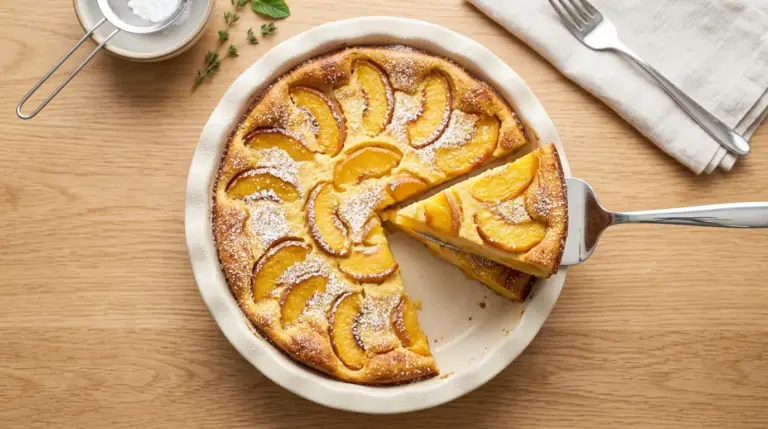
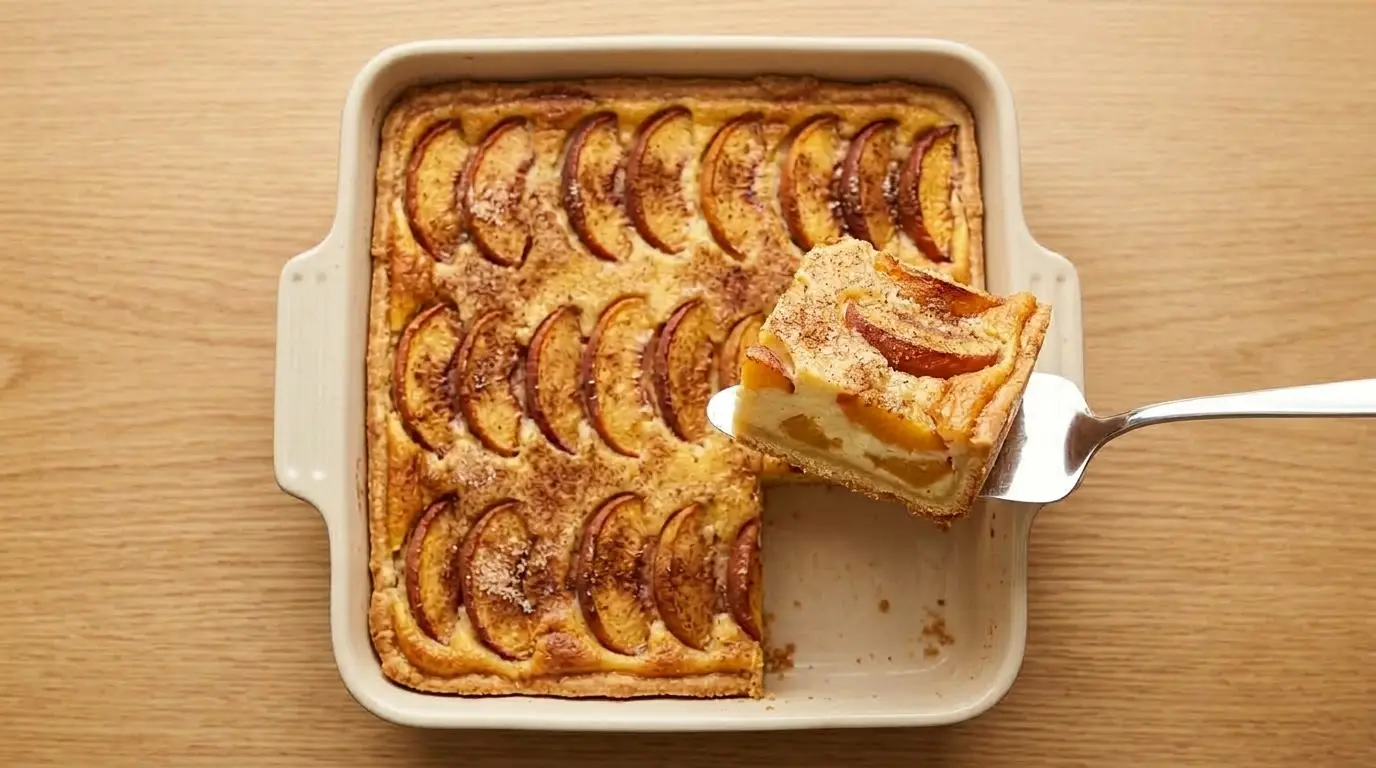
A good German peach kuchen recipe rests on one thing most versions get wrong: the custard. It should set into a soft, sliceable layer that hugs the peaches, not slide off the fork in a puddle.
The base here is a pressed shortbread-style crust, closer to a thick sugar cookie than a rolled pie dough. No chilling, no rolling pin, just butter and flour patted into the pan with your fingers.
Ripe peaches go on in fan-arranged slices, then a dusting of cinnamon sugar. The custard, egg yolks whisked with sour cream and a spoonful of flour, gets poured over right before baking.
That spoonful of flour is the fix. It stabilizes the yolks so the custard sets firm enough to slice cleanly instead of weeping around the fruit.
Start to finish runs about an hour, with roughly 20 minutes of hands-on work. The word “kuchen” simply means cake in German, and this one lands somewhere between cake, custard pie, and cobbler.
| Quick Recipe Summary | |
|---|---|
| Prep Time | 20 minutes |
| Cook Time | 45 minutes |
| Total Time | 1 hour 5 minutes |
| Servings | 9 slices |
| Difficulty Level | Easy |
For a different way to bake with summer stone fruit, see Peach Coffee Cake.

Why You’ll Love This German Peach Kuchen Recipe
This is the kind of dessert that looks like it came from a bakery but asks very little of you. The crust is pressed, not rolled, and the custard is whisked in one bowl.
Here is what makes it worth baking:
- The crust needs no chilling or rolling. You pat it straight into the pan with your fingers, which takes about five minutes and skips the whole rolled-dough headache.
- The custard actually sets. A tablespoon of flour whisked into the egg yolks and sour cream keeps it firm enough to slice, so you avoid the runny middle that sinks so many kuchen.
- It works year-round. Fresh peaches shine in summer, but drained canned or thawed frozen peaches give you the same dessert in January.
- One pan, one bowl for the custard. Cleanup is minimal, and there is no stand mixer required at any stage.
- It flexes across meals. A slice is dessert with ice cream, breakfast with coffee, or an afternoon snack, and it holds its texture for days.
- The flavor is balanced, not cloying. Sour cream adds a gentle tang that cuts the sweetness, so the peaches taste like peaches rather than syrup.
You might also enjoy: Peach Bread Pudding
Ingredients
Every component here uses pantry staples plus fresh or preserved peaches. The measurements below fill a standard 9-inch (23 cm) square or round baking pan and serve nine.
For the crust:
- 1½ cups (190 g) all-purpose flour
- ½ cup (100 g) granulated sugar
- ¼ teaspoon baking powder
- ¼ teaspoon salt
- ½ cup (113 g) unsalted butter, cold and cut into cubes
For the peach layer:
- 4 to 5 medium ripe peaches (about 1½ pounds / 680 g), peeled and sliced, or 2½ cups (400 g) drained canned or thawed frozen peach slices
- 3 tablespoons granulated sugar
- 1 teaspoon ground cinnamon
For the custard:
- 3 large egg yolks
- 1 cup (240 g) full-fat sour cream
- ⅓ cup (67 g) granulated sugar
- 1 tablespoon all-purpose flour
- 1 teaspoon pure vanilla extract
- ¼ teaspoon almond extract (optional)
I tested this with both fresh and canned peaches. Canned actually gave me a more reliable set, because the fruit releases less water once it has already been drained.
Read Also: Peach Crumble
Kitchen Equipment Needed
Nothing specialized is required, which is part of this dessert’s charm. A single baking pan and a couple of bowls carry the whole recipe.
Here is what you will want on hand:
- A 9-inch (23 cm) square or round baking pan
- A large mixing bowl for the crust
- A medium bowl for the custard
- A wire whisk for blending the yolks and sour cream
- A pastry blender or fork for cutting butter into the flour
- A sharp paring knife for peeling and slicing peaches
- Measuring cups and measuring spoons
- A cooling rack
For another easy baked dessert with minimal gear, see Peach Cobbler.
Recommended Products for This Recipe
These are the items I reach for when I want this kuchen to come out right every time. Each one solves a specific problem I hit while testing.
1. Nordic Ware Naturals Aluminum Baking Pan
A thin, dark pan browned my crust before the custard set, leaving me with a scorched bottom and a wet middle. This natural aluminum pan heats evenly, so the crust turns golden at the same pace the custard firms up.
2. OXO Good Grips Y Peeler
Peeling ripe peaches with a paring knife tears the flesh and wastes fruit. A sharp Y peeler glides just under the skin, so you keep more of the peach and your slices stay clean.
3. Penzeys Vietnamese Cinnamon
Cinnamon does a lot of quiet work in the peach layer, and a dull, stale jar barely registers under the fruit. A fresh, high-oil cinnamon like this one gives the top real warmth without you having to add more sugar.
4. Nielsen-Massey Pure Almond Extract
A few drops of almond extract in the custard make peaches taste more like themselves, a trick I picked up after a flat-tasting batch. Imitation versions taste harsh, so a pure extract is worth the small splurge.
For more warm-spice baking, try: Peach Cinnamon Rolls

Step-by-Step Instructions: How to Make German Peach Kuchen
Follow these steps in order and you’ll have a golden, custard-topped kuchen cooling on your counter in just over an hour.
1. Prep the oven and pan
- Preheat your oven to 350°F (175°C) and position a rack in the center.
- Lightly grease a 9-inch (23 cm) square or round baking pan, or line the bottom with parchment for easy removal.
- Have all your ingredients measured and within reach before you start mixing.
2. Make the pressed crust
- In a large bowl, whisk together the 1½ cups (190 g) flour, ½ cup (100 g) sugar, ¼ teaspoon baking powder, and ¼ teaspoon salt.
- Add the ½ cup (113 g) cold cubed butter.
- Using a pastry blender or fork, cut the butter into the dry ingredients until the mixture looks like coarse, sandy crumbs with a few pea-sized pieces.
- Tip the crumbs into the prepared pan and press them firmly and evenly across the bottom with your fingers or the flat base of a measuring cup.
- Prick the crust a few times with a fork to keep it from puffing up.
3. Arrange the peaches
- If using fresh peaches, peel them, halve them to remove the pit, then cut into ½-inch (1 cm) slices.
- If using canned or frozen, make sure they are well drained or fully thawed and patted dry.
- Lay the peach slices over the crust in an even layer, slightly overlapping, covering as much surface as you can.
4. Add the cinnamon sugar
- In a small bowl, stir together the 3 tablespoons sugar and 1 teaspoon cinnamon.
- Sprinkle this mixture evenly over the arranged peaches.
- This step draws out a little sweetness and gives the top its warm, spiced aroma as it bakes.
5. Whisk the custard
- In a medium bowl, whisk the 3 egg yolks until smooth.
- Add the 1 cup (240 g) sour cream, ⅓ cup (67 g) sugar, 1 tablespoon flour, 1 teaspoon vanilla, and the ¼ teaspoon almond extract if using.
- Whisk until the custard is completely smooth with no streaks of sour cream remaining.
- The flour should be fully dissolved so the finished custard sets evenly.
6. Pour and bake
- Pour the custard slowly and evenly over the peaches, letting it settle into the gaps around the fruit.
- Transfer the pan to the center of the oven.
- Bake for 40 to 45 minutes, until the edges are set and lightly golden and the center jiggles only slightly when you gently shake the pan.
- If the crust edges brown too fast, tent loosely with foil for the final 15 minutes.
7. Cool before slicing
- Move the pan to a wire rack and let the kuchen cool for at least 45 minutes.
- The custard firms up considerably as it cools, so slicing too early gives you a loose center.
- Serve slightly warm or at room temperature, and refrigerate any leftovers.
Read Also: Peach Galette

Tips for The Best German Peach Kuchen
Small choices make the difference between a clean slice and a soupy one. These are the details I pay attention to every time.
- Drain your fruit well. Excess water is the number one cause of a runny custard, so pat canned or thawed peaches dry and let very juicy fresh ones sit on a paper towel for a few minutes.
- Use ripe but firm peaches. Overly soft fruit collapses into mush during baking, while firm-ripe slices hold their shape and give you distinct layers.
- Don’t skip the tablespoon of flour. It stabilizes the egg yolks so the custard sets rather than weeps, and leaving it out is the most common reason a kuchen turns out loose.
- Judge doneness by the jiggle. The center should wobble slightly, not slosh, when you shake the pan, because it continues to set as it cools.
- Cool completely for neat slices. I learned this the hard way after a warm first slice slid apart on the plate, so patience here pays off.
- Bring cold ingredients closer to room temperature. Room-temperature yolks and sour cream blend into a smoother custard than fridge-cold ones straight from the carton.
- Tent the crust if it browns early. A loose sheet of foil protects the edges while the custard finishes setting in the center.
A similar handheld take on this idea appears in Peach Crumble Bars.
What to Serve with German Peach Kuchen
Kuchen sits comfortably at any point in the day, so what you pour or plate alongside it depends on the occasion. A warm slice invites something cool and creamy, while a room-temperature square pairs well with a hot drink.
Here are pairings that work well:
- A scoop of vanilla Peach Ice Cream for a double dose of stone fruit
- A dollop of lightly sweetened whipped cream to offset the custard’s tang
- Strong black coffee or an espresso for a classic German Kaffee und Kuchen afternoon
- A pot of Peach Iced Tea for a summer dessert table
- A drizzle of warm Peach Compote spooned over each slice
- Fresh berries on the side for color and a bit of tartness
- A glass of Peach Lemonade for a garden gathering or brunch
- A cup of hot spiced cider in cooler months
You might also like: Peach French Toast
Variations of German Peach Kuchen
The base recipe is forgiving, which is exactly why so many families have their own version. Once you have the crust and custard down, the fruit and flavorings are open to interpretation.
Try these spins:
- Plum kuchen: Swap the peaches for halved Italian plums, a traditional German favorite that turns jammy and deep purple as it bakes.
- Apple kuchen: Use thin slices of tart apple and add a pinch of extra cinnamon for a cozy fall version.
- Almond streusel top: Scatter a simple butter-flour-sugar streusel with sliced almonds over the custard before baking for extra crunch.
- Apricot or nectarine: Both stone fruits slot in directly for peaches with no other changes needed.
- Berry kuchen: Press fresh raspberries or blueberries into the custard for pockets of tartness.
- Heavy cream custard: Replace the sour cream with an equal amount of heavy cream for a richer, sweeter, less tangy topping.
- Cornstarch swap: For a gluten-free custard, use 1½ teaspoons cornstarch in place of the tablespoon of flour.
Read Also: Peach Tart
Storage and Reheating
Because this kuchen contains an egg-and-dairy custard, it keeps best in the refrigerator rather than on the counter. Proper storage protects both the texture and the food safety of the custard layer.
Here is how to handle leftovers:
- Refrigerate promptly: Cover the cooled kuchen or transfer slices to an airtight container and refrigerate within two hours of baking.
- Storage time: It keeps well in the fridge for up to 3 days, though the crust softens slightly over time.
- Serve cold or warm: Many people enjoy chilled kuchen straight from the fridge, especially in summer.
- To reheat: Warm individual slices in a 325°F (160°C) oven for about 10 minutes, or microwave a single slice for 15 to 20 seconds.
- Freezing: The custard texture changes after freezing and can turn slightly watery on thawing, so I keep this one fresh rather than frozen.
- Make-ahead tip: You can bake it a day ahead and refrigerate, then bring slices to room temperature or gently rewarm before serving.
Another option worth trying is Peach Trifle.
Nutritional Facts
The values below are estimates for one slice, based on a yield of nine slices made with sour cream and fresh peaches. Actual numbers vary with the specific ingredients and fruit you use.
| Nutrient | Amount per Slice |
|---|---|
| Calories | 295 kcal |
| Total Fat | 15 g |
| Saturated Fat | 9 g |
| Cholesterol | 95 mg |
| Sodium | 110 mg |
| Total Carbohydrates | 37 g |
| Sugars | 22 g |
| Protein | 4 g |
| Fiber | 1.5 g |
For a lighter option, try: Air Fryer Peaches
Health Benefits of Key Ingredients
While this is firmly a dessert, several of its core ingredients bring real nutritional value to the plate. The fruit and dairy in particular offer more than just flavor.
Here is what the key ingredients contribute:
- Peaches: They provide vitamin C for immune support, vitamin A for eye health, and a dose of dietary fiber that aids digestion.
- Peaches (antioxidants): The fruit contains polyphenols and carotenoids, plant compounds linked to reducing inflammation.
- Eggs: The yolks supply high-quality protein, choline for brain function, and fat-soluble vitamins A, D, and E.
- Sour cream: It offers calcium for bone health along with a small amount of protein and fat-soluble vitamins.
- Cinnamon: This spice carries antioxidant compounds and has been studied for its role in supporting healthy blood sugar levels.
- Almond extract: Used in tiny amounts, it adds aroma without calories, letting you boost flavor without extra sugar.
For a nutrient-dense way to use peaches, see Peach Baked Oatmeal.
FAQs About German Peach Kuchen
1. Why is my peach kuchen custard runny?
The most common cause is excess moisture from the peaches, especially if you used juicy fresh fruit or undrained canned slices. Draining the fruit well and including the tablespoon of flour in the custard both help it set firmly.
Underbaking is the other culprit. The center should jiggle only slightly when you shake the pan, and the custard continues to firm up as it cools.
2. Can I use canned or frozen peaches instead of fresh?
Yes, both work beautifully and let you make this dessert year-round. Drain canned peaches thoroughly, and fully thaw and pat dry frozen ones before arranging them on the crust.
In my testing, canned peaches gave an even more reliable set. The fruit has already released much of its water, so less liquid seeps into the custard.
3. Do I need to refrigerate peach kuchen?
Yes, because it contains an egg and dairy custard, it should be refrigerated rather than left at room temperature. Cover it and store it in the fridge within two hours of baking.
It keeps well chilled for up to three days. Many people actually prefer it cold, though a brief warm-up in the oven revives the crust.
4. What kind of pan should I use?
A 9-inch square or round baking pan works perfectly for this quantity. A light-colored metal pan browns the crust more evenly than a dark one, which can scorch the bottom before the custard sets.
If your crust browns too quickly, tent it loosely with foil. This protects the edges while the center finishes baking.
5. Can I make German peach kuchen ahead of time?
Absolutely, and it is a great make-ahead dessert for gatherings. Bake it a day in advance, cool it completely, then cover and refrigerate.
Bring slices to room temperature or warm them gently before serving. The flavor holds up well, though the crust softens slightly after a day.
6. What other fruits can I use in kuchen?
Plums are the most traditional choice in Germany, followed closely by apples and apricots. Nectarines, cherries, and berries all work with little or no adjustment.
Just keep the total fruit quantity roughly the same. Adjust the sugar slightly if your fruit is especially tart or sweet.
Read Also: Peach Cobbler With Cake Mix
German Peach Kuchen
Ingredients
- 1½ cups all-purpose flour - 190 g
- ½ cup granulated sugar - 100 g
- ¼ teaspoon baking powder
- ¼ teaspoon salt
- ½ cup unsalted butter - 113 g, cold and cut into cubes
- 4 to 5 medium ripe peaches - about 1½ pounds / 680 g, peeled and sliced; or 2½ cups (400 g) drained canned or thawed frozen peach slices
- 3 tablespoons granulated sugar
- 1 teaspoon ground cinnamon
- 3 large egg yolks
- 1 cup full-fat sour cream - 240 g
- ⅓ cup granulated sugar - 67 g
- 1 tablespoon all-purpose flour
- 1 teaspoon pure vanilla extract
- ¼ teaspoon almond extract - optional
Equipment
- 9-inch (23 cm) square or round baking pan - Light-colored metal recommended for even browning
- Large mixing bowl - For the crust
- Medium bowl - For the custard
- Wire whisk - For blending yolks and sour cream
- Pastry blender or fork - For cutting butter into flour
- Sharp paring knife - For peeling and slicing peaches
Method
- Preheat oven to 350°F (175°C) and position a rack in the center. Lightly grease a 9-inch (23 cm) square or round baking pan, or line the bottom with parchment.
- Whisk together flour, sugar, baking powder, and salt in a large bowl. Cut in cold cubed butter with a pastry blender or fork until the mixture resembles coarse sandy crumbs.
- Tip the crumbs into the prepared pan and press firmly and evenly across the bottom with your fingers or the flat base of a measuring cup. Prick the crust a few times with a fork.
- Peel and slice fresh peaches into ½-inch (1 cm) slices, or drain canned and pat dry thawed frozen peaches. Arrange the slices over the crust in an even, slightly overlapping layer.
- Stir together 3 tablespoons sugar and 1 teaspoon cinnamon, then sprinkle evenly over the arranged peaches.
- Whisk the egg yolks until smooth, then add sour cream, sugar, flour, vanilla, and almond extract if using. Whisk until completely smooth with no streaks.
- Pour the custard slowly and evenly over the peaches, letting it settle into the gaps around the fruit. Bake for 40 to 45 minutes, until the edges are set and lightly golden and the center jiggles only slightly.
- Move the pan to a wire rack and let the kuchen cool for at least 45 minutes before slicing, as the custard firms up considerably as it cools. Serve slightly warm or at room temperature.
Nutrition
Notes
- Drain your fruit well. Excess water is the number one cause of a runny custard, so pat canned or thawed peaches dry and let very juicy fresh ones sit on a paper towel for a few minutes.
- Use ripe but firm peaches. Overly soft fruit collapses into mush during baking, while firm-ripe slices hold their shape and give you distinct layers.
- Don’t skip the tablespoon of flour. It stabilizes the egg yolks so the custard sets rather than weeps, and leaving it out is the most common reason a kuchen turns out loose.
- Judge doneness by the jiggle. The center should wobble slightly, not slosh, when you shake the pan, because it continues to set as it cools.
- Cool completely for neat slices. Slicing too early gives you a loose center, so patience here pays off.
- Bring cold ingredients closer to room temperature. Room-temperature yolks and sour cream blend into a smoother custard than fridge-cold ones straight from the carton.
- Tent the crust if it browns early. A loose sheet of foil protects the edges while the custard finishes setting in the center.
- Storage: Refrigerate covered within two hours of baking. Keeps well in the fridge for up to 3 days, though the crust softens slightly over time.
- Make-ahead: Bake a day in advance, cool completely, then cover and refrigerate. Bring slices to room temperature or gently rewarm before serving.
- Variations: Swap peaches for plums, apples, apricots, nectarines, or berries. Replace sour cream with heavy cream for a richer custard, or use 1½ teaspoons cornstarch in place of flour for a gluten-free custard.
Private Notes
Tried this recipe?
Let us know how it was!Final Thoughts
German peach kuchen is proof that a humble, pressed-crust dessert can feel special enough for company. The tender base, spiced fruit, and silky custard come together with very little fuss.
Give it a try the next time peaches are at their peak, or reach for canned ones to bring a little summer into a winter afternoon. Either way, that first cool, custardy slice is worth the short wait.
If you bake this one, I’d love to hear how it turned out for you. Leave a comment below and share it with a friend who appreciates a classic.
Recommended:
- French Peach Clafoutis
- Peach Turnovers
- Peach Muffins
- Peach Bread
- Peach Pie
- Italian Peach Crostata
- Peach Scones
- Peach Danish
- Grilled Peaches
- Peach Crisp