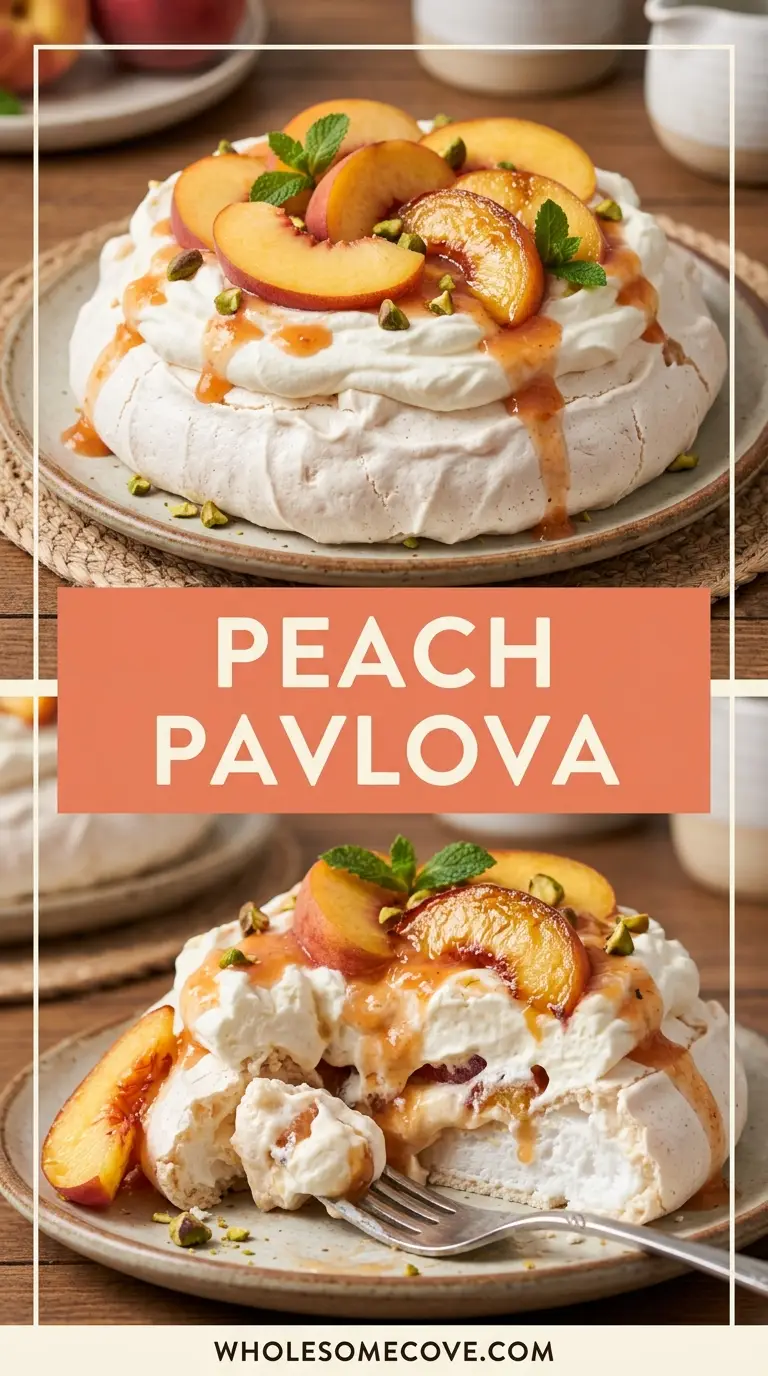
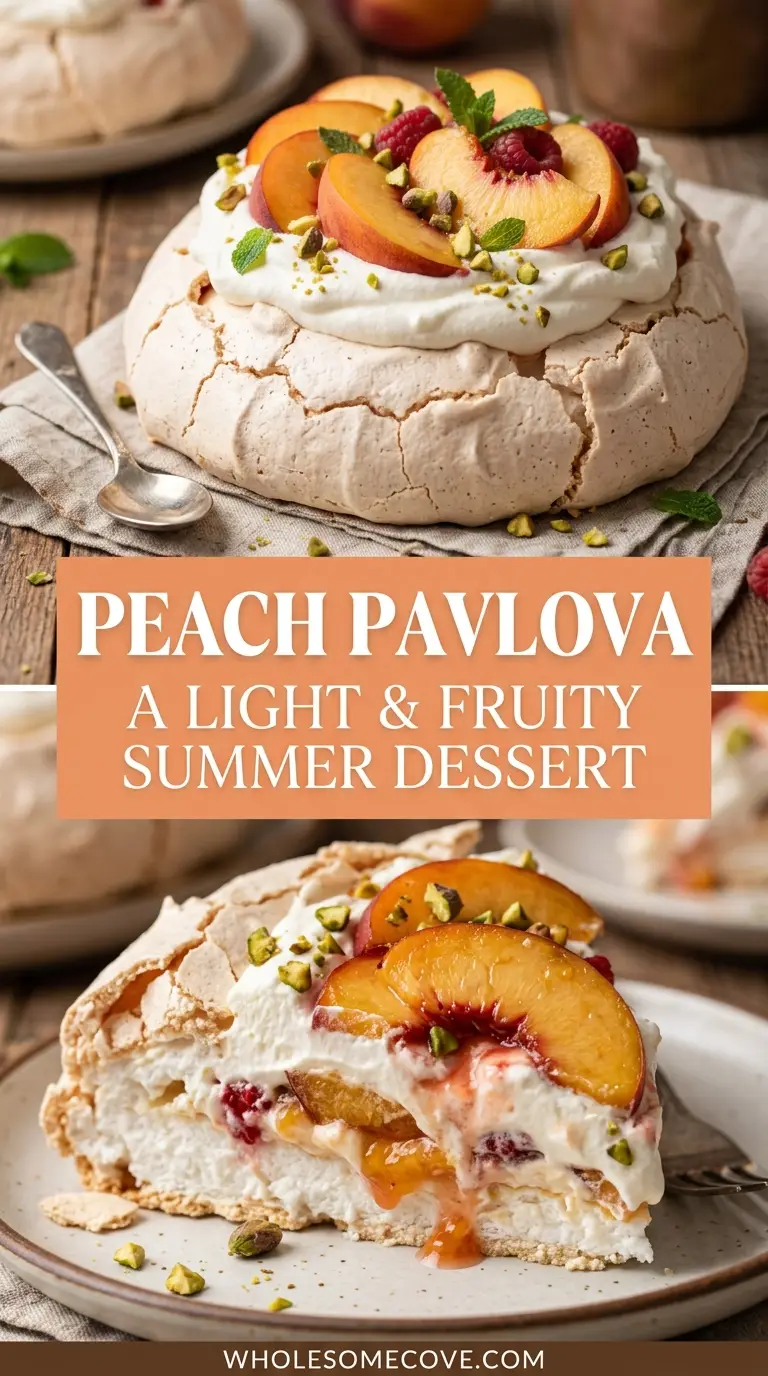
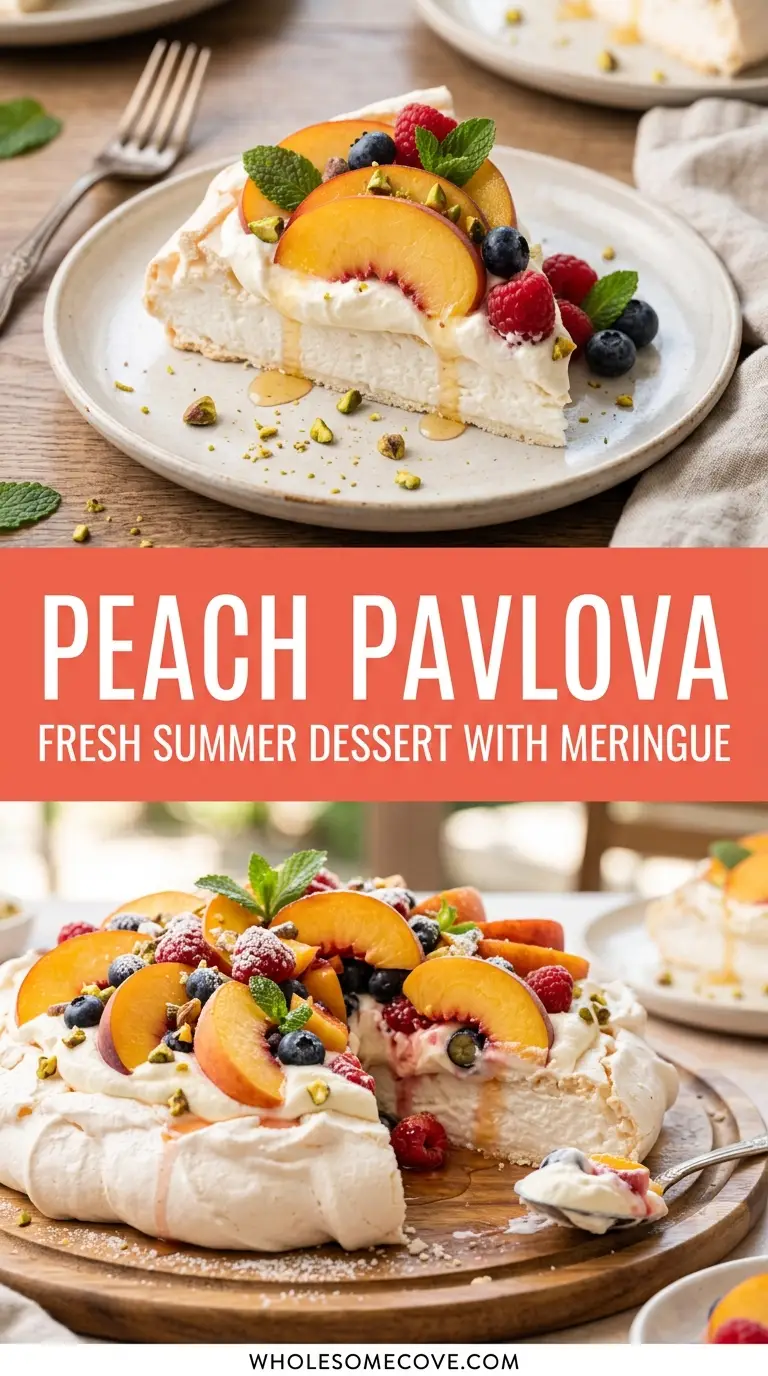
This peach pavlova recipe turns four egg whites and a cup of sugar into a dessert with a crackly white shell and a center that stays soft like marshmallow. Ripe peaches and lightly sweetened cream go on top, so every bite has crunch, softness, and juice at once.
The most common reason home pavlovas fail is weeping, those sticky syrup beads that appear when the sugar never fully dissolves into the whites. Superfine sugar added a spoonful at a time fixes that here.
A teaspoon of vinegar and two teaspoons of cornstarch are what give the inside its marshmallow pull instead of a dry crunch all the way through. Leave them out and you have a plain meringue, not a pavlova.
The meringue bakes low at 250°F (120°C), then cools inside the turned-off oven, which is the step that keeps the shell from shattering. Slice it into eight wedges and add the cream and fruit right before serving so the base stays crisp.
| Quick Recipe Summary | |
|---|---|
| Prep Time | 20 minutes |
| Cook Time | 1 hour 15 minutes |
| Cooling Time | 1 hour 30 minutes |
| Total Time | 3 hours 5 minutes |
| Servings | 8 slices |
| Difficulty Level | Intermediate |
You might also enjoy: Peach Tiramisu
Why You’ll Love This Peach Pavlova Recipe
Pavlova looks like a bakery showpiece but comes down to two components you assemble at the last minute. The meringue can be baked the day before, which spreads the work out.
Here is what makes it worth the oven time:
- Texture contrast in every bite. The shell shatters like a thin crust while the middle stays soft and chewy, and that difference is the whole appeal.
- A short ingredient list. The base is egg whites, sugar, cornstarch, vinegar, and vanilla, all pantry items apart from the eggs.
- Naturally gluten free. Cornstarch replaces flour entirely, so the dessert works for gluten-free guests without any swaps.
- Peaches carry the flavor. Ripe summer peaches need almost nothing done to them, so the topping is fast and fresh.
- Make-ahead friendly. Bake the meringue in advance and store it airtight, then whip cream and slice fruit when you are ready to serve.
- Feeds a crowd. One meringue cuts into eight generous wedges, which covers most dinner tables.
- Endlessly adaptable. Swap in berries, add a fruit sauce, or fold cocoa into the cream once you know the base method.
For a baked peach dessert with a custardy base, take a look at French Peach Clafoutis.
Ingredients
Measure everything before you start, because meringue moves quickly once the whites are whipping. The quantities below make one 9-inch (23cm) pavlova that serves eight.
For the meringue base:
- 4 large egg whites (about 140g), at room temperature
- 1 cup (200g) superfine or caster sugar
- 2 teaspoons cornstarch (cornflour)
- 1 teaspoon white wine vinegar
- 1 teaspoon pure vanilla extract
- Pinch of fine salt
For the whipped cream:
- 1 1/4 cups (300ml) cold heavy cream (double cream)
- 2 tablespoons (16g) powdered sugar (icing sugar)
- 1/2 teaspoon pure vanilla extract
For the peach topping:
- 4 ripe peaches (about 1.5 lb / 680g), sliced
- 1 tablespoon fresh lemon juice
- 2 tablespoons peach jam, warmed, for an optional glaze
- Fresh mint leaves, for garnish (optional)
A quick note on the sugar. I’ve found caster sugar dissolves noticeably faster than regular granulated in this meringue, which cut my grittiness problems almost entirely.
For a rustic Italian option, try: Italian Peach Crostata
Kitchen Equipment Needed
Pavlova rewards clean, dry, grease-free tools more than any special gadget. Wipe the bowl and whisk with a little vinegar before you begin.
- A stand mixer with a whisk attachment, or a handheld one
- An electric hand mixer as an alternative
- A large stainless steel mixing bowl, since metal or glass holds no grease film
- A rimmed baking sheet
- Parchment paper to line the tray
- An offset spatula for shaping the meringue
- A pencil, for tracing a circle guide on the parchment
- A cooling area away from drafts
I keep a clean bottle of white vinegar by the mixer just to wipe the bowl and whisk before starting, since even a film of grease from the last wash keeps the whites from climbing.
Read Also: German Peach Kuchen
Recommended Products for This Recipe
These are the items I reach for when I want a pavlova to behave, chosen because each one solves a problem that comes up again and again with meringue.
1. Oven Thermometer
Most home ovens run hotter or cooler than the dial claims, and pavlova is unforgiving about it. A cheap in-oven thermometer lets you confirm the real temperature so the shell dries slowly instead of browning or staying tacky.
2. Cream of Tartar
If you would rather not taste any vinegar at all, cream of tartar stabilizes the whipped whites just as well with no acidic note. A small pinch helps the foam hold its air through the long, low bake.
3. Vanilla Bean Paste
Extract adds flavor but also liquid, and meringue is sensitive to extra moisture. Vanilla bean paste gives you deeper flavor and pretty flecks without loosening the mixture the way a heavy hand of extract can.
4. Digital Kitchen Scale
Weighing the egg whites and sugar keeps the ratio consistent every time, which matters more here than in most recipes. A scale also lets you portion sugar exactly so it dissolves fully.
Fans of layered peach desserts often enjoy Peach Trifle.
Step-by-Step Instructions: How to Make Peach Pavlova
Follow these steps in order and you will have a crisp, marshmallow-centered pavlova ready to top with cream and peaches.
Step 1: Prep the oven and tray
- Position a rack in the center of the oven and preheat to 250°F (120°C).
- Line a baking sheet with parchment paper.
- Using a pencil, trace a 9-inch (23cm) circle on the parchment as a size guide.
- Flip the parchment over so the pencil side faces down, keeping the line visible through the paper.
Step 2: Whip the egg whites to soft peaks
- Make sure the bowl and whisk are spotless and dry, wiping them with a little vinegar first if unsure.
- Add the 4 room-temperature egg whites and the pinch of salt to the bowl.
- Beat on medium speed until the whites turn foamy and hold soft peaks that curl over at the tip.
Step 3: Add the sugar slowly
- With the mixer running on medium, add the 1 cup (200g) superfine sugar one tablespoon at a time.
- Wait about 20 seconds between additions so each spoonful dissolves before the next goes in.
- Continue until the meringue is thick, glossy, and holds stiff peaks.
- Rub a little between two fingers, and if it still feels gritty, keep beating until smooth.
Step 4: Fold in the stabilizers
- Sprinkle the 2 teaspoons cornstarch over the meringue.
- Add the 1 teaspoon vinegar and 1 teaspoon vanilla extract.
- Beat on low for just a few seconds, only until combined, to avoid deflating or loosening the mixture.
Step 5: Shape the meringue
- Scoop the meringue onto the center of the traced circle.
- Using an offset spatula, spread it to fill the circle, building the sides slightly higher than the middle.
- Create a shallow well in the center to hold the cream and fruit later.
- Run the spatula up the sides to make decorative peaks, which also strengthen the shell.
Step 6: Bake low and slow
- Place the tray in the oven and immediately reduce the temperature to 225°F (110°C).
- Bake for 1 hour 15 minutes without opening the door.
- The pavlova is ready when the outside is dry, pale, and lifts cleanly from the parchment.
Step 7: Cool inside the oven
- Turn the oven off and prop the door open a couple of inches.
- Leave the pavlova inside to cool gradually for at least 1 hour 30 minutes, or until completely cool.
- This slow cooldown is what prevents the shell from cracking apart as it contracts.
Step 8: Whip the cream
- Pour the 1 1/4 cups (300ml) cold heavy cream into a chilled bowl.
- Add the 2 tablespoons powdered sugar and 1/2 teaspoon vanilla.
- Beat until the cream holds soft, spreadable peaks, being careful not to overwhip into a grainy texture.
Step 9: Prep the peaches
- Slice the 4 peaches into wedges.
- Toss them gently with the 1 tablespoon lemon juice to keep them from browning.
- If using the glaze, warm the 2 tablespoons peach jam until pourable.
Step 10: Assemble and serve
- Transfer the cooled meringue to a serving plate.
- Spoon the whipped cream into the center well and spread it toward the edges.
- Pile the peach slices over the cream.
- Drizzle with the warmed peach jam and scatter mint leaves on top, then slice and serve right away.
For a free-form pastry version, try: Peach Galette
Tips for The Best Peach Pavlova
Small habits make the difference between a crisp, clean pavlova and a sticky, cracked one. These are the ones that matter most.
- Start with grease-free everything. Any trace of fat or egg yolk stops the whites from whipping, so wipe tools with vinegar first.
- Use older egg whites if you can. Whites a few days old whip to slightly more volume than very fresh ones.
- Add sugar gradually. Rushing the sugar leaves crystals that melt and leak out as syrup during baking.
- Do not overbeat. Once the whites are stiff and glossy, stop, because overworked whites turn grainy and weep.
- Keep the oven closed. Opening the door drops the temperature suddenly and cracks the shell.
- Cool it slowly. The gradual cooldown in the turned-off oven is not optional if you want an intact shell.
- Avoid humid days. Meringue pulls moisture from the air, so a rainy day works against you.
- Top it last. Cream and fruit soften the shell within an hour, so assemble just before serving.
I ruined my first pavlova by cranking the mixer to high the moment the sugar went in. The whites stiffened fast but stayed gritty, and the baked shell wept syrup, so now I add the sugar slowly on medium speed every time.
Read Also: Peach Crumble
What to Serve with Peach Pavlova
Pavlova is rich and sweet, so the best partners are light, cold, or a little tart. Think of drinks and extra fruit that echo the peach without competing with it.
- A spoonful of warm Peach Compote alongside each slice for extra syrupy fruit
- A scoop of Peach Ice Cream for a double-peach dessert plate
- A lighter, dairy-free Peach Sorbet to cut the richness of the cream
- Charred Grilled Peaches piled on top in place of fresh slices
- A cold glass of Peach Lemonade for a bright, tart contrast
- A pitcher of Peach Iced Tea for a relaxed afternoon serving
- Fresh raspberries or blueberries scattered over the cream for color and acidity
- A pot of strong black coffee or espresso to balance the sweetness
- A glass of sparkling wine or prosecco for a celebration table
Peaches that are just short of fully ripe hold their slices better on top than very soft ones, which slump and slide into the cream within minutes.
For a warm, spoonable partner to this dessert, see Peach Cobbler.
Variations of Peach Pavlova
Once the meringue base is second nature, the toppings and flavors are open to change. Here are ways to make it your own.
- Peach melba pavlova. Add a drizzle of raspberry sauce and a handful of fresh raspberries over the peaches.
- Mixed summer fruit. Combine peaches with strawberries, blueberries, and blackberries for a colorful top.
- Mascarpone cream. Fold a few spoonfuls of mascarpone into the whipped cream for a richer, more stable topping.
- Individual pavlovas. Pipe the meringue into small nests and shorten the bake to about 45 minutes.
- Brown sugar meringue. Replace part of the sugar with light brown sugar for a caramel note in the shell.
- Caramelized peaches. Cook the peach slices briefly in butter and sugar until syrupy, then cool before topping.
- Lemon curd layer. Spread a thin layer of lemon curd under the cream for a tart, glossy contrast.
- Chocolate ribbon. Swirl melted dark chocolate into the meringue before baking for a marbled effect.
For a fruit-and-crumb finish, try: Strawberry Peach Tart
Storage and Reheating
Pavlova is best eaten the day it is assembled, but the parts store differently. Plan around the meringue, which is the fragile piece.
- Unbaked meringue: Do not store it. Meringue must go into the oven as soon as it is shaped.
- Baked, un-topped meringue: Keep it in an airtight container at room temperature for up to 2 days. Add a paper towel to absorb stray moisture.
- Humid climates: Store the bare meringue in the turned-off oven rather than the counter, since the fridge adds moisture.
- Assembled pavlova: Refrigerate leftovers loosely covered for up to 1 day, knowing the shell will soften and the fruit will release juice.
- Freezing the meringue: A bare, fully cooled meringue can be frozen airtight for up to 1 month, then thawed at room temperature before topping.
- Do not reheat. Pavlova is served cold or at room temperature, so no reheating is needed or wanted.
- Make-ahead plan: Bake the shell a day ahead, then whip the cream and slice the peaches within an hour of serving.
For a make-ahead peach breakfast in the same spirit, try Peach Chia Pudding.
Nutritional Facts
Values below are estimates for one of eight slices, including cream and peach topping. Actual numbers vary with peach size and cream amount.
| Nutrient | Per Serving (approx.) |
|---|---|
| Calories | 235 kcal |
| Total Fat | 14 g |
| Saturated Fat | 9 g |
| Cholesterol | 42 mg |
| Sodium | 45 mg |
| Total Carbohydrate | 27 g |
| Sugars | 25 g |
| Protein | 3 g |
| Vitamin C | 6 mg |
Read Also: Peach Frozen Yogurt
Health Benefits of Key Ingredients
This is a dessert, so it is a treat first. Still, a few of the components bring something useful along with the sweetness.
- Peaches: They provide vitamin C and vitamin A, along with fiber and antioxidants that support skin and immune health.
- Egg whites: Pure protein with almost no fat, egg whites give the dessert structure and a small protein boost.
- Heavy cream: In moderation, cream supplies fat-soluble vitamins A and D and makes the peaches’ nutrients easier to absorb.
- Lemon juice: A splash adds vitamin C and helps keep the peach slices bright and fresh looking.
- Cornstarch: Used in a tiny amount, it keeps the recipe naturally gluten free, which helps those avoiding wheat.
- Vanilla: Real vanilla contains trace antioxidant compounds and lets you use less added sugar for the same perceived sweetness.
You might also like: Peach Caprese Salad
FAQs About Peach Pavlova
1. Why did my pavlova crack?
Some cracking is completely normal and part of the dessert’s rustic look. It happens because the soft center shrinks slightly as it cools and the crisp shell settles around it.
Severe cracking usually comes from a bake that was too hot or a cooldown that was too fast. Keep the oven low and let the pavlova cool gradually inside with the door ajar.
2. Why is my pavlova weeping or sticky?
Weeping, those syrup beads on the surface, means the sugar did not fully dissolve into the whites. Add sugar slowly next time and beat until the mixture feels smooth, not gritty, between your fingers.
A tacky shell usually means it needs more drying time or the air is humid. Try a longer, lower bake and avoid making pavlova on rainy days.
3. Can I make peach pavlova ahead of time?
Yes, and the meringue base is the part to make ahead. Bake it a day early and store it airtight at room temperature until you are ready.
Wait to add the cream and peaches until close to serving. The topping softens the crisp shell within about an hour.
4. Can I use canned or frozen peaches instead of fresh?
Canned peaches work if you drain and pat them dry so extra liquid does not pool on the cream. They are a good option outside of peach season.
Frozen peaches also work once fully thawed and drained. Fresh, ripe peaches still give the best texture and brightest flavor.
5. How do I know when the pavlova is done baking?
The outside should look dry and pale, not browned, and feel firm to a light touch. It should also lift away from the parchment without sticking.
Do not judge by the center, which stays soft on purpose. If it seems tacky after cooling, a short extra bake at a low temperature can help.
6. What is the difference between pavlova and meringue?
A plain meringue is crisp all the way through and shatters completely. Pavlova adds cornstarch and vinegar, which create a soft, marshmallow-like center inside a crisp shell.
That soft interior is the defining feature. It is why pavlova is served with cream and fruit rather than eaten dry like a meringue cookie.
For a different fresh-fruit dessert, see Peach Tart.
Peach Pavlova
Ingredients
- 4 large egg whites - about 140g, at room temperature
- 1 cup superfine or caster sugar - 200g
- 2 teaspoons cornstarch (cornflour)
- 1 teaspoon white wine vinegar
- 1 teaspoon pure vanilla extract
- fine salt - pinch
- 1 1/4 cups cold heavy cream (double cream) - 300ml
- 2 tablespoons powdered sugar (icing sugar) - 16g
- 1/2 teaspoon pure vanilla extract
- 4 ripe peaches - about 1.5 lb / 680g, sliced
- 1 tablespoon fresh lemon juice
- 2 tablespoons peach jam - warmed, for an optional glaze (optional)
- fresh mint leaves - for garnish (optional)
Equipment
- Stand mixer - with whisk attachment, or a handheld one
- Electric hand mixer - alternative to stand mixer (optional)
- Large stainless steel mixing bowl - metal or glass holds no grease film
- Parchment paper - to line the tray
- Offset spatula - for shaping the meringue
- Pencil - for tracing a circle guide on the parchment
- Oven thermometer - recommended for confirming oven temperature
- Digital kitchen scale - recommended for weighing egg whites and sugar
Method
- Position a rack in the center of the oven and preheat to 250°F (120°C). Line a baking sheet with parchment paper and trace a 9-inch (23cm) circle on the parchment, then flip it over so the pencil side faces down.
- Ensure the bowl and whisk are spotless and dry. Add the room-temperature egg whites and a pinch of salt, then beat on medium speed until foamy and holding soft peaks.
- With the mixer running on medium, add the superfine sugar one tablespoon at a time, waiting about 20 seconds between additions, until the meringue is thick, glossy, and holds stiff peaks. Rub a little between your fingers; if gritty, keep beating until smooth.
- Sprinkle the cornstarch over the meringue, add the vinegar and vanilla, and beat on low for just a few seconds until combined.
- Scoop the meringue onto the traced circle and spread it with an offset spatula, building the sides slightly higher than the middle. Create a shallow well in the center and run the spatula up the sides to make decorative peaks.
- Place the tray in the oven and immediately reduce the temperature to 225°F (110°C). Bake for 1 hour 15 minutes without opening the door, until the outside is dry, pale, and lifts cleanly from the parchment.
- Turn the oven off and prop the door open a couple of inches. Leave the pavlova inside to cool gradually for at least 1 hour 30 minutes, or until completely cool.
- Pour the cold heavy cream into a chilled bowl, add the powdered sugar and vanilla, and beat until the cream holds soft, spreadable peaks.
- Slice the peaches into wedges and toss gently with lemon juice. If using the glaze, warm the peach jam until pourable.
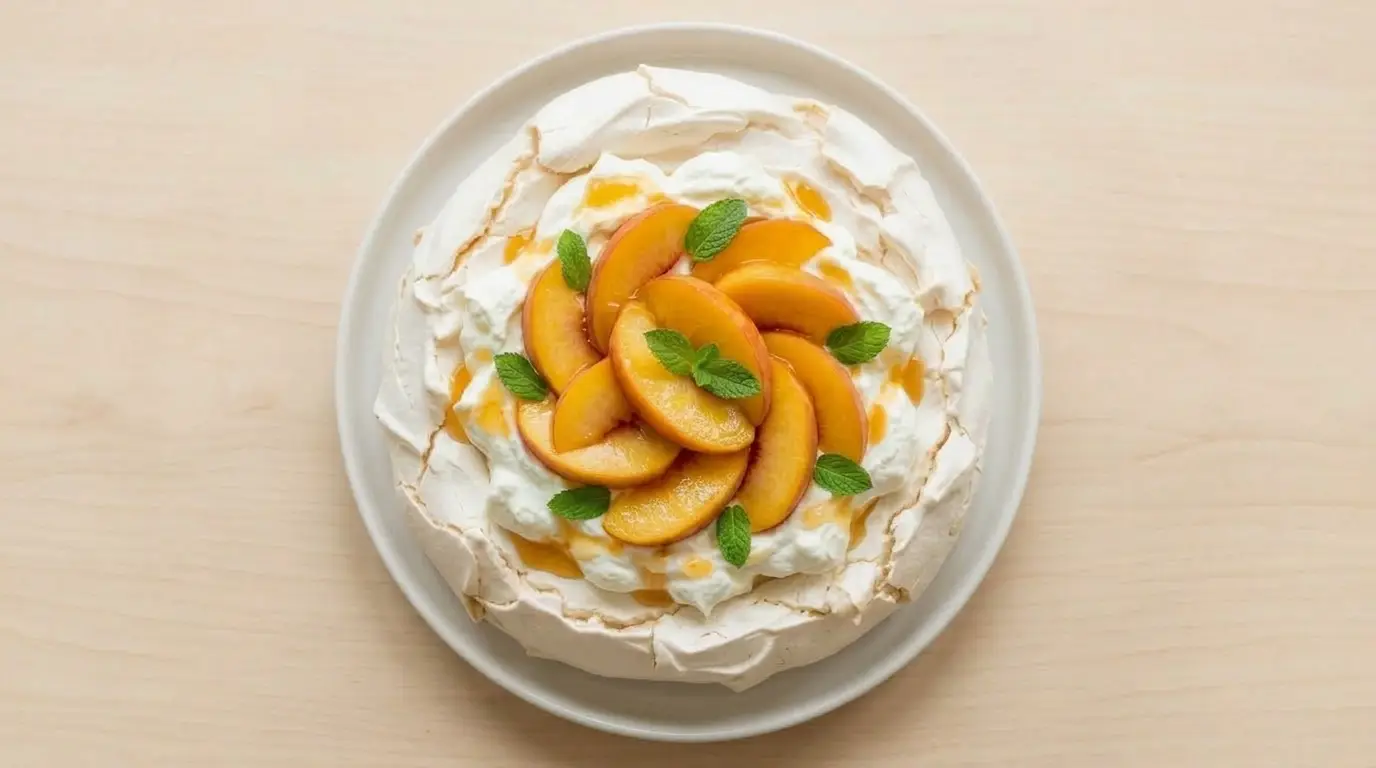
- Transfer the cooled meringue to a serving plate. Spoon the whipped cream into the center well, pile the peach slices over the cream, drizzle with warmed peach jam, scatter mint leaves on top, and serve right away.
Nutrition
Notes
- Grease-free everything: Any trace of fat or egg yolk stops whites from whipping, so wipe tools with vinegar first.
- Older egg whites: Whites a few days old whip to slightly more volume than very fresh ones.
- Add sugar gradually: Rushing the sugar leaves crystals that melt and leak out as syrup during baking.
- Do not overbeat: Once the whites are stiff and glossy, stop, because overworked whites turn grainy and weep.
- Keep the oven closed: Opening the door drops the temperature suddenly and cracks the shell.
- Cool it slowly: The gradual cooldown in the turned-off oven is not optional if you want an intact shell.
- Avoid humid days: Meringue pulls moisture from the air, so a rainy day works against you.
- Top it last: Cream and fruit soften the shell within an hour, so assemble just before serving.
- Storage: Baked, un-topped meringue keeps in an airtight container at room temperature for up to 2 days; freeze bare meringue airtight for up to 1 month.
- Make-ahead plan: Bake the shell a day ahead, then whip the cream and slice the peaches within an hour of serving.
- Variations: Try peach melba with raspberry sauce, mixed summer fruit, mascarpone cream, individual nests, brown sugar meringue, caramelized peaches, lemon curd layer, or a chocolate ribbon.
- Canned or frozen peaches: Both work if drained and patted dry; fresh ripe peaches give the best texture and flavor.
Private Notes
Tried this recipe?
Let us know how it was!Final Thoughts
Peach pavlova looks impressive but really comes down to patience with the sugar and the cooldown. Get those two things right and the rest is just whipping cream and slicing fruit.
Make the shell a day ahead, then crown it with cream and ripe peaches when your guests are ready. That crisp-then-soft first bite is what people remember.
Give this one a try the next time peaches are at their best. If you make it, leave a comment with how it turned out and share it with a friend who loves a summer dessert.
Recommended:
- Peach Bruschetta
- Peach Milkshake
- Peach Popsicles
- Peach Scones
- Peach Danish
- Peach Coffee Cake
- Peach Turnovers
- Grilled Peach Salad
- Peach Burrata Salad
- Peach Pie