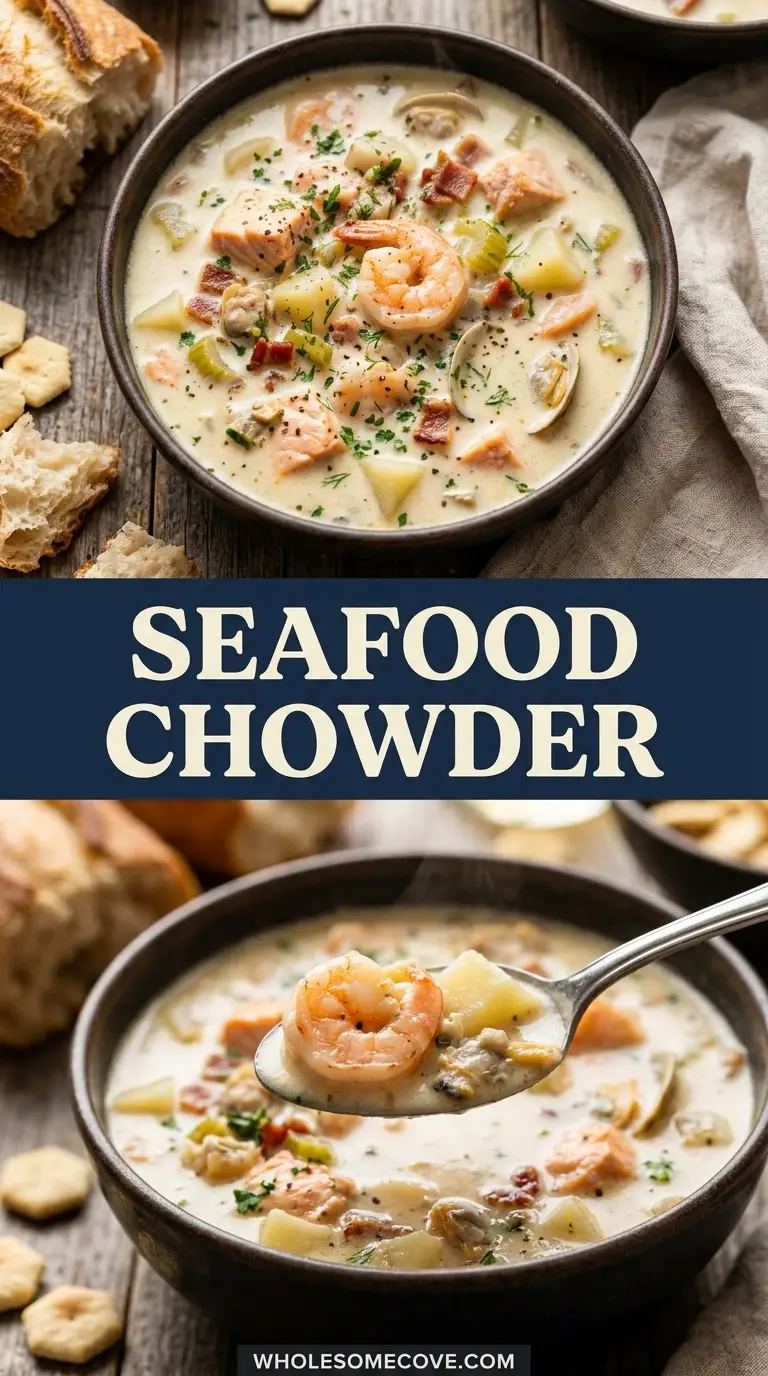
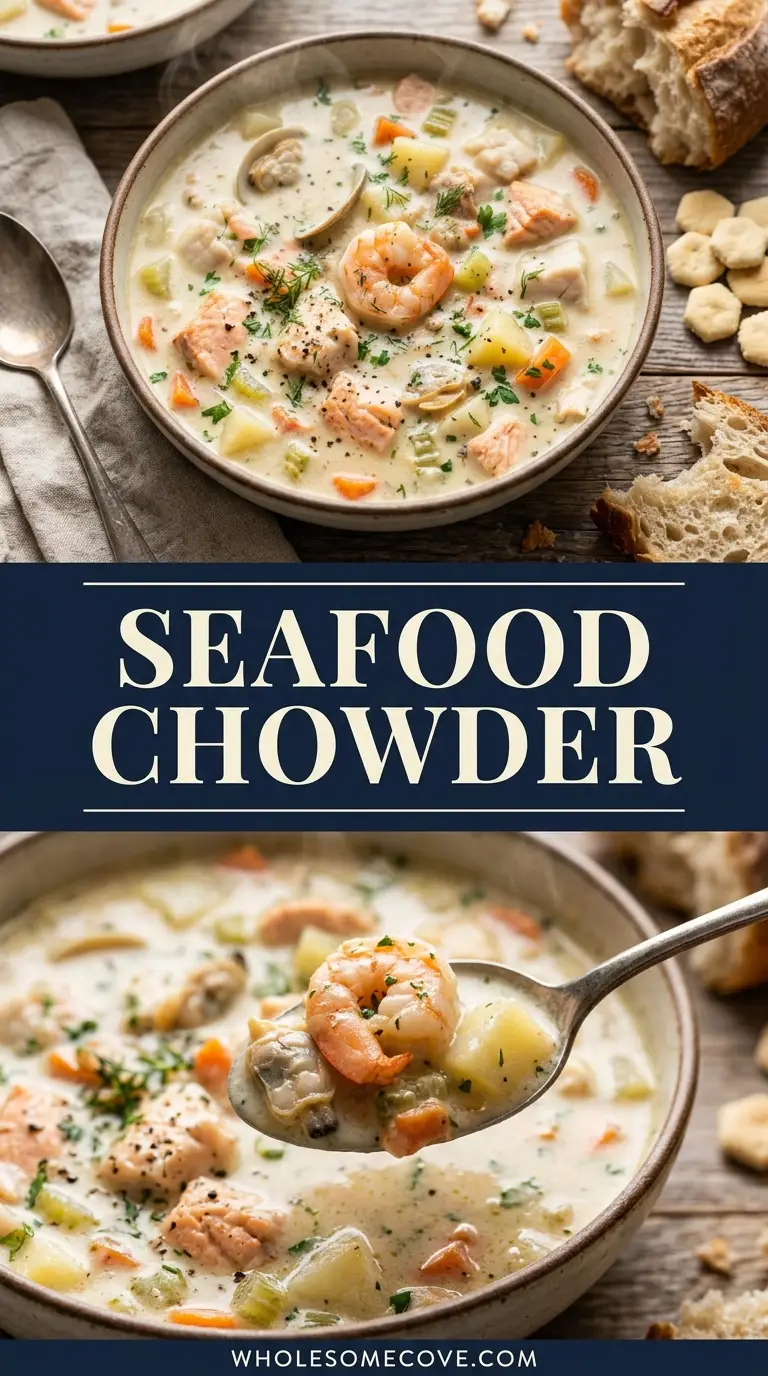
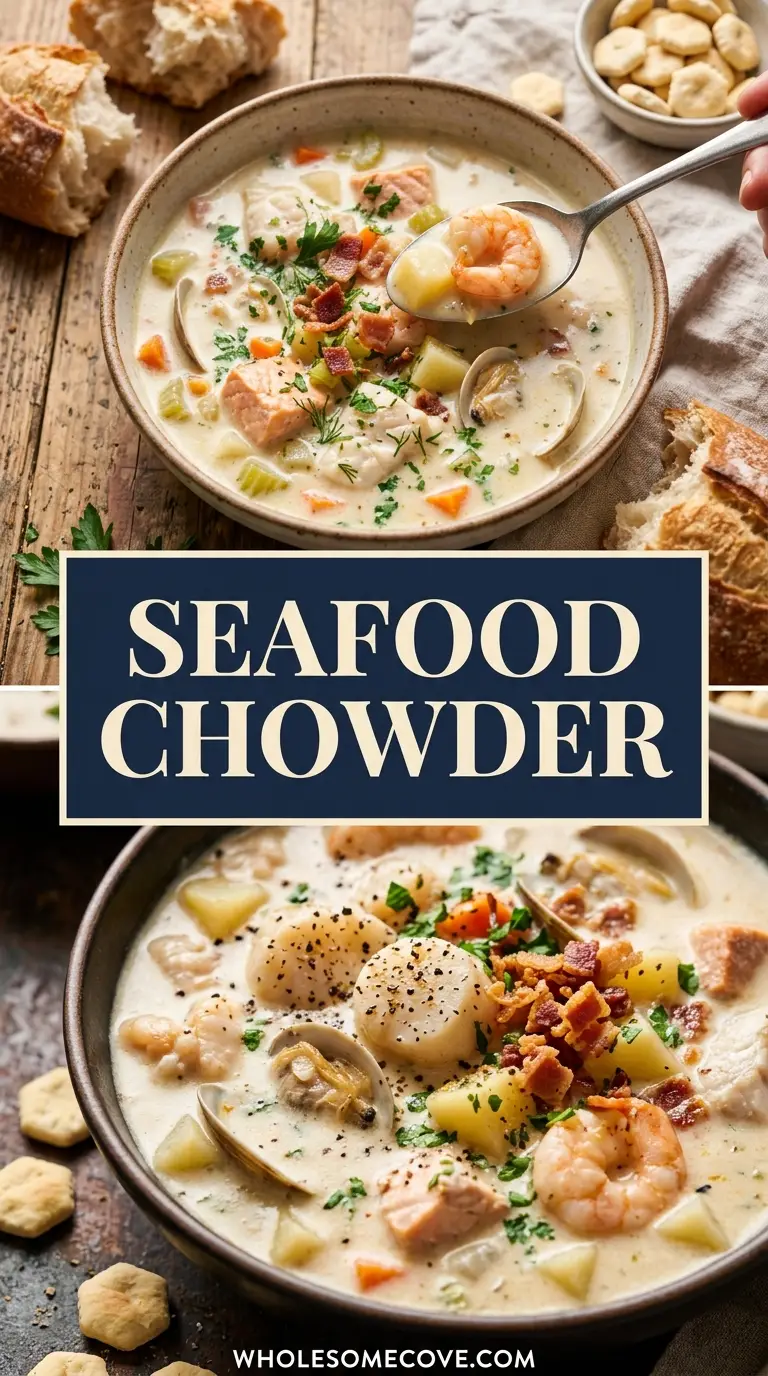
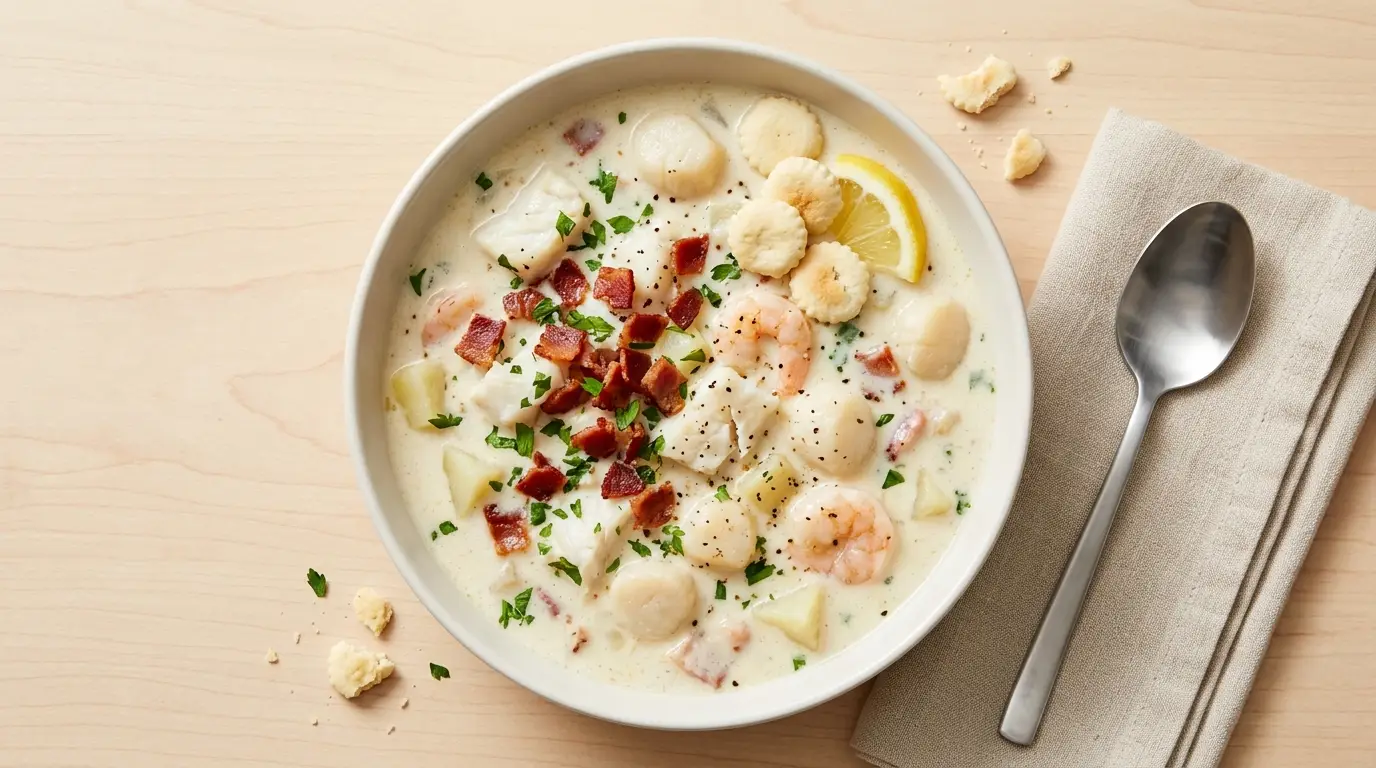
This seafood chowder recipe uses four kinds of seafood, cod, shrimp, scallops, and chopped clams, each added at a different point so nothing overcooks.
The broth gets its body from Yukon Gold potatoes and a light roux. It coats the spoon without turning gluey.
Most versions fall apart in the final five minutes. Shrimp and scallops need only about three minutes, so adding everything at once makes them chewy.
Here the fish simmers first, then the quick-cooking shellfish goes in to finish. A teaspoon of Old Bay, fresh thyme, and bacon rendered at the start give it a smoky, savory backbone.
Start to finish it takes about an hour and makes six generous bowls. Most of the list is pantry staples plus whatever seafood looks freshest at the counter.
| Quick Recipe Summary | |
|---|---|
| Prep Time | 25 minutes |
| Cook Time | 35 minutes |
| Total Time | 1 hour |
| Servings | 6 bowls |
| Difficulty Level | Intermediate |
Read Also: New England Clam Chowder
Why You’ll Love This Seafood Chowder Recipe
This is the kind of pot you make once and then keep coming back to whenever good seafood is in reach. The method is forgiving, and the payoff is a thick, restaurant-style bowl at a fraction of the cost.
Here is what makes it worth your time:
- A real mix of seafood. Cod, shrimp, scallops, and clams each bring a different texture, so no two spoonfuls are the same.
- Tender seafood every time. Staggering when each one goes in means the shrimp stay snappy and the fish stays in whole pieces instead of shredding.
- A broth with actual body. Potatoes and a short roux thicken it naturally, so you get a creamy base without a wall of heavy cream.
- Smoky depth from bacon. Rendering bacon first builds a savory foundation that plain butter cannot match.
- One pot, about an hour. Everything happens in a single Dutch oven, and the whole thing comes together in around 60 minutes.
- Easy to scale and swap. Use whatever seafood is freshest, and the ratios still hold.
You might also enjoy: Fish Chowder
Ingredients
Gather your seafood and vegetables before you start, since the cooking moves quickly once the base is built. Quantities below make six servings, with both imperial and metric measurements listed.
Seafood:
- 1 lb (450 g) firm white fish such as cod or haddock, cut into 1-inch (2.5 cm) pieces
- 8 oz (225 g) raw large shrimp, peeled and deveined
- 8 oz (225 g) sea scallops, side muscle removed, halved if large
- One 6.5 oz (184 g) can chopped clams, meat and juice separated
Base and aromatics:
- 4 slices thick-cut bacon, chopped
- 3 tbsp (43 g) unsalted butter
- 1 large yellow onion, diced (about 1.5 cups / 200 g)
- 2 celery stalks, diced (about 1 cup / 120 g)
- 3 cloves garlic, minced
- 1/3 cup (40 g) all-purpose flour
- 4 cups (960 ml) seafood stock or bottled clam juice
- 1.5 lb (680 g) Yukon Gold potatoes, peeled and cut into 1/2-inch (1.3 cm) cubes (about 4 cups)
- 1 bay leaf
- 1 tsp fresh thyme leaves, or 1/2 tsp dried thyme
- 1 tsp Old Bay seasoning
- 1/2 tsp smoked paprika (optional)
- 1 cup (240 ml) heavy cream
- 1 cup (240 ml) whole milk
- Salt and freshly ground black pepper, to taste
To finish:
- 2 tbsp fresh parsley, chopped
- Oyster crackers or crusty bread, for serving
- Lemon wedges (optional)
For a lighter, shellfish-only take, see Shrimp Chowder.
Kitchen Equipment Needed
You do not need anything specialized for this chowder, just a sturdy pot and a few basics. A heavy-bottomed vessel matters most, because a thin pan scorches a cream base fast.
Here is what to have ready:
- A 5 to 6 quart Dutch oven or heavy-bottomed soup pot
- A sharp chef’s knife for the seafood and vegetables
- A wooden cutting board
- A wooden spoon for stirring the roux
- A whisk for working in the stock without lumps
- A soup ladle for serving
- A slotted spoon for lifting out the bacon
- Measuring cups and spoons
For a different base, try: Salmon Chowder
Recommended Products for This Recipe
These are the tools and ingredients I reach for whenever I make this chowder, picked because each one solves a specific problem that comes up with a creamy seafood soup.
1. Lodge Enameled Cast Iron Dutch Oven
A cream and potato base scorches the second it touches a hot spot, and thin pots are full of them. The thick enameled cast iron holds a steady, even heat so the bottom never catches while the potatoes simmer, and it moves straight from stove to table.
2. Bar Harbor Clam Juice
The single biggest flavor lever in this recipe is the liquid you build the broth on. Bottled clam juice gives you a clean, briny seafood base even when you cannot get to a fishmonger, and it keeps for months in the pantry.
3. Old Bay Seasoning
One teaspoon is what separates a flat chowder from one that tastes like the coast. The celery salt, paprika, and warm spices tie the different seafoods together without overpowering any of them.
4. OXO Good Grips Fish Spatula
Cod and scallops are delicate, and a bulky spoon breaks them into shreds. A thin, flexible fish spatula lets you fold the seafood through the broth gently so the pieces stay whole in the bowl.
Read Also: Corn Chowder
Step-by-Step Instructions: How to Make Seafood Chowder
Follow these steps in order and you’ll have a creamy, loaded seafood chowder ready in about an hour.
Step 1: Prep the Seafood and Vegetables
- Pat the cod, shrimp, and scallops dry with paper towels and keep them chilled until needed. Dry seafood sears and holds together better than wet.
- Open the can of chopped clams and drain it over a bowl, keeping both the meat and the juice. You will add the meat at the end and the juice to the broth.
- Dice the onion and celery, mince the garlic, and peel and cube the potatoes into even 1/2-inch (1.3 cm) pieces so they cook at the same rate.
Step 2: Render the Bacon
- Set your Dutch oven over medium heat and add the chopped bacon.
- Cook, stirring now and then, for 6 to 8 minutes until the bacon is crisp and the fat has rendered.
- Lift the bacon out with a slotted spoon and set it on a plate. Leave the rendered fat in the pot.
Step 3: Build the Aromatic Base
- Add the butter to the bacon fat and let it melt over medium heat.
- Stir in the diced onion and celery with a pinch of salt. Cook for 5 to 6 minutes until softened and translucent.
- Add the minced garlic and cook for about 1 minute, just until fragrant, so it does not brown and turn bitter.
Step 4: Make the Roux
- Sprinkle the flour evenly over the vegetables.
- Stir constantly for 1 to 2 minutes to cook off the raw flour taste and coat everything in a light paste. This is what thickens the broth.
Step 5: Add the Liquid and Potatoes
- Slowly pour in the seafood stock (or bottled clam juice) a little at a time, whisking after each addition to keep the roux smooth and lump-free.
- Stir in the reserved clam juice from the can.
- Add the cubed potatoes, bay leaf, thyme, Old Bay, and smoked paprika.
- Bring to a gentle simmer and cook uncovered for about 15 minutes, until the potatoes are fork-tender.
Step 6: Stir in the Dairy
- Lower the heat to medium-low.
- Pour in the heavy cream and whole milk, stirring to combine.
- Warm gently for 2 to 3 minutes. Do not let it come to a hard boil, or the dairy can separate.
Step 7: Cook the Seafood in Stages
- Add the cod pieces and scallops first. Simmer very gently for 3 to 4 minutes.
- Add the shrimp and the reserved clam meat. Cook for another 2 to 3 minutes, just until the shrimp turn pink and opaque and the fish flakes.
- Remove and discard the bay leaf.
Step 8: Season and Serve
- Taste the broth and season with salt and freshly ground black pepper. Clam juice and bacon are already salty, so add gradually.
- Stir in half of the cooked bacon and half of the chopped parsley.
- Ladle into bowls and top with the remaining bacon, more parsley, oyster crackers, and a lemon wedge on the side.
A heartier, tomato-based cousin is Manhattan Clam Chowder.
Tips for The Best Seafood Chowder
A few small habits make the difference between a good chowder and one people ask you to make again. Most of them come down to timing and temperature.
- Stagger the seafood. I ruined my first pot by dropping all the seafood in at once, which left the shrimp rubbery by the time the fish cooked through, and adding them in two stages fixed it completely.
- Pat the scallops dry. Scallops release a surprising amount of water, so I dry them well before they go in or the broth turns thin and loses its cling.
- Choose waxy potatoes. I’ve found Yukon Gold potatoes hold their shape here while russets break down into mush and cloud the broth.
- Keep it at a simmer. A cream base that reaches a rolling boil can curdle, so hold it at a lazy bubble once the dairy is in.
- Undercook the seafood slightly. It keeps cooking in the hot broth off the heat, so pull the pot the moment the shrimp turn pink.
- Season at the very end. The bacon, Old Bay, and clam juice all add salt, so wait until everything is in before adjusting.
- Let it rest. Five minutes off the heat lets the flavors settle and the broth thicken slightly.
You might also like: Chicken Chowder
What to Serve with Seafood Chowder
Seafood chowder is rich and filling on its own, so the best partners are simple sides that soak up the broth or cut through the cream. Bread is almost mandatory, and a crisp vegetable side rounds out the bowl.
Here are pairings that work well:
- Warm Homemade Biscuits for tearing and dipping into the broth
- Soft Dinner Rolls brushed with butter
- A slice of Sourdough Focaccia with its crackly crust
- A wedge of Cornbread for a slightly sweet contrast
- A crunchy, tangy Coleslaw to cut the richness
- A cold Broccoli Salad with a sharp dressing
- Lobster Rolls for a full seafood-shack spread
- A simple green salad with a bright lemon vinaigrette
- A crisp white wine or a cold lager alongside
Read Also: Seafood Stew
Variations of Seafood Chowder
The base recipe is a template, and the seafood mix is where you can make it your own. Here are ways to change it up depending on what you have and who you are feeding.
- New England style: Lean heavily on clams and swap most of the fish for an extra can or two of chopped clams.
- Luxe version: Add chunks of lobster meat or crab in the final two minutes for a special-occasion pot.
- Smoky twist: Stir in a few ounces of smoked haddock or smoked salmon for a deeper, cured flavor.
- Corn and seafood: Add 1 cup of sweet corn kernels with the potatoes for pops of sweetness.
- Lighter broth: Replace the heavy cream with half-and-half or extra milk for a thinner, less rich bowl.
- Dairy-free: Use full-fat coconut milk in place of the cream and milk, which pairs surprisingly well with the briny seafood.
- Spicy kick: Add a pinch of cayenne or a diced jalapeño with the aromatics.
- Gluten-free: Skip the roux and thicken by mashing a few of the cooked potatoes against the side of the pot.
Another option worth trying is Chicken Corn Chowder.
Storage and Reheating
Seafood chowder keeps well for a couple of days, though it is best within the first 48 hours while the seafood is at its freshest. Cream-based soups need a gentle hand on the reheat.
- Refrigerate: Cool the chowder, then store it in an airtight container in the fridge for up to 3 days.
- Reheat low and slow: Cream-based chowder separates if you boil it on the reheat, so I warm leftovers over low heat, stirring often, until just steaming.
- Loosen as needed: The broth thickens in the fridge, so add a splash of milk or stock to bring it back to the right consistency.
- Avoid the microwave for large portions: It heats unevenly and can overcook the delicate seafood. A small single bowl on 50 percent power is fine.
- Freezing: Cream and seafood do not freeze well, since the dairy can split and the seafood turns rubbery. If you plan to freeze, make the potato and broth base without the cream or seafood, then add both fresh when reheating.
For a classic coastal dish, try: Oyster Stew
Nutritional Facts
The values below are an estimate per serving, based on six servings and the ingredients as written. Your exact numbers will vary with the specific seafood and dairy you use.
| Nutrient | Amount per Serving |
|---|---|
| Calories | 430 kcal |
| Protein | 33 g |
| Total Fat | 23 g |
| Saturated Fat | 12 g |
| Carbohydrates | 25 g |
| Fiber | 2 g |
| Sugar | 5 g |
| Cholesterol | 155 mg |
| Sodium | 920 mg |
Read Also: Potato Soup
Health Benefits of Key Ingredients
Beyond being comforting, this chowder is built on ingredients that bring real nutritional value. The seafood in particular makes it a protein-dense, nutrient-rich meal.
- Cod and white fish: Lean, high in protein, and a good source of vitamin B12 and iodine with very little fat.
- Shrimp: Low in calories and rich in selenium, an antioxidant mineral, plus protein that keeps you full.
- Scallops: Provide protein along with magnesium and potassium, both important for heart and muscle function.
- Clams: One of the best food sources of vitamin B12 and iron, which support energy and red blood cell health.
- Potatoes: Add fiber, potassium, and vitamin C, and help make the meal satisfying.
- Onion, celery, and garlic: Bring antioxidants and natural compounds associated with supporting the immune system.
- Parsley: A small garnish that still adds vitamin K and a fresh hit of antioxidants.
Readers who like this often enjoy Creamy Tomato Basil Soup.
FAQs About Seafood Chowder
1. What seafood is best for seafood chowder?
A mix gives the best texture, so aim for one firm white fish plus two kinds of shellfish. Cod or haddock, shrimp, scallops, and clams are the classic combination.
Choose whatever looks freshest at the counter. The ratios in this recipe work with almost any blend.
2. Can I use frozen seafood?
Yes, frozen seafood works well and is often fresher than thawed seafood sold at the counter. Thaw it fully in the fridge and pat it very dry before cooking.
Excess water from frozen seafood can thin out the broth. Drying it first keeps the chowder thick.
3. Why is my seafood chowder watery, and how do I thicken it?
The most common cause is skipping or shorting the roux, which is what gives the broth its body. Make sure you cook the flour with the vegetables before adding liquid.
You can also mash a few of the cooked potatoes against the side of the pot. Their starch thickens the broth naturally.
4. How do I keep the chowder from curdling or separating?
Curdling happens when a cream base gets too hot. Keep the pot at a gentle simmer and never let it reach a rolling boil after the dairy goes in.
Adding the cream off the highest heat also helps. Reheat leftovers low and slow for the same reason.
5. Can I make seafood chowder ahead of time?
You can make the potato and broth base a day ahead and refrigerate it. For the best texture, add the cream and seafood fresh when you reheat.
Seafood overcooks quickly on a second heating. Cooking it just before serving keeps every piece tender.
6. What is the difference between a chowder and a bisque?
A chowder is chunky, with pieces of seafood, potato, and vegetables in a thicker broth. A bisque is smooth and pureed, usually strained for a silky texture.
This recipe is firmly a chowder. The texture comes from the whole pieces of seafood and potato.
You might also enjoy: Loaded Baked Potato Soup
Seafood Chowder
Ingredients
- 1 lb firm white fish such as cod or haddock - 450 g, cut into 1-inch (2.5 cm) pieces
- 8 oz raw large shrimp - 225 g, peeled and deveined
- 8 oz sea scallops - 225 g, side muscle removed, halved if large
- 6.5 oz canned chopped clams - 184 g, meat and juice separated
- 4 slices thick-cut bacon - chopped
- 3 tbsp unsalted butter - 43 g
- 1 large yellow onion - about 1.5 cups or 200 g, diced
- 2 stalks celery - about 1 cup or 120 g, diced
- 3 cloves garlic - minced
- 1/3 cup all-purpose flour - 40 g
- 4 cups seafood stock or bottled clam juice - 960 ml
- 1.5 lb Yukon Gold potatoes - 680 g, peeled and cut into 1/2-inch (1.3 cm) cubes, about 4 cups
- 1 bay leaf
- 1 tsp fresh thyme leaves - or 1/2 tsp dried thyme
- 1 tsp Old Bay seasoning
- 1/2 tsp smoked paprika - optional
- 1 cup heavy cream - 240 ml
- 1 cup whole milk - 240 ml
- salt and freshly ground black pepper - to taste
- 2 tbsp fresh parsley - chopped
- oyster crackers or crusty bread - for serving
- lemon wedges - optional
Equipment
- 5 to 6 quart Dutch oven or heavy-bottomed soup pot - Heavy-bottomed vessel prevents scorching
- Chef’s knife - Sharp, for seafood and vegetables
- Wooden cutting board
- Wooden spoon - For stirring the roux
- Whisk - For working in the stock without lumps
- Soup Ladle - For serving
- Slotted spoon - For lifting out the bacon
Method
- Pat the cod, shrimp, and scallops dry with paper towels and keep them chilled. Drain the chopped clams over a bowl, keeping both the meat and the juice. Dice the onion and celery, mince the garlic, and peel and cube the potatoes into even 1/2-inch pieces.
- Set a Dutch oven over medium heat and add the chopped bacon. Cook, stirring now and then, for 6 to 8 minutes until crisp and the fat has rendered. Lift the bacon out with a slotted spoon and set it on a plate, leaving the rendered fat in the pot.
- Add the butter to the bacon fat and let it melt over medium heat. Stir in the diced onion and celery with a pinch of salt and cook for 5 to 6 minutes until softened and translucent. Add the minced garlic and cook for about 1 minute, just until fragrant.
- Sprinkle the flour evenly over the vegetables. Stir constantly for 1 to 2 minutes to cook off the raw flour taste and coat everything in a light paste.
- Slowly pour in the seafood stock a little at a time, whisking after each addition to keep the roux smooth and lump-free. Stir in the reserved clam juice, then add the cubed potatoes, bay leaf, thyme, Old Bay, and smoked paprika. Bring to a gentle simmer and cook uncovered for about 15 minutes, until the potatoes are fork-tender.
- Lower the heat to medium-low. Pour in the heavy cream and whole milk, stirring to combine, and warm gently for 2 to 3 minutes. Do not let it come to a hard boil, or the dairy can separate.
- Add the cod pieces and scallops first and simmer very gently for 3 to 4 minutes. Add the shrimp and the reserved clam meat and cook for another 2 to 3 minutes, just until the shrimp turn pink and opaque and the fish flakes. Remove and discard the bay leaf.
- Taste the broth and season with salt and freshly ground black pepper. Stir in half of the cooked bacon and half of the chopped parsley. Ladle into bowls and top with the remaining bacon, more parsley, oyster crackers, and a lemon wedge on the side.
Nutrition
Notes
- Stagger the seafood: Adding all the seafood at once leaves the shrimp rubbery by the time the fish cooks through. Add the cod and scallops first, then the shrimp and clams a few minutes later.
- Pat the scallops dry: Scallops release a lot of water, so dry them well before they go in or the broth turns thin and loses its cling.
- Choose waxy potatoes: Yukon Gold potatoes hold their shape here, while russets break down into mush and cloud the broth.
- Keep it at a simmer: A cream base that reaches a rolling boil can curdle, so hold it at a lazy bubble once the dairy is in.
- Undercook the seafood slightly: It keeps cooking in the hot broth off the heat, so pull the pot the moment the shrimp turn pink.
- Season at the very end: The bacon, Old Bay, and clam juice all add salt, so wait until everything is in before adjusting.
- Let it rest: Five minutes off the heat lets the flavors settle and the broth thicken slightly.
- Storage: Cool the chowder, then store in an airtight container in the fridge for up to 3 days. Reheat low and slow, stirring often, until just steaming, and loosen with a splash of milk or stock if needed.
- Freezing: Cream and seafood do not freeze well. If you plan to freeze, make the potato and broth base without the cream or seafood, then add both fresh when reheating.
- Make ahead: The potato and broth base can be made a day ahead and refrigerated. Add the cream and seafood fresh when you reheat for the best texture.
- Variations: Swap in lobster or crab in the final two minutes for a luxe version, add smoked haddock for a smoky twist, stir in 1 cup sweet corn with the potatoes, use half-and-half for a lighter broth, or use full-fat coconut milk for a dairy-free pot.
Private Notes
Tried this recipe?
Let us know how it was!Final Thoughts
There is a reason a big pot of seafood chowder feels like an event. It turns a handful of simple ingredients and whatever seafood is in reach into something that tastes like a coastal restaurant kitchen.
Make it once and you will have the timing down for every pot after. The staggered seafood and the potato-thickened broth are the two things that keep it from ever feeling heavy or overcooked.
Try it this week and ladle it into your biggest bowls with plenty of crackers. If you make it, leave a comment to tell me which seafood blend you used, and share it with someone who loves a good bowl of chowder.
Recommended:
- Baja Fish Tacos
- Shrimp Tacos with Mango Salsa
- Grilled Salmon with Dill Sauce
- Baked Salmon with Asparagus and Lemon
- Old Fashioned Salmon Patties
- Tartar Sauce
- Cocktail Sauce
- Lemon Garlic Shrimp over Couscous
- Shrimp Pasta Salad
- Tomato Soup