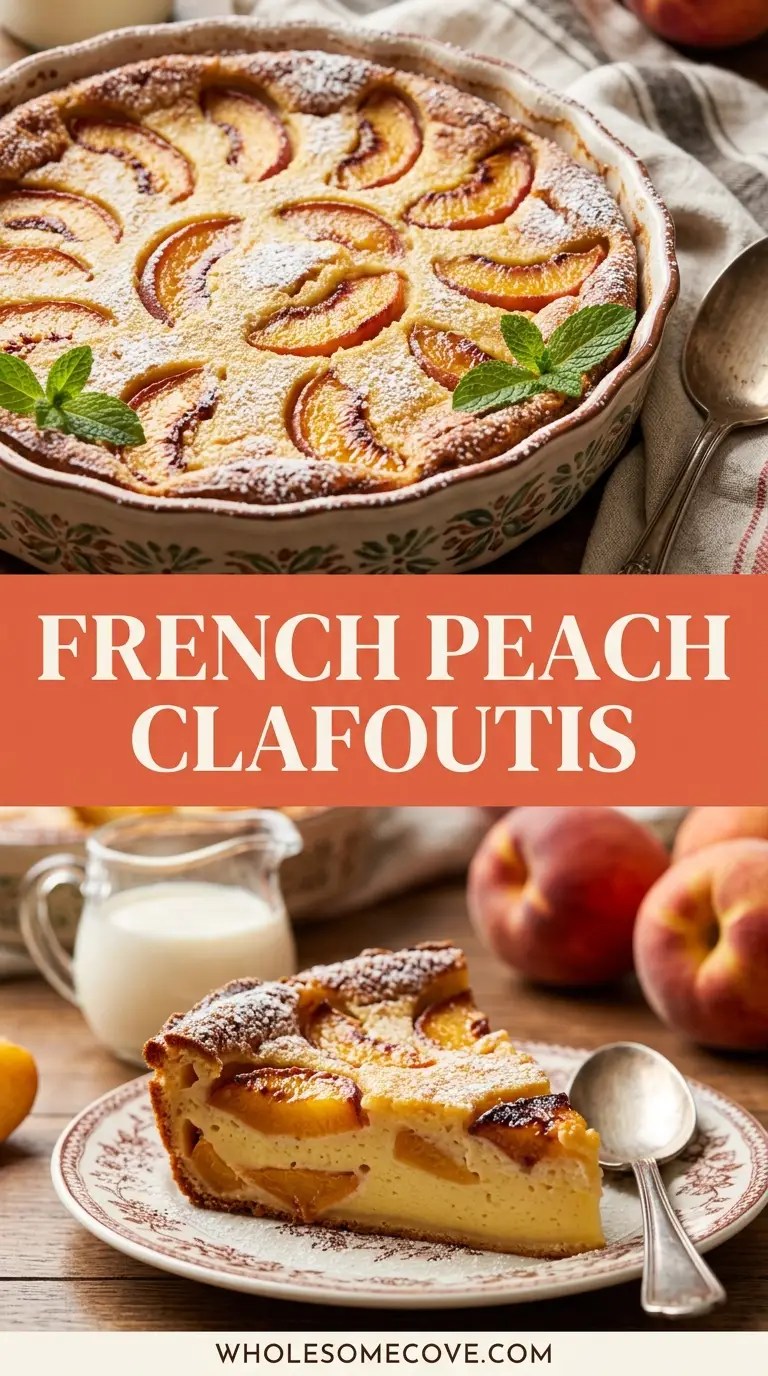
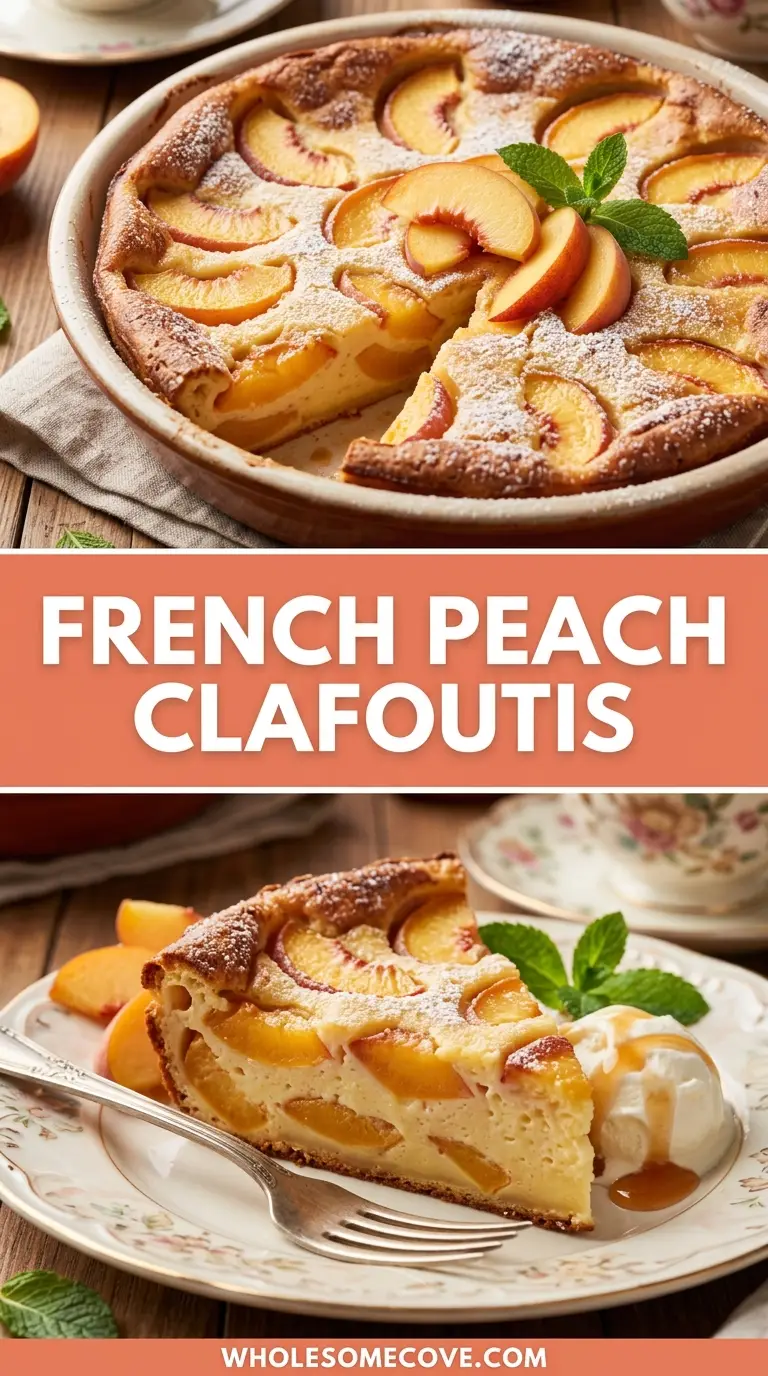
This French Peach Clafoutis Recipe turns six ripe peaches and a thin, crepe-like batter into a golden dessert that sits somewhere between a custard and a cake. The batter is nothing more than eggs, milk, flour, sugar, and vanilla, whisked in one bowl and poured over sliced fruit.
Most peach versions turn out watery because the fruit releases juice as it bakes and loosens the custard. Tossing the peach slices in a spoonful of flour first solves it, so the center sets silky instead of soggy.
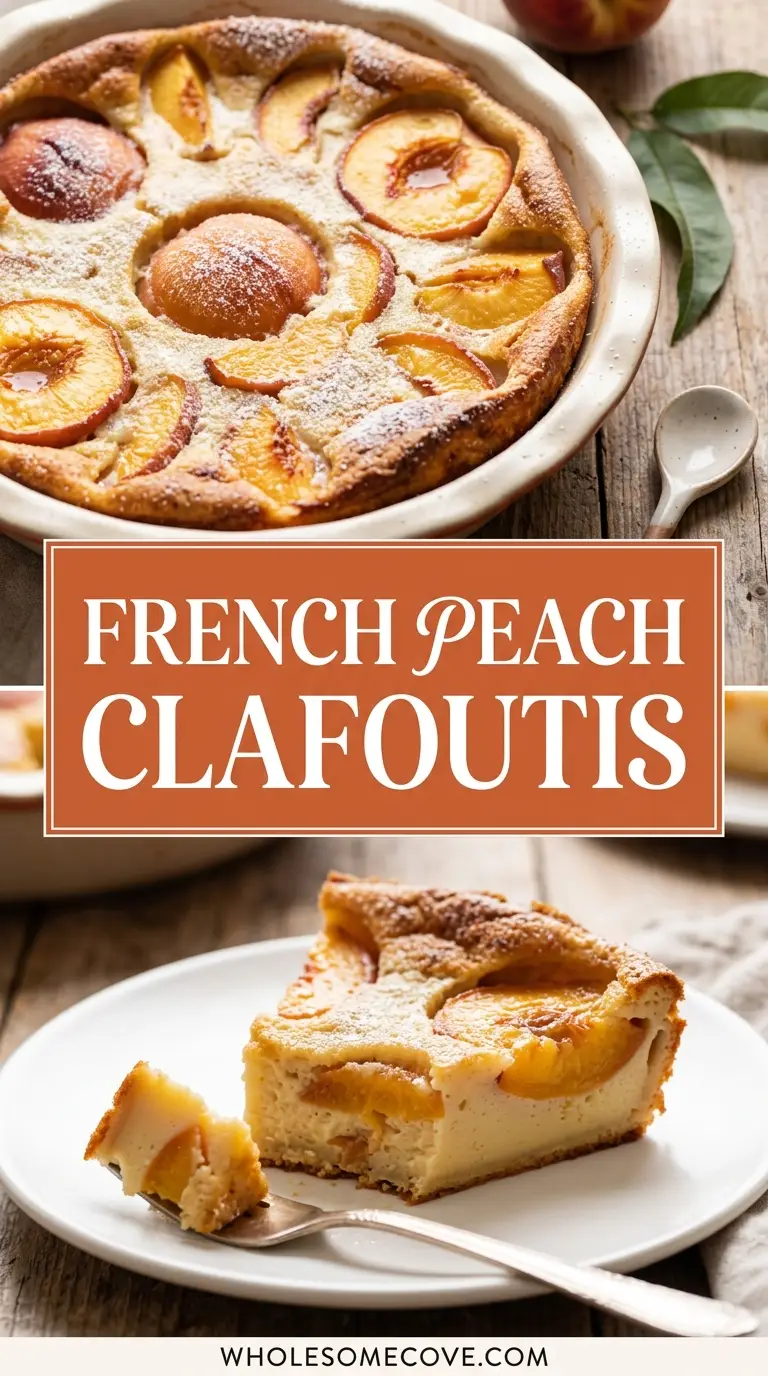
The dish puffs dramatically in the oven, then sinks as it cools. That deflation is not a failure, it is exactly what gives clafoutis its dense, spoonable middle.
From bowl to oven takes about 15 minutes, and the whole thing bakes in a single dish with no crust to roll or blind bake.
| Quick Recipe Summary | |
|---|---|
| Prep Time | 15 minutes |
| Cook Time | 45 minutes |
| Total Time | 1 hour |
| Servings | 8 slices |
| Difficulty Level | Easy |
For a rustic peach dessert that leans the other way, toward buttery pastry and caramelized fruit, take a look at Peach Tarte Tatin.
Why You’ll Love This French Peach Clafoutis Recipe
Clafoutis is the rare impressive dessert that asks almost nothing of you. There is no crust, no mixer, and no tricky technique, just a batter you can whisk by hand in a couple of minutes.
Here is what makes this one worth baking again and again:
- One bowl, one dish. The batter and the bake happen in the same ceramic dish you serve from, so cleanup is minimal.
- A texture you can’t get anywhere else. The inside sets like a loose flan while the edges puff and turn golden, giving you two textures in one slice.
- It highlights the peaches. With only a light touch of sugar and vanilla, the fruit stays the star instead of getting buried under streusel or pastry.
- Beginner-proof. If you can stir pancake batter, you can make this, and a knife inserted in the center tells you exactly when it is done.
- Flexible year-round. Fresh summer peaches are ideal, but well-drained frozen or canned peaches work when the season is over.
- Great warm or cold. It is best warm from the oven, but leftovers straight from the fridge make a genuinely good breakfast.
Read Also: Peach Cobbler
Ingredients
The ingredient list reads like a pantry inventory, which is the whole point of a rustic French bake. The only thing you need to shop for is good, ripe peaches.
- Fresh peaches – 6 medium (about 2 lb / 900 g), ripe but firm, pitted and sliced into wedges. Firm fruit holds its shape; overripe peaches collapse into mush.
- Large eggs – 4, at room temperature. They are the backbone of the custard.
- Whole milk – 1 1/4 cups (300 ml), at room temperature.
- Heavy cream – 1/4 cup (60 ml). This small amount enriches the custard without making it heavy.
- All-purpose flour – 2/3 cup (85 g), plus 1 tablespoon extra for tossing the peaches.
- Granulated sugar – 1/2 cup (100 g) for the batter, plus 1 tablespoon for the fruit.
- Pure vanilla extract – 2 teaspoons. Vanilla paste works beautifully here if you have it.
- Almond extract – 1/4 teaspoon (optional). It echoes the almond note that cherry pits traditionally give a classic clafoutis.
- Unsalted butter – 3 tablespoons (45 g), melted and cooled, plus more for greasing the dish.
- Fine sea salt – 1/4 teaspoon.
- Lemon – 1, zested. The zest brightens the fruit and keeps the slices from browning.
- Demerara sugar – 1 tablespoon (optional), for a crackly top.
- Powdered sugar – for dusting before serving.
For another way to let ripe peaches carry a dessert, see Peach Crumble.
Kitchen Equipment Needed
None of this is specialized, which is part of the appeal. If you own a bowl and a whisk, you are most of the way there.
- Ceramic baking dish – a 9 to 10 inch (23 to 25 cm) round dish or pie plate, at least 1 1/2 inches deep. Clafoutis does not transfer well, so bake it in the dish you plan to serve from.
- Large mixing bowl – for the batter.
- Balloon whisk – or a blender if you prefer a puffier result.
- Citrus zester – for the lemon zest.
- Paring knife – for pitting and slicing the peaches.
- Measuring cups and spoons – or a kitchen scale for the metric weights.
- Fine mesh sieve – for dusting powdered sugar at the end.
A similar batter-over-fruit approach shows up in Peach French Toast.
Recommended Products for This Recipe
These are the pieces I reach for when I make clafoutis, chosen because each one fixes a specific problem I ran into along the way. They are worth the small upgrade if you bake fruit desserts often.
1. Emile Henry Ceramic Pie Dish
A thin metal pan browns the edges before the custard sets, leaving you with a pale, wobbly middle. A thick ceramic dish heats gently and evenly, so the whole clafoutis cooks at the same pace and comes out golden across the top.
2. OXO Balloon Whisk
Clafoutis batter needs to be smooth but not aerated, and a good balloon whisk knocks out flour lumps in a few strokes without whipping in a lot of air. Too many air bubbles leave a bumpy, blistered surface on the baked custard.
3. Microplane Zester
Lemon zest does quiet but real work in this recipe, and a sharp Microplane takes only the fragrant yellow layer while leaving the bitter white pith behind. A dull grater tears into the pith and drags a sourness into the batter you do not want.
4. Vanilla Bean Paste
Extract works, but vanilla bean paste gives you the same depth plus flecks of real vanilla seed suspended through the pale custard. In a dessert this simple, that visible speckling makes it look far more intentional.
You might also enjoy: Poached Pear
Step-by-Step Instructions: How to Make French Peach Clafoutis
Follow these steps in order and you’ll have a golden, custardy clafoutis on the table in about an hour.
1. Prep the Oven and Dish
- Preheat your oven to 350°F (180°C) and position a rack in the center.
- Generously butter the entire inside of your ceramic baking dish, bottom and sides.
- Sprinkle about a teaspoon of granulated sugar into the buttered dish and tilt it to coat the surface, then tap out the excess. This sugar coating helps the clafoutis release cleanly and adds a faint crispness to the edges.
2. Prepare the Peaches
- Pit the peaches and slice each one into wedges about 1/2 inch (1 cm) thick. Leave the skins on for a rustic look, or peel them if you prefer a smoother bite.
- Place the sliced peaches in a bowl and add the 1 tablespoon of granulated sugar, the lemon zest, and the 1 tablespoon of flour.
- Toss gently until every slice is lightly coated. The flour is the key step here, it absorbs the juice the peaches release as they bake so the custard sets instead of turning watery.
3. Arrange the Fruit
- Spread the coated peach slices in a single, even layer across the bottom of the prepared dish.
- Leave a little space between the slices so the batter can puff up around each piece.
- Do not overcrowd the fruit, too much peach and not enough batter makes it hard for the clafoutis to set.
4. Make the Batter
- In a large mixing bowl, whisk the 4 eggs with the 1/2 cup granulated sugar and the salt until pale and smooth.
- Whisk in the vanilla extract, the almond extract if using, and the cooled melted butter.
- Pour in the milk and heavy cream, whisking until fully combined.
- Add the 2/3 cup flour and whisk just until the batter is smooth with no lumps. It should be thin, closer to crepe batter than cake batter. Avoid over-whisking, which beats in air bubbles that mar the surface.
5. Pour and Top
- Slowly and evenly pour the batter over the arranged peaches. Pouring gently keeps the fruit in place rather than pushing it all to one side.
- Some peach slices will float up through the batter, and that is completely fine.
- If you want a crackly top, sprinkle the tablespoon of demerara sugar evenly over the surface.
6. Bake
- Bake for 40 to 45 minutes, until the clafoutis is puffed, deeply golden on top, and just set in the center.
- Test it by inserting a thin knife into the middle. It should come out clean or with only a few moist crumbs, not wet batter.
- If the top browns too fast before the center sets, tent it loosely with foil for the last 10 minutes.
7. Cool and Serve
- Let the clafoutis cool for at least 10 to 15 minutes. It will deflate and sink as it cools, which is exactly what creates the silky, custardy interior.
- Dust the top generously with powdered sugar right before serving.
- Slice into wedges and serve warm or at room temperature, on its own or with a scoop of vanilla ice cream.
For a no-crust fruit dessert with a similar low-effort payoff, try Air Fryer Peaches.
Tips for The Best French Peach Clafoutis
A clafoutis has a small margin between eggy and overbaked, so a few details make the difference between good and excellent. These are the ones that mattered most in my testing.
- Use ripe but firm peaches. Soft, overripe fruit turns to mush and dumps too much liquid into the batter. Fruit with a little give holds its shape and flavor.
- Do not skip the flour toss. Coating the peaches in a tablespoon of flour is the single best defense against a watery custard.
- Bring the dairy and eggs to room temperature. A cold batter bakes unevenly and can take longer to set in the middle.
- Rest the batter if you have time. Letting it sit for 20 to 30 minutes relaxes the gluten and gives you a more tender, custardy result. I rushed this on my first attempt and got a slightly rubbery edge; letting the batter rest fixed it completely on the next bake.
- Blend for a puffier version. Whisking by hand gives a denser, flan-like texture, while a quick blitz in the blender makes it rise taller and lighter. Choose based on the texture you prefer.
- Skim the bubbles. If air bubbles gather on the surface after pouring, skim them off with a spoon for a cleaner-looking top.
- Bake in the serving dish. Clafoutis is too delicate to transfer, so it goes from oven to table in the same dish.
- Expect the sink. The dramatic deflation as it cools is normal and desirable, so do not try to rush it back into the oven.
Read Also: Peach Compote
What to Serve with French Peach Clafoutis
Clafoutis is a finished dessert on its own, but a few simple accompaniments turn a slice into something special. It works equally well at the end of dinner or as the centerpiece of a summer brunch.
Here are the pairings I come back to most:
- Vanilla ice cream – A scoop melts into the warm custard and is the classic partner.
- Softly whipped cream – Lightly sweetened and barely whipped, it keeps things airy.
- Crème fraîche – Its gentle tang cuts the sweetness of the peaches.
- A drizzle of Peach Compote – Doubling down on peach makes the fruit flavor sing.
- Fresh berries – Raspberries or blackberries add a tart pop against the mild custard.
- Espresso or coffee – The bitterness balances the dessert beautifully for an afternoon treat.
- A glass of dessert wine – A chilled Sauternes or Moscato d’Asti is a lovely match for a dinner party.
- A brunch spread – Serve it alongside Peach French Toast for a peach-forward morning table.
For a lighter fruit finish to a meal, try: Grilled Peaches
Variations of French Peach Clafoutis
The beauty of clafoutis is how forgiving the base recipe is. Once you have the batter down, you can swap the fruit and flavorings freely.
- Classic cherry clafoutis – Return to the original by using pitted black cherries instead of peaches.
- Mixed stone fruit – Combine peaches with plums, apricots, or nectarines for a deeper flavor.
- Berry clafoutis – Fold in blueberries, raspberries, or blackberries, either alone or with the peaches.
- Peach and almond – Bump the almond extract to 1/2 teaspoon and scatter sliced almonds on top before baking.
- Boozy version – Add a tablespoon of brandy, dark rum, or amaretto to the batter for a grown-up note.
- Warm spice – Whisk 1/2 teaspoon of ground cardamom or cinnamon into the batter for a cozier, fall-leaning dessert.
- Citrus twist – Swap the lemon zest for orange zest, or add a splash of orange blossom water.
- Gluten-free – Replace the all-purpose flour with a 1:1 gluten-free baking blend; the custard sets just fine.
Read Also: Peach Trifle
Storage and Reheating
Clafoutis is at its best the day it is baked, but it keeps well enough that leftovers are worth planning for. Store it properly and it makes a great next-day snack.
- Refrigerate: Cover the cooled clafoutis tightly with plastic wrap or transfer to an airtight container. It keeps in the fridge for 3 to 4 days.
- Serve cold or reheated: Many people, myself included, like it cold straight from the fridge for breakfast. To serve warm, reheat in a 350°F (180°C) oven for 5 to 10 minutes.
- Microwave option: For a single slice, warm it in 15-second bursts until just heated through.
- Freezing: Clafoutis does not freeze well. The fruit softens and releases moisture on thawing, which turns the custard soggy and ruins the texture.
- Make-ahead batter: You can whisk the batter up to a day ahead and refrigerate it. Give it a quick stir and arrange fresh fruit just before baking.
For another peach dessert that holds up as leftovers, see Peach Bread Pudding.
Nutritional Facts
| Nutrition Per Serving (1 of 8 slices) | |
|---|---|
| Calories | 245 kcal |
| Total Fat | 11 g |
| Saturated Fat | 6 g |
| Carbohydrates | 31 g |
| Sugars | 22 g |
| Protein | 6 g |
| Fiber | 2 g |
| Sodium | 110 mg |
Values are estimates and will vary with the size of your peaches and whether you peel them.
For a fruit-forward dessert with a lighter profile, take a look at Peach Sorbet.
Health Benefits of Key Ingredients
For a dessert, clafoutis carries a surprising amount of genuine nutrition, mostly thanks to the fruit and the egg-and-dairy custard. Here is what the main ingredients bring to the table.
- Peaches – They deliver vitamin C, vitamin A, and potassium, along with fiber that supports digestion. Their natural sweetness also means the recipe needs less added sugar than many desserts.
- Eggs – A strong source of complete protein, eggs also provide choline, which supports brain and nerve function, plus vitamin D and B vitamins.
- Whole milk and cream – These supply calcium and vitamin D for bone health, along with a little protein that helps the custard set.
- Lemon zest – The zest carries aromatic oils and a small dose of vitamin C, and it brightens the dish without adding sugar or fat.
- Almond extract – Used in a tiny amount, it adds the warm, nutty aroma that defines a traditional clafoutis with no measurable calories.
Read Also: Peach Chia Pudding
FAQs About French Peach Clafoutis
1. What is the difference between a clafoutis and a flaugnarde?
A clafoutis is traditionally made specifically with cherries, most classically black cherries with the pits still in. When any other fruit is used, such as peaches, plums, or apples, the dessert is technically called a flaugnarde.
In everyday cooking, most people still call the peach version a clafoutis. The technique and batter are identical, so the name is more about tradition than method.
2. Do I need to peel the peaches?
No, peeling is entirely optional. The skins soften as they bake and add color and a slightly rustic texture to the finished dish.
If you prefer a smoother bite, peel them. Blanching the peaches for 30 seconds in boiling water and dropping them into ice water makes the skins slip off easily.
3. Why did my clafoutis turn out watery?
The most common cause is excess moisture from the fruit. Very ripe peaches, or canned and frozen peaches that were not drained, release liquid that loosens the custard.
Tossing the peach slices in a tablespoon of flour before baking absorbs much of that juice. Using ripe but firm fruit and draining any thawed peaches thoroughly also helps the center set.
4. Can I use canned or frozen peaches?
Yes, both work when fresh peaches are out of season. The key is moisture control, so drain canned peaches well and thaw frozen ones completely.
After thawing frozen peaches, pat them dry with paper towels before tossing them in flour. Skipping this step is the fastest way to a soggy custard.
5. How do I know when the clafoutis is done?
The top should be puffed and deeply golden, and the center should look just set rather than liquid. Insert a thin knife into the middle to check.
If the knife comes out clean or with only a few moist crumbs, it is ready. If wet batter clings to it, give it another 5 to 10 minutes.
6. Why did my clafoutis sink after baking?
Sinking is completely normal and even desirable. The batter puffs up dramatically from the heat, then deflates as it cools and the steam escapes.
That gentle collapse is what gives clafoutis its dense, custardy interior. A clafoutis that stays fully puffed usually means it was overbaked.
7. Can I make clafoutis ahead of time?
The batter can be made up to a day in advance and kept in the fridge. Give it a quick whisk and pour it over fresh fruit just before baking.
The baked clafoutis is best the day it is made but keeps for 3 to 4 days refrigerated. Reheat gently or enjoy it cold.
For more peach inspiration to bookmark, see Peach Cobbler with Cake Mix.
French Peach Clafoutis
Ingredients
- 6 medium fresh peaches - about 2 lb / 900 g, ripe but firm, pitted and sliced into wedges
- 4 large eggs - at room temperature
- 1 1/4 cups whole milk - 300 ml, at room temperature
- 1/4 cup heavy cream - 60 ml
- 2/3 cup all-purpose flour - 85 g, plus 1 tablespoon extra for tossing the peaches
- 1/2 cup granulated sugar - 100 g for the batter, plus 1 tablespoon for the fruit
- 2 teaspoons pure vanilla extract - Vanilla paste works beautifully here if you have it
- 1/4 teaspoon almond extract - optional; echoes the almond note that cherry pits traditionally give a classic clafoutis
- 3 tablespoons unsalted butter - 45 g, melted and cooled, plus more for greasing the dish
- 1/4 teaspoon fine sea salt
- 1 lemon - zested; the zest brightens the fruit and keeps the slices from browning
- 1 tablespoon demerara sugar - optional, for a crackly top
- powdered sugar - for dusting before serving
Equipment
- Ceramic baking dish - 9 to 10 inch (23 to 25 cm) round dish or pie plate, at least 1 1/2 inches deep
- Large mixing bowl - For the batter
- Balloon whisk - Or a blender if you prefer a puffier result
- Citrus Zester - For the lemon zest
- Paring knife - For pitting and slicing the peaches
- Measuring cups and spoons - Or a kitchen scale for the metric weights
- Fine mesh sieve - For dusting powdered sugar at the end
Method
- Preheat oven to 350°F (180°C) with a rack in the center. Generously butter the entire inside of a 9 to 10 inch ceramic baking dish, then sprinkle in about a teaspoon of granulated sugar and tilt to coat, tapping out the excess.
- Pit the peaches and slice each into 1/2 inch (1 cm) wedges, leaving the skins on or peeling as preferred. In a bowl, toss the slices with 1 tablespoon granulated sugar, the lemon zest, and 1 tablespoon flour until lightly coated.
- Spread the coated peach slices in a single, even layer across the bottom of the prepared dish, leaving a little space between slices so the batter can puff up around each piece. Do not overcrowd the fruit.
- In a large bowl, whisk the eggs with 1/2 cup granulated sugar and the salt until pale and smooth. Whisk in the vanilla, almond extract if using, and cooled melted butter, then pour in the milk and heavy cream and whisk until fully combined. Add the 2/3 cup flour and whisk just until smooth with no lumps; the batter should be thin, like crepe batter, so avoid over-whisking.
- Slowly and evenly pour the batter over the arranged peaches, pouring gently to keep the fruit in place. If desired, sprinkle 1 tablespoon demerara sugar evenly over the surface for a crackly top.
- Bake for 40 to 45 minutes, until puffed, deeply golden on top, and just set in the center. A thin knife inserted in the middle should come out clean or with only a few moist crumbs; if the top browns too fast, tent loosely with foil for the last 10 minutes.
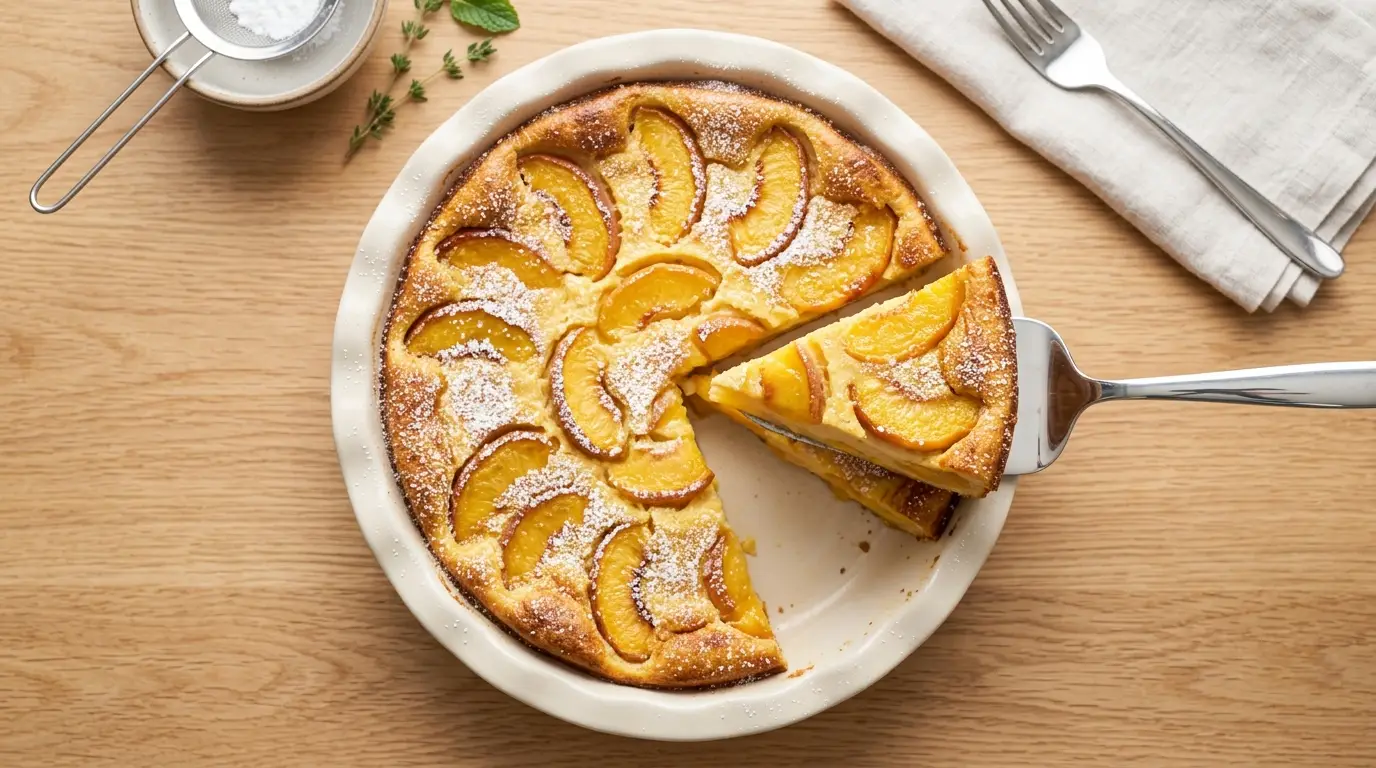
- Let the clafoutis cool for at least 10 to 15 minutes; it will deflate and sink as it cools, which creates the silky, custardy interior. Dust generously with powdered sugar, slice into wedges, and serve warm or at room temperature.
Nutrition
Notes
- Use ripe but firm peaches; soft, overripe fruit turns to mush and releases too much liquid into the batter.
- Do not skip tossing the peaches in 1 tablespoon of flour; it is the single best defense against a watery custard.
- Bring the dairy and eggs to room temperature so the batter bakes evenly and sets properly in the middle.
- If you have time, rest the batter for 20 to 30 minutes to relax the gluten and get a more tender, custardy result.
- For a puffier version, blend the batter instead of whisking by hand; whisking gives a denser, flan-like texture.
- Skim off any air bubbles that gather on the surface after pouring for a cleaner-looking top.
- Expect the clafoutis to deflate and sink as it cools; this is normal and desirable, not a failure.
- Store covered in the fridge for 3 to 4 days; serve cold or reheat in a 350°F (180°C) oven for 5 to 10 minutes, or microwave single slices in 15-second bursts.
- Clafoutis does not freeze well; thawing fruit releases moisture that turns the custard soggy.
- The batter can be made up to a day ahead and refrigerated; stir quickly and pour over fresh fruit just before baking.
- Technically, a peach version is called a flaugnarde, but most people still call it a clafoutis; the technique and batter are identical.
- For variations, try cherry clafoutis, mixed stone fruit, berry clafoutis, peach and almond, a boozy version with brandy or amaretto, warm spice with cardamom or cinnamon, citrus twist with orange zest, or a gluten-free blend.
Private Notes
Tried this recipe?
Let us know how it was!Final Thoughts
French Peach Clafoutis is proof that the most memorable desserts are often the simplest. A bowl of batter, a handful of ripe peaches, and one dish give you something that tastes far more special than the effort it takes.
Bake it while the peaches are at their summer peak, and serve it warm with a scoop of ice cream melting into the custard. It is the kind of dessert that quietly steals the show at any table.
If you make this clafoutis, I would love to hear how it turned out. Leave a comment below and share it with a friend who needs an easy summer dessert in their rotation.
Recommended:
- Peach Cobbler
- Peach Crisp
- Peach Galette
- Peach Pie
- Peach Ice Cream
- Peach Muffins
- Peach Bread
- Peach Scones
- Grilled Peach and Burrata Salad
- Peach Turnovers